






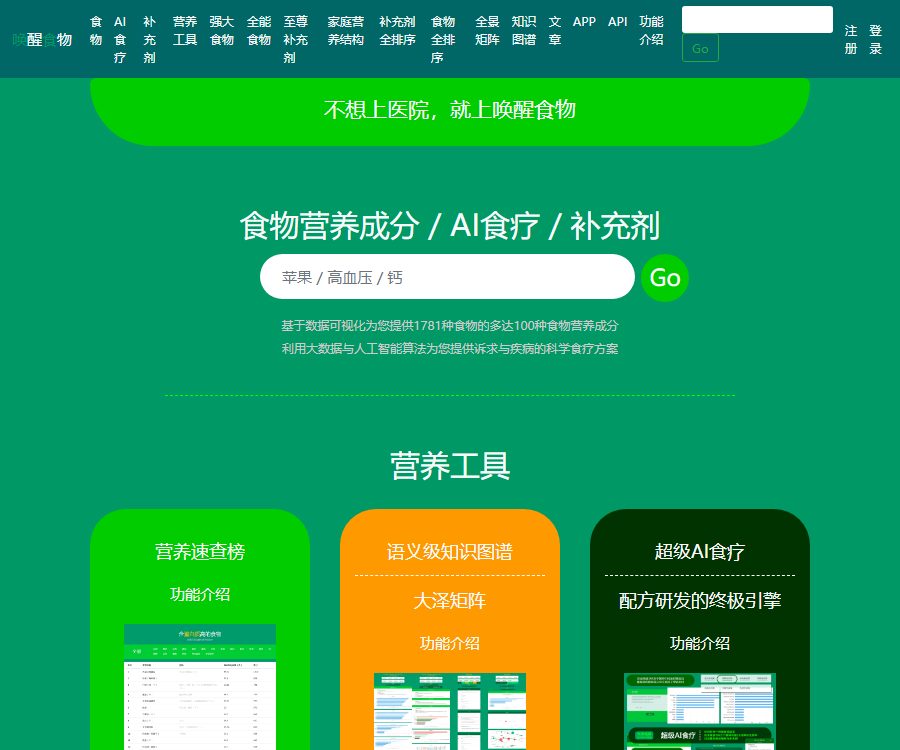
Nutritional components of food and scientific dietary therapy plans
Food nutrients and scientific dietary plans help AI to make work more efficient and simpler.
Tags:AI improves efficiencyWhat is awakening food?
Wake Up Food is a nutrition and health information platform that integrates food nutrition databases, literature analysis, and data visualization. It offers information on the nutritional components of foods, rankings for individual nutrients as well as in combinations, comparisons between different foods, data on supplements, PubMed literature searches, and AI-driven analysis of dietary therapies.
The platform is operated by Qingdao Bencao Matrix Technology Co., Ltd., with the developer identified as Great Whale. The results provided are suitable for obtaining nutritional information and organizing research clues; they should not be used as a basis for medical diagnosis, prescribing, or treatment plans.
A one-sentence summary
WakeUp Food is an AI-based health information tool that covers analysis of food nutrition, supplements, and biomedical literature; it offers extensive visualization capabilities, but the results related to diseases and recipes must be reviewed by a doctor or a registered dietitian.
Core functions
Querying food nutritional components
Users can search for the nutritional content and score per 100 grams of a food, by category or name, and view this information in graphical forms or as lists. The platform also displays alternative names for foods, their acidity levels, as well as certain functional properties.
- Detailed nutritional data for over 1,700 common foods.
- Public tools allow for viewing and sorting items based on around 100 categories of nutrients.
- The basic interface offers 1,780 different foods and 54 essential nutrients.
- Different origins, varieties, as well as methods of processing and cooking can result in variations in the actual values.
Quick nutrition reference and combination sorting
The nutrition quick-reference list allows foods to be arranged in order, from highest to lowest or from lowest to highest, based on individual nutrients. The nutrition combination list can include up to 10 different nutrients at once; for example, it can be used to find foods that are high in protein and low in cholesterol.
Food comparison
Paid members can compare up to 10 different foods in the same chart, using line or area graphs. The comparison results are based on the data stored in the database; they do not represent an individual’s absorption rate, allergy risks, or actual amounts consumed.
Flavonoids and Fatty Acids Database
The platform contains information on 46 different flavonoid compounds found in around 360 types of foods, as well as data on 26 types of unsaturated fatty acids present in more than 7,000 different foods. These detailed datasets can be used for research and for selecting appropriate ingredients, but they cannot be used alone to determine the effectiveness of treatments for diseases.
Analysis of AI-based dietary therapy and supplements
AI-based dietary therapy uses platform algorithms to determine the relative importance of various diseases or health issues in relation to nutrients, natural extracts, and herbal medicines. Supplement Guide, on the other hand, presents information from the perspective of supplements, highlighting any potential related or adverse effects, as well as the number of studies available and the areas in which these supplements are effective.
The weight values are the result of algorithms developed by the platform, and they are not equivalent to the efficacy grades specified in clinical guidelines. The existence of numerous relevant studies does not necessarily mean that these supplements are effective; it also does not indicate that their dosage, safety profile, or appropriate user groups have been determined.
PubMed literature browsing
The premium package allows users to view the number, proportion, titles, and abstracts of relevant PubMed research reports, with support in both Chinese and English for easier reading. Abstracts only provide an overview of a study; they cannot replace reading the full text, assessing the study design, or evaluating the quality of the evidence.
Family nutrition structure
Users can enter information about their family’s regular diet, allowing the system to analyze potential nutritional imbalances and provide suggestions for making adjustments. Individual diseases, medications, age, pregnancy status, allergies, and test results all have a significant impact on the recommendations; therefore, it is not sufficient to rely solely on general family-based plans.
Oze matrix and knowledge graphs
The Oozawa matrix conducts real-time retrieval and analysis of PubMed articles based on keywords, and performs identification of word frequencies, species, supplements, diseases, and context. The premium version allows for processing a larger number of articles, generating relationship diagrams, or using a pool of formulas.
Generation of large-model formulations
Some members can use the platform’s analysis results to generate recipe instructions with the help of various large language models. The names and versions of these models may change, and any recipes produced might contain omissions, errors, or inaccuracies regarding dosages; such recipes cannot be used directly for humans or animals.
Data range
| Data module | Public scale | Main content | Precautions |
|---|---|---|---|
| Basic food interface | 1,780 types of foods | 54 essential nutritional components | Does not include all advanced derived fields. |
| Flavonoid database | About 360 types of foods | 46 subcomponents of flavonoids | Not all foods are recorded. |
| Fatty acid database | 7,090 types of foods | 26 types of unsaturated fatty acids | Pay attention to differences in food types and testing methods. |
| Diseases and demands | 310 species | Weights related to supplements | It belongs to algorithm analysis rather than diagnosis. |
| Supplements | 1,288 species, with a continuous increase | Nutrients, natural extracts, and herbal medicines | Do not take medication on your own based on this information. |
| Species identification database | Over 236,000 genera | Species name identification | Mainly targeted at professional data services |
Where do the data come from?
The basic data on foods, whose alternative names end with the letter U, come from the United States Department of Agriculture; the data ending with J come from Japan’s Ministry of Education, Culture, Sports, Science and Technology; and the data without any letter designation come from public sources in China. When food entries originate from different databases, the definitions, sampling, and testing methods may vary.
The analysis of supplements and dietary therapies relies on sources such as PubMed research reports, publicly available scientific materials, Wikipedia, and traditional Chinese medical texts. The reliability of evidence from different sources varies greatly; traditional records, animal experiments, observational studies, and randomized clinical trials cannot be treated as equivalent to one another.
Lifetime member price
The price information was verified on August 24, 2026; the platform currently offers five tiers of one-time lifetime memberships, with prices expressed in RMB. The lifetime benefits, the availability of external models, and the scope of long-term services may change over time as operations evolve, so it is necessary to refer to the settlement page and any written instructions before making a payment.
| Package | Price | Main positioning | Representative capabilities |
|---|---|---|---|
| Premium Member | 600 yuan/lifetime | Nutrition and basic AI-based dietary therapy queries | Complete weights, flavonoids, combined ranking, and food comparisons |
| Premium Member | 1,800 yuan/lifetime | It is necessary to read literature and consult advanced nutritional data. | PubMed abstracts, family nutrition, fatty acids, and formula development |
| Corporate members | 6,000 yuan/lifetime | Research on supplements and professional analysis | Full sorting, panoramic matrix, customized requirements, and knowledge graph |
| Super Member | 38,000 yuan/per lifetime | Large-scale literature and formula research | Super data, super analytics, and custom formula pools |
| Super Member Max | 200,000 yuan/lifetime | Ultra-large-scale document processing | When there are over 30,000 results, all of the retrieved documents are processed. |
Differences between Super Member and Max
When the number of documents related to a single set of keywords is 30,000 or less, both tiers can handle all of them. When the number exceeds 30,000, the Super Member can process around 20% of the documents, while Super Member Max can handle all of them; however, the actual time required and any limitations imposed by external services still need to be determined.
Open interfaces and databases
WakeUp Food provides interfaces for accessing food options, disease-related services, and supplements; it returns JSON data and also offers database files that can be imported into MySQL. The public page does not indicate fixed prices for these interfaces, the number of calls allowed, or any service guarantees – it is necessary to contact the platform in order to request and purchase such services.
| Services | Data content | Delivery format | Price |
|---|---|---|---|
| Food interface | 1,780 types of foods and 54 essential nutrients | JSON | Contact for a quote |
| Disease request interface | Weights of 310 types of requests and supplements | JSON | Contact for a quote |
| Supplement interface | 1,288 supplements and related requests | JSON | Contact for a quote |
| Food database | Data on carbohydrates, flavonoids, and fatty acids | MySQL files | Inquire for lifetime usage rights |
| Identify databases | Names of species and supplements | MySQL files | Contact for a quote |
Before making a purchase, it is necessary to verify the authentication methods, request limits, data updates, troubleshooting procedures, field definitions, commercial licensing terms, and privacy regulations. Lifetime access to the database does not automatically mean that the original data can be made public and redistributed.
Usage tutorial
- Start by checking the nutritional information of the food, to determine its name, variety, and the nutrient content per 100 grams.
- Use single or combined sorting methods to identify potential foods; do not treat the scores directly as conclusions regarding health.
- Compare foods to identify the differences, and then convert that to the actual amount a person consumes.
- In the event of an illness, consult a doctor first to determine the diagnosis, as well as any medication requirements, allergies, and nutritional restrictions.
- When viewing supplement entries, read the adverse claims, special notes, and relevant literature as well.
- Open a PubMed record and distinguish between human trials, animal experiments, in vitro studies, and reviews.
- Any formula should be evaluated by a doctor or a registered nutritionist, who will determine the appropriate dosage and any potential interactions before making a decision.
Which users are it suitable for
- Ordinary users who search for the nutritional information of common foods and compare them.
- Nutritionists and health professionals who need to combine various criteria when selecting nutrients.
- Researchers or product developers who organize supplements and research clues from PubMed.
- Development teams that need interfaces for food, supplements, and disease-related data.
- An institution that focuses on formula design, knowledge graphs, and biomedical text analysis.
Product advantages
- Nutritional data includes various components, such as flavonoids and unsaturated fatty acids.
- It supports single-item sorting, multiple combined sorting, and comparison of up to 10 foods.
- Display the results of the supplement algorithm alongside the number of PubMed articles on the same interface.
- It offers open interfaces and database delivery to facilitate professional system integration.
- The price for the five-tier lifetime membership is available publicly, allowing professional users to choose based on the level of analysis required.
Restrictions and medical risks
- The platform is not a hospital; it cannot perform diagnoses, prescribe medications, adjust dosages, or provide emergency care.
- Algorithm weights and word frequencies reflect the computational relationships within a platform; they do not prove causality or clinical efficacy.
- The platform claims to reduce model hallucinations, but it cannot guarantee that the analysis is entirely accurate or free of any omissions.
- Supplements may interact with prescription drugs, and they can also damage the liver and kidneys or affect surgical procedures.
- Pregnant women, children, the elderly, pets, and people with chronic diseases cannot use the standard formula.
- Conditions such as cancer, diabetes, and mental illnesses cannot be treated with dietary remedies in place of standard medical treatment.
- The cost of a lifetime membership is high; it is advisable to try it out first and check the terms of ongoing service before making a purchase.
Important instructions on medical safety
In case of emergencies such as chest pain, difficulty breathing, altered consciousness, severe allergies, persistent high fever, or a risk of self-harm, it is necessary to contact emergency services or seek medical help immediately; there is no need to wait for the results from the platform. Users who are currently under treatment should not stop taking their medications on their own or replace them with supplements.
When reading research literature, it is important to consider the study subjects, sample size, control methods, dosage, endpoints, and adverse effects. It is not possible to determine whether a particular food or supplement is suitable for an individual based solely on the title, abstract, number of relevant studies, or color coding.
Privacy and account security
Information regarding family nutrition, health concerns, and inquiries about supplements can reflect an individual’s health status and is considered sensitive data. Before submitting such data, it is necessary to minimize the amount of personal information provided, and avoid uploading medical records, identity cards, contact details, or health information belonging to other people without their permission.
The public page does not provide a comprehensive explanation regarding the processing of interface data, account deletion, and the retention period; these details should be specified in the contract for corporate purchases. When using third-party large models to generate formulas, it is also necessary to review the data policies of the service providers for those models.
Open source and copyright status
The food recommendation platforms, algorithms, weights, derived data, and page designs are considered commercial, closed-source assets, and the operators retain full rights over them. No official repository containing the complete source code of the product has been made public by the company.
The projects with the same name on code hosting platforms are mainly third-party scraping scripts or data organization repositories; they cannot be considered official open-source versions. The availability of basic data does not mean that the database as organized by the platform can be copied or redistributed freely.
Basic information
| Project | Content |
|---|---|
| Product name | Awakening food |
| Operating company | Qingdao Bencao Matrix Technology Co., Ltd. |
| Time of going live | 2018 |
| Tool type | Nutritional data, research on supplements, and AI-based platform for dietary advice |
| Price pattern | Free queries and five tiers of lifetime membership |
| Whether an interface is provided | Yes, please contact us for pricing details. |
| Is it open source? | No |
| Can it replace doctors? | No. |
Recommendation score
Its recommendation score is 4.1 points; it is suitable for comparing the nutrition of different foods and for organizing information related to supplements. There are high risks associated with its use in disease treatment and formula design, so ordinary users should use it as a tool for information retrieval rather than as a guide for taking action.
Frequently Asked Questions
Can Awakening Food be used for free?
Some food inquiries and basic pages are accessible; advanced analysis requires membership. Current membership options range from 600 yuan to 200,000 yuan for lifetime subscriptions in five different tiers.
Are the nutritional data accurate?
The platform aggregates public databases from countries such as China, the United States, and Japan, but the types of foods, their origins, and cooking methods can affect the actual values. The results are provided for reference only and do not represent experimental tests of specific meals.
Can AI-based dietary therapy cure diseases?
No treatment conclusions can be drawn from this; the results of the algorithm are not medical diagnoses nor clinical guidelines. Diseases must be assessed by qualified medical professionals.
Can supplements be purchased and taken on one’s own?
It is not recommended to take supplements based solely on their weight-related values; such supplements carry risks related to dosage, allergies, damage to the liver and kidneys, as well as drug interactions. It is advisable to consult a doctor or pharmacist first.
Are interfaces provided?
It provides interfaces for food, health-related requests, and supplements; it also sells database files. Prices, licensing terms, and usage limits need to be confirmed with the platform.
Is WakeUp Food open source?
It is not open source; the operator retains the rights to the platform’s code, algorithms, and derived data. Third-party extraction from the repository does not constitute an official open-source project.
Summary
Wake Up Food offers a wide range of functions for visualizing nutritional components, sorting foods together, comparing them, and organizing information on supplements. Users should be aware of the difference between algorithmic recommendations and clinical evidence; any decision regarding diseases, supplements, or dietary plans must be made after consulting a professional medical practitioner.
Tools similar to those that deal with the nutritional components of food and scientific dietary plans.



 Guigong Network Security Registration No. 45132202000164