






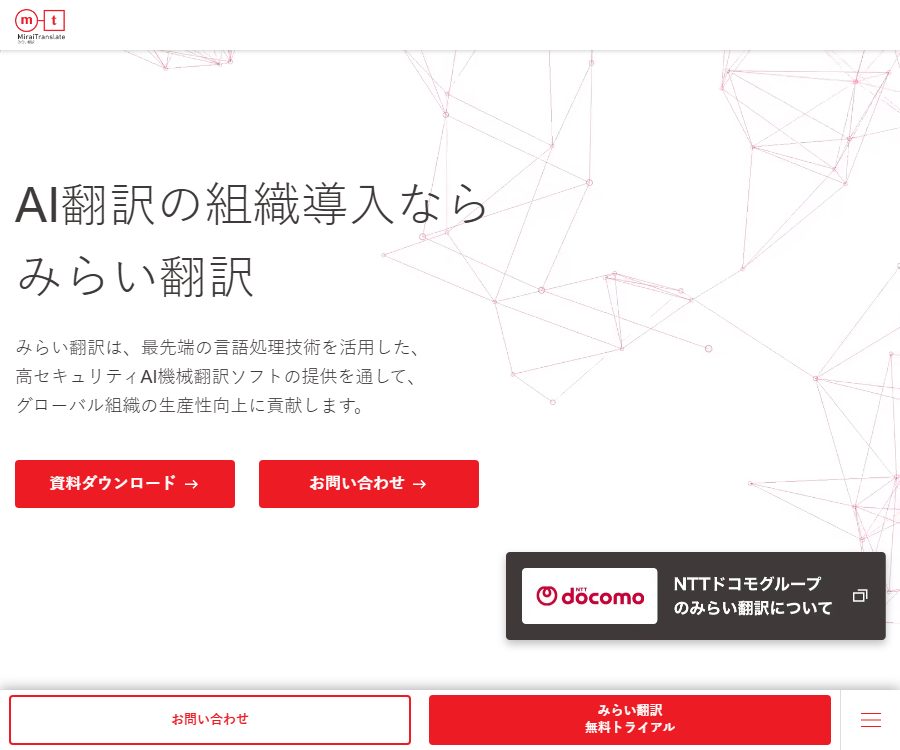
Mirai Translation
Mirai Translation – uses AI to make work more efficient and simpler.
Tags:AI improves efficiencyWhat will translation be like in the future?
Future Translate is an AI-powered machine translation service developed and operated by the Japanese company Mirai Translate; its Japanese name is みらい翻訳. This product is designed primarily for use in business communications, corporate documents, legal and financial matters, patent-related tasks, as well as system integration scenarios.
It isn’t just a single web page translation box; rather, it consists of product lines such as Plus, FLaT, and translation interfaces. Individuals and small teams can subscribe to Plus, large organizations can use FLaT, while development teams can integrate translation capabilities into their business systems.
A one-sentence summary
Future Translation is an AI translation service that places emphasis on the quality of Japanese translations as well as on the security of corporate data; it supports the translation of text and office documents, term management, as well as the use of specialized models and system interfaces.
Main product lines
| Products | Positioning | Support range | Billing method | Suitable for users |
|---|---|---|---|---|
| Future Translation Plus | Online translation for individuals and small teams | 14 languages, texts, and office documents | Free or via user subscription | Individuals, freelancers, and small teams |
| Future translation FLaT | Organizational-level machine translation platform | 20 languages, specialized models, and centralized management | Pay annually based on the amount of translation, or on a monthly basis with no limit. | Medium and large enterprises and government organizations |
| Translation API service | Embed translation in the existing system | Text, files, terminology, and translation memory | Annual contract, monthly settlement | Developers of software, websites, and business systems |
Core functions
Text translation and English writing
Users can paste text for translation and use back-translation to check whether the original meaning has been altered. Plus combines neural machine translation with generative AI capabilities to assist in adjusting English expressions, but the final choice of words still requires human judgment.
Overall translation of office documents
Plus supports PDF, PowerPoint, Word, Excel, and plain text files, and it is able to output translations while preserving the original layout. The basic package allows the uploading of a single file with a maximum size of 25MB; the number of translations that can be performed per month is determined by the chosen package.
- PDF files are suitable for reading reports and explanatory materials.
- PowerPoint can be used for presentations and training materials.
- Word is suitable for draft contracts, reports, and general documents.
- Excel can be used for tables, lists, and structured business data.
- Plain text is suitable for content that does not require complex formatting.
Glossary and translation control
Users can specify company names, product names, technical terms, and fixed translations, thereby reducing the occurrence of various translations for the same word in different documents. The enterprise interface also offers a dictionary and translation memory functions to control the desired output for individual words or entire sentences.
Web page translation extension
The Plus subscription package includes a browser extension that allows for the translation of web pages, making it useful for reading materials from abroad and handling everyday information. Web pages may contain scripts, images, text, or complex layouts; even after translation, it is still necessary to check for any missing paragraphs.
Legal, financial, and patent models
For corporate products, specialized translation models designed for contracts, regulations, financial documents, and patent-related texts can be used. The legal and financial translation models support translation between Japanese and English as well as between Japanese and Chinese, while the patent translation models are primarily intended for translations from Japanese to English; the specific capabilities of these models depend on the requirements specified in the contract.
Enterprise management and high-capacity usage
FLaT offers account management and translation capabilities suitable for organizations to deploy on a unified basis; it is possible to choose a plan based on the amount of text translated, or one without any set limits on the number of users or the amount of text translated. The unlimited plan still has system constraints such as the processing capacity per unit of time, and it does not mean unlimited concurrent operations.
Future price of Translation Plus
The prices listed below were verified on August 24, 2026; they represent the amount in yen, including taxes, per user. The display format differs for monthly and annual subscriptions – the annual subscription column shows the equivalent monthly cost. The actual amount to be paid, as well as the renewal cycle, are specified on the purchase page.
| Package | Monthly price | Average monthly amount for annual payment | Text quota | Number of files per month |
|---|---|---|---|---|
| Free | 0 yen | 0 yen | 5,000 characters, with a daily limit. | 1 |
| Starter | 550 yen per month | 495 yen per month | 20,000 characters | 10 |
| Standard | 2,970 yen per month | 2,475 yen per month | Marked as allowing unlimited characters, but subject to system restrictions. | 30 |
| Premium | 5,940 yen per month | 4,950 yen per month | Marked as allowing unlimited characters, but subject to system restrictions. | 120 |
Differences in the Plus package
All four packages support 14 languages, glossaries, files up to 25MB in size, and do not use the input content for further training. The Starter package allows for up to 10 users, while the Standard and Premium packages allow for up to 50 users; some versions of the team plan accept bank transfers.
- Free is suitable for occasionally translating short texts and trying out a file.
- Starter is suitable for handling a small number of emails, articles, and office documents per month.
- Standard is suitable for professional users who have large amounts of text and moderate file requirements.
- Premium is suitable for teams that need to process a large number of files on a monthly basis.
Price of FLaT Enterprise Edition
FLaT offers two main pricing models: one based on the volume of translations and another without any limits. The prices listed below are in yen, before tax. When organizing a procurement, it is also necessary to consider the contract duration, account size, available models, management functions, and implementation support.
| Plan | Translation quota | Price | Number of users | Billing instructions |
|---|---|---|---|---|
| Translation volume linkage type | 120,000 words | 120,000 yen/year | Up to 500 accounts | Entry level: selection based on the number of words per year |
| Translation volume linkage type | 200,000 words | 200,000 yen per year | Up to 500 accounts | Before tax |
| Translation volume linkage type | 400,000 words | 350,000 yen/year | Up to 500 accounts | Before tax |
| Translation volume linkage type | 1 million words | 700,000 yen per year | Up to 500 accounts | Before tax |
| Translation volume linkage type | 5 million words | 2,500,000 yen per year | Up to 500 accounts | Before tax |
| Translation volume linkage type | 20 million words | 6,000,000 yen per year | Up to 500 accounts | Before tax |
| Unlimited type | There is no upper limit on the total amount of translation. | 250,000 yen per month | There is no limit on the number of users. | There is still a limit on the amount of work that can be processed per unit of time. |
When FLaT is calculated based on the number of words, Japanese, Chinese, and Korean typically count two characters as one word, while other languages count one character as one word. The actual calculation method should be based on the quotes provided by the company and the rules specified in the contract before making any purchase.
Translation interface and prices
In the future, Translation will offer public interface specifications for text translation, and it will be possible to add support for multiple languages, specialized translation models, and file translation as part of contracts. The basic translation pairs include Japanese to English and Japanese to Chinese, as well as English to Chinese; additional services can cover more languages.
| Project | Public information | Explanation |
|---|---|---|
| Text translation | Starting at 1 yen per 1,000 characters | The minimum unit price decreases as the monthly minimum volume of translations increases. |
| Contractual method | Annual contract, monthly settlement | Payment for invoices: specific thresholds require inquiry. |
| Multilingual expansion | Optional | Add 18 language combinations |
| Professional models | Optional | Legal, financial, and patent models |
| File translation interface | Optional | Supports Word, Excel, PowerPoint, and PDF |
| Terminology and translation memory | Support | Some languages may have restrictions. |
The price shown on the page is the minimum starting price; it is not the fixed price that will apply to all usage levels. Companies should request a quote based on the estimated monthly volume of characters processed, and they must also take into account factors such as concurrency, response time, retry options in case of failures, scope of support, and service guarantees.
Supported languages
14 languages in Plus
Plus supports Japanese, English, Simplified Chinese, Traditional Chinese, Korean, Thai, Vietnamese, Indonesian, Italian, Spanish, German, French, Portuguese, and Russian. Not all language pairs can be translated into one another; it is necessary to check the available translation directions on the interface before use.
20 languages for FLaT and interfaces
The product listings of the company are available in 20 languages, but the combination of languages for basic services and additional services varies. The supported interfaces include Korean, Arabic, Italian, Indonesian, Dutch, Spanish, Thai, Turkish, German, Norwegian, Hungarian, French, Hebrew, Vietnamese, Portuguese, Polish, Burmese, and Russian.
Usage tutorial
- First, determine whether it is individual online translation, centralized deployment by an organization, or system interface integration.
- Select the source language and target language, then paste a small amount of representative text to test terms and tone.
- Create a glossary of company names, product names, and technical terms to standardize the desired translations.
- Before translating a document, clean up scans, annotations, hidden tables, and any sensitive content that does not need to be processed.
- Upload the file and wait for it to be processed; after downloading, check the page structure, tables, numbers, and proper nouns.
- Have professionals review contracts, patents, medical, and financial documents.
- When the team is in use, account permissions, file storage, review, and final publication guidelines are established.
Which users are it suitable for
- Individuals and teams that frequently handle business communications in Japanese-English, Chinese-Japanese, or multiple languages.
- Marketing, sales, procurement, and administrative staff who need to maintain the format of office documents.
- Large and medium-sized organizations that need to standardize terminology and centrally manage translation accounts.
- A specialized department for translating contracts, financial documents, or patent-related paperwork.
- Development teams that wish to integrate translation into websites, applications, customer service systems, or internal systems.
- Organizations with clear requirements regarding the secondary use of translation data and the location for processing within the country.
Product advantages
- Long-term development tailored for Japanese business contexts, with an emphasis on the quality of translation between Japanese and English, as well as between Japanese and Chinese.
- It offers a comprehensive range of options, from low-cost individual packages to organizational platforms and APIs.
- It supports common office documents and tries to preserve their layout, thereby reducing the need for copying and pasting.
- It provides a glossary, translation memory, and specialized models to help regulate the way a company expresses itself.
- The translation data is not used for the secondary training of the model, and a clear mechanism for deleting such data is provided.
- It holds ISO27001 and ISO27017 certifications, making it suitable for organizations that place a high emphasis on security audits.
Restrictions and Precautions
- Plus, FLaT, and the interfaces differ in terms of the number of supported languages, file size limits, and prices; therefore, they cannot be used interchangeably.
- The character limit for text in Standard and Premium versions is still governed by system constraints.
- Automatic translation may misinterpret context, negative words, numerical units, and industry abbreviations.
- File translation cannot guarantee that every complex layout, scanned text, and embedded object will be preserved intact.
- Professional models can improve performance in specific fields, but they cannot replace lawyers, patent agents, or professional translators.
- The enterprise rates are usually given on a tax-exclusive basis, and the minimum price per task depends on the volume of translation required.
Security and data processing
In the future, Translation Future will obtain the ISO27001 certification for information security management and the ISO27017 certification for cloud security; all translation tasks will be carried out on servers located in Japan. The translated content entered is not used for the secondary training of the service model, and registered data such as accounts, glossaries, translation memories, and interface keys are stored in an encrypted form.
Regular text is deleted after translation is completed, while the translation results of FLaT files can be retained for up to 10 days for downloading, or they can be deleted manually by the user. Plus usually deletes the data once translation is finished, but in case of technical issues it may keep the data for up to 72 hours; therefore, confidential materials still need to comply with the organization’s internal rules.
Enterprise products offer options such as IP address restrictions and two-factor authentication, along with a security checklist for support. The interfaces use key-based authentication, and the rules for saving and deleting audio translation data may differ from those applicable to ordinary text; it is necessary to verify each detail during procurement.
Open-source status and development capabilities
In the future, Translation will provide official translation interfaces and public specification pages; technical articles on integrating these translation interfaces into MCP workflows have also been published. The availability of these interfaces depends on commercial contracts, authentication details, and the scope of activation, and they are not equivalent to free public services.
Translation platforms and core models are commercial, closed-source products; no complete source code for these products or an official SDK repository has been made available by the company. The editor extensions, command-line scripts, and sample projects available on code hosting platforms are third-party projects and cannot be considered part of the official client.
Basic information
| Project | Content |
|---|---|
| Chinese name | Future Translation |
| Japanese name | Mirai Translation |
| English name | Mirai Translate |
| Operating company | Mirai Translate, Inc. |
| Date of establishment | October 2014 |
| Tool type | AI machine translation, document translation, and translation APIs |
| Price pattern | Free, subscription-based, annual payment, monthly payment, and pay-as-you-go pricing |
| Whether an interface is provided | Yes |
| Is it open source? | No |
Recommendation score
The recommendation score is 4.6 points; it is particularly suitable for enterprise users who need Japanese-language business translation, processing of office documents, and security controls. Ordinary individuals should first consider the Plus package, while FLaT or interface services are necessary only in cases of large-scale organizational deployment or system integration.
Frequently Asked Questions
Will translation be available for free in the future?
Yes, Plus Free offers a limit of 5,000 characters for the text and one translation per month; it supports 14 languages. The free version still has restrictions on the amount of text that can be processed per day.
Which files is Plus compatible with?
PDF, PowerPoint, Word, Excel, and plain-text files are supported. The maximum size for a single file under the standard plan is 25 MB; files with complex layouts or scanned documents still require further inspection.
Will the entered content be used for training?
The product’s official documentation states that user-generated translation content is not used for the secondary training of models, and it is deleted after processing. In case of technical issues, file downloads, or due to the limited retention period applicable to different product lines, it is necessary to refer to the relevant contract terms.
Can you translate contracts and patents?
Corporate products offer specialized models for legal, financial, and patent matters, but automated translations still require review by qualified personnel. Translation services cannot provide final legal opinions.
Is a translation interface available?
The lowest available price is 1 yen per 1,000 characters; contracts are offered on an annual basis with monthly billing. The actual price varies depending on the volume of text to be translated, the language, the model used, and the capabilities of the file handling.
Will translation be open-source in the future?
It is not open-source; the platform and core models are commercial products. Third-party extensions and scripts do not represent the official source code.
Summary
The advantages of future translation services lie in the quality of Japanese-language business documents, the efficiency of document processing, term management, and enterprise security mechanisms. Users should first decide whether to choose the Plus, FLaT, or interface-based product lines, and then compare the options based on language direction, number of documents, volume of translation required, and contract costs.
Tools similar to Mirai Translation


 Guigong Network Security Registration No. 45132202000164