






Poly AI
Poly AI: an intelligent tool focused on improving the efficiency of AI.
Tags:AI improves efficiencyTool Introduction
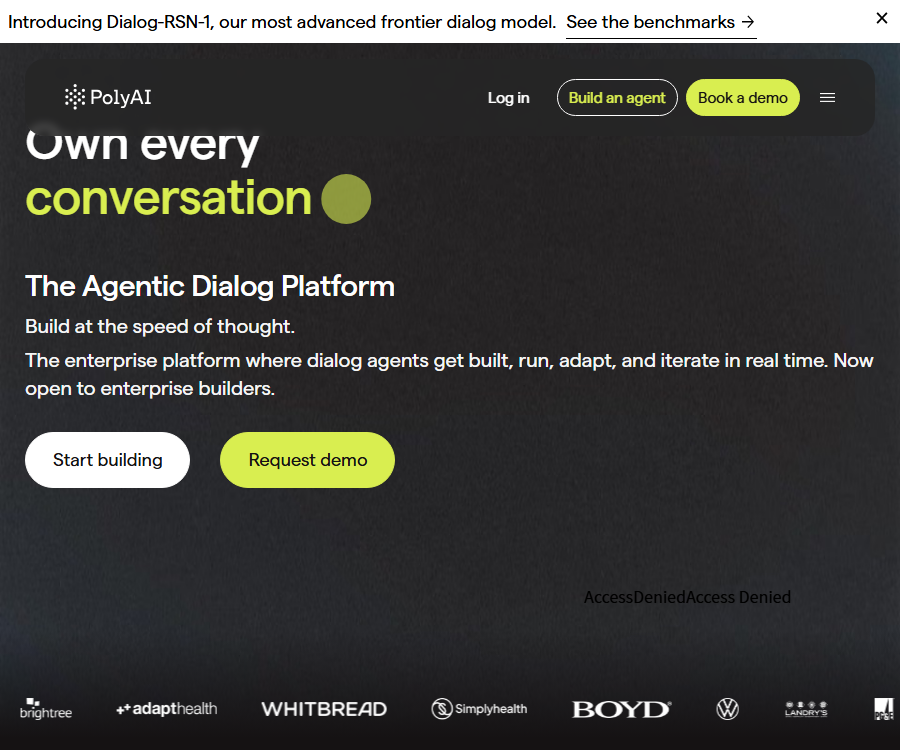
PolyAI is a voice and chatbot platform designed for enterprise customer service, used to automatically handle real customer conversations over phone calls, web chats, and messaging channels. It can answer questions, arrange appointments and complete transaction processes, and pass the context on to human agents when necessary.
Main functions
Voice and multi-channel dialogue
The platform combines speech recognition, dialogue models, and speech synthesis to create real-time customer service agents; it also supports web chat and text messaging. These agents can handle interruptions, accents, background noise, and multi-turn conversations, but complex or high-risk issues should still be routed to human agents.
- Handle common inquiries, reservations, payments, and troubleshooting over the phone.
- The proxy knowledge and processes can be reused through channels such as web chats and text messages.
- Pass the collected information to the live agent to avoid customers having to repeat their details.
Agent Studio and workflows
Agent Studio offers a visual interface for configuring roles, knowledge, voices, rules, processes, tools, and routing destinations. Each change can first be tested in a test environment before being gradually deployed to the production environment.
- Create FAQs, controlled knowledge, and multi-step dialogue processes.
- Configure different brand, site, language, and call routing variants.
- In conversation review, view transcripts, recordings, tool calls, and retrieved content.
Integration and dynamic operations
PolyAI can be connected to phone systems, CCaaS platforms, CRM systems, ticketing systems, payment systems, and booking systems; it also supports custom interfaces as well as MCP tools. Each read or write operation in external systems should have its own permissions control and failure handling mechanisms.
- The official catalog offers a variety of pre-built integrations, and it supports OAuth as well as field mapping.
- Proxy tools can be used, such as Python functions, network interfaces, or MCP extensions.
- It supports integration with existing phone and contact center platforms via SIP or PSTN.
Analysis and Governance
Administrators can view dashboards, conversation details, reasons for routing, and agent performance, and they can restrict access to various functions based on role permissions. Commitments regarding security, privacy, and compliance should be verified in light of the company’s location, the plans purchased, and the official agreements in place.
Usage tutorial
- Create an Agent Studio account or contact the enterprise team to define the customer service scenarios, channels, languages, and rules for manual escalation.
- Create a new agent and set its name, primary language, voice, welcome message, behavioral boundaries, and brand tone.
- Add approved knowledge topics and data sources, and then configure processes and tools such as scheduling, payment, or ticketing.
- In the Sandbox, tests are conducted using different accents, ways of expression, abnormal inputs, and sensitive scenarios, with each conversation being reviewed.
- Connect to phone numbers, web components, or existing customer service systems; first proceed with pre-release testing, and then roll it out to the live environment.
- Continuously monitor logs and conduct analysis, update knowledge bases, adjustment criteria, and security rules, while also maintaining version rollback options.
Comparison of construction methods
| Construction method | Operation mode | Is code needed? | Suitable for users |
|---|---|---|---|
| Agent Studio | Web visualization configuration, testing, deployment, and analysis | Optional | Dialogue designers, operations, and business teams |
| PolyAI ADK | Command line and Python packages, local files, and Git workflows | Python is required. | Engineering team and continuous integration process |
| Agent Studio API | REST API for programmatic management of proxies and data | It is necessary. | Companies that already have an internal platform |
Which users are it suitable for
- Call centers and customer service departments that handle a high volume of calls and must deal with common requests around the clock.
- Hotels, retail, and service businesses that need to automate processes such as reservations, orders, account inquiries, or payments.
- Financial and medical organizations that need to manage routing, auditing, permissions, and data integration.
- The enterprise AI team aims to have the business team work together with developers to maintain voice agents.
Prices and packages
The official website states that enterprise voice agents are charged based on the number of minutes of calls; this fee includes efforts to improve performance, maintenance, and 24/7 support. However, the price per minute or any minimum commitment amount is not disclosed. The actual costs vary depending on the volume of calls, the complexity of the scenarios, the channels used, integration needs, and professional services required.
| Package or version | Price | Billing cycle | Core benefits or quota | Suitable for users |
|---|---|---|---|---|
| Corporate voice agent | Contact sales; pricing is per minute. | Charging is based on continuous usage; the contract duration is not disclosed. | Maintenance, performance improvements, round-the-clock support, monitoring, upgrades, and a 99.9% availability SLA for telephone lines | Corporate call center |
| Self-service Agent Studio | The authorities have not made this information public yet. | The authorities have not made this information public yet. | Visualization for construction, testing, deployment, and analysis; the actual rights and benefits are determined by the account and contract. | Teams that wish to build their own proxies |
The official website features promotional pages for specific partners and within certain time periods, but these do not represent the general public prices. When making purchases, it is necessary to have the official party specify separately the implementation fees, telephone costs, call minutes, concurrent usage, storage requirements, integration needs, as well as any charges for excess usage.
Product advantages
- Speech recognition, dialogue runtime, voice synthesis, and phone access and analysis constitute a complete technical stack.
- The same agent can be maintained collaboratively through a visual interface, code tools, and APIs.
- The pre-installed integrations cover a variety of contact center, telephone, CRM, and ticketing systems.
- It provides processes for moving from testing to production, version management, and diagnostic capabilities for conversations.
Usage restrictions and precautions
- Different pages on the official website mention more than 24 and 45 standard languages respectively; there are discrepancies in the stated figures, so it is necessary to conduct tests on-site depending on the target language, channel, and account.
- Telephone agents may misinterpret names, numbers, account details, or accents; confirmation steps must be in place for payments, identity verification, and medical scenarios.
- Recording, transcription, and customer data are subject to privacy and communication regulations; businesses need to establish policies regarding notification, consent, retention, and deletion.
- Automation should maintain clear manual handover and failure fallback pathways, and cannot rely solely on the promises of models.
- In addition to per-minute billing, there may also be costs associated with telephone providers, integration, modeling, implementation, and internal maintenance.
APIs, SDKs, and open-source status
PolyAI offers multiple sets of APIs for creating agents, reading conversations, facilitating chats, generating alerts, and handling Webhooks; it also provides Python ADK and Android messaging SDKs. The ADK and Android SDKs are distributed under the Apache 2.0 license, but the core Agentic Dialog Platform and the proprietary Raven model are not released as open-source products – these two should be kept separate.
Frequently Asked Questions
Does PolyAI only support phone calls?
No, the platform excels in voice communication, but it also supports web chat, text messages, and other messaging methods. The available options and integrations depend on the settings configured by the enterprise.
Is there a public price for PolyAI?
The official website outlines that the voice service is charged on a per-minute basis, but it does not specify a fixed price per minute. Companies need to provide information about their usage and the intended use case in order to obtain a quote.
Can it completely replace human customer service?
It should not be planned in this way; the platform supports manual routing and the transmission of context. For complex complaints, unusual transactions, sensitive health issues, and situations where the model is uncertain, human intervention is still necessary.
Tools similar to Poly AI



 Guigong Network Security Registration No. 45132202000164