






OnDemand
OnDemand: an intelligent tool focused on improving AI efficiency.
Tags:AI improves efficiencyTool Introduction
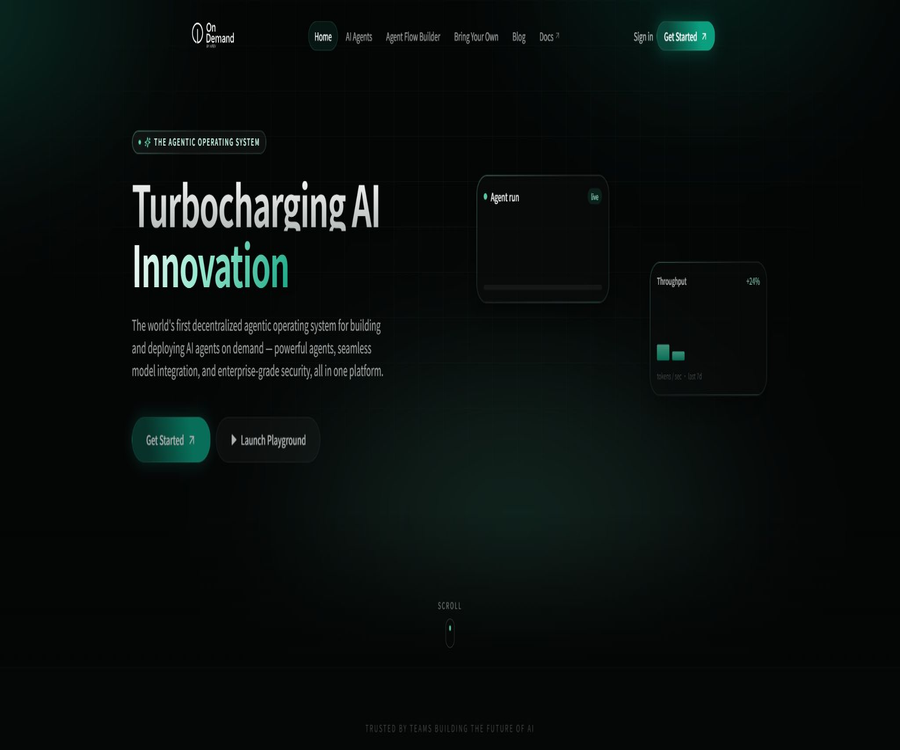
OnDemand is a platform for building, orchestrating, and deploying AI agents, operated by School Hack FZ-LLC; it is referred to by its developers as a decentralized agent operating system. It serves purposes such as code-free experimentation, enterprise automation, and developer integration, and covers aspects including agents, knowledge, workflows, model inference, and various types of APIs.
Main functions
Agents and Real-time Playground
Users can test models, files, and custom agents in the Playground, adjust parameters such as temperature, and view execution logs. The platform supports the creation of tools, agents, and multi-agent workflows, and it also provides reusable components, scheduling mechanisms, persistent memory, and human approval nodes.
- You can start with pre-built agents or tools, or configure prompts, models, and behaviors on your own.
- Use real-time debugging to view requests, code examples, steps, and tool calls.
- Maintain cross-session context through memory, and control team access using role permissions.
- Manual confirmation is required for actions such as sending emails and modifying data, in order to reduce the risks associated with autonomous execution.
Knowledge connections, plugins, and MCP
The platform allows for the uploading of files and directories, and it can also be connected to cloud storage services, as well as platforms such as SharePoint, OneDrive, and Amazon S3. Agents can utilize default plugins, custom endpoints, OAuth connectors, and MCP tools in order to access external capabilities.
- Enable the agent to search through corporate data and generate context-rich responses.
- Read data, trigger actions, or combine processes after connecting to third-party systems.
- It supports PDF and image mapping within files, facilitating the processing of complex documents.
- The availability of connectors and their scope of permissions depend on the account, deployment method, and administrator settings.
Models, inference, and application deployment
OnDemand allows users to choose from platform-based models, built-in models, or private inference endpoints; it is also possible to deploy Hugging Face models on dedicated GPUs and run them using vLLM. Developers can also deploy serverless applications and create interactive products with streaming responses.
- Select multiple large language models uniformly, and implement Pro-level access control for the advanced models.
- Retain the choice of model and inference infrastructure through BYOM and BYOI.
- Package the agent workflows into websites, internal systems, or customer applications.
- The model’s support scope, GPU availability, and performance vary depending on the region and plan.
Develop interfaces
| Interface or capability | Primary uses | Suitable scenarios | Precautions |
|---|---|---|---|
| Chat API | Create stateful sessions, connect to agents, and return results in a streaming manner | Customer service, Q&A, and in-app assistant | It is necessary to manage sessions, keys, rate limiting, and retry on failures. |
| Media API | Upload or reference media, and extract information from audio, video, and documents. | Document analysis, transcription, and content retrieval | It is necessary to verify the file format, size, and the scope of sensitive data. |
| Cloud Services API | Speech to text and text to speech | Voice assistants, meetings, and accessibility features | Language, tone, and pricing are based on the account. |
| Agent Tools API | Create a session, prompt the agent, and invoke tools. | Automated tasks and multi-step processes | Write-oriented tools should incorporate minimum permissions and approval processes. |
| BYOM and BYOI | Deploy your own models or connect to your own inference endpoints | Private models, dedicated computing power, and controlled environments | Operation and maintenance, security, and model licensing are the responsibility of the user. |
Usage tutorial
- Register an account, select a model in Playground, and use tasks that do not contain sensitive information to test the outputs.
- Create a knowledge space, upload a small number of representative documents, and check the parsing, segmentation, and search results.
- Create a new agent and set the system instructions, model, knowledge, memory, as well as the tools that can be used.
- When multi-step automation is required, connect triggers, models, tools, approval, and output nodes in the process builder.
- Generate an API key and copy the Python, JavaScript, or command-line examples provided by the platform to the testing environment.
- Before going live, configure key isolation, budget settings, rate limiting, logging, role permissions, manual review, and exception rollback.
Which users are it suitable for
- Product and innovation teams that need to quickly test RAG-based Q&A systems and tool-oriented intelligent agents.
- Developers who wish to integrate conversations, media, or voice AI into their applications via APIs.
- Operational teams that need to connect multiple models, tools, and approval steps within a visual workflow.
- Companies that wish to use their own models, private inference, or local deployment options.
- Users who only need simple personal conversations may not require full deployment and governance capabilities.
Prices and packages
| Hierarchy | Current publicly disclosed amount | Scope confirmed | Suitable for users |
|---|---|---|---|
| Start for free | Starting from $0 | The official website offers free access to structured product information; users can register and gain access to the platform. | Trial and prototype verification |
| Pro | The authorities have not made this information public yet. | Some advanced models and specialized functions are subject to Pro permissions. | Individuals or teams that require advanced models and ongoing use thereof |
| Enterprise or on-premises deployment | Contact the team | Role permissions, white labeling, custom models, private inference, local mode, and customization support are to be determined based on the specific plan. | Organizations with requirements regarding security, compliance, and deployment |
| APIs and computing capacity usage | The items in the account are displayed as they actually are. | Models, agents, media, voice, storage, GPUs, and serverless computing may be billed separately. | Production applications and high-volume projects |
Official updates from May 2026 indicate that the pricing system has been adjusted, and in July Pro-level controls were introduced for the advanced models; the official website does not always display the current prices of the packages or the total amount available. After registration, it is necessary to refer to the usage and billing pages, rather than relying on the old prices provided by third parties.
The platform’s terms require users to bear the costs associated with their accounts; it is stated that the amount listed on the invoice is exclusive of taxes and must be paid within five days of issuance. Information regarding cancellations, refunds, the validity period of free credits, and the price for excess usage is not fully detailed on the public pages, so written confirmation should be obtained before making any purchases.
Product advantages
- It also offers code-free experiments, visual orchestration, and development APIs, facilitating the transition from prototypes to integrated solutions.
- Knowledge, plugins, MCP, models, and deployment capabilities are all gathered on the same platform.
- You can use your own models or inference endpoints, which reduces the risk of being locked in by a single model provider.
- It supports production governance features such as manual approval, user roles, execution history, and logs.
- The developers continuously release functional updates, and provide API documentation as well as the ability to export code.
Usage restrictions and precautions
- There are multiple platform levels, and the combination of models, tools, plugins, knowledge, and deployment increases the complexity of debugging.
- When an agent calls external systems, it may cause real-world side effects; therefore, permissions should be restricted and rollback mechanisms should be implemented.
- The costs can arise from various aspects such as models, media, voice, GPUs, storage, and execution.
- Models provided on their own do not automatically address issues related to licensing, data leakage, command injection, and output security.
- The official specifications regarding performance, security, and the number of models are provided in the platform’s documentation; companies still need to conduct their own load and risk tests.
Security, Privacy, and Deployment
The official website lists the SOC 2 Type 1 audit and explains that enterprise roles, Azure sign-in, private inference, and local knowledge patterns can be used. The scope of certification, the latest reports, as well as data residency and sub-processors must be confirmed through sales or security review materials.
The platform’s terms state that customer data will only be accessed when providing services, calculating fees, or as required by law, and that reasonable technical and organizational measures will be employed. Before handling sensitive data, an appropriate data agreement must be signed, outlining the rules for storage, deletion, backup, model training, and event notification.
APIs, SDKs, and open-source status
OnDemand does provide an API reference page that covers interfaces for chat and agent tools, media, and voice; it also allows for the export of code in Python, JavaScript, and for command-line usage. These are official development interfaces, and keys should be stored only on the server, with separate storage for different environments.
Official public materials do not confirm the existence of a formal SDK that is released independently and maintained under an open-source license; nor does any open-source license apply to the product itself. Being able to view the code for intelligent agents, deploy open-source models, or use open-source vLLM does not mean that the OnDemand platform itself is open-source.
Frequently Asked Questions
Can OnDemand be used for free?
The official website offers an option to start using the service for free, but the current free usage quota, range of available models, and validity period are not fully listed on the public page. Once you log in to your account, you should first check the usage rules and billing details.
Is it necessary to use the models provided by the platform?
It’s not necessary. The platform supports BYOM and BYOI; it is possible to deploy one’s own models or connect to external inference endpoints, but the specific features and costs depend on the chosen solution.
Does it have a public API?
Yes. The official provider offers API references and code exports, covering functions such as messaging, chatbots, media handling, and voice communication; however, the usage limits and prices must be checked in the account.
Tools similar to OnDemand


 Guigong Network Security Registration No. 45132202000164