






Ohm
Ohm, an intelligent tool focused on improving AI efficiency
Tags:AI improves efficiencyTool Introduction
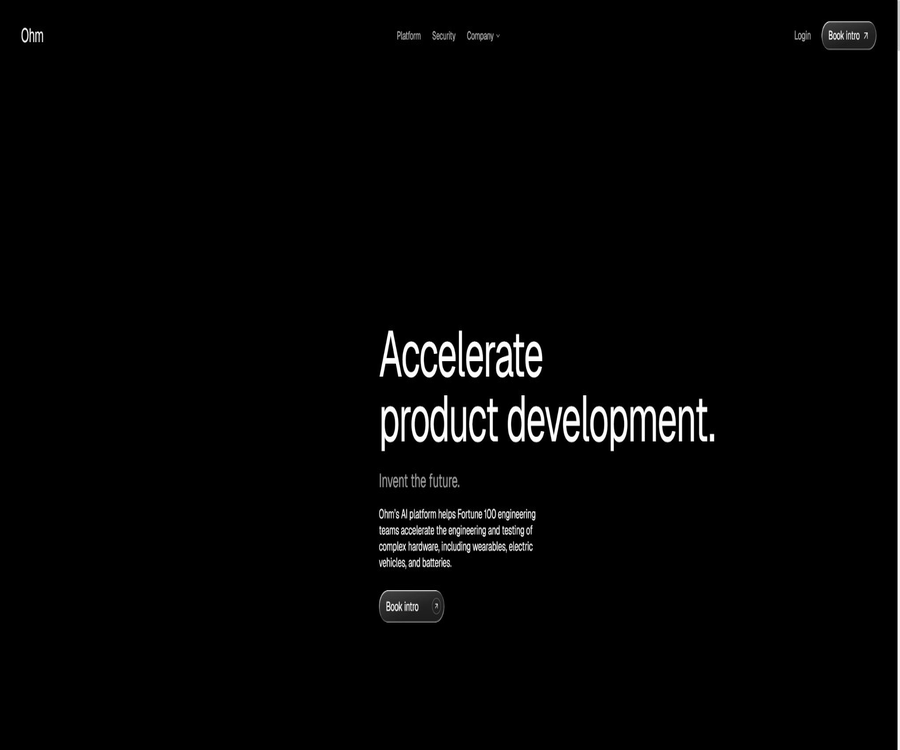
Ohm is an enterprise AI platform provided by Byterat, Inc. for teams involved in the development, testing, and validation of complex hardware. It brings together multimodal test data, predictive models, anomaly detection tools, engineering analysis functions, and collaborative reporting capabilities in a single workspace, and is utilized in industries such as batteries, automotive, aerospace, wearable devices, and data centers.
Main functions
Integration and unified management of test data
The platform can connect to various data sources such as time series, Excel files, documents, testing equipment, external laboratories, and manufacturing databases, and it performs standardization and context-related processing. Automatic quality checks identify abnormal values, testing errors, and formatting issues, thereby preventing faulty data from being included in subsequent analyses.
- Aggregate test records scattered across devices, files, and databases into a unified data layer.
- It supports drilling down from long-term cyclical trends to view signals at the millisecond level.
- It provides real-time testing, monitoring of channel and device status, and can issue alerts for abnormalities.
- Generate dashboards and reports to reduce the need for manual tracking of test progress.
Predictive analytics and anomaly detection
Ohm uses historical data to predict test results and provide confidence intervals, thereby assisting engineers in deciding whether it is possible to terminate low-value tests ahead of time. The platform is also capable of detecting performance deviations, signs of degradation, and process drifts; however, the final decision still requires engineering validation.
- Run prediction models and anomaly detection in real-time data pipelines.
- It supports code-free training and deployment of common custom machine learning models.
- Analyze hardware behavior by combining physical models with data-driven methods.
- Provides the capability to execute PyBaMM models for battery workflows.
AI-assisted scientists
Engineers can use natural language to specify analysis tasks across different datasets; the system will retrieve the necessary data, write and execute the analysis code, find relevant research studies, and generate visualizations and reports. The code, algorithms, hyperparameters, and statistical methods that are created can be reviewed, and once validated, the entire process can be saved as a template that can be reused.
- It automatically detects anomalies and ranks the possible causes, thereby forming a root-cause investigation plan.
- Include the test protocols, material specifications, project objectives, and historical results in the analysis context.
- Transform the validated engineering analyses into team knowledge and automated workflows.
Usage process
- Schedule a product presentation to explain the testing equipment, data formats, project scale, and security requirements to the Ohm team.
- Select pilot testing projects, and configure data connections, field mappings, permissions, and quality inspection rules.
- Import historical test data and verify that the metrics, units, time axis, and device context are correct.
- Test predictions, anomaly detection, and root cause analysis using known cases, and verify the generated code as well as the basis for the conclusions.
- After the engineer approves the workflow, it is used for real-time testing, with continuous monitoring of false positives, model drift, and data changes.
Which users are it suitable for
- A team responsible for the development and validation of batteries, managing large-scale experimental data.
- Automotive and aerospace teams that need to shorten the duration of durability, reliability, or performance tests.
- Engineers who work on wearable devices or consumer electronics, dealing with sensor signals as well as thermal, electrical, and mechanical signals.
- A cross-functional R&D organization that aims to standardize laboratory data, models, analysis code, and reports.
- Large hardware companies that require enterprise security, data governance, and dedicated implementation support.
Price and procurement methods
The official website currently provides only options for making appointments for introductions and demonstrations; it does not disclose information regarding standard packages, pricing per user, data volume limits, free versions, or the duration of free trials. This product should be viewed as something that needs to be customized for each enterprise, and the actual cost may depend on factors such as data integration, the scope of deployment, the number of users, industry-specific requirements, and support needs.
Product advantages
- Designed specifically for hardware testing, it can handle time series and experimental contexts that are not well handled by standard chat tools.
- It covers the entire process, including data ingestion, quality inspection, forecasting, investigation, reporting, and knowledge accumulation.
- Generating analysis code for inspection helps engineering teams review algorithms and statistical methods.
- An architecture-independent design is employed, allowing different models to be selected for language, visual, and time-series tasks.
- The official website indicates compliance with SOC 2 Type II and ISO 27001, making it suitable for inclusion in corporate security assessment processes.
Usage restrictions and precautions
- The product is intended for corporate engineering teams; it is not a general data analysis tool that individual users can register and use directly.
- Prediction and root cause analysis are tools for supporting decision-making; they cannot replace test standards, experimental replication, expert review, or security certification.
- The data units, sensor calibration, testing conditions, and sample deviations directly affect the results of the model.
- Before importing undisclosed designs, supplier specifications, and failure data, it is necessary to verify the tenant isolation, access control, retention, and deletion policies.
- The old terms and privacy page primarily described battery life data, while the current product page covers a wider range of hardware tests; it is necessary to confirm the scope of the contract at the time of signing.
Data and Privacy
The privacy policy states that customers own the battery data and calculation results they upload; the platform does not sell or rent out customer data, and it utilizes cloud infrastructure as well as identity verification services to process the necessary data. The procedures for returning or deleting data after the service is terminated, as well as the use of anonymized aggregated data and its cross-border transfer, are governed by the customer contract and the latest privacy documents.
Platforms, models, and interfaces
Ohm is a cloud-based platform for enterprise collaboration, capable of connecting testing equipment, files, documents, and manufacturing data systems. It emphasizes a model-agnostic architecture; however, the vendor has not yet disclosed a list of specific underlying models, rules for selecting models, or options for local deployment.
The company has not yet made available to the public any APIs, SDKs, or developer documentation, and no official open-source projects have been identified. The ability to integrate with other systems does not equate to the availability of public APIs; before implementation, it is necessary to ask the sales and technical teams for information regarding the interfaces, authentication procedures, usage limits, and data export rules.
Frequently Asked Questions
Is Ohm the original Byterat?
The current privacy policy and terms of service identify the company in question as Byterat, Inc., and it uses the Ohm brand. The scope of its products has now expanded to include a variety of hardware testing functions, beyond just battery data management.
Is there a free version of Ohm?
The authorities have not yet disclosed information regarding a permanently free version, a trial period, or the standard price. It is necessary to schedule a demonstration in order to obtain a customized solution.
Can Ohm automatically decide to stop the test?
The platform can predict the outcomes and suggest ending the tests ahead of time, but the decision to stop them should be made by the engineering team based on factors such as risk, confidence intervals, regulations, and the verification plan.
Is Ohm an open-source platform?
The officials have not yet made the open-source licensing for the product public, nor is there any available public SDK. The transparent display of the generated analysis code does not mean that the platform itself is open source.
Tools similar to Ohm



 Guigong Network Security Registration No. 45132202000164