






Neurons
Neurons: an intelligent tool focused on improving the efficiency of AI.
Tags:AI improves efficiencyWhat are neurons?
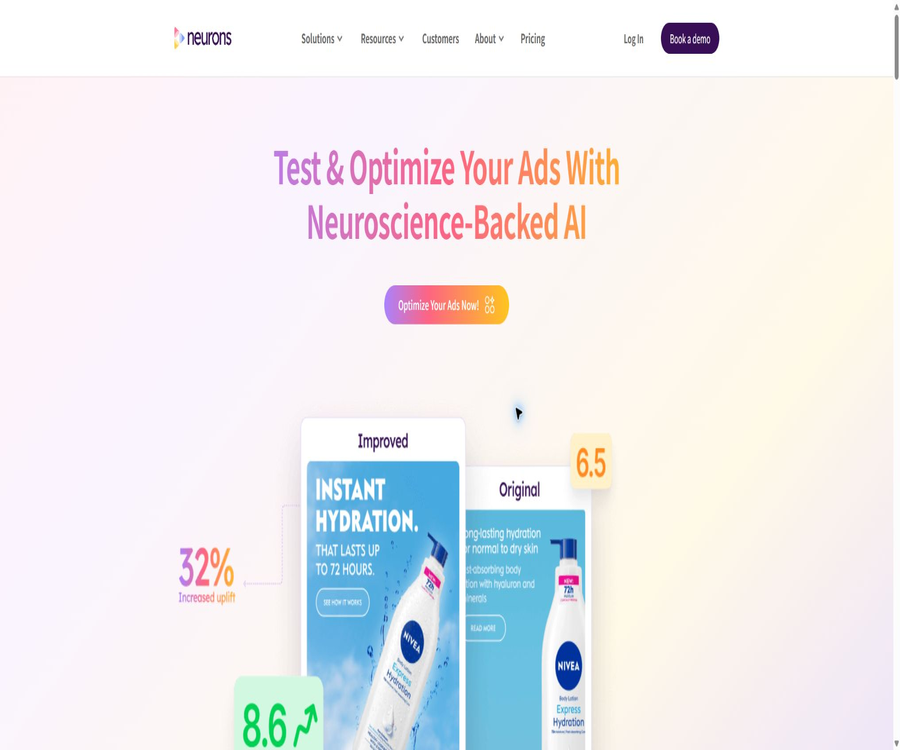
Neurons AI is an enterprise-level platform for creative analytics in neuromarketing, developed by Neurons Inc.; it uses artificial intelligence to predict the attention, cognitive, and emotional responses of audiences when they see advertising images or videos. The company was founded in 2013 by neuroscientist Thomas Zoëga Ramsøy, and its headquarters are located in Denmark.
The product is primarily used to test creative ideas before they are launched in advertisements; it is not intended for generating campaign data or replacing real consumer research. Marketers can use the predictive results to select the best versions, identify visual issues, and provide suggestions to the design team for further improvements.
Main functions
Attention heatmaps and cognitive metrics
- Attention heatmaps predict the areas in an image that are most likely to capture attention, with colors indicating the expected distribution of gaze; fog maps use masking to highlight content that is easy to see.
- The Focus score indicates the level of concentration, Cognitive Demand measures the burden associated with processing visual information, while Engagement and Memory are used to estimate positive emotional responses and the likelihood of remembering the advertisement.
- Both images and videos can be analyzed; for videos, the results include a score curve per frame, which makes it easy to identify how the visibility of a brand, product, or action button changes over time.
- Heat maps and scores are predictions made by the model; they are not based on real-time measurements of eye movement or brain activity among the current advertising audience, and therefore cannot be equated directly with click-through rates, conversion rates, or increases in sales.
AOI interest area analysis
- Users can define AOI areas for brand logos, products, titles, text, and action buttons, in order to see the level of attention paid to each element, as well as its contribution to perception, engagement, and memory.
- Image AOI can provide information on total attention, estimated viewing time, and the expected proportion of being viewed; video AOI includes data on visible time, relative attention, as well as performance during the beginning and end of the video.
- The system can automatically suggest common AOI options, and it also allows users to manually adjust them using rectangles or polygons; brand elements in videos can be automatically detected and tracked.
- Incorrect selection using the AOI tool can affect the baseline comparison and the overall score; therefore, it is necessary to manually check the element types, their positions, and the extent of overlap before saving the results.
Industry benchmarks, comparisons, and reports
- The platform determines, based on criteria such as brand building or conversion goals, as well as industry and advertising purposes, what level a particular asset’s score falls at in comparison with similar assets.
- Targets can be automatically identified by visual language models, or they can be modified manually; incorrect classification leads to the comparison of materials with inappropriate benchmarks.
- In Compare mode, up to six images can be compared at the same time; it is suitable for selecting the main visual, packaging, banner, or social media ad version under the same evaluation criteria.
- The results can be downloaded as PDFs or as editable presentations; furthermore, videos can be exported as CSV files containing frame-by-frame scores and AOI data, which facilitates internal reporting and further analysis.
AI insights and visual suggestions
- The recommendation engine takes into account creative objectives, prediction scores, heat maps, and industry benchmarks to provide suggestions for improving the copy, element placement, visual hierarchy, and overall style.
- Image insights are generated using Claude, while video insights are created with Gemini; customer materials and heat maps are sent to the respective models for processing, although it is stated that this data is not used for training purposes.
- Visual Recommendations is a paid additional feature that converts textual suggestions into up to four visually presented examples that have been filtered through prediction; sometimes it also provides a wildcard creative idea.
- Generating examples usually takes no more than three minutes, and it is done within the allocated quota; these images serve as inspiration drafts and are not final ads that can be used directly – it is still necessary to check the compliance of the text, characters, products, and brand elements.
Brand kit
The additional feature of the Brand Kit allows for uploading a PDF version of the brand guide with a size of no more than 20MB at the folder level. The platform extracts information such as fonts, colors, tone of voice, logo guidelines, and brand values, using this data to adjust the AI-generated suggestions in that folder and its subfolders.
Only one brand kit can be kept in each folder; new files will overwrite the old ones. After uploading or replacing a file, it is necessary to regenerate the insights so that the existing materials can apply the latest rules.
Supported inputs and technical limitations
| Media type | Supported formats | Main limitations | Processing instructions |
|---|---|---|---|
| Image | JPG, JPEG, PNG, WebP | 50 to 5000 pixels, up to 20MB | If either side exceeds 3000 pixels, it will be reduced to 3000 pixels. |
| Video and mixed media | MP4, MKV, AVI, MOV, WebM; GIF and other mixed media formats are also supported. | 128 to 5000 pixels, 5 to 121 frames per second, 1 to 500 MB, 1 second to 7 minutes | Before analysis, the frame rate is set to 24 frames per second, and the size is adjusted to a range of 128 to 1024 pixels while maintaining the aspect ratio. |
| Document | Only 1 page, up to 20MB | Suitable for analyzing single-page ads or layouts as visual materials. |
The interface requirements for plugins, web platforms, and APIs may not be exactly the same. For example, the API video documentation provides specific resolution requirements for creation requests; when integrating multiple elements at once, it is necessary to follow the latest validation criteria for the relevant endpoints.
Usage tutorials and workflows
- First, determine whether the goal of the test is brand building or conversion, and prepare advertising materials with dimensions, format, and duration that meet the requirements.
- Upload images, videos, or single-page PDFs to let the system identify the industry, purpose, and testing objectives; manually correct any inaccurate classifications.
- Check the automatically identified brand, product, title, text, and action buttons using AOI; fill in the missing areas and remove any incorrectly identified boxes.
- After the results are generated, first examine the overall impact score; then, by taking into account factors such as attention, cognitive load, engagement, and memory indicators, identify the specific issues.
- Use industry benchmarks for comparison with similar versions; do not focus solely on achieving a high score. Generate textual insights or visual suggestions when necessary.
- The preferred direction is handed over to the design team for further refinement, and then re-tested using the same objectives and AOI; finally, it is validated through actual deployment or user research.
Prices and packages
| Package or version | Price | Billing cycle | Core benefits or quota | Suitable for users |
|---|---|---|---|---|
| Starter Package | Custom quote | The contract is finalized. | Unlimited analysis and forecasting, 500 Visual Recommendations, customer success manager, courses, up to 5 users | The team that began to develop a process for creative testing |
| Pro Package | Custom quote | The contract is finalized. | Unlimited analysis and forecasting, 1,000 Visual Recommendations, Customer Success Manager, courses, up to 5 users, Brand Kit | Optimize the brands or agencies associated with multiple campaigns at the same time |
| Scale Package | Custom quote | The contract is finalized. | Unlimited analysis and forecasting, 2000 Visual Recommendations, Customer Success Manager, courses, Brand Kit, SSO, and specialized workshops | Companies that expand creative testing across different teams |
| Neurons API | Contact sales | The contract is finalized. | Image and video prediction, AOI, and media management interfaces; API keys are provided by the Customer Success Manager. | Enterprises that require batch or embedded analysis |
None of the public packages specify a fixed price; the page offers demos and a way to request a quote, but there is no information regarding a permanently free version or a trial quota. The actual costs, the amount available for Visual Recommendations, the number of users, SSO capabilities, Brand Kit options, and API rights are all determined by the sales contract.
For Starter and Pro plans, users, SSO, or workshops can be added as additional services; for the Scale plan, users and extra visual suggestions can be added. There are no uniform rules for refunds on public pages, so businesses should clarify the arrangements regarding renewal, cancellation, overuse, refunds, and data export in the order or main service agreement before making a purchase.
APIs, plugins, and integrations
Neurons API
- API v2 allows for the uploading and analysis of images and videos, the retrieval of media lists and results, the deletion of media, the processing of AOI data, as well as the viewing of account plans and usage details.
- The request must be authenticated using the customer’s dedicated API key; the public documentation does not provide information on how to obtain such a key or its price, so it is necessary to contact the Customer Success Manager to enable it.
- The maximum number of predictions for images is 100 per network address every 10 seconds, while for videos it is 50 per 10 seconds; the media deletion feature, as well as the AOI and account interfaces, each have their own limits.
- The video upload process supports incremental uploading, making it suitable for marketing asset management, creative review, or batch system testing; however, it is still necessary to handle asynchronous status, retry on failures, and rate-limiting responses.
Figma and Chrome plugins
- The Figma plugin can analyze the selected board directly, displaying scores and heat maps, and it allows the results to be copied back into the design file; rectangular or polygonal layers named AOI can be used to define areas of interest.
- Chrome extensions can analyze the currently visible page or the area selected by the user, and save the prediction results in a specified folder.
- The plugin requires a personal plugin key to be generated from a Neurons account, and its availability and usage limits are determined by the enterprise plan.
It has not been confirmed that the Neurons AI hosting platform is based on open-source licenses, nor has any official public repository containing the source code of the product been found. The existence of public API documentation and a list of plugins does not mean that the product is open-source; companies cannot use this information to deploy the models on their own.
Suitable for users and typical use cases
- The brand marketing team checks before launching whether the logos, products, titles, and action buttons receive sufficient attention.
- Advertising agencies use unified metrics to compare various creative approaches and generate editable reports for communication with clients.
- The e-commerce, consumer goods, and social media teams assess the visual hierarchy of packaging, banners, short videos, or the homepage layout.
- Large enterprises integrate predictions into their asset libraries, creative approval processes, or batch quality inspection workflows through APIs.
Advantages and usage boundaries
Advantages
- Putting heat maps, cognitive metrics, AOI, industry benchmarks, and improvement suggestions within the same workflow makes it easier to work with than relying on just a single attention map.
- It supports static images, videos, single-page PDFs, web pages, as well as Figma files, covering various stages from design to pre-launch review.
- APIs, plugins, SSO, brand kits, and customer success support are suitable for companies with fixed creative output and collaboration processes.
Boundary
- The model’s outputs are predictions based on historical neuroscience research and training data, and they cannot take into account each country, specific demographic groups, media environments, and cultural contexts.
- High attention levels do not necessarily indicate a positive attitude, and high levels of engagement or memory scores do not always lead to clicks, purchases, or long-term brand growth.
- Industry and application categories, AOI labeling, as well as the exposure conditions for the materials can affect the results; therefore, versions should be compared under identical settings.
- Visual suggestions generate probabilistic images that may alter product details, characters, or text; they are suitable only as a basis for design presentations and to explore possible directions.
- The fixed price is not made public, which makes it difficult for individual creators or teams that occasionally test small amounts of material to estimate the costs before requesting a quote.
Privacy, security, and copyright
- Neurons Inc is located in the EU and provides data processing services; its clients are usually the data controllers, with Neurons acting as the processor. The agreements cover cross-border data transfers, processing timelines, types of data, and arrangements regarding sub-processors.
- The service terms state that customers retain the rights to their materials and to the insights generated from them, and that the uploaded content is not used for model training; Visual Recommendations also specify that such data is processed only by approved suppliers and is stored for a limited period of time.
- During the analysis phase, images or video content is sent to external large models for processing; sensitive, unreleased advertisements must first have their supplier, location, retention period, and confidentiality requirements checked against those specified in the contract.
- The company lists its SOC 2 monitoring certification and describes access control, malware protection, firewalls, and risk assessment; however, such certification does not guarantee absolute security in any situation.
- Privacy policies should be made public at an early stage, covering various types of data such as that related to customers, research participants, and those involved in recruitment processes. Companies should prioritize using the most up-to-date data processing agreements, lists of sub-processors, and signed contracts to regulate specific projects.
- The downloaded reports and AI recommendations may contain customer materials, and the copyright, trademark, and confidentiality rules applicable to those original materials must still be respected before they are shared with external agents or customers.
Summary
Neurons AI is suitable for brands and agencies that have a steady volume of advertisements to produce and need to evaluate their visual appearance before launching them. Its strength lies in its ability to integrate attention prediction, AOI quantification, cognitive and memory metrics, as well as benchmarks and actionable recommendations, into a single corporate workflow.
The key factors in procurement decisions are not only the predicted quantities but also the limits associated with Visual Recommendations, plugin users, APIs, SSO, brand kits, and data terms. Actual implementation should take into account experiments, conversion data, and research on target users; it is important to avoid relying solely on model scores as an indicator of business outcomes.
Tools similar to Neurons



 Guigong Network Security Registration No. 45132202000164