






MonoKit
MonoKit, an intelligent tool focused on improving AI efficiency
Tags:AI improves efficiencyWhat is MonoKit?
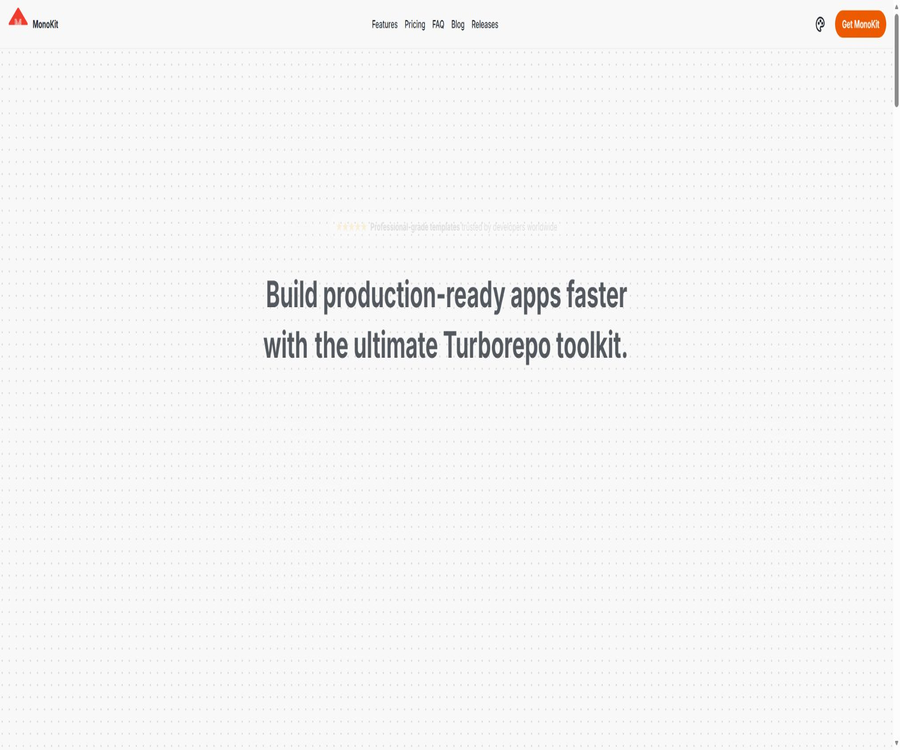
MonoKit is a commercial full-stack Monorepo template used for developing SaaS and web products; its core technologies include Next.js, React, Fastify, TypeScript, Tailwind CSS, and Turborepo.
It bundles the front end, back end, and common infrastructure into a single code repository, helping developers avoid the repetitive work involved in setting up authentication, payment systems, email functions, storage solutions, content management, and deployment processes.
The AI capabilities referred to by MonoKit are primarily code structures, AI components, and MCP servers that are suitable for understanding by AI programming agents; they are not independent large models or hosted AI conversation services.
Project architecture and main functions
Web, API, and shared packages
- Web application: Built using Next.js and React, it features over 50 interface components, a responsive layout, theme switching, and dark mode; it can be used as a marketing site, a control panel, or a user product interface.
- API applications: Backend services are built using Fastify, and this approach is suitable for implementing business interfaces, authentication checks, payment callbacks, and internal services; users still need to design the domain logic and permission systems on their own.
- Shared packages: AI, CMS, databases, email, storage, testing, TypeScript configurations, and the UI are managed as reusable packages, thereby reducing duplicate code across different applications.
- Monorepo toolchain: Turborepo is responsible for handling multiple packages and caching, while pnpm manages dependencies; developers can execute commands for development, building, testing, and inspection in a unified manner.
- Alternative configurations: The public documentation lists configurations for Fastify API, Serverless API, and Drizzle ORM, allowing for the replacement of certain default implementations based on the desired deployment scenario.
Authentication, database, and content management
- Authentication: Integrates Better Auth, enabling login methods such as OAuth, JWT, and magic links; in a production environment, it is necessary to configure provider credentials, session policies, and callback addresses.
- Data layer: Prisma is used by default, offering type-safe queries, database migration, and a connection pool; the actual database instances, backups, and high availability are the responsibility of the party that carries out the deployment.
- Content management: It is possible to connect Sanity as a headless CMS for use in blogs, marketing pages, or to manage structured content; the service limits and data policies are determined by the third-party account.
- SEO and blogs: The templates provide the infrastructure needed for displaying content and optimizing it for searches, but keywords, structured data, site performance, and content quality still require ongoing attention from the project team.
Payments, email, and file storage
- Payments and subscriptions: Integration with Polar enables handling of payments, subscriptions, invoices, and global tax matters; merchant eligibility, rates, refunds, and settlements are determined by the payment platform account.
- Transactional emails: Design templates using React Email, and send verification, notification, and business-related emails via AWS SES; it is necessary to set up domain verification, sending permissions, and bounce handling.
- Object storage: Files can be uploaded using AWS S3; pre-signed URLs, access control, compression, and previewing are supported. Costs related to storage, data transfer, and content security must be managed separately.
- Environment variables: Authentication, databases, payments, email, storage, and CMS all rely on key configurations; development and production environments should be separated from each other, with dedicated key management solutions used.
Development experience tailored for AI
- The code structure emphasizes consistent naming, module boundaries, and shared packages, which facilitates AI programming agents in identifying the context and modifying code across different applications.
- The template includes AI-related shared packages and components that can serve as a starting point for AI functions within a product; however, the available models, invocation costs, and data processing depend on the services connected by the developer.
- The MCP server is used to expose controlled contexts or capabilities to compatible AI development tools; when connecting to such tools, it is necessary to restrict their permissions, review write operations, and prevent production keys from being sent to the models.
- AI-generated code may still contain dependency errors, security flaws, and issues with business logic; therefore, type checking, testing, code review, and dependency scanning should be carried out before integrating it.
Components and external services
| Ability | Default technology or service | Main outputs | Matters that need to be handled by oneself |
|---|---|---|---|
| Web frontend | Next.js, React, Tailwind CSS | Marketing pages, application interfaces, and components | Product design, content, performance, and accessibility |
| Backend API | Fastify | Business interfaces and service logic | Permissions, rate limiting, logging, and runtime environment |
| Data access | Prisma | Type-safe queries and migration | Database costs, backup, and data governance |
| Identity verification | Better Auth | OAuth, JWT, and magic links | Provider configuration, session security, and account processes |
| Payment | Polar | Payments, subscriptions, invoices, and tax handling | Transaction fees, refunds, merchant compliance, and settlement |
| React Email, AWS SES | Email templates and sending | Sending fees, domain reputation, and unsubscribe mechanism | |
| file | AWS S3 | Upload, pre-signed access, and preview | Storage and traffic costs, permissions, and lifecycle management |
| Content | Sanity | Blogs and structured content | External account, quota, and content governance |
The workflow from purchase to going live
- First, identify the target product, the size of the team, the platform on which deployment is to take place, as well as the certification, payment, email, and storage services that are necessary; only after that should you choose the license package.
- Complete the purchase to obtain access to the code repository, and read the documentation on installation, system requirements, project structure, environment variables, and cloud deployment.
- Install the pnpm dependencies and launch the Turborepo development environment, then verify that the Web interface, the API, and the shared packages can be started locally.
- Create databases for the development environment, as well as accounts for authentication, Polar, AWS, and Sanity; store the keys in secure environment configurations and do not commit them to the version control repository.
- First, replace the brand, navigation, and page content; then implement synchronization for domain data models, APIs, permissions, payment items, and subscription status.
- Add automated tests for logging in, payment callbacks, uploading, emails, database migration, and management permissions, and review the changes generated by AI.
- Configure a pre-release environment using Vercel, Cloudflare, AWS, Docker, or your own infrastructure, and carry out tests for security, performance, backup, and disaster recovery.
- After going live, ongoing monitoring is carried out regarding third-party service costs, dependency vulnerabilities, database migrations, and product updates; compatibility is tested in a separate branch before any upgrade is performed.
Price packages
| Package or version | Price | Billing cycle | Core benefits or quota | Suitable for users |
|---|---|---|---|---|
| Startup | 149 dollars | One-time use | Complete templates, SEO and blogging tools, payment solutions, AI components, email template options, S3 integration, Discord support, access to code repositories, and priority assistance; the sales page indicates lifetime updates. | Independent developers and early SaaS |
| Scale | 299 dollars | One-time use | The main capability of Startup is the addition of support for personal integration. | Small teams that need assistance with integration. |
| Enterprise | 999 dollars | One-time use | Main template capabilities, personal integration support, and integration scheduling | Enterprise projects that require more extensive support |
The amount mentioned above is the price for a template license; it does not include ongoing costs from third parties such as databases, cloud servers, domain names, model calls, payment transactions, email services, object storage, and CMS.
Prices, discounts, and benefits may change; the final terms shall be those stated on the purchase settlement page and in the written authorization conditions.
Authorization, updates, and refunds
| Matters | The rules have been verified. | Pay attention before purchasing. |
|---|---|---|
| Nature of the license | A one-time purchase grants a non-exclusive, non-transferable permanent license for use. | The licensor’s terms also reserve the right to terminate the license, and the applicable conditions must be specified. |
| Modification is allowed. | You can modify the template for your own projects. | The final product must still comply with the terms of service and dependencies of third parties. |
| Distribution is prohibited. | Templates or their derived versions cannot be resold, relicensed, or redistributed as independent templates. | The scope of agency development, client projects, and multiple projects must be confirmed in writing. |
| Update | The sales page indicates that updates are available for life as part of the Startup benefits. | The terms of service state that updates and new features are not guaranteed and may require separate purchase, which presents a contradiction in the wording. |
| Support | Different packages include priority support or individual integration support. | The documentation for the terms is limited; additional support may incur extra costs. |
| Refund | No refunds, no exchanges, and no cancellations once access has been granted. | Before purchasing, check the technology stack, demonstrations, documentation scope, and licenses. |
The sales page and the terms of service do not always align regarding the commitment to updates. If lifetime updates are an important factor in the decision to make a purchase, a written confirmation applicable to the selected package should be obtained before making the payment.
Deployment platform and operational boundaries
| Platform | Support methods | Suitable situations | Precautions |
|---|---|---|---|
| Vercel | Public documents provide deployment topics. | Next.js frontend and rapid deployment | The backend, database connections, and usage costs need to be designed separately. |
| Cloudflare | Listed as deployable cloud platforms | Edge computing and global distribution | Runtime compatibility must be verified on a per-project basis. |
| AWS | It can be combined with cloud services as well as S3 and SES. | Teams that need a complete cloud infrastructure | Higher permissions, network requirements, costs, and operational complexity. |
| Docker | Offers containerization and continuous delivery solutions. | Self-hosted or multi-cloud deployment | Mirrors, keys, monitoring, and patches are the responsibility of the team. |
MonoKit provides the source code and the foundation for deployment, but it is not a managed SaaS service. Responsibility for availability, monitoring, scaling, backup, disaster recovery, and compliance lies with the purchaser’s project team.
GitHub, APIs, and open-source status
- Purchasing the license grants access to GitHub repositories; however, the associated account does not currently have any public repositories, so it is not possible to view the complete template code on public pages.
- Being hosted on GitHub does not mean it is open source. MonoKit uses a commercial license that restricts resale and redistribution; there is no open source license that allows the public to copy it freely.
- The template includes a Fastify API application, which is the source code used to build one’s own backend after purchase; it does not mean that MonoKit provides a separate public SaaS API.
- The public documentation lists the modules related to APIs, AI, and MCP, but detailed information on interfaces, versions, access permissions, and code licenses must be checked in the repository and documentation available after purchase.
- The open-source frameworks that are used as dependencies each come with their own licenses; the team should create a list of these dependencies and examine the requirements regarding attribution, redistribution, and commercial use.
Suitable for users and typical use cases
- Independent developers: Need to quickly launch a SaaS product with login features, subscription options, email support, and a content system.
- Startup team: Hope to share types, components, and configurations between the front-end and back-end, and to iterate on the marketing site and the application within the same repository.
- Agency development team: Creates customized web products for clients, but it is necessary first to clarify the boundaries regarding authorization for multiple clients, multiple projects, and the delivery of source code.
- AI-assisted development team: They aim to make the code structure easier for programming agents to understand, and they use MCP to enhance the development process.
- Teams with a fixed technology stack: If an organization is already using Next.js, Fastify, Prisma, AWS, and Polar, the time required for basic integration can be reduced.
Advantages and limitations
- The boundaries between the front end, APIs, and shared libraries are clear, making it suitable for maintaining websites, the business backend, and generic components simultaneously.
- Authentication, payment, email, storage, and CMS provide integration points that can shorten the prototype development phase, but they do not replace the actual development of business functions.
- A one-time payment makes it easier to estimate the cost of purchasing templates, whereas third-party cloud services and model calls continue to incur ongoing expenses.
- The default service combination is well-defined; however, if a team uses different payment methods, databases, or cloud platforms, the costs associated with replacement and migration may offset the benefits of using this template.
- Public demonstrations and documentation cannot cover all the paid source code; prior to purchase, it is difficult to assess the quality of the code, the extent of testing that has been carried out, and its compatibility with future updates.
- There is a conflict between the sales page and the terms regarding update commitments, and the license includes termination clauses; written confirmation is required for business projects.
- The template itself does not guarantee application security, performance, availability, or compliance; independent testing and auditing are still required before it is deployed in production.
Privacy and security considerations
- During the purchase and support process, account details, contact information, and other necessary data are processed; Google login may pre-fill the username and profile picture, while payments are handled by third-party services.
- The privacy rules permit the storage or sharing of data within the framework of fulfilling obligations, providing support, meeting legal requirements, and ensuring security; users can request access to their data, have it corrected or deleted, limit its processing, or object to such processing.
- Users who develop applications using templates bear independent responsibility for data control; they are required to create their own privacy policies, obtain consent from users, and establish rules regarding data deletion, export, and retention.
- Minimal permissions should be applied to authentication, payment callbacks, databases, object storage, and email credentials; production keys must not be exposed to clients or uncontrolled AI tools.
- The data location, training usage, log retention, and compliance certification related to third-party services are not handled automatically by the template; applicable agreements must be signed for each of these aspects, along with a risk assessment being conducted.
Summary
MonoKit is suitable for developers who wish to quickly set up SaaS infrastructure using modern TypeScript Monorepos, and who are willing to handle the business logic, deployment, and maintenance themselves.
When making a purchase, it’s important to consider not only the list of features but also the scope of the license, any conflicts regarding update commitments, restrictions on refunds, costs associated with external services, and the extent to which the team is compatible with the default technology stack.
Tools similar to MonoKit


 Guigong Network Security Registration No. 45132202000164