






Mesh
Mesh, an intelligent tool focused on improving AI efficiency.
Tags:AI improves efficiencyWhat is Mesh?
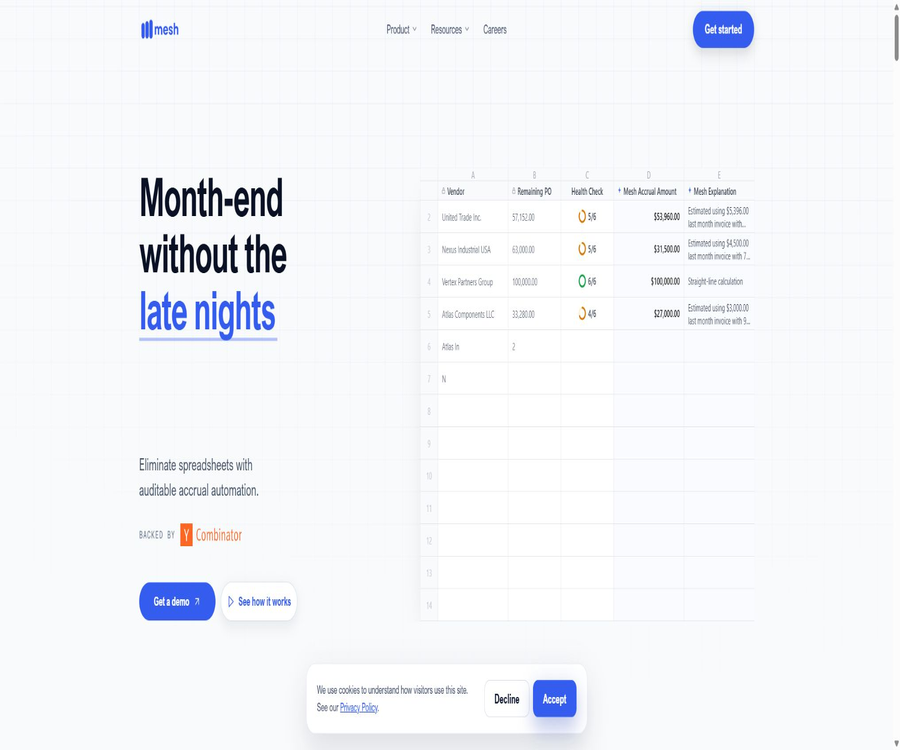
Mesh is an automation platform for accounting and prepaid expenses, developed by Mesh, Inc.; it is designed to assist Controllers, Accounting Managers, and CFOs. It aggregates data related to purchases, accounts payable, contracts, and internal communications, identifies the suppliers for whom expenses need to be recorded in the current period, and generates draft accounting entries that can be reviewed.
Mesh is not a general-purpose AI chat tool or a complete financial closing suite; its main purpose is to replace the spreadsheet-based methods used for manually managing accrued and prepaid expenses. The system carries out repetitive checks and calculations automatically, but final approval, accounting policies, and significant decisions remain the responsibility of financial staff.
Main functions
- Identification of accrued items: By analyzing purchase orders, emails related to accounts payable, contracts, and other business-related data, it is possible to identify expenses that have been incurred but for which no invoice has yet been received or that have not been recorded in the accounts. This approach reduces the reliance on employees’ memory or on having to ask suppliers individually.
- Reusable calculation scripts: Convert the calculation logic specific to each supplier from spreadsheets into maintainable scripts that can be run repeatedly over different periods. The accounting team should verify the data parameters, dates, allocation methods, and rounding rules for these scripts.
- Versioning policy rules: The same accrual policy shall be applied consistently across different periods, with any changes to the rules being recorded. When there are updates to the policy, modifications to the contract, or changes in the business model, re-approval is required; the old logic cannot continue to be used automatically.
- Handling of prepaid expenses: Based on the contract, payment terms, and duration of service, the expenses that need to be deferred or amortized are identified, and corresponding plans or journal entries are created. Complex contracts, variable consideration, and significant judgments still require the assistance of professional accountants.
- Exception queue: Normal items are processed according to the established logic; only those with missing assumptions, abnormal amounts, contract changes, or other significant discrepancies are sent for manual review. This allows focus to be placed on high-risk items, rather than reviewing all items again.
- Journal entry formulas and evidence: Each accrued journal entry is accompanied by a calculation formula, the input data, and supporting documents, so that the amounts and the basis for them can be traced within the same record. Auditors may still request additional original contracts, invoices, and proof of approval and control.
- Posting after review: Drafts are first placed in a review queue, where accountants can approve, edit, or reject them, after which they are synchronized to the ERP system. Manual signing ultimately helps reduce the risk of errors being entered directly into the general ledger.
- Read-only ERP connection: The product focuses on establishing a connection between the ERP system and the procurement system without having to migrate the existing general ledger, allowing for the retrieval of necessary data in a read-only manner. Actual rights for making transactions, the direction of the connection, and related controls need to be determined one by one during implementation.
- Support for closing accounts at the end of the month: Ongoing preparation of accrued and prepaid items helps to reduce the need for bulk collections, formula copying, and evidence organization at the end of the month. The degree of automation and the acceleration in account closure seen in customer examples are specific results of certain implementations and are not guaranteed in all cases.
Input, processing, and output
| Stage | Main inputs | System processing | Output |
|---|---|---|---|
| Signal aggregation | Purchase orders, payable emails, contracts, internal communications | Match suppliers, periods, and outstanding expenses | List of suppliers to be provided pending confirmation |
| Accrual calculation | Contract amount, service period, invoices, and historical assumptions | Execute versioning policies and calculation scripts | Journal entry amount, account, and calculation details |
| Exception handling | Missing data, significant changes, and abnormal differences | Mark according to the rules and enter the manual queue. | Projects to be supplemented, modified, or rejected |
| Audit evidence | Formulas, contracts, procurement, and approval data | Associate the supporting materials with the entries. | Audit records with an evidence chain |
| Posting and closing accounts | The journal entry has been approved. | Synchronize the financial system according to the implemented configuration. | General ledger records and period closing results |
Complete workflow
- The finance team lists the current accrual and prepayment spreadsheets, suppliers, accounts, policies, data entry points, and monthly manual steps.
- Select suppliers with high frequencies and clear rules as pilots, and first exclude those involving significant estimates, controversial contracts, and high-risk situations.
- Connect to the ERP, procurement, accounts payable email systems, and contract systems in read-only mode to verify field mappings, account permissions, and data integrity.
- Create calculation scripts and versioning rules for each type of supplier, and document the service period, amount criteria, reversal rules, amortization methods, and significance thresholds.
- Use playback from the historical period to compare the Mesh draft with the finalized general ledger, and analyze missing items, incorrect entries, and amount discrepancies.
- Configure exception conditions and review queues to determine who can modify assumptions, approve entries, and release them to ERP.
- At the end of the month, perform signal detection and calculations, fill in any missing data, and review each abnormality.
- After approval, make the entry; save the formulas, evidence, rule versions, the person who made the changes, and the approval records.
- After closing the account, review the differences between the actual invoices and the estimates, update the scripts and thresholds, and then expand the list of suppliers.
Suitable for users and scenarios
- Medium-sized enterprises with around 200 to 2,000 employees often face a large number of suppliers, significant fluctuations in expenses, and irregular invoicing times.
- It is necessary to identify the financial team responsible for unpaid accrued amounts within the procurement, accounts payable, contracts, and communication systems.
- Controllers who wish to reduce the need for accrual spreadsheets, formula copying, manual responses, and the organization of audit evidence.
- Companies that need to prepare for financing, auditing, SOX controls, or more stringent financial governance require stable policies and a complete chain of evidence.
- Companies that use SaaS, market platforms, fintech, or other models with high supplier complexity.
- It is not suitable for users who only need a task list for closing accounts, a complete set of general ledgers, tax filings, invoice generation, or personal bookkeeping.
Boundaries with other financial instruments
| Tool type | Mainly solves problems | The relationship between Meshes |
|---|---|---|
| ERP and General Ledger | Official accounting, accounts, reports, and transaction systems | Mesh is layered on top of the existing system and does not replace the general ledger. |
| Purchasing and Accounts Payable System | Ordering, suppliers, invoices, and payment processes | Provide design signals and supporting data for Mesh. |
| Account closure management platform | Lists, tasks, responsible persons, reconciliation, and progress | Mesh focuses on accrual calculations and can be used in conjunction with closing management. |
| Spreadsheet | Manually calculate and maintain the accrual plan. | Mesh attempts to replace this with scripts, rules, and audit trails. |
| Universal AI Assistant | Q&A, writing, and unstructured analysis | Mesh is designed for controlled accounting workflows, and it is not an open chatbot. |
Prices and Purchases
| Package or version | Price | Billing cycle | Core benefits or quota | Suitable for users |
|---|---|---|---|---|
| Enterprise solutions | Contact sales | In accordance with the contract | Automation of accruals and prepayments, system integration, rule configuration, as well as the scope of implementation and support are determined on a project-by-project basis. | Financial team of medium-sized enterprises |
Mesh does not have any publicly specified prices for subscriptions, a free version, a fixed trial period, or fees based on the number of seats or usage volume. When making a purchase, it is necessary to request that the costs for the software itself, implementation, connectors, support, data migration, training, as well as any charges for excess usage and price increases upon renewal, be broken down separately.
The public page also does not reveal a unified refund policy. Business contracts typically include specific milestones and annual commitments; it is necessary to agree upon procedures for pilot project evaluation, contract termination, data export, as well as handling of refunds for services that were not delivered, prior to signing the contract.
Platforms, Integration, and APIs
- The currently confirmed form of use is cloud-based web applications integrated with enterprise systems; there are no public native clients for iOS, Android, Windows, or Mac.
- The product will be connected to procurement systems, accounts payable email systems, contracts, internal communication tools, payment systems, banking services, and accounting systems. The specific brands, directions of connection, and permissions depend on the implementation details.
- The official explanation states that read-only ERP access is provided and there is no need to replace the existing systems; however, the methods for writing back transactions, the approval controls, and the list of supported ERPs need to be confirmed during the demonstration.
- No public API documentation, SDKs, Webhook specifications, developer pricing, or service level agreements have been identified. The ability for enterprise integration does not equate to the availability of open APIs.
GitHub and the open-source status
No official open-source product repositories, SDKs, or example projects released by Mesh, Inc. have been identified; therefore, the entire platform should be considered proprietary enterprise software. The use of cloud infrastructure, AI models, or third-party connectors does not change the licensing status of the product itself.
There are many Mesh projects with the same name, including those related to networking, payment systems, graphics, and distributed computing software; it is not possible to identify this specific product merely based on its name. The scope of commercial use and further development is determined by the enterprise contracts and the licenses for the individual components.
Privacy, security, and accounting controls
- Mesh handles names, email addresses, companies, account credentials, uploaded CSV files and tables, financial transactions, accounting settings, supplier and customer data, general ledger information, as well as device and log data.
- When connecting to third-party services, only the data necessary for completing the billing process should be authorized. Implementation teams should adopt the principle of least privilege, use service accounts, implement access reviews, and establish mechanisms for periodic revocation of access rights.
- The privacy policy states that data transmission is encrypted, and access controls, infrastructure monitoring, and secure cloud services are employed; however, it does not disclose the specific encryption standards, authentication methods, or the scope of penetration testing.
- The information is retained for as long as it is necessary to provide services, maintain accounts, fulfill legal obligations, or resolve disputes; no specific number of days is specified. Users can request access to their data, request corrections or deletions, limit its processing, or export it.
- The platform claims not to sell personal information, but it may share data with providers for cloud services, data processing, support, monitoring, and analysis. The full list of subcontractors and the locations where the data is stored must be specified in the contract.
- Accounting entries cannot be considered correct merely because they are generated by the system. It is necessary to implement measures such as separation of duties, thresholds, review processes, approval procedures, change logging, reversal checks, and post-period invoice verification.
- Contracts, suppliers, and internal communications may contain confidential and personal information; before uploading them, it is necessary to verify the requirements regarding authorization, retention, audit access, and cross-border transmission.
Advantages and usage limitations
- Advantage: It directly aggregates real business signals to determine accruals, rather than waiting for employees to make manual markings.
- Advantage: Embedding formulas, policy versions, and supporting evidence within entries enhances traceability during month-end reviews and audits.
- Advantage: By leaving only missing assumptions and significant changes to human review, duplicate inspections can be reduced.
- Limitations: The product focuses on accrued and prepaid expenses; it does not provide a complete list of accounts closed, a general ledger, tax information, or a full set of financial management tools.
- Limitations: The effectiveness of automation depends on the quality of data related to purchases, contracts, accounts payable, and ERP systems, as well as on whether company policies provide clear guidelines for coding.
- Limitation: Approximately 90% of the improvements in automation and faster account closure reported by customers are based on individual cases, and therefore cannot be used as a guarantee of actual implementation.
- Limitations: The pricing, standard implementation timeline, list of connectors, APIs, SLAs, certification processes, and refund policies have not been fully disclosed.
Summary
Mesh is suitable for the financial teams of medium-sized enterprises that have complex supply chains and still rely on spreadsheets to handle accrued and prepaid expenses. When selecting this solution, it is necessary to verify the detection rate and accuracy of amounts by reviewing historical data, and to include elements such as manual approval processes, audit evidence, system permissions, contract prices, and exit mechanisms within the overall acceptance criteria.
Tools similar to Mesh



 Guigong Network Security Registration No. 45132202000164