






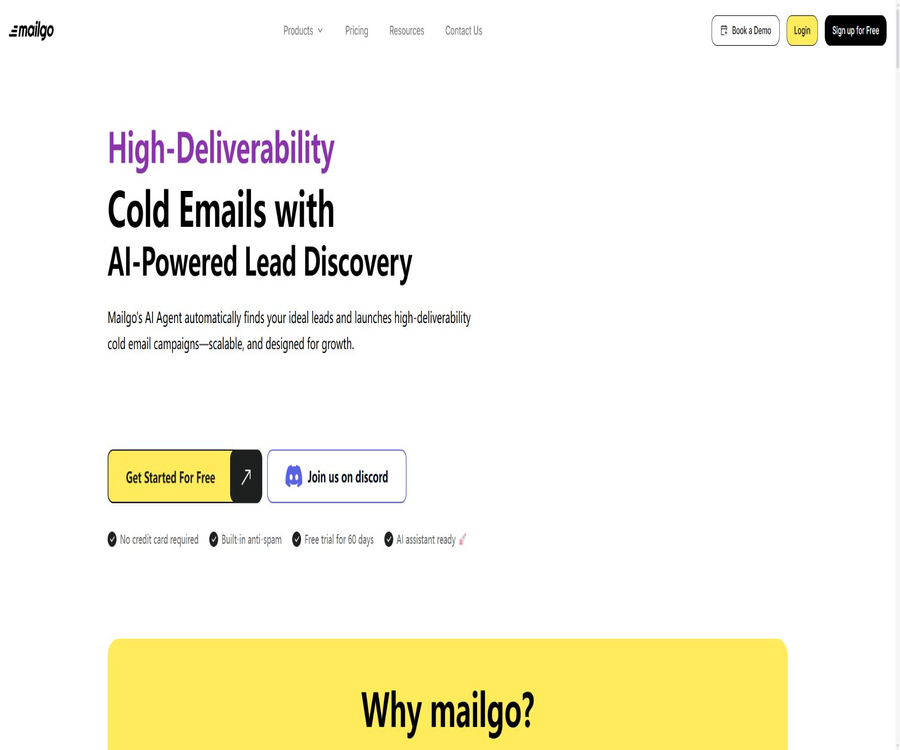
Mailgo
Mailgo, an intelligent tool focused on improving efficiency through AI.
Tags:AI improves efficiencyWhat is Mailgo?
Mailgo is a B2B cold email marketing platform provided by LeadsNavi Pte. Ltd. in Singapore; it helps sales, growth, and agency teams with email address collection, contact import, email verification, content writing, automated sending, response management, and performance analysis.
It is not a regular personal email client, nor does it guarantee that emails will end up in the main inbox or lead to any transactions. Users are still responsible for determining how to get in touch with contacts, deciding on the basis for sending emails, crafting the content of those emails, handling unsubscribe requests, and complying with the rules set by various email service providers.
Main functions
Email connection and warming up
- Multiple service provider connections: It is possible to connect to Google, Microsoft, and enterprise email accounts that support SMTP, and manage multiple sending accounts within the paid plans.
- Automatic preheating: A sending history is created by gradually increasing the level of interaction; users can monitor the preheating status and pause or resume the process.
- Preheated email addresses: The platform offers the option of using preheated email addresses, and the developer tools also allow developers to obtain free email addresses with a validity period of 60 days, which receive high rating scores for their emails.
- Account rotation: Tasks can be distributed among multiple sending accounts, thereby reducing the risk of a single account sending a large volume of messages suddenly.
- Dynamic restrictions: The terms allow the platform to adjust the number of connected accounts and the daily sending limit in order to maintain the credibility of the accounts; therefore, the option of an unlimited number of accounts within a package does not mean an unlimited data transfer rate.
Contact person and email verification
- CSV import: Use a template to organize names, companies, email addresses, and custom fields, then add them in bulk to a specified campaign.
- Manual addition: You can paste multiple email addresses directly, which is suitable for small lists or quick testing.
- Email verification: Check the validity and deliverability of the address before sending it officially, in order to reduce the number of emails that are returned due to invalid addresses.
- Estimated email address: After entering the name and the company’s domain name, the system suggests possible work email addresses based on common naming conventions; however, these estimates still need to be verified.
- AI Lead Agent: The payment quota can be used to find potential customers, with the consumption based on agent credits purchased on a usage-based basis.
AI writing and personalization
- AI Writer: Generates topics and email bodies based on the product, audience, tone, and language, making it suitable for quickly creating drafts.
- Adaptive AI Mail: Generates different versions of the content for various recipients, thereby preventing all contacts from receiving exactly the same template.
- Content optimization: Developer tools can identify common spam-triggering words, clean up HTML, and include gentle exit messages by default.
- Variable substitution: Fields such as names, companies, and positions can be inserted into the subject and body text, but it is necessary to check for missing values and incorrect mappings.
- Step preview: Before the campaign goes live, you can view each step of the sequence to check for delays, conditions, and personalized results.
Activity automation and inbox
- Email sequence: It is possible to create multiple sending steps, which are executed according to a schedule, with subsequent actions determined by specific conditions.
- Smart scheduling: The sending time is determined based on time zones, account status, and behavioral patterns, in order to avoid sending messages in inappropriate times.
- Unified inbox: Allows you to view replies from multiple sending accounts in one place; AI can categorize these replies and assign them priorities.
- Activity control: It allows for the creation, activation, suspension, deletion, and querying of activities, enabling immediate cessation in cases of abnormal email responses or an increase in complaints.
- Real-time analysis: It allows you to view metrics such as transmissions, deliveries, opens, clicks, replies, and bounces, and to evaluate performance by batch or date.
Complete usage process
- Define the target customer profile, and determine the methods for obtaining the list, the legal basis for doing so, as well as the electronic marketing rules applicable in the relevant regions.
- Register for Mailgo, connect to your own Google, Microsoft, or SMTP email account, or obtain and rent an email address provided by the platform as needed.
- Enable preheating first and set a conservative daily sending volume; do not send to the new domain or new email address at full capacity right away.
- Import contacts using CSV or manually, and remove irrelevant, duplicate, and addresses that have explicitly refused marketing communications.
- Run email verification to distinguish between valid, risky, unknown, and invalid results, and send messages only to contacts for whom there is a legitimate reason.
- Use AI to generate a draft of the email, then add the actual identity details, company information, reason for contacting, explanation of the value offered, and a clear way to unsubscribe.
- Set the theme, variables, sending time, follow-up steps, and termination conditions, then send a preview to the internal testing address.
- Launch the campaign in small batches, and continuously monitor refund requests, complaints, responses, as well as the domain’s reputation; suspend the campaign immediately in case of any abnormalities and make the necessary corrections.
- Handle responses and cancellation requests promptly, and synchronize the list of individuals who should not be contacted with subsequent campaigns and other marketing systems.
Input, output, and application scenarios
| Stage | Enter | Output | Suitable for tasks | Main risks |
|---|---|---|---|---|
| Clue management | CSV, manual email addresses, and company details | Event contact list | B2B sales lead generation | The list lacks a legal basis. |
| Email verification | One or more email addresses | Results of deliverability check | Eliminate the risk of rejected emails | Verification does not equate to agreeing to receive. |
| AI writing | Products, audience, tone, and variables | Theme, main text, and personalized variants | Create a preliminary draft for outreach. | Exaggerated, incorrect, or offensive content |
| Automatic sequence | Steps, conditions, time, and account for sending | Send in batches and follow up | Large-scale outreach | Configuration errors can increase complaints. |
| Effect analysis | Sending and recipient behavior data | Metrics for delivery, opening, clicking, and responding | Optimization campaign | Tracking technologies are constrained by privacy and client limitations. |
Suitable for users
- Entrepreneurs and independent consultants: Use a small list to test market demand and willingness to collaborate.
- B2B sales team: Manage multiple emails, various campaigns, and phased follow-ups.
- Growth and Marketing Team: Test the effectiveness of different audiences, topics, copy, and timing of deliveries.
- Sales development agents: Manage activities for multiple clients, but it is necessary to separate the data, permissions, and blocklists.
- Enterprise teams: Carry out large-scale outreach with customized quotas, private deployment, and dedicated support.
Price packages
| Package or version | Price | Billing cycle | Core benefits or quota | Suitable for users |
|---|---|---|---|---|
| Free | 0 dollars | Free for a long time | 100 active contacts and 200 outreach emails per month; certain preview, verification, analysis, and AI features are available on a trial basis or on a pay-as-you-go basis. | Small-scale testing |
| Basic | Starting at $19 or $15.20 | Converted to a monthly amount on a monthly or annual basis | 1,000 active contacts per month, 5,000 emails, 5,000 verification requests; no limit on the number of email accounts that can be connected or on the amount of pre-warming activity. Points for using proxies can be chosen arbitrarily. | Individuals and small teams |
| Pro | Starting at $89 or $71.2 | Converted to a monthly amount on a monthly or annual basis | 100,000 active contacts per month, 200,000 emails; no limits on verification, email connection, and warming up processes; additional proxy point discounts and exclusive support. | Large-scale sales team |
| Enterprise | Custom quote | In accordance with the contract | Over 200,000 active contacts, over 500,000 emails; no restrictions on verification or preprocessing; private deployment and custom features available | Large enterprises |
- The price including the character “starting at” increases depending on the level of the selected agent and the configuration; it is not possible to estimate the total cost based solely on the lowest figure.
- The annual payment page indicates a 20% discount, while the monthly payment options are listed as Basic at 19 dollars and Pro at 89 dollars; the actual amount depends on the account’s billing cycle and configuration.
- Once the number of emails sent or the number of unique contacts for that month reaches the limit set by the plan, further sending will be suspended until the next cycle, and any unused quota will not be carried over.
- AI clue agent credits are available for purchase on a pay-as-you-go basis; both the free version and the paid version can incur additional charges outside the package scope.
- If it is not canceled before the subscription expires, it will be automatically renewed at the original interval; the price for subsequent periods may change.
- Unless otherwise stipulated in the contract or required by law, a purchase constitutes a final transaction; no refunds are available and cancellations are not permitted.
Email, domain name, and platform restrictions
| Project | Support or rules | User responsibility | Restrictions |
|---|---|---|---|
| Personal email address | Google, Microsoft, SMTP | Have the necessary authorization and comply with the service provider’s policies. | It can be throttled or disabled by the service provider. |
| Renting email addresses and domain names | Provided by a third party and integrated with Mailgo | Assume legal responsibility for the act of sending. | Only usage rights are available during the subscription period. |
| Web application | Browser registration and activity management | Protecting accounts and connection credentials | The native desktop or mobile application has not been identified. |
| API | Use a personal OpenAPI key | Properly store the keys and revoke them in a timely manner. | It is possible to create, send, and delete events; it grants high levels of permission. |
| Integration of AI assistants | MCP plugins and various coding assistant skills | Review the execution actions and recipient list. | Automatic execution may result in messages being sent externally directly. |
API, MCP, and open-source status
- Mailgo provides personal OpenAPI keys, allowing developer tools to utilize interfaces for email verification, account creation, event creation, activation, suspension, deletion, and reporting.
- The official public repository provides a set of cold email campaign plugins that can be used with Claude, Cursor, Codex, OpenCode, and Gemini CLI.
- The plugin includes Python scripts, skill descriptions, content optimization rules, and industry templates; Python 3.7 or a higher version is required.
- API keys are used to manage activities and send emails; they must be stored only in local environment variables, and should not be pasted into chats, script repositories, or shared documents.
- The repository is publicly readable, but no license is specified; therefore, just because the code is accessible, it cannot be considered an open-source project whose copying, modification, distribution, or commercial use is permitted.
- The Mailgo SaaS platform is a proprietary service, and its terms prohibit reselling, mirroring, reverse engineering, and competitive use without written permission.
Privacy and data processing
- The platform processes names, contact information, job titles, billing and transaction data, uploaded content, configuration preferences, communication records, as well as device and network information.
- After connecting to an email account, Mailgo can access it in order to send test emails, diagnose issues, and provide services; however, the actual usability of the email account remains determined by the corresponding service provider.
- Subscribers retain the rights to their contacts, email content, and activity data, while granting Mailgo access to and permission to process these data in order to provide the service.
- The platform can use anonymized and aggregated data to improve, test, and operate its services, and this license remains valid even after the agreement comes to an end.
- The privacy policy specifies that the data from Google Workspace API is not used for developing, improving, or training general-purpose, non-personalized AI models.
- Personal data is retained only for as long as it is necessary to achieve the purposes for which it was collected and to fulfill legal, tax, and reporting obligations; however, no fixed number of days is specified for activity data.
- Users can request access, copying, correction, deletion, restriction of processing, or withdrawal of consent; the specific rights depend on the region in which they are located.
- Data may be stored, processed, and transmitted outside the user’s country; for transmissions to the European Economic Area and the United Kingdom, mechanisms such as adequacy decisions or standard contract clauses are used.
Compliance and security considerations
- A valid email address does not mean that the recipient agrees to receive marketing messages; verification tools cannot replace legitimate grounds and privacy notices.
- Users must comply with the applicable anti-spam, electronic privacy, data protection, and consumer protection rules, and keep records of cancellations and requests to stop being contacted.
- Each commercial email should clearly indicate the sender’s identity, accurate contact information, and an easy way to unsubscribe, and unsubscribe requests should be handled promptly.
- One should not purchase lists of unknown origin, harvest private email addresses, conceal one’s identity, or repeatedly contact those who have clearly refused.
- The preheating pool may expose users to the contact information of other participants, and the terms prohibit saving, sharing, transferring, or using it for any other purpose.
- High open rates, low rejection rates, and AI optimization do not guarantee compliance, delivery, or sales results; improper use may lead to restrictions on email addresses and domain names.
Capacity boundaries
- Opening and clicking on tracked items can be affected by privacy protection features, image blocking, and security scans; therefore, this cannot be considered an exact reflection of a person’s actual interests.
- Personalized content generated by AI may contain incorrect company information, wrong titles, or inappropriate assumptions; it must be reviewed manually before being sent.
- Email predictions are merely probabilistic results; they must be verified before use, and data protection and anti-harassment regulations cannot be bypassed.
- The platform can adjust the daily sending limit based on reputation and stability; the monthly quota specified for a plan does not mean that messages can be sent at full speed at any time.
- Third-party email service providers can independently restrict, suspend, or close accounts, and Mailgo is not responsible for such external decisions.
Summary
Mailgo brings together contact verification, email warming, AI-generated messages, automatic sequencing, unified responses, and analysis in one cold email workspace; the free version is suitable for verification tasks, while the Basic and Pro versions are designed for higher volumes of emails sent.
What truly determines the long-term outcomes is not the maximum volume of emails that can be sent, but rather the quality of the email list, its relevance, the timing of sending emails, the way complaints and rejected emails are handled, and the legal basis for such actions. Before launching large-scale campaigns, it is necessary to conduct tests on a small scale first and establish procedures for dealing with complaints, rejected emails, and managing user permissions.
Tools similar to Mailgo



 Guigong Network Security Registration No. 45132202000164