






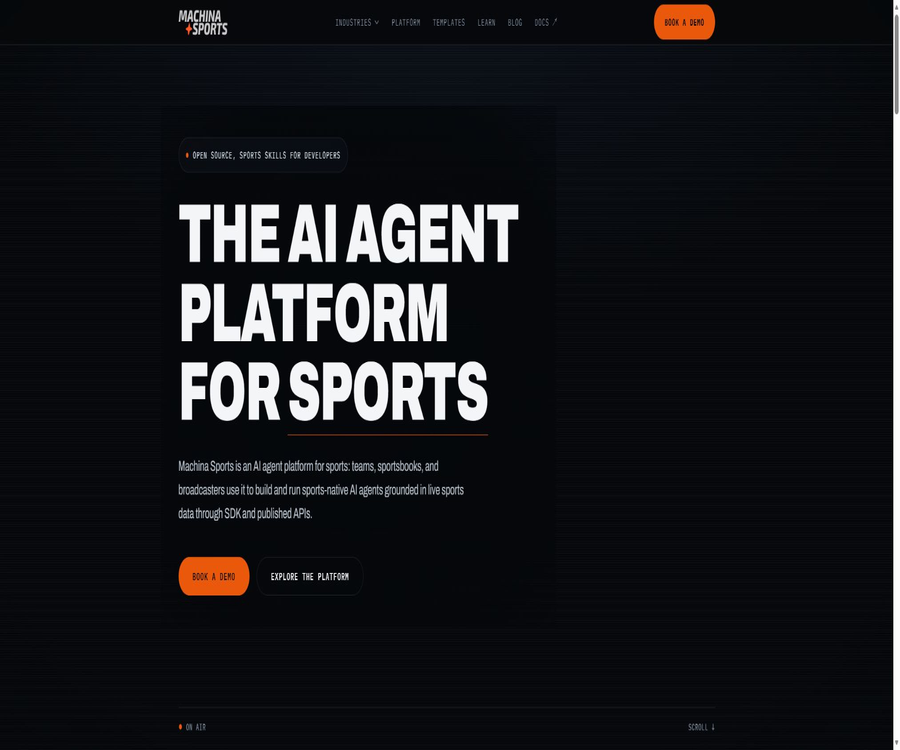
Machina Sports
Machina Sports: intelligent tools focused on improving efficiency through AI.
Tags:AI improves efficiencyWhat is Machina Sports?
Machina Sports is an AI platform for the sports industry, operated by GeniusTech Corporation; its clients include teams, leagues, sports media outlets, broadcasting companies, and gambling operators. It integrates real-time schedules, statistics, odds, market data, and fan sentiment into generative AI to create data-driven content and interactive experiences.
The platform consists of components such as Machina Studio, agents, connectors, data mapping, prompts, workflows, APIs, SDKs, and MCP. Users can either deploy solutions quickly using templates, or integrate these capabilities into websites, applications, content management systems, or messaging channels.
Main functions
- Sports AI agents: It is possible to create interactive agents for answering fans’ questions, providing information about competitions, facilitating data queries, or conducting business analyses; scheduled agents can also be used to synchronize data at regular intervals and execute workflows.
- Real-time data connection: Utilizes the schedule, league tables, player statistics, changes in odds, prediction markets, and fan sentiment as context during generation, so that the output reflects the current status of the competitions.
- Content automation: It generates pre-match previews, post-match reports, player feature articles, quizzes, votes, and multilingual content based on competition data and brand guidelines, making it suitable for bulk distribution during major events.
- Dialogue experience: Queries about events, explanations of data, and personalized interactions can be carried out through chatting; in the gambling context, users’ intentions can be mapped to the operator’s own odds and betting pages.
- Workflow orchestration: Connector tasks are used to retrieve data from external interfaces; mappings are employed to standardize different data structures, and results are generated or distributed through prompts, document retrieval, and proxy tasks.
- Visualization workspace: Machina Studio offers interfaces for managing projects, templates, agents, connectors, prompts, mappings, workflows, and usage metrics; it also enables serverless deployment after testing in a sandbox environment.
- Developer interface: The general interface supports chat completion, content creation, event insights, and fan sentiment analysis; specialized sports products also offer structured REST endpoints, MCP tools, and machine-readable documentation.
- Multi-channel delivery: This capability can be integrated through APIs, SDKs, MCP, web interfaces, and messaging channels; the public page also lists various enterprise delivery methods such as SMS, WhatsApp, RCS, and push notifications.
Core components
| Components | Function | Enter | Output |
|---|---|---|---|
| Template | Encapsulated installable proxy and workflow structures | Sports, teams, content objectives, and connection settings | The starting point of the item that can be modified |
| Connector | Read sports data, models, and external services | Interface keys, parameters, and external data | Schedule, statistics, odds, or model responses |
| Mapping | Unify fields from different suppliers | External data structure and target key name | Stable internal data format |
| Hint | Define generation tasks, tone, and constraints. | Messages, context, and brand rules | Articles, answers, or structured results |
| Workflow | Coordinate connectors, documents, and prompt tasks in sequence. | Parameters, environment variables, and task conditions | Results of automated processing |
| agent | Accept interactive requests or run processes as scheduled | User questions, events, or time-based triggers | Chat, content, data synchronization, and business actions |
Input, output, and sports scenarios
- The input can include team and event identifiers, natural language questions, schedules, standings, player performances, odds, market prices, social discussions, and rules specific to the brand.
- The output can be structured data, answers in natural language, previews of events, summaries of matches, stories about players, quizzes, votes, sentiment analysis, images, or content suitable for further dissemination.
- Teams and leagues can create match-day assistants, fan Q&A sessions, and personalized interactions; the media can generate multilingual coverage articles in bulk and integrate them into the editing process.
- Sports betting operators can develop chat assistants, content engines, and market analysis tools that rely on real-time odds, but they must bear the responsibilities related to obtaining licenses, handling advertising, conducting age verification, and ensuring responsible gambling practices.
- Development teams can integrate sports intelligence into their own applications and third-party agents via APIs or MCP, and they can also use templates and workflows to reduce the time required for data integration.
Usage process
- Create an account and a project; during the onboarding process select the sport, team, personality traits of the agent, and key aspects of the content, in order to generate an interactive sample agent.
- Go to the template area to install data collection tools or content templates, and then add the keys required by sports data providers, models, or your own interfaces in the connector area.
- Check the data fields and create mappings to ensure that team names, players, events, and times from different data services remain consistent within the workflow.
- Provide configuration guidelines and brand rules that specify the language, tone, output structure, the data fields that must be included, and the procedures to follow in cases where information cannot be confirmed.
- Use workflows to sequence the steps of data retrieval, document search, content generation, and saving; when regular execution is required, create a scheduled agent and set the frequency.
- Test normal matches, delays, data loss, teams with the same name, changes in odds, and interface failures in the sandbox, to check whether the output contains incorrect combinations or uses outdated data.
- Deployed in the serverless environment of Machina, or connected to custom frontends, content systems, and messaging channels via APIs, SDKs, and MCP.
- After going live, monitor usage, data freshness, latency, and error logs, while also maintaining options for editorial review, manual suspension, and fallback solutions in case of connector failures.
Connector and current status
| Category | Available now | Marked as upcoming. | Use reminders |
|---|---|---|---|
| Sports data | Data built into Machina | Sportradar, Stats Perform, Genius Sports, Kin Analytics | Some promotional materials mention corporate partnerships for integration, but the public integration catalog still shows that several connectors are not yet available widely. |
| Large models | OpenAI models, Llama models | Gemini model | The availability and cost of the model can change. |
| Social media | Items that are generally available have not been listed yet. | YouTube, X, Reddit | The ability to perform emotion analysis does not mean that all social connectors are available. |
| Content | HeyGen | VideoDB | External media generation is also subject to limits imposed by third-party quotas and authorizations. |
| Tools | Web search | Zapier, Fan Emotion Connector | The content of web pages needs to be checked for timeliness and licensing. |
| Customer Relationship Management | Items that are generally available have not been listed yet. | Salesforce, HubSpot | The enterprise solution should demonstrate the actual connection method during the presentation. |
The scope shown on the connector directory and the enterprise case pages is not exactly the same; this may be due to private deployments, cooperative accounts, or a phased approach to accessibility. When making purchases, it is necessary to verify each item specific to each account, as the roadmap or custom projects should not be regarded as standard features available in regular packages.
Price and quantity used
| Package or version | Price | Billing cycle | Core benefits or quota | Suitable for users |
|---|---|---|---|---|
| Studio Starter | There is a free quota in addition to pay-as-you-go pricing; the specific unit price has not yet been disclosed. | According to the amount used | Developer dashboard, sandbox, built-in connectors, and starting tokens | Prototypes and development testing |
| Studio Enterprise | Contact sales | Customization | Flexible deployment, dedicated support, business data, and organizational-level requirements | Teams, the media, and betting agencies |
| World Cup Free | 0 dollars | One-time limit | 100 points, no credit card required; includes all specialized skills, interfaces, and MCP tools | Interface verification and prototyping |
| World Cup Starter | 50 dollars | One-time purchase | 5,000 points, at 0.010 US dollars per point | Applications for small-scale competitions |
| World Cup Pro | 200 dollars | One-time purchase | 25,000 points, at 0.008 US dollars per point | Products with moderate usage levels |
| World Cup Scale | 600 dollars | One-time purchase | 100,000 points, at 0.006 US dollars per point | High-profile event experience with heavy usage |
- According to World Cup Intelligence, points do not expire and can be used across different Machina products; a health check requires 0 points, while regular data, market information, social aspects, intelligence insights, edge analysis, and comprehensive skills each require different amounts of points.
- Most specific calls require 1 to 3 points, while calls related to AI intelligence involve higher costs; a full set of skills may cost 25 to 60 points. The cost should be determined by testing different endpoint combinations.
- Payment via accountless stablecoins is still listed as upcoming and cannot be considered a viable settlement method at the moment.
- General Studio does not disclose a complete list of fixed prices or all the resource limitations; in addition, corporate projects may involve costs related to data licensing, deployment, support, and custom development.
- Fees are charged in US dollars, and taxes may apply. According to the terms of service, payments made are generally non-refundable; subscriptions may renew automatically, and to terminate such renewal it is necessary to give at least 30 days’ notice in advance.
API, SDK, and MCP
- The API relies on keys generated by the dashboard for authentication, and it enables functions such as chat completion, content creation, competitive insights, and analysis of fan emotions; the dedicated World Cup interfaces are accessed using organization-specific keys and product permissions.
- MCP makes capabilities such as schedule analysis, calendar management, event previews, match reports, player profiles, fan sentiment analysis, and market insights available as tools that can be detected by intelligent agents.
- The public page claims to support SDKs, but the general documentation does not list all language packs and versions in a complete manner. Developers should rely on the current documentation, package repositories, and example projects, rather than assuming that an official client for a particular language exists.
- Workflows are defined in YAML to specify inputs, outputs, context variables, as well as tasks such as connectors, documents, and prompts; they make it possible to manage configurations through version control and to deploy them repeatedly.
- When the keys and licenses from third-party data providers need to be provided by the user, the usage amount for Machina, the cost of the models, and the authorization from the data provider must be calculated separately.
The difference between open-source projects and commercial platforms
- The official sports-skills repository makes available sports data skills and related code under the MIT license; these can be installed using skill commands or Python packages.
- These open-source tools primarily access public or third-party data, and the repositories specify that they are intended for personal, educational, and research purposes. The underlying sports data remains subject to the terms set by the respective data providers; the MIT license does not grant any rights regarding such data.
- Open skills include various ball games, racing, as well as the ability to read news and forecast market trends; some of these trading modules carry a higher level of risk. Financial operations require explicit authorization and the protection of encryption keys.
- Machina’s hosted Studio, business connectors, licensing data, cloud deployment, and enterprise support have not become open-source products as a result of the open-sourcing of sports-skills.
- Official organizations also make available templates, command-line tools, examples, and dedicated documentation repositories; the licenses for each of these repositories need to be checked separately, as they cannot all be treated under the MIT license.
Copyright and commercial use restrictions
- The customer retains the right to enter content and, within the limits permitted by law, has the right to obtain the resulting output; Machina transfers any rights it may have regarding such output to the customer.
- Customers must still ensure that the data they enter, as well as images, videos, brand materials, and any content they publish, are covered by legitimate licenses. Ownership of the generated content does not equate to ownership of the rights related to third-party leagues, teams, players, or data providers.
- The terms prohibit the use of AI models that are designed to compete with Machina, but allow for the development of models intended solely for classifying or organizing data, under conditions that prevent their commercial distribution to third parties.
- The outputs of betting and prediction markets can change and may be delayed; therefore they should not be used as a guarantee of profits or to determine the outcome of bets. When presenting such information to consumers, it is necessary to comply with local regulations, risk warnings, and requirements related to responsible gambling.
Privacy and security
- The service collects account information, contact details, payment data, communication records, logs, and usage data; the business operations handled by customers through the API are governed primarily by the customer agreement and the data processing appendix.
- Personal information may be processed in the United States and may be handed over to service providers in other jurisdictions. For cross-border projects, it is necessary to determine the appropriate mechanisms for data transfer, the location where the data will be stored, and the relevant corporate contracts.
- The terms permit the use of interactive data for further training and fine-tuning of models; therefore, before uploading private tactics, customer information, gambling account details, or other restricted data, it is necessary to verify whether the corporate agreement provides options for withdrawal or stricter data protection requirements.
- Customers must provide appropriate privacy notices and obtain the necessary consent for the processing of personal data; in cases involving protected health information, such data may not be processed without signing a dedicated annex to the business partnership agreement.
- The service commitment includes the use of security measures such as access control, principle of least privilege, multi-factor authentication, logging, risk assessment, and incident response; however, internet and email transmissions cannot guarantee absolute security.
- After termination, the customer’s content will be deleted within 30 days, unless legal requirements dictate otherwise. There is no fixed deadline for personal information in general; it is retained as necessary for the purposes of providing services, ensuring security, resolving disputes, and complying with legal obligations.
Advantages and capabilities boundaries
- The advantage is that it brings sports data, generation models, workflows, and various delivery interfaces together within a single development platform, thereby reducing the time required for teams to assemble the infrastructure on their own.
- Templates and serverless deployment can accelerate prototyping, but high-quality production systems still need to address data licensing, entity matching, latency, event changes, auditing, and failure recovery.
- Real-time data can help reduce the occurrence of fabricated data, but it cannot eliminate errors in the supplier’s data, time differences between different markets, or deviations in model interpretations. Key results should include timestamps and allow for verification against the original data.
- Multiple connectors in the integrated catalog are still under development, and enterprise use cases may also require customized solutions; before making a purchase, it is necessary to request technical validation using one’s own data and target channels.
- Open interfaces are suitable for experiments with low entry barriers, but they can change over time and do not guarantee commercial-level service quality. Formal products should use authorized data along with clear support agreements.
Summary
Machina Sports is designed for developers and sports organizations that need to convert real-time sports data into conversations, content, analyses, and enhanced fan experiences. It offers a hosted Studio, APIs, MCP, as well as open-source tools; however, the prices, licensing terms, data quality, and level of service support vary for each of these options. Before implementation, it is necessary to check the status of the connectors, obtain the necessary authorizations from data providers, consider the amount of resources required, and review the privacy-related agreements.
Tools similar to Machina Sports



 Guigong Network Security Registration No. 45132202000164