






Lexi
Lexi: an intelligent tool focused on improving AI efficiency.
Tags:AI improves efficiencyWhat is Lexi?
Lexi is an AI-based tool for managing advertisements on Facebook and Instagram; it is also known as Lexi Studio or Lexi AI Ad Manager. By analyzing a company’s website, products, and target audience, it generates advertising strategies, copy, images, suggestions regarding targeting and budgeting, and it provides continuous monitoring of the Meta ads that have been created.
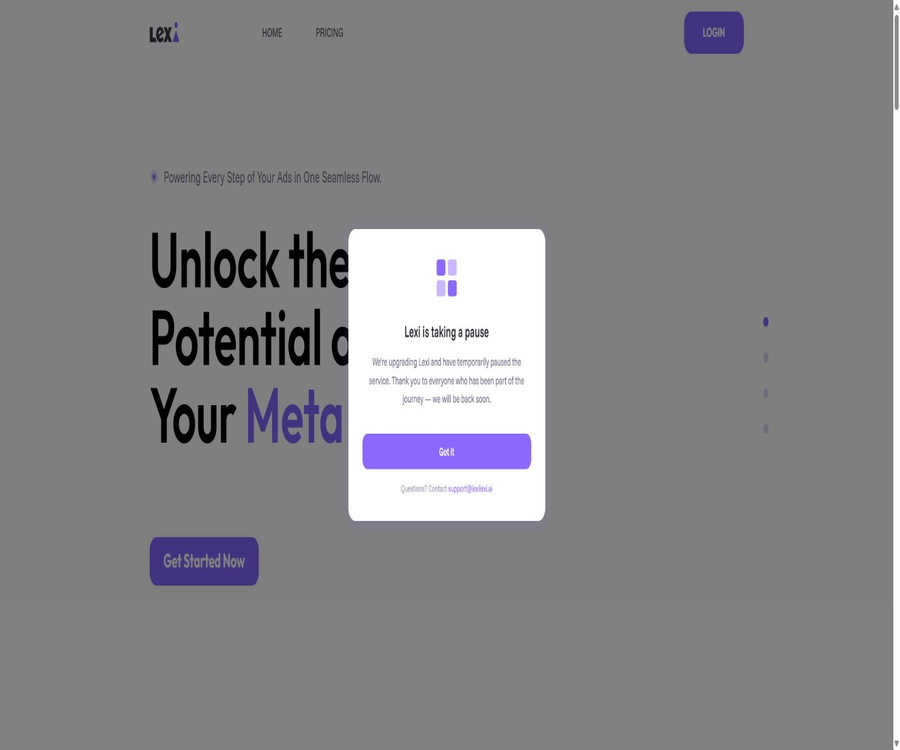
The current product page clearly states that Lexi is undergoing an upgrade, and its services have been temporarily suspended with a plan to resume them later. At this stage, it is possible to learn about the product’s features and its previous prices, but the ‘Start’ button or the promotional prices shown on the page should not be construed as indications that the services are available for purchase on a permanent basis.
Current operating status
| Project | Current status | How should users handle it? |
|---|---|---|
| Products and Services | Temporarily pause the upgrade | Do not connect to the official advertising account until recovery is confirmed. |
| Existing account | Keep the login entry. | Contact support to verify the status of data, ads, and subscriptions. |
| New user registration | It should not be considered as being normally open. | Wait for the pause prompt to be canceled and verify the entire process. |
| Page price | Promotions and corporate plans are still displayed. | It is intended solely as historical or information to be restored, and not as a valid settlement commitment. |
| Recovery time | No specific date has been announced. | Pay attention to product notifications and verify with the support team. |
Main functions
- Access the company’s page and analyze its business, products, and target audience.
- Quickly create Meta ad strategies and campaign structures.
- Provides AI market research and audience insights.
- Create Facebook and Instagram ad copy.
- Create image concepts suitable for advertising campaigns.
- Predict the performance of activities under different budgets.
- Automatically allocate budgets and adjust bids.
- Continuously test audiences, creatives, and ad groups.
- Monitor inefficient ads and budget waste.
- Display real-time data and audiences with high performance.
Start from the website page.
The standard entry requirement for Lexi is that users provide a page for their company, store, product, or service; based on this, the system identifies the category, key features, visual style, and target audience. Website analysis can reduce the need for manual data entry, but incomplete page content may lead to strategies being built on incorrect assumptions.
- Prepare business pages with complete information that is publicly accessible.
- Verify that the price, product specifications, region, and promises on the landing page are accurate.
- Have Lexi analyze the business, target audience, and products.
- Check market research and audience assumptions.
- Correct the incorrect selling points and inappropriate positioning.
- Generate candidates for activity structure, copy, and images.
- Before connecting to the Meta account, verify the permissions and billing boundaries.
- Launch with a small budget and gradually evaluate its performance.
AI market research
Lexi generates information on competitors, customer needs, selling points, and advertising strategies based on the business page content and market signals, thereby helping small businesses that lack specialized marketing expertise to develop plans quickly. Such analyses are based on automatic inference and do not equate to comprehensive investigations, internal data on competitors on the platform, or interviews with actual customers.
- Identify the core problems that the product may solve.
- Identify the characteristics of potential customers and their purchasing motivations.
- Generate different marketing angles and value propositions.
- Find a target audience suitable for advertising tests.
- Transform the research findings into advertising copy and creative concepts.
- Manual verification of competitor prices and market facts is carried out.
Advertising strategies and quick setup
The product’s advantage lies in the ability to complete the initial setup of a campaign in a short time – including defining goals, target audience, budget, and creative elements. This quick configuration is suitable for creating a first version for testing, but it is not possible to skip checks related to pixels, conversion events, attribution windows, as well as regional and platform-specific policies.
| Set project | The assistance that Lexi can provide | Human verification is required. |
|---|---|---|
| Activity objectives | Propose target recommendations based on the business and pages. | Choose sales volume, leads, or other actual objectives. |
| Audience | Recommend potential high-value individuals | Region, age, excluded and special ad categories |
| Budget | Allocate and forecast different budget performances | Cash flow, customer acquisition limits, and daily risk |
| Creativity | Generate image and copy versions | Brand rights, product authenticity, and platform policies |
| Go live | Establish an advertising structure and carry out continuous optimization. | Pixels, catalogs, payment, and final approval |
Precise target audience identification
Lexi uses business data, advertising performance metrics, and platform signals to identify Meta audiences that may be more valuable, and it tests and makes adjustments as it goes. Since the platform’s algorithms and advertising bidding systems are constantly changing, targeting recommendations cannot guarantee specific conversion rates, costs, or levels of coverage.
- Establish initial interests and user assumptions.
- Test multiple audience combinations.
- Identify the audience that performs well.
- Reduce obviously ineffective budget allocations.
- Expand or narrow the target audience based on new data.
- Maintain manual control over geography, age, and exclusion criteria.
Creation of ad copy and images
Lexi is able to create ad copy, titles, and images based on the product and target audience, and to generate multiple variations for testing. Users need to verify the image elements, textual claims, trademarks, portraits, and copyright status of the materials; the results generated cannot be considered ready-to-publish final products.
| Creative section | AI output | Main risks |
|---|---|---|
| Ad text | Key benefits, pain points, and action instructions | Exaggerated promises, factual errors, and sensitive wording |
| Title | Short titles and promotional phrases | Character limits, misleading prices, and excessive promises |
| Image | Visual solutions that match the product and the target audience | Incorrect product details, trademarks, and intellectual property rights |
| Multiple version testing | Different angles and material combinations | Too many variables make it impossible to determine causality. |
Budget optimization and forecasting
Lexi estimates the outcomes of campaigns based on the user’s budget, and adjusts the budget for ad groups, bids, and audience testing during the campaign’s execution. Predictions can only indicate possible ranges based on the model and available data; actual performance is also influenced by the account’s history, seasonality, creative elements, landing pages, and bidding strategies.
- Compare the expected ranges for different daily budgets.
- Allocate the budget to the ad groups that perform better.
- An increase in costs or a decline in conversion rates is observed.
- Stop or replace combinations that are clearly inefficient.
- Avoid making frequent and significant adjustments when there is insufficient data.
- Set separate hard limits for the total cost and the daily cost.
Ongoing optimization and monitoring
The product is designed to monitor ad groups, audience behavior, budget efficiency, and creative fatigue on a 24/7 basis, and to identify effective combinations as well as replace ineffective content. Automatic optimization should be accompanied by alerts, records of changes, and the ability to pause operations manually; in particular, it is not permissible to increase the budget while there are abnormal conversion patterns.
- Identify ad groups with declining performance.
- Monitor changes in audience and budget efficiency.
- Continuously test the text, images, and positioning.
- Expand the combinations that perform well.
- Generate new ideas for campaigns whose performance is declining.
- Stop automatic execution when the risk threshold is reached.
Prerequisites for using a Meta account
The standard plan involves connecting to a Facebook advertising account, with a daily advertising budget limit of 150 dollars. Users still need to have Meta Business Manager available, an advertising account, the necessary permissions for accessing assets, a compliant landing page, and proper conversion tracking in place.
- Verify that the enterprise management platform and the advertising account are in normal condition.
- Grant only the minimum permissions required, and avoid sharing personal passwords.
- Check the pixels, the Conversions API, or the target events.
- Confirm the payment method and who will cover the advertising costs.
- Set budget limits at the account level, activity level, and tool level.
- Revoke Lexi’s access token when exiting the service.
Advertising costs and service fees
The Lexi terms describe both subscription services and the Fully Managed Services that may be offered; the pricing for advertising purposes differs between these two types of services. Managed services combine media placement and management into a single Campaign Service Fee, and this cannot be considered equivalent to the amount that the user pays directly to Meta as an advertising fee.
| Cost type | Possible payment methods | It is necessary to confirm before making a purchase. |
|---|---|---|
| Software subscription fee | By month, quarter, year, or corporate contract | Is it just tool usage or does it include human services as well? |
| Meta ad spending | The user’s ad account expenses are paid directly or covered by the hosting package. | Payment entity, account ownership, and invoice |
| Campaign Service Fee | Pay once or on a periodic basis according to the service order | Media fees and management fees do not necessarily have to be separated. |
| Taxes and fees | The price usually does not include tax. | Settlement region, currency, and tax documents |
The page displays the price.
The price information was verified on August 23, 2026; the actual amounts, taxes, exchange rates, and discounts may vary, and the final figures will be those displayed on the settlement page.
At the bottom of the paused page, the monthly promotion is still displayed, with a price of $39.9 per month; the original price of $199 is also shown, along with an indication that 80% off is applied. Since the service is currently paused, the validity period of the promotion, the price after it resumes, and whether transactions can be completed must all be confirmed again.
| Plan | The page displays the price. | Billing cycle | Key capabilities | Restrictions or status |
|---|---|---|---|---|
| Monthly promotions | $ | On a monthly basis | Quick setup, market research, budget optimization, forecasting, AI-generated copy, and real-time insights | Only 1 Facebook account allowed; the daily advertising budget is limited to $150, and services are currently suspended. |
| Enterprise | Custom quote | Monthly or annually | Enhanced creativity, advanced testing, no budget limits, multiple accounts, team collaboration, and dedicated consultants | Contact sales; current availability is pending confirmation. |
| Historical quarterly plan | It was shown that the equivalent amount is 167 dollars per month. | Prepay on a quarterly basis | Standard automation capabilities | The current main page is not listed as the primary option. |
| Historical annual plan | It was shown that the equivalent amount is 109 dollars per month. | Prepayment on an annual basis | Standard automation capabilities | The current main page is not listed as the primary option. |
| Historical weekly payment plan | There are significant differences in price versions. | By week | Cost after the short-term trial period | It cannot be used as a current stable quote. |
Why is it necessary to verify the price carefully?
On Lexi’s pages in different languages, as well as on the testing page and the account billing page, various amounts such as 19.9, 39.9, 89, 109, 167, and 199 dollars were displayed at the same time. These amounts correspond to different pricing options: promotional rates, rates for the first week, weekly payments, monthly payments, quarterly rates, or annual rates; they cannot be considered as part of a single standard package.
- Confirm whether $39.90 is the discounted initial price or the regular monthly fee.
- Check whether the promotion will still be in effect after services are restored.
- Check the amount for automatic renewal after the trial period ends.
- Check the total actual amount deducted for monthly, weekly, quarterly, and annual payments.
- Confirm whether the advertising costs are to be paid separately.
- Confirm the account, budget, and scope of services for the corporate solution.
- All payments are typically non-refundable according to the terms.
Subscription processing during suspension
- Do not submit new payments based solely on the old price button.
- Existing users should first check whether their account is still on automatic renewal.
- Confirm whether the advertising campaign will continue to run during the suspension period.
- Download activity, creative, billing, and configuration records.
- Revoke Meta access permissions that are no longer needed.
- Ask in writing about the recovery time, service compensation, and refund policies.
- Re-verify using a small budget only after receiving a clear notification of recovery.
Cancellation and refund
The terms allow users to cancel and stop charges for the next billing cycle at any time, but the fees already paid for subscriptions and hosting services are generally not refundable. After cancellation, it is still necessary to check that all ads, automatic campaigns, and external payments have been stopped.
- Complete the cancellation before the next deduction date.
- Saving is successful, and communication records are supported.
- It is confirmed that quarterly or annual prepayments will not be refunded for the remaining period.
- Check the independent termination conditions for managed advertising service orders.
- Revoke the platform’s access to Meta, pages, and business assets.
- Download the advertising materials and reports that need to be retained.
Platform coverage
| Platform or channel | Current support status | Explanation |
|---|---|---|
| Web applications | Main entrance | Used for website analysis, strategy, creativity, connection, and monitoring |
| Facebook ads | Core support | The standard plan allows only one advertising account. |
| Instagram ads | Supported through the Meta ecosystem | Managed together with Facebook assets and campaigns |
| Other advertising networks | Mentioned in the terms | The current product’s feature page does not demonstrate equivalent comprehensive support to that of Meta. |
| Native iOS apps | Not verified. | It mainly operates through a browser. |
| Native Android apps | Not verified. | It mainly operates through a browser. |
APIs, SDKs, and open capabilities
No public API documentation, official SDKs, Webhooks, or self-service integration marketplace for Lexi have been identified. Its connection to Meta advertising accounts is based on internal product authorization, and it does not constitute an open developer interface.
| Openness capability | Status | Correct understanding |
|---|---|---|
| Public API | Not verified. | It is not possible to manage ads in bulk through the developer interface. |
| Official SDK | Not verified. | There are no public client libraries or licenses. |
| Webhooks | Not verified. | There are no public event subscription documents available. |
| Meta account connection | Product capabilities | It is used to authorize Lexi to manage ads; it is not a general-purpose API. |
| Corporate customization | Contact sales. | Specific technical integration requires separate confirmation. |
GitHub and the open-source status
No official public GitHub repository maintained by Lexi or Sandwich Lab was found; therefore, the platform should be classified as a closed-source commercial SaaS solution. There are no publicly available self-hosted versions of the advertising strategies, optimization algorithms, creative generation tools, or account management code.
- The Lexi platform is not an open-source tool.
- The model weights and optimization algorithms are not made public.
- There is no verifiable official SDK license.
- The suspension of the product does not mean that the source code will be made public.
- Do not link to other Lexi chat or legal projects with the same name.
Operating entity and terms
The product page indicated Sandwich Lab AI HK Limited, and the terms of service are governed by Hong Kong law. Before registering for or signing up for corporate services, it is necessary to confirm the actual party entering into the contract on the settlement page, invoice, and service order.
Privacy and account data
Lexi handles names, email addresses, phone numbers, cities, time zones, passwords, devices, Cookies, session interactions, communication tools, and billing information. Once connected to Meta, it also accesses the account and activity data needed to provide advertising services.
- Account connections should use the platform’s authorization process, rather than sharing passwords.
- The interface may log clicks and mouse movements for troubleshooting.
- The website uses session and persistent cookies.
- Data can be used for personalization, analysis, marketing, and service improvement.
- The information may be shared with affiliates, partners, and service providers.
- Personal data may be transferred and stored across borders.
- Users should exercise their rights to delete or access through the supported channels.
Rights and responsibilities regarding advertising content
Users are responsible for ensuring that the advertisements are legal, accurate, free of intellectual property issues, and comply with the platform’s rules; Lexi does not guarantee that AI-generated content can be published directly. The terms also grant the platform broad rights to use the advertisement content submitted by users, and it is necessary to conduct a thorough evaluation before uploading any proprietary assets.
- Ensure that the product images, trademarks, and portraits of people have been authorized.
- Check the price, validity period of discounts, inventory levels, and feature claims.
- Avoid guarantees related to healthcare, finance, and income.
- Check for special ad categories and discriminatory targeting.
- Human and brand oversight is maintained for AI-generated images.
- Before uploading important materials, verify that the licenses meet internal requirements.
Effectiveness promise boundaries
The figures shown on the page – such as 30 times faster speed, 6 times greater savings, a 10.8 times higher ROAS – as well as customer success stories – are part of the marketing presentation; they do not guarantee identical results for every account. The actual performance of advertisements depends on factors such as the product, price, market conditions, tracking methods, creative elements, the account’s history, and the bidding environment.
- First, establish the baseline performance of the current account.
- Use control and incremental budgeting tests.
- View conversion quality, refunds, and profits at the same time.
- Do not rely solely on the ROAS within the platform to determine the incremental value.
- Avoid automatically increasing the budget when tracking anomalies.
- Record the duration and reason for each automatic change.
Which users are it suitable for
- Small businesses that lack dedicated Meta pitchers.
- E-commerce sellers who need to test products quickly.
- Startup teams that wish to create multiple sets of advertising ideas.
- Users who manage a single Facebook account with a daily budget of no more than 150 dollars.
- Freelance marketers who need market research and an initial draft targeting the audience.
- Brands that rely on multiple corporate accounts and consultant support.
Product advantages
- An initial advertising plan can be created right from a website page.
- Place research, the target audience, budgeting, copywriting, and images within the same process.
- It supports continuous monitoring and creative updates.
- The standard plan imposes clear limits on accounts and daily budgets.
- The corporate plan includes multiple accounts, teams, and dedicated consultants.
- Cancellation will stop the subscription for the next cycle.
Restrictions and Precautions
- Upgrades for the current service have been suspended, and the date of resumption has not been announced.
- The presence of a purchase button on the page does not mean that the service is available normally.
- The prices shown vary greatly depending on the page and the period.
- The standard plan supports only one Facebook account.
- The maximum daily advertising budget for the standard plan is 150 dollars.
- AI forecasting and automatic optimization cannot guarantee advertising returns.
- All advertisement content must be pre-reviewed by the user themselves.
- Fees that have already been paid are usually non-refundable.
- There are no public APIs, SDKs, mobile apps, or open-source core.
- The advertising costs for hosting services and the costs associated with software subscriptions need to be checked separately.
Use the checklist after recovery
- It is confirmed that the pause prompt has been removed, allowing for actual login to be completed.
- Check with the support team regarding the current plan and the renewal cost.
- Check the boundaries regarding software fees, advertising costs, and hosting service fees.
- Use test assets or low-budget campaigns to connect to Meta.
- Check the requested page, ad account, and business permissions.
- Verify pixels, conversion events, attribution, and data feedback.
- Manual review of each group of audiences, images, and copy.
- Set daily budget, total budget, and threshold for suspension in case of anomalies.
- Compare the incremental profit before and after automatic optimization, rather than focusing solely on ROAS.
- Confirm the processes for exiting, exporting, and revoking authorization.
Frequently Asked Questions
Can Lexi still be used?
The product page currently indicates that upgrades have been temporarily suspended and will resume shortly. Existing users should contact support to check the status of their accounts and ads, while new users should not subscribe until the service is back up and running.
Which ads does Lexi mainly manage?
At present, the core is Meta advertising, which includes Facebook and Instagram. The terms mention other advertising networks, but there is no evidence indicating that they possess equally comprehensive capabilities for creation and automatic optimization at this stage.
How much is Lexi?
The page currently shows a promotional price of $39.9 per month and the regular price of $199; corporate plans come with customized quotes. As the service is currently suspended and prices on previous pages varied greatly, it is necessary to verify the actual price on the settlement page once service is resumed.
Does the subscription fee include costs for Meta ads?
It cannot be generalized; the payment structures for standard software subscriptions and Fully Managed Services differ. Before making a purchase, it is necessary to obtain written confirmation regarding the media fees, management fees, payment accounts, and ownership of advertising assets.
Can I cancel my subscription?
The terms allow for cancellation and suspension of charges for the subsequent period at any time, but the fees that have already been paid are generally not refundable. During the suspension period, it is also necessary to ensure that any activities, advertising expenditures, and external authorizations are halted as well.
Are APIs or open-source code available?
No public APIs, SDKs, Webhooks, or official core GitHub repositories were found; Lexi is a closed-source advertising management platform.
Summary
Lexi’s main advantage lies in its ability to integrate Meta’s advertising research, audience analysis, creative elements, budget management, and ongoing optimization into a single AI-driven process. The standard version is intended for businesses with just one account and those whose advertising spending does not exceed 150 dollars per day. It is attractive to small businesses that lack dedicated advertising specialists, but it cannot eliminate issues related to advertising policies, tracking, and business decision-making.
At this stage, the most important information is not the features but rather the suspension of services. Users should first verify when services will resume, what the pricing will be, what the rules regarding advertising fees are, and what the status of their account data is, before attempting to test the system again with a limited budget; until then, Lexi cannot be recommended as a stable tool that can be used immediately.
Tools similar to Lexi



 Guigong Network Security Registration No. 45132202000164