






Lifemind
Lifemind: an intelligent tool focused on improving AI efficiency.
Tags:AI improves efficiencyWhat is Lifemind?
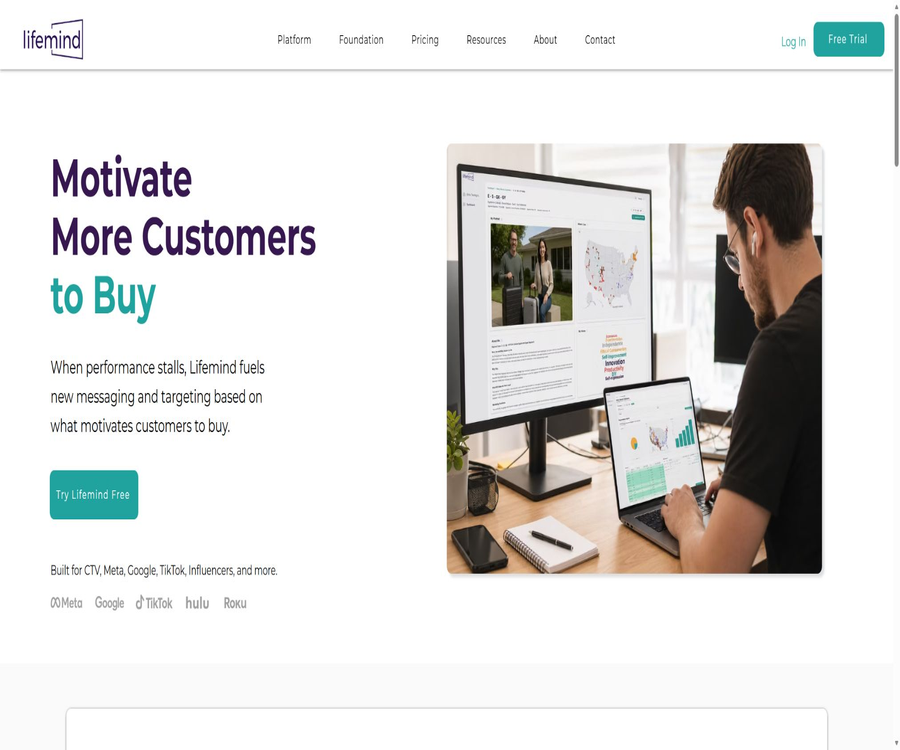
Lifemind is an AI-powered consumer insights platform designed for brands, marketing teams, and agencies; it focuses on analyzing why customers make purchases, rather than merely considering factors such as age, clicks, or past transactions. It links values and motivations to marketing positioning, advertising concepts, media placement, and brand collaborations.
The platform primarily uses U.S. postal codes along with the corresponding number of customers to conduct group-level analyses; there is no need to upload names, email addresses, or individual customer records. Its capabilities are particularly suitable for DTC businesses, retail and franchise operations, the financial sector, insurance, healthcare, as well as national and local marketing efforts.
Main functions
- Learn about the product, its positioning, and the background of the business by reviewing the brand’s page.
- Upload postal codes and the number of customers to analyze the motivations of the audience.
- Identify and rank current customers and potential expansion opportunities.
- Generate values, motivations, and purchase profiles for each segment.
- Converse with virtual audiences through Virtual Focus Group.
- Generate creative angles and advertising content tailored to different segments.
- Export combinations of postal codes and interests for use in Google and Meta targeting.
- Provide audience strategies for CTV, audio, outdoor, and direct mail.
- Filter influencers, celebrities, and podcasts that match the audience’s values.
- Identify regional activities and potential sponsorship opportunities.
How does Lifemind analyze customers?
The user prepares a customer report organized by U.S. postal codes; each row contains only the postal code and the number of customers. The system matches these distributions with its own Customer Worldview Code to identify the groups of customers who stand out among the brand’s customers.
- Enter the brand page to allow the platform to create a brand profile.
- Export customer postal codes and numbers from the CRM or marketing platform.
- Remove name, email, phone number, and other personal identification fields.
- Upload the aggregated report and create an Audience.
- View breakdowns for high matches, current opportunities, and potential expansion opportunities.
- Read the detailed profiles and use virtual focus groups to ask further questions.
- Generate corresponding positioning, creative, and collaboration suggestions.
- Test it in actual operations and compare it with business results.
Data foundation
Lifemind maps the study of individual values to various geographic regions in the United States; currently, it includes over 41,000 coded postal codes and 189 different categories of motivations. Its approach integrates elements from social anthropology, social psychology, third-party research, as well as analysis of purchasing decision processes.
| Data layer | Platform handling method | Questions that can be answered | Matters that cannot be proven directly |
|---|---|---|---|
| Brand information | Analyze brand pages and product positioning | What values might a brand be in line with? | Actual customers will surely agree with these positions. |
| ZIP code and number of people | Compare customer geographic distribution with cluster models | Which subsets of worldviews are prominent among customers | The personal values of a specific customer |
| 189 subcategories | Forming motivations, beliefs, and purchase profiles | What information might different groups respond to? | All industries have the same predictive power. |
| Virtual audience | Generate dialogue responses using detailed data. | Information and product assumptions can be explored. | Equivalent to a real interview or represents an individual’s opinion |
Ranked Segmentation
The platform sorts these segments, helping teams to identify those customer groups that are already performing well and those groups whose reach can be expanded through new information. Each segment comes with its own profile, marketing recommendations, and access to virtual focus groups.
- Identify the groups of current customers with motivations above the baseline.
- Identify adjacent, yet not fully reached, expanded segments.
- Compare customers of different products or high-value customers.
- Understand local value differences by region.
- Link the segments to creative, media, and collaboration strategies.
- Verify the value of sorting using actual ads and conversion results.
Audience profile
A detailed profile describes a group’s core values, worldview, purchasing motivations, factors that drive loyalty, as well as the individuals or cultural elements that may influence their decisions. It can be used to enhance creative briefs and marketing strategies, but it should not be regarded as a stereotypical description of all residents in a given area.
Virtual Focus Groups
Each audience segment offers virtual focus groups on demand, allowing marketers to pose questions related to positioning, products, messaging, creative ideas, and potential collaborations. The responses are research materials generated based on the segmentation model; they are not recordings of interviews with actual consumers.
- Test the attractiveness of the benefits of different products.
- Ask for opinions on price, quality, and reliability.
- Compare emotional demands with rational demands.
- Explore loyalty, referral, and churn motivations.
- Check whether the values of celebrities or internet influencers align with each other.
- Prepare more targeted questions for genuine research.
Creation of creative content
Lifemind connects the underlying motivations to creative concepts, titles, platform copy, and landing page content, enabling the same product to be presented in different ways tailored to various values. The subscription includes unlimited use of targeting options and creative content, but the resulting outputs must still comply with brand, platform, and industry guidelines.
| Channels | Content that can be generated or suggested | Check before publishing |
|---|---|---|
| Facebook and Instagram | Concepts, titles, main text, and detailed perspectives | Advertising policies, image rights, and guarantees regarding genuine products |
| TikTok | Short-video creativity, information framework, and audience language | Platform rhythm, creator authenticity, and disclosure |
| CTV and streaming media | Video propositions, audience background, and script direction | Production costs, geographic coverage, and frequency |
| Digital audio and podcasts | Voiceover angle, program, or partnership suitability | Host tone and sponsorship disclosure |
| Outdoor and direct mail | Localized information, titles, and region combinations | Postal code coverage, layout, and printing restrictions |
| Emails, text messages, and web pages | Lifecycle information and detailed content | Agree, unsubscribe, and existing CRM rules |
Media positioning
The platform can generate location files organized by postal code, and it provides suggestions for interest filtering to Google and Meta. It does not guarantee that every possible segmentation will be accepted by the platform; media professionals still need to configure their settings in accordance with the fields available on the advertising platform, the minimum size of the target audience, and privacy rules.
- Filter high-potential postal codes based on customer motivations.
- Combine the geographical area with platform interests.
- Design region-specific information for national campaigns.
- Compare efficient audiences with expansive audiences.
- Use the targeting files for paid social, programmatic, and CTV planning.
- The actual increase is evaluated using the experimental group and the control group.
Partners have discovered it
Lifemind can also identify potential influencers, celebrities, actors, singers, podcasters, and local events based on specific value criteria. It generates a list of candidates, but before entering into any partnership it is necessary to assess the actual audience, brand safety, costs, exclusivity terms, and any past controversies.
| Type of cooperation | The assistance provided by the platform | Additional due diligence |
|---|---|---|
| Social media creators | Look for candidates whose motivations align with the specific requirements. | Authenticity of fans, quality of interaction, and content risks |
| Celebrities and performers | Compare value alignment with the brand | Scope of authorization, costs, and reputational risks |
| Podcast | Filter programs that may affect the target audience. | Audience composition, ad formats, and measurement methods |
| Event sponsorship | Discover local or regional events | Actual number of attendees, rights, and exclusivity |
Free MindMap tool
MindMap is a free tool provided by Lifemind for brand matching; by entering a brand’s website, it is possible to identify the most suitable American market segments, core motivations, factors that influence loyalty, and relevant signals. The free results usually focus on a single market segment and are intended for testing purposes only, and they do not represent a comprehensive analysis of customer data.
Comparison between the full platform and MindMap
| Project | MindMap | The complete Lifemind platform |
|---|---|---|
| Enter | Brand page | Add customer ZIP code and headcount report to the brand page |
| Analysis object | The most suitable potential customer segments for the brand | Multiple Audiences in the actual customer distribution |
| Number of subcategories | Focus on providing a personalized experience based on individual matches. | Sort current and potential expansion opportunities |
| Virtual focus groups | Basic interactive experience | Each subset is used as needed. |
| Positioning and creativity | Limited display | Unlimited generation with coverage across multiple channels |
| Suggestions for cooperation | Basic signal | Complete list of influencers, celebrities, podcasts, and events |
Applicable industries
- DTC brands that wish to reduce their customer acquisition costs.
- A marketing agency that provides strategies and creative ideas for multiple clients.
- Retail and franchise businesses that require coordination between national brands and local stores.
- Financial and healthcare marketing that aims to analyze regional motivations without requiring the upload of account or health data.
- Marketing teams that need to operate based on the life cycle of differentiated market information.
- Plan media teams for CTV, programming, outdoor, and direct mail.
- Brand teams looking to collaborate with creators, celebrities, and events.
Current price
The price information was verified on August 23, 2026; the actual amounts, taxes, exchange rates, and discounts may vary, and the final figures will be those displayed on the settlement page.
Lifemind operates on a model based on a single basic subscription, with additional purchases available for users and brands; the standard price is $499 per month. The basic package includes 1 user, 1 brand, 3 target audiences, as well as unlimited use of targeting options and creative content.
| Project | Price | Billing cycle | Included content | Suitable situations |
|---|---|---|---|---|
| Basic subscription | 499 dollars | Monthly | 1 user, 1 brand, 3 target audiences; no restrictions on positioning or creativity; suggestions for collaboration and virtual focus groups | Single-brand DTC or a streamlined marketing team |
| Additional users | 99 dollars | Per user per month | Add one more platform seat | Multiple people are needed for access and collaboration. |
| Additional brands | 399 dollars | Each brand, per month | Create separate analysis for another brand. | Agents or multi-brand companies |
| 14-day trial | $ | 14 days at a time | No credit card required to experience the full platform of Audience. | Verification method before official subscription |
| MindMap | Free | Use the current free entry point | Obtain a tailored experience through the brand page. | Initial exploration without the need for customer reports |
How is Audience calculated?
An Audience is a group of customers that needs to be analyzed separately; for example, all customers, high-value customers, customers who purchase a particular product, or customers who make repeat purchases. The 3 Audiences associated with the basic subscription are not three ad platform audiences, but rather three separate groups of customers that can be uploaded and analyzed independently.
- All customers can be treated as one Audience.
- The most valuable customers can serve as the second audience.
- Customers of a particular product or region can serve as the third audience.
- Changing the filtering criteria for the same customer group may result in the creation of a new Audience.
- Before making a purchase, it is necessary to confirm the rules regarding deletion, replacement, and re-uploading.
Free trial
A 14-day free trial is available without the need for a credit card; it provides access to the full platform and allows for the analysis of one audience segment. This trial is ideal for using real aggregated postal code data to test whether segmentation, virtual focus groups, creative approaches, and targeting strategies can lead to new hypotheses.
- Choose a brand or product with a clear business problem.
- Prepare a report that includes only U.S. postal codes and the number of customers.
- Run brand profile and single audience analysis.
- Document the agreements and discrepancies between high-ranking segments and existing user research.
- Generate three distinct combinations of information and positioning.
- Have the internal team conduct a joint review with real customer research.
- Test click, conversion, and incremental effects in low-budget campaigns.
- Decide whether to subscribe based on the verification results.
How to choose the purchase method
| Demand | Suggested approach | Reasons |
|---|---|---|
| I just want to know the values that might be compatible with a particular brand. | MindMap | It’s free and no customer reports are required. |
| Verify the segmentation of real customers’ motivations | 14-day trial | It is possible to analyze an audience and experience all the features. |
| Managing multiple customer segments for a single brand | $ | Includes 3 audiences and no restrictions on creative orientation. |
| Multiple strategy officers need to log in. | Basic subscription with additional users | $ |
| Agents manage multiple client brands. | Increase brand awareness or contact sales. | A fee of $399 per month applies to each new brand; for larger scale, custom arrangements need to be finalized. |
Platforms and integration
Lifemind is primarily used through web applications; users export aggregated reports from CRM or marketing platforms and upload them, along with the generated location data and creative suggestions, to advertising channels. No complete list of connectors for direct order synchronization, real-time CDP events, or automatic updates to advertising campaigns has been identified.
| Platform or method | Support status | Precautions |
|---|---|---|
| Web applications | Support | Complete the work related to branding, audience analysis, customer profiles, communication, and creativity. |
| CSV-style customer reports | Support | Only upload the postal code and the total number of aggregated customers. |
| The positioning of Google and Meta | Provide postal code and interest suggestions | Media professionals are still needed to configure the advertising platform. |
| Native iOS apps | Not verified. | It is primarily used through a browser. |
| Native Android apps | Not verified. | It is primarily used through a browser. |
| Public API | Not verified. | There are no public developer documentation or pricing information for calls. |
| Webhooks and SDKs | Not verified. | It should not be labeled as an open development platform. |
GitHub and the open-source status
No official public GitHub repository, model weights, or self-hostable code for the Lifemind platform could be found. The product should be classified as a closed-source commercial SaaS; moreover, the academic methodology descriptions and free MindMap tools do not indicate that the platform is open source.
- The core platform and Customer Worldview Code are not open source.
- 189 subcategories fall under proprietary data and methodological assets.
- There are no public APIs, SDKs, or developer licenses available.
- It is not possible to reproduce the full Lifemind service through local deployment.
- Third-party projects with the same name should not be linked to this tool.
What does it mean by no PII?
The customer analysis reports required by the platform include only the U.S. postal codes and the number of customers; names, email addresses, phone numbers, account numbers, or individual transaction records are not necessary. This reduces the risk of directly identifying individuals, but postal codes, segmentation data, and combinations of small sample sizes can still reveal information about sensitive groups.
- Use the aggregate number of customers rather than individual records.
- Delete all direct identifiers and free-text fields.
- Set a minimum aggregation threshold for postal codes with a low number of entries.
- Do not upload information related to health, finance, or minors.
- Restrict who can view the Audience and export location files.
- Save the upload parameters, date, and data authorization records.
Notes on the Privacy Policy
Lifemind handles accounts, bills, contacts, devices, cookies, and information related to website usage; it may also delegate tasks to services providers for marketing, analysis, advertising, payment processing, and customer support. The privacy policy also allows for the sharing of information with partners under certain circumstances, and business users should conduct their own reviews before starting use.
Current policies classify email addresses as examples of non-personal information, which does not align with the common definitions used in many privacy frameworks. Users should not rely solely on the indication that no PII is involved to assume compliance; instead, they need to distinguish between customer analysis files, account details, website tracking, and data shared with partners.
Method boundaries
The postal code-based model reflects group probabilities and regional tendencies; it is not possible to assume that everyone within a given postal code shares the same values. A single postal code can encompass communities with great differences in terms of income, culture, and lifestyle.
- Use segmentation to develop marketing hypotheses, not for assessing individual qualifications.
- Do not deny financial, insurance, medical, or employment opportunities on the basis of assumptions.
- Used in conjunction with first-party transactions, research, and creative testing.
- The confidence level is reduced for small samples and highly heterogeneous postal codes.
- Different products and purchasing situations may trigger different motivations.
- Virtual focus groups cannot replace interviews with actual customers.
- Correlation and partial matching do not equate to causation.
Advertising and fairness risks
Positioning based on geography and values may inadvertently lead to the proxy screening of protected groups, especially in advertisements related to housing, credit, employment, insurance, and healthcare. It is necessary to examine the specific category rules of the advertising platforms, as well as local laws and organizational policies on fairness, before using them.
- Avoid using postal codes to exclude protected or vulnerable groups.
- Record the legitimate marketing purposes for using each segment.
- Evaluate whether the idea reinforces stereotypes.
- Apply a broader and more inclusive approach to sensitive industries.
- Set up manual approval and regular deviation assessment.
- The control group is retained to determine whether there is a genuine improvement in incremental performance.
Which users are it suitable for
- DTC marketing teams looking for new avenues for growth.
- Agents who need to create psychological segmentation for customers.
- A national brand that manages stores in multiple regions as well as franchise locations.
- Media professionals who wish to provide local insights for CTV, outdoor advertising, and programmatic advertising.
- A brand strategy team that can quickly develop creative briefs is needed.
- We are looking for partners to help identify influencers, celebrities, and sponsorship opportunities.
- Marketing departments in regulated industries that do not wish to upload personal identity data.
Product advantages
- For customer documents, only the postal code and the total number of people are required.
- Link audience insights directly to creativity and media positioning.
- The 189 subcategories cover more than 41,000 U.S. postal codes.
- Each segment can be explored through virtual focus groups.
- It covers advertising, CTV, audio, outdoor, and direct mail at the same time.
- Provide suggestions for collaborations with influencers, celebrities, podcasts, and events.
- A 14-day trial is available without a credit card, and a full Audience is provided.
- A single subscription structure is easier to understand than multi-layered feature locks.
Restrictions and Precautions
- The core geographic data focuses on U.S. postal codes and is not suitable for analyzing other countries directly.
- ZIP code-based inference cannot represent individual people.
- Virtual focus groups are not actual consumer research.
- The basic price is $499 per month, which is high for individuals and very small teams.
- The basic subscription includes 1 user, 1 brand, and 3 audiences.
- Additional users and brands require monthly additional purchases.
- No public APIs, SDKs, mobile applications, or complete connectors have been identified.
- The absence of PII does not mean that account and website data are entirely exempt from privacy regulations.
- Positioning suggestions still need to comply with the restrictions set by advertising platforms and in sensitive industries.
Pre-purchase checklist
- It is confirmed that the key clients and media events are located in the United States.
- Set de-identification and minimum threshold values for customer reports.
- Select a real business problem to define the trial Audience.
- Compare the segmentation with existing research, transaction data, and team experience.
- Use virtual focus groups to generate hypotheses rather than final conclusions.
- Test ideas and postal code targeting in low-budget campaigns.
- Calculate the total monthly cost for the required users, brands, and audience.
- Review the privacy, partner sharing, and sensitive advertising rules.
- Confirm the processes for exporting, deleting, replacing Audience, and unsubscribing.
- The actual value is determined based on incremental conversion, CAC, and brand metrics.
Frequently Asked Questions
Is Lifemind free?
MindMap offers a free trial for single-brand matching; the full version of the platform provides a 14-day free trial along with access to one audience. The basic subscription fee for ongoing use is $499 per month.
What is included in the basic package?
$
Is it necessary to upload the customer’s name and email address?
It is not necessary; the customer analysis file only requires the U.S. postal code and the number of customers in that area. Users should still perform aggregation, set thresholds for small sample sizes, and avoid uploading data related to sensitive individuals.
Can Chinese or European customers be analyzed?
The current public methods are based on over 41,000 postal codes in the United States; no geographic models with a similar level of detail exist in China or Europe. These subdivisions should not be applied directly to markets outside the United States.
Is Virtual Focus Group a real-person survey?
No, it generates responses using AI and various models, making it suitable for exploring hypotheses and creative ideas. For major products, brands, or decisions that are subject to regulations, actual customer research is still necessary.
Are APIs provided?
No public APIs, SDKs, or Webhooks were identified. The current workflow involves uploading aggregated reports, and then exporting as well as utilizing the insights, location data, and creative ideas generated by the platform.
Is Lifemind open source?
No, the platform, the 189 distinct components, and the Customer Worldview Code are proprietary technologies that remain closed source. The presentation of free tools and methods does not imply that the corresponding code or data is made available publicly.
Summary
Lifemind is suitable for teams in the U.S. market that are looking to find new ideas and positioning strategies by examining values and purchasing motivations. It reduces reliance on personal data by utilizing aggregated postal code information, and it connects various segments to virtual research, content, media, and partnership strategies.
Its results should be regarded as hypotheses for group-level marketing strategies, rather than individual psychological judgments. The most reliable approach is to use a 14-day trial to analyze an actual audience, and then verify through studies of real customers and small-scale experiments whether the cost of $499 per month plus any additional fees is justified.
Tools similar to Lifemind



 Guigong Network Security Registration No. 45132202000164