






LastMile AI
LastMile AI: an intelligent tool focused on improving AI efficiency.
Tags:AI improves efficiencyWhat is LastMile AI?
LastMile AI was originally a platform designed for developers working with generative AI, offering tools for debugging, evaluation, and improvement; it provided AI Workbooks, AutoEval, datasets, experimental capabilities, as well as APIs. Over time, the product’s focus has expanded to include agents, model context protocols, and cognitive computing.
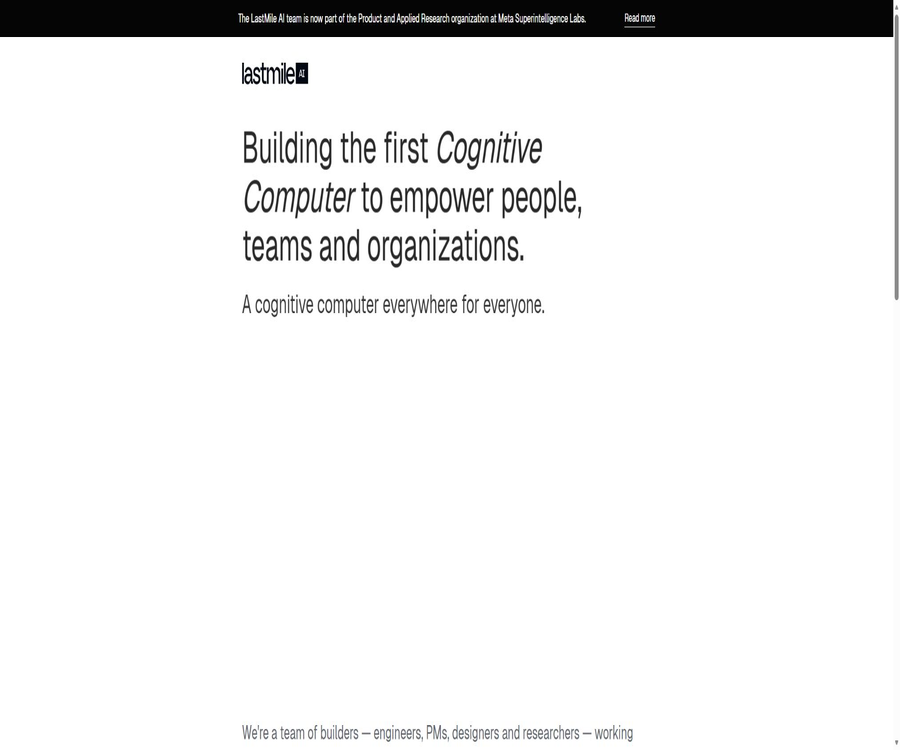
The most significant change at present is that the LastMile AI team has joined Meta Superintelligence Labs’ organization for product and application research. The previous standalone website now mainly provides information on the team’s direction and vision; it no longer displays details related to registering for the commercial platform, making purchases, or accessing existing packages.
How should the current status be understood?
LastMile AI cannot be simply classified as an independent SaaS product that is still being sold normally. The catalog entries should consider the original commercial platform as a legacy product, while treating the open-source project that is still under maintenance as the core capability that is currently available for use.
| Project | Current status | How to label it appropriately |
|---|---|---|
| LastMile AI team | Joined Meta Superintelligence Labs | The team has been integrated into Meta’s related organizations. |
| The original LastMile development platform | The document is still accessible, but there is no obvious option to purchase it. | The availability of historical platforms or those currently in use is yet to be confirmed. |
| mcp-agent | Open source and under continuous maintenance | Current key open-source agent frameworks |
| AIConfig | Make it publicly open-source and retain the development materials. | Model and prompt configuration framework |
| mcp-eval | Open source | MCP server and agent evaluation tools |
| MCP-Cloud | Open testing phase | It is currently available for free testing; rules may change in the future. |
The most noteworthy open-source projects at the moment
- mcp-agent: Uses MCP to connect models, tools, and external services in order to create composable agent workflows.
- AIConfig: Separates prompts, models, parameters, and runtime configurations from the application code.
- mcp-eval: Runs tests and quality assessments in an environment where a real proxy interacts with the MCP server.
- OpenAI Apps example: Demonstrates how to host backend projects for application integration.
- MCP registry search item: Provides semantic retrieval and service interfaces for the MCP server directory.
Core capabilities of mcp-agent
mcp-agent is currently LastMile AI’s most representative open-source project; it is a MCP-based intelligent agent framework primarily written in Python. This framework handles matters such as the lifecycle of MCP server connections, tool calls, configuration, logging, and execution context, allowing developers to focus on the behavior of the agents and the business processes involved.
- It supports features such as MCP tools, resources, prompts, notifications, OAuth, sampling, and user guidance.
- It offers combination patterns such as routing, parallelism, orchestration, evaluation and optimization, as well as multi-agent collaboration.
- The agent applications can be re-exposed as standard MCP servers.
- It supports normal asynchronous execution, and can also be integrated with Temporal to enable pause, resume, retry, and persistent execution.
- It provides structured logging, OpenTelemetry monitoring, and token usage tracking.
- It can connect to various model providers as well as existing MCP servers.
- Provides commands for project initialization, configuration, execution, installation, and cloud deployment.
mcp-agent workflow mode
| Pattern | Main function | Suitable scenarios |
|---|---|---|
| Routing | Based on the task, it is determined which model, agent, or tool should be used. | Multi-intent customer service and task routing |
| Parallel processing | Execute multiple independent sub-tasks simultaneously | Multi-channel retrieval and batch analysis |
| Orchestrator and worker nodes | Break down complex goals and aggregate the results of multiple nodes | Research, reporting, and complex automation |
| Evaluation and optimization | After the results are generated, they are checked against standards and improved iteratively. | Copywriting, code, and high-quality answers |
| Multi-agent handover | Allow agents with different specialties to take over tasks based on certain conditions. | Multi-departmental processes and professional consulting |
| Persistent execution | Saves the workflow status and supports pausing, resuming, and retrying. | Long-duration tasks and manual approval |
How to start using mcp-agent
The MCP-agent is suitable for developers who are familiar with Python, model APIs, and the basic concepts of MCP. Before getting started, it is necessary to have a Python environment ready, as well as the credentials for the selected model service, along with at least one MCP server to which a connection is desired.
- Install the recommended Python projects and dependency management tools.
- Initialize a new mcp-agent project and select a basic template.
- Register the MCP servers that need to be connected in the configuration file.
- Store the model key in a dedicated secret configuration or environment variable; do not commit it to the code repository.
- Create a proxy name, instructions, and a list of accessible servers.
- Select the model adapter and combine routing, parallel processing, or evaluation and optimization workflows.
- Run it locally first to check the tool’s permissions, logs, tokens, and error handling.
- Decide whether to use self-hosting, run it persistently, or deploy it to MCP-Cloud after conducting the tests.
MCP connection and proxy server
The framework can be used as an MCP client to connect to file systems, search engines, databases, and enterprise services; it can also be utilized to deploy complete proxy applications as new MCP servers. This enables desktop assistants, code editors, or custom clients to invoke complex workflows through a unified protocol.
| Usage method | Enter | Output | Key points to note |
|---|---|---|---|
| Connect to the existing MCP server | Server commands, transmission methods, and permissions | Tools and resources available for agent invocation | Only the permissions necessary for completing the task are granted. |
| Combine multiple servers | Multiple service configurations | Unified toolset | Handle name conflicts, timeouts, and failure isolation |
| The exposure proxy is an MCP server. | Agents, workflows, and utility functions | Standard MCP endpoint | Configure authentication, throttling, and auditing. |
| Connect to the desktop or editor client | Deployment address and access credentials | Agents that can be invoked within the client | Credentials cannot be written to the public configuration. |
Persistent execution and observability
Simple projects can make use of an asynchronous execution engine, while complex tasks can switch to theTemporal backend. Persistent execution is suitable for agents that need to run for extended periods, require human confirmation, allow for automatic retries, or need to resume operation after being interrupted.
- Structured logs help identify abnormalities in models, tools, and workflows.
- OpenTelemetry can record the entire call chain and execution spans.
- The token count is used to track the consumption of agents, workflows, and model nodes.
- Observers can trigger alerts or take control actions when usage reaches a threshold.
- A persistent history facilitates the inspection of pause, retry, and manual input processes.
What is AIConfig?
AIConfig saves prompts, model names, parameters, variables, and chain dependencies as serializable configurations, thereby separating the behavior of generative AI from the application code. These configuration files can be placed under version control, and they can be edited, tested, and compared using an editor.
- Use unified configuration to save prompts, model, and inference parameters.
- It supports Python and Node development methods.
- It is possible to run prompt chains with variables and dependencies.
- It supports expansion with multiple modalities such as text, images, and audio.
- It allows access to different models and custom inference endpoints.
- It is suitable for managing prompt versions, evaluation codes, and application code separately.
AIConfig usage process
- Install Python packages or Node software packages according to the project’s language.
- Create an AIConfig configuration file and enter the name, model, and default parameters.
- Set a separate name, variable, and dependencies for each prompt.
- Run the prompt in the editor and observe the model’s output.
- Include stable configurations in version control and subject them to code review.
- Load the configuration in the application, and invoke the specified prompt at runtime.
- Compare the performance of models, parameters, and prompt versions using the test set.
What is MCP-EVAL?
mcp-eval is used to test MCP servers as well as the agents that call these servers; it runs actual agents to interact with the servers, rather than merely simulating a single function. The testing process allows for the recording of the sequence of actions taken, the response content, delays, tokens, costs, and comprehensive tracking data.
- It supports various testing methods such as decorators, pytest, and data-driven testing.
- It is possible to determine whether a specific tool has been invoked, how many times it has been called, and in what order it was executed.
- It is possible to check the response text, regular expression patterns, and structured conditions.
- It supports limits on response time, the number of model calls, and path efficiency.
- LLM reviewers can be used to assess the quality of the content based on a scale.
- Test reports in JSON, HTML, and Markdown are provided.
- It is possible to integrate with continuous integration processes to carry out regression testing.
MCP-Eval implementation steps
- Prepare Python 3.10 or a later version, as well as the MCP server that is to be tested.
- Install mcpevals and initialize the test project.
- The startup method of the registration server, transmission configuration, and necessary environment variables.
- Create tests for normal paths, abnormal inputs, permissions, and boundaries.
- Set content, tools, performance, paths, or LLM judge assertions.
- Run the tests and check the traces, reports, and reasons for failures.
- Include stability testing in continuous integration to carry out regression verification after changes.
The historical capabilities of the original LastMile business platform
The older version of the LastMile development platform provided centralized management for AI Workbooks, AutoEval, datasets, experiments, synthetic annotation, and evaluation models. Workbooks enabled the combination of text, images, audio, and model elements within the same workspace, while AutoEval was used for assessing the quality of RAG-generated content.
| History module | Capabilities that were once provided | Current usage recommendations |
|---|---|---|
| AI Workbooks | Multimodal model testing, unit arrangement, and collaboration | Do not assume that new users can still register and use it by default. |
| AutoEval | Datasets, metrics, experiments, and automated evaluation | Documents can be used to enhance historical understanding. |
| Evaluation metrics | Accuracy, relevance, summary quality, and harmful content detection | The current model and its usability need to be verified separately. |
| API V2 | Datasets, evaluations, experiments, tuning, and permission interfaces | Old endpoints should not be used directly in new projects. |
| Python and Node SDK | Invoke platform capabilities using a key | It should be regarded as an interface from the old platform. |
| VPC deployment | Run containers in the customer’s private cloud | Historical corporate solutions cannot be used as current quotes. |
Price and usage costs
The price information was verified on August 23, 2026; the actual amounts, taxes, exchange rates, and discounts may vary, and the final figures will be those displayed on the settlement page.
At present, there are no reliable information available regarding the current packages or purchase prices for independent commercial LastMile platforms; the descriptions of free starter plans and enterprise VPCs in older documents cannot be used as current quotes. The open-source code itself can be used freely, but costs still apply for model invocation, servers, databases, monitoring, and maintenance.
| Product or version | Price | Billing cycle | Core benefits or quota | Suitable for users |
|---|---|---|---|---|
| Former LastMile SaaS | The current price is not available. | Unclear | History includes Workbooks, AutoEval, datasets, and APIs | The original customer who needs to verify the availability of the service first |
| mcp-agent | Open source and free of charge | No subscription period required | MCP connections, proxy mode, persistent execution, and observability | Python Agent Development Team |
| AIConfig | Open source and free of charge | No subscription period required | Tips, model and parameter configuration, as well as Python and Node runtime environments | Teams that need to manage the configuration of generative AI applications |
| mcp-eval | Open source and free of charge | No subscription period required | MCP servers, proxies, assertions, and regression testing | MCP Development and Quality Team |
| MCP-Cloud | Free during the open testing phase | Rules during the testing period | Host MCP proxies, servers, keys, logs, and ensure continuous operation | Developers who wish to deploy testing projects quickly |
| Models and infrastructure | Charged according to the selected supplier | Pay-as-you-go or subscription | Model tokens, computing, storage, networking, and monitoring | All actually deployed projects |
Open-source license
| Project | License | Commercial understanding |
|---|---|---|
| mcp-agent | Apache-2.0 | Modifications are generally allowed for commercial use, but the license and related statements must be retained. |
| AIConfig | MIT | Typically, use, modification, and distribution are allowed, provided that the copyright and license text are retained. |
| mcp-eval | Apache-2.0 | It can be used in commercial testing processes while complying with license requirements. |
| The original LastMile platform | Closed-source commercial services | The entire platform cannot be labeled as open source just because some of its warehouses are open source. |
| Third-party models and MCP servers | respective clauses | The model, data, and connection service permissions must be checked separately. |
Which users are it suitable for
- Developers who wish to create MCP native agents using Python.
- AI teams that require routing, parallelization, orchestration, and the evaluation of optimization strategies.
- The product team that is preparing to release the agent as a standard MCP server.
- Workflow developers who need to pause, resume, retry, or obtain manual approval.
- Engineering teams that wish to separate hints and model parameters from the business code.
- A quality team that is required to conduct real-world interaction tests on MCP servers and proxies.
- Former users of the LastMile platform and companies that are evaluating options for migration.
Product advantages
- mcp-agent is based on open protocols; when connecting tools, there is no need to develop a dedicated framework for each service.
- The proxy pattern maintains composability, making it suitable for gradual expansion from simple programs.
- The Temporal backend provides the capability for restoring and persistently executing long-running processes.
- AIConfig facilitates version control of prompts, models, and parameters.
- mcp-eval covers real tool calls, as well as quality, performance, and path checks.
- The three projects cover the building, configuration, and testing phases respectively.
- The license allows developers to modify and use it for commercial purposes once certain conditions are met.
Restrictions and risks
- The existing business platform does not provide clear information regarding separate registration, sales, and current prices.
- Old documents and old SDKs do not mean that the relevant cloud interfaces are still available.
- Open-source frameworks require you to configure the models, servers, permissions, and runtime environment on your own.
- Cloud services in the open testing phase may see changes to their prices, quotas, and availability.
- Connecting files, databases, and enterprise systems increases the risk associated with the agent’s permissions.
- Errors can occur in model generation, tool selection, and LLM evaluation.
- Open-source licenses do not automatically grant third parties the right to use models, data, and services for commercial purposes.
- Different warehouses have varying levels of activity; it is necessary to check the version and maintenance status before using them.
Checklist for migrating users from the original platform
- Verify that existing accounts, workspaces, API endpoints, and support channels are still accessible.
- Export datasets, evaluation results, experiment records, hints, and model configurations.
- Record the version of the SDK in use, dependencies, keys, and permission scopes.
- Stop using the package and service commitments from old documents as a basis for renewal.
- Evaluate whether AIConfig can handle prompt and model configuration management.
- Evaluate whether mcp-eval can reconstruct critical evaluation and regression tests.
- When agent orchestration is required, use mcp-agent to reimplement the core processes.
- Recalculate the total cost for modeling, storage, deployment, monitoring, and maintenance.
- Before migrating, revoke any keys that are no longer in use and remove sensitive data.
Suggestions for safe use
- Apply the principle of least privilege and use separate credentials for each MCP server.
- The model key is stored in a secret management system or a dedicated configuration.
- Manual confirmation is required for actions such as writing files, sending messages, and modifying databases.
- Limit the directories, accounts, tables, and network ranges that agents can access.
- Hide tokens, personal information, and trade secrets in logs and traces.
- Set strict limits on tool timeout, repeated calls, loops, and costs.
- Use mcp-eval to handle scenarios of privilege escalation, prompt injection, and error recovery.
Frequently Asked Questions
Does LastMile AI still offer its original business platform?
The current website does not clearly display the registration, plan selection, and purchase processes of the original platform; moreover, the team has joined relevant Meta organizations. The old documents are still accessible, but this does not indicate that the commercial SaaS product is still being sold as usual.
Was LastMile AI acquired by Meta?
It is confirmed that the team has joined Meta Superintelligence Labs’ organization for product and application research. Without solid evidence, it should not be assumed that the entire company has been acquired or that the original products have become official Meta services.
Is LastMile AI an open-source product?
The original commercial platform is not a fully open-source product, but MCP-Agent, AIConfig, and MCP-Eval are released under public licenses. The documentation should clearly indicate whether the platform itself is open-source or not, as well as the open-source status of these separate repositories.
Can MCP-agent be used for free?
The framework code can be used freely under the Apache-2.0 license. However, operational costs such as those related to model APIs, computing, storage, networking, databases, and maintenance are still required.
Is MCP-Cloud charged?
The current document indicates that MCP-Cloud is in the open testing phase and can be used free of charge. The testing policies may change; for official projects, it is necessary to verify the quotas, continuity of service, and subsequent billing rules once again before deployment.
Can the old LastMile SDK still be used in new projects?
It is not recommended to use them directly without verification; the old SDKs are associated with interfaces from older platforms. For new projects, it is advisable to first evaluate the currently maintained MCP-Agent, AIConfig, and MCP-Eval tools, and to actually test the required endpoints.
Summary
The focus of the LastMile AI entry has shifted from being an independent commercial AI development platform to the current situation following the team’s integration into Meta, as well as the open-source tools such as MCP-Agent that are still available for use. Its practical value for developers lies in the creation of MCP agents, configuration management, and the evaluation of real-world interactions.
Before adopting this approach, it is necessary to evaluate separately the historical SaaS solutions, current open-source repositories, and cloud testing services. Existing customers should prioritize exporting data and ensuring service continuity, while new projects should start with minimal permissions, local testing, and reversible evaluation methods.
Tools similar to LastMile AI



 Guigong Network Security Registration No. 45132202000164