






KowboyKit
KowboyKit, an intelligent tool focused on improving AI efficiency
Tags:AI improves efficiencyA one-sentence summary
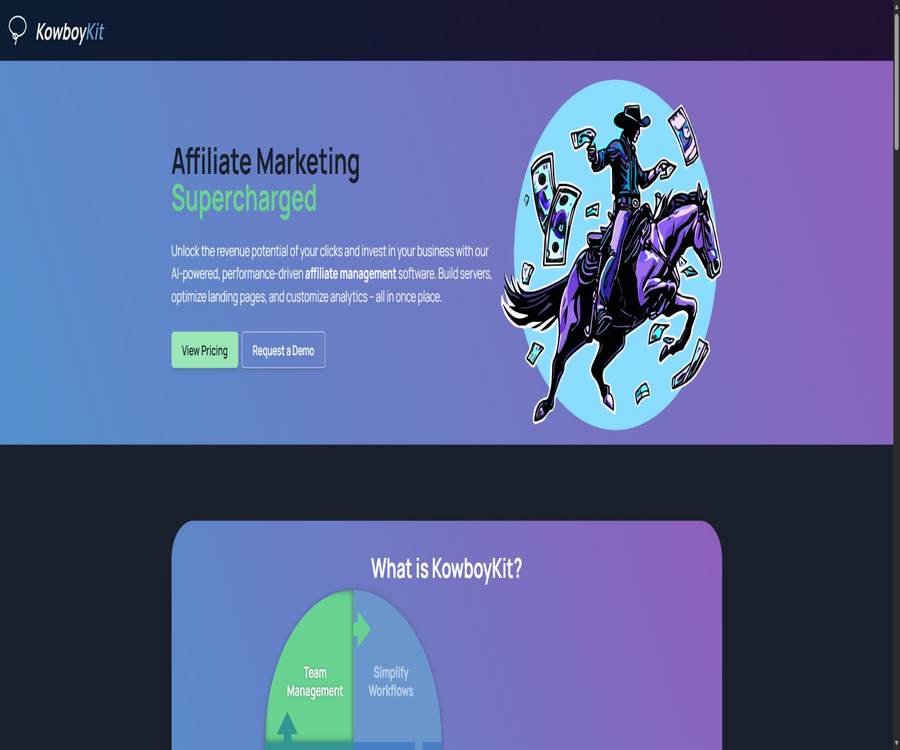
KowboyKit is an operational platform designed for affiliate marketing and media procurement teams; it consolidates advertising campaigns, offers, landing pages, servers, click tracking, team permissions, spending, and internal accounting within a single system.
Tool Introduction
KowboyKit is designed for teams that need to manage multiple advertising campaigns, media buyers, and affiliate offers at the same time. It focuses on automated offer rotation, landing page testing, capacity assessment, server creation, and detailed analysis, rather than being a simple tool for generating affiliate links for individuals.
The product highlights AI and automation as its key features, but it does not disclose the names of the specific models, the training methods, the prompt interfaces, or the amount of AI resources used. The correct understanding is that rules, data, and automation are employed to optimize advertising operations, rather than relying on generative AI to guarantee profits.
Main functions
Offer rotation and capacity monitoring
The system can rotate the alliance offers based on settings, and it can reduce the amount of traffic sent to those offers that have already reached their capacity limits, by using capacity monitoring. Teams still need to check the real-time data of the alliance networks, as well as the latency values and rules related to alternative offers.
Landing page management
Users can manage, edit, and capture landing pages in a centralized manner, and assign these pages to different advertising campaigns. Crawling and reusing are only allowed for pages that one owns or for which permission has been obtained; it is not possible to copy content that is protected by third parties.
A/B testing
A/B testing and tracking of landing pages allow for the comparison of different combinations of pages, visuals, and offers. It is necessary to define metrics and sample sizes in advance to avoid making frequent changes based on a small number of clicks.
Traffic segmentation
Teams can assign visitors to different campaigns based on custom demographic attributes or business criteria. The rules for such segmentation are governed by the advertising platform’s policies, privacy consent requirements, and anti-discrimination laws; it is not sufficient to rely solely on conversion rates to determine whether such practices are lawful.
Analysis dashboard
Custom dashboards summarize activities, clicks, offers, geographical locations, spending, and member performance. In-depth analysis, data segmentation, and geographic reports help identify changes in conversion rates and abnormal traffic patterns.
Media buyer performance
The team can view activities and results by member, and use CowboyKit to filter and analyze the performance of different buyers. Performance data should be considered in conjunction with the advertising budget, the quality of traffic, and the difficulty of the campaigns; it is not sufficient to rely solely on absolute revenue figures.
Costs and internal settlements
Optional expense tracking is used to record the costs of various activities, while custom settlement settings enable the calculation of compensation for media buyers based on their individual contributions. Before any payments or commissions are issued, the finance department must verify the contracts, exchange rates, refunds, and tax aspects.
One-click server deployment
The server builder allows connection to hosting providers, helping to create active servers as well as manage domain names and SSH keys. Automatic deployment involves access to actual infrastructure and credentials; it is necessary to use separate accounts, grant minimal permissions, and set up alerts for cost-related issues.
Monitoring and Notifications
The system offers checks for server availability, automatic restarts, as well as email and SMS notifications. For alerts, it is possible to configure contacts, priorities, mechanisms to prevent repeated notifications, and escalation procedures, so as to avoid being overwhelmed by a large number of low-priority messages.
Landing pages and click protection
Landing page protection includes safeguards against click hijacking; the click retention feature is used to reduce abnormal charge deductions and to verify data. These mechanisms cannot be used to hide illegal pages, circumvent ad reviews, or manipulate affiliate network records.
Functional module
| module | Representative capabilities | Primary users | Key checks |
|---|---|---|---|
| Event management | Ad Kit, Campaign, Offer, and Landing Page | Media buyers and operations | Name, status, budget, and ownership |
| Automatic optimization | Offer rotation, capacity testing, and variant testing | Optimizer | Rules, delays, samples, and fallbacks |
| Traffic routing | Audience segmentation and geographical factors | Deployment team | Agreement, platform policies, and fairness |
| Analysis | Dashboards, drilling down, slicing, and geographic reports | Managers and analysts | Diameter, time zone, deduplication, and attribution |
| Team governance | Resource allocation and functional permissions | Team administrator | Minimum permissions and recovery upon departure |
| Finance | Expense tracking and buyer settlement | Finance and managers | Invoices, refunds, exchange rates, and taxes |
| Infrastructure | Servers, domain names, and SSH keys | Technical operations | Permissions, fees, backups, and exit |
| Stability | Monitoring, restart, and notifications | Operations and duty personnel | False alarms, upgrades, and incident records |
What is an Ad Kit?
The public plans use the Ad Kit as the main unit of measurement, but the price page does not specify exactly how many campaigns, domain names, servers, landing pages, or clicks are included in one Ad Kit. A written description of the quota details is required before making a purchase; an Ad Kit cannot be considered equivalent to a single advertising campaign.
- Verify that the Ad Kits correspond one-to-one with the Campaigns.
- Verify whether the suspended and archived Kits are using up quotas.
- Confirm the number of landing pages and offers allowed per Kit.
- Verify whether different members can share the same Kit.
- Confirm when the quota will be released after deletion.
- Confirm the fees incurred when exceeding the limit or the methods of blocking.
- Confirm migration, export, and retention of historical data.
Team permissions
KowboyKit enables control over the data that members can see, based on campaigns, servers, or landing pages, and it determines which functions members are allowed to use. Teams can also manage the affiliate networks and offer catalogs that are permitted for promotion.
| Permission object | Controllable content | Suggested characters |
|---|---|---|
| Campaign | View, edit, and run specified activities | Media buyers and event organizers |
| Landing page | Visit, edit, scrape, and test pages | Creativity and Technical Operations |
| Server | Create, allocate, and maintain infrastructure | Administrators and operations staff |
| Network and Offers | View and select projects approved for promotion | Union Operations and Compliance Officers |
| Analyze data | View team or individual performance | Managers, analysts, and relevant buyers |
| Costs and Settlements | Enter costs and calculate internal rates of return | Financial and authorization managers |
| Keys and domain names | Managed account, SSH, and domain name operations | A very small number of platform administrators |
Role permissions should correspond to the actual responsibilities within an organization; it is not acceptable to allow all media buyers to share administrator accounts. When a member leaves the organization, the partnership ends, or an event is suspended, access to the platform, servers, domain names, and the affiliate network must be revoked immediately.
Steps to establish a team
- List the roles of team leaders, media buyers, analysts, as well as financial and technical maintenance personnel.
- Determine the activities, landing pages, servers, and reports that each role can access.
- Use a separate account to invite members; passwords are not shared.
- Server, domain name, and key management are available only to a few administrators.
- Establish an approved alliance network and an offer catalog.
- Assign responsible persons for inputting, reviewing, and settling configuration costs.
- Use testing activities to verify that members cannot see data to which they do not have access.
- Set up procedures for onboarding, job transfers, departures, and emergency revocation of rights.
- Regularly review dormant accounts and resources that are no longer in use.
Process for creating ad campaigns
- Verify that the advertiser, affiliate network, and traffic platform allow the current method of promotion.
- Create an event and set the owner, budget, time zone, and attribution rules.
- Import or create landing pages that have obtained copyright and commercial licensing.
- Add offers and record capacity, region, commission, and restrictions.
- Set up traffic segmentation, offer rotation, and fallback in case of failure.
- Create landing page variants and define testing metrics.
- Assign servers, domain names, and the necessary tracking parameters.
- Use internal testing to verify redirects, events, and reports.
- Launch with a small budget and monitor for abnormal clicks, costs, and conversions.
- Adjust the traffic and increase the budget after reaching the sample threshold.
The boundary between AI and automation
The public page classifies offer rotation, A/B testing, and capacity testing under AI-driven automation, but it does not specify the type of algorithms used, the input features, the scope of training, or the details of any manual control. Users should regard this as an optimization system that needs to be verified, rather than a guarantee of automatic profit generation.
- Establish an artificial benchmark using historical data.
- Specify the variables and upper limits that can be adjusted in the algorithm.
- Reserve an exploration budget for new activities.
- Record each automatic decision along with the indicators before and after it.
- Set the minimum sample size and the maximum daily expenditure.
- There must be a secure fallback when the offer becomes invalid.
- Manual approval is required for high-risk areas and sensitive audiences.
- Monitor abnormal traffic and attribute attacks.
- Regularly compare the net returns of automated and manual strategies.
Analysis and Attribution
The platform allows results to be viewed by campaign, member, geographic region, and custom segments; however, the accuracy of the reports depends on factors such as the ID used for reference, time zone, duplication removal, conversion reporting, and data from affiliate networks. The revenues and costs from different platforms cannot be added together directly without first standardizing them.
| Indicators | Possible uses | Common misconceptions |
|---|---|---|
| Click | Monitor traffic and abnormal fluctuations | Robots, repetitions, and quantity deductions can affect the total amount. |
| Transformation | Evaluate the effectiveness of the offer and the landing page. | The feedback delay and attribution window are different. |
| Income | Calculate gross revenue | Cancellations, refunds, and rejected payments are not included. |
| Advertising spending | Evaluate the cost of deployment | Exchange rates, taxes, and platform refunds may be omitted. |
| ROI | Compare activity efficiency | Different diameters will lead to incorrect sorting. |
| Member performance | Observe the contributions of buyers | Differences in budget and activity difficulty can lead to bias. |
| Geographical manifestation | Adjust regional deployment | IP location, privacy issues, and limited sample size |
| Offer capacity | Avoid exceeding the allowed data volume. | There may be delays in the update of the alliance network. |
Server and domain name management
One-click server creation involves connecting to external hosting accounts, and it may involve creating instances, configuring domain names, and managing SSH keys. While this brings convenience, it also increases the system’s permissions as well as the potential costs associated with infrastructure.
- Use a cloud account or sub-account dedicated to CowboyKit.
- Limits the regions where creation is allowed, as well as the instance specifications and quantities.
- It is prohibited to hand over the root account key to the platform.
- Enable multi-factor authentication and transfer locks for domain registrars.
- Regularly rotate SSH keys and remove the keys of employees who have left the company.
- Set budgets, tags, snapshots, and deletion protection for instances.
- Confirm that automatic restarts will not conceal ongoing faults or incur additional costs.
- When activities are halted, the server, IP addresses, storage, and domain name records are cleared simultaneously.
Prices and packages
KowboyKit offers three monthly subscription plans, all of which are high-priced team-level services. The price page uses the dollar symbol, but the old terms state that, in the absence of other specifications, the fees are quoted in euros; the currency, taxes, and payment conditions must be confirmed during the demonstration and in the final contract.
| Package or version | Page pricing | Billing cycle | Core benefits or quota | Suitable for users |
|---|---|---|---|---|
| Hobby Kit | $ | Monthly | 10 Ad Kits along with one-time setup, landing pages, servers, teams, accounting, variant testing, offer rotation, and a dashboard | Small media procurement team |
| Standard Kit | $ | Monthly | 50 Ad Kits, setup and support, capacity monitoring, advanced analytics, notifications, landing page protection, and AI automation suite | Teams that run multiple activities simultaneously |
| Enterprise Kit | $ | Monthly | Priority access to 100 Ad Kits, all features of Standard, and new functions | Large media procurement organizations |
| Demonstration and implementation | Not publicly available yet. | Based on sales confirmation | The scope of demonstration, setup, support, and personalization needs to be confirmed. | Teams that need to evaluate data and processes |
| Exceeds Ad Kit or custom requirements | Not yet made public | In accordance with the contract | Additional capacity, development, migration, and integration may incur extra costs. | Customers who exceed the public package limits |
The price page does not show information regarding the free version, free trial, annual discounts, number of clicks, number of user accounts, number of servers, SMS services, storage capacity, data retention policies, and the price per extra unit. The option “includes setup and support” should not be interpreted as meaning that all implementation costs and third-party fees are covered.
Comparison of package features
| Functions | Hobby | Standard | Enterprise |
|---|---|---|---|
| Ad Kit quota | 10 | 50 | 100 |
| Dynamic landing page management | Includes | Includes | Includes |
| One-click server setup | Includes | Includes | Includes |
| Team management and built-in accounting | Includes | Includes | Includes |
| Variant testing and offer rotation | Includes | Includes | Includes |
| Automatic capacity detection | Not listed | Includes | Includes |
| Advanced analysis tools | Not listed | Includes | Includes |
| Custom alerts | Not listed | Includes | Includes |
| Protection of landing page content | Not listed | Includes | Includes |
| AI and automation suites | Not listed | Includes | Includes |
| Priority access to new features | Not listed | Not listed | Includes |
Quotation list before procurement
- Confirm the official currency and taxes associated with the dollar sign.
- It is required to define the quota relationships between Ad Kit, Campaign, Offer, Lander, and Server.
- Verify user seat limits, role restrictions, and the maximum number of customer organizations.
- Confirm the limits for clicks, conversions, SMS messages, storage, and report retention.
- List the settings, data migration, training, and the scope of services provided by customer managers.
- List the additional costs for servers, domain names, SMS, and third-party networks.
- Obtain SLA, backup, disaster recovery, and support response times.
- Obtain DPA, sub-processors, data locations, and deletion arrangements.
- Confirm contract duration, automatic renewal, price increases, cancellation, and refunds.
- Confirm the data export format, access period after termination, and migration assistance.
- Complete the technical and financial acceptance through a real-world activity.
Demo application
The demonstration form asks for the name, email address, Telegram account, time zone, size of the team, number of campaigns, daily and monthly advertising expenses, current tracking method, traffic source platform, type of offer, and the problems that need to be solved. Before filling out the form, it is necessary to avoid submitting lists of customers, keys, or any confidential business data.
- Apply using the company email and a summary of the non-sensitive project details.
- Do not paste the affiliate network credentials in the additional notes.
- Advertising budgets can use reasonable ranges rather than exact, confidential figures.
- Identify the real pain points in existing reports and workflows in advance.
- It is required to demonstrate permissions for display, reports, data export, and exception handling.
- Use anonymous test data to verify the functionality.
- Request a formal quote and contract documents after the demonstration.
Privacy and business data
The website’s privacy policy covers information such as visitors’ IP addresses, locations, device details, clicks on links, viewed content, and advertising cookies; it does not list all the fields related to affiliate marketing. The processing of customer activity data also requires consideration of the DPA and the end-user agreement.
| Data category | May contain | Key governance aspects |
|---|---|---|
| Accounts and Teams | Name, company, email, role, and login records | Minimum permissions, multi-factor authentication, and deletion upon departure |
| Activities and Offers | Network, commissions, capacity, region, and marketing rules | Trade secrets, permissions, and contractual authorizations |
| Click and Convert | Click on ID, time, IP, device, and conversion events | Agree, retain, cross-border, and anonymize |
| Advertising spending | Budget, costs, revenue, and ROI | Financial accuracy and access isolation |
| Member performance and settlement | Contributions, compensation, and team analysis | Labor, taxation, fairness, and complaints |
| Servers and keys | Cloud account, domain name, and SSH credentials | Encryption, rotation, auditing, and emergency revocation |
| Content of the landing page | Copywriting, materials, scripts, and tracking code | Copyright, malicious code, and version control |
| Demo application | Budget, team, and campaign information | Sales visits, retention, and deletion |
The website’s policy states that visitor data is retained only for as long as it is necessary to achieve the intended purpose, and visitors have the rights to access, correct, delete, restrict, transfer their data, and object to its use. Corporate clients still need to specify in the DPA the duration of data retention, procedures for deleting backups, information regarding sub-processors, and the timing required for notifying them in case of a data breach.
Terms and account responsibilities
The service is provided by CowboyKit LLC; to use the full version of the software, it is necessary to register, obtain an end-user license, and sign a DPA. The data that users upload, download, and process remains their property, but cancellation of the account does not necessarily result in the immediate deletion of all such data.
- Users must be at least 18 years old and have the authority to sign contracts on behalf of a company.
- The software must not be used for illegal transactions, fraud, or violations of privacy.
- It is not allowed to upload viruses, data that is illegal, or data that infringes on the rights of third parties.
- The account holder is responsible for the actions of members and any unauthorized use.
- Prices and packages can be adjusted upon prior notice.
- The service may modify, suspend, or terminate certain features.
- The software is provided as it is, without any guarantee of being error-free at all times.
- The maximum public liability limit is equal to the cost of the selected package for six months.
- In the event of a conflict between the end-user agreement and the website terms, the former takes precedence.
The website terms were last revised in May 2023, and they may not cover additional features such as AI automation, server integration, or details related to current packages. Any formal purchase shall be governed by the latest end-user agreement, DPA, and quotation signed by both parties.
Affiliate marketing compliance
- Only offers that have been approved by advertisers or affiliate networks should be promoted.
- Comply with the advertising platform’s rules regarding landing pages, redirections, and tracking.
- Clearly disclose the partnership relationship and any necessary advertising identifiers.
- Page protection features must not be used to hide illegal content.
- False clicks, bots, or self-conversion are not allowed.
- Sensitive attributes must not be used for illegal or discriminatory segmentation.
- Additional reviews are conducted for health, financial, gambling, and adult-related offerings.
- Save records of material licensing, event approvals, and user consent.
- Regularly check for changes in the terms of the alliance network and regional regulations.
GitHub and the open-source status
No official GitHub repository, SDK, or open-source license for the CowboyKit affiliate marketing platform has been found. The website offers commercially hosted software; it is not appropriate to label AI technologies, server automation tools, or web development frameworks as open source.
| Project | Current status | Correct understanding |
|---|---|---|
| KowboyKit core platform | Commercial SaaS | It has not been confirmed whether the core code is publicly available. |
| AI automation module | Package features | Model or algorithm code that is not made public |
| Server Builder | Hosting feature | Automatic deployment does not equate to open-source infrastructure code. |
| Public API or SDK | No verification has been done yet. | The integration capabilities need to be confirmed in the demonstration and the contract. |
| Self-hosted version | Not yet made public | It cannot be assumed that it can be deployed on one’s own server. |
| Data export | The terms allow users to download their own data. | It does not mean providing the database or the source code of the program. |
Which users are it suitable for
- Teams that manage multiple affiliate offers and advertising campaigns at the same time.
- Organizations that need to centrally manage the permissions and performance of media buyers.
- Teams that wish to integrate the landing page, servers, and domain management within the same system.
- A marketing team that requires capacity monitoring and automatic rotation of offers is needed.
- Managers who need to handle data on expenses, revenues, and settlements with internal buyers.
- A professional team capable of covering the monthly software costs, which amount to four digits.
- Companies that are willing to ensure compliance with advertising regulations, protect data, and maintain the security of their infrastructure.
Which users are not suitable for it
- Individuals who only occasionally share a small number of affiliate links.
- Creators who need free or inexpensive tools to get started.
- Teams without a stable advertising budget and clear operational processes.
- Users who hope that AI will automatically ensure profitability for advertisements.
- Teams that cannot verify the copyright of the landing page or the authorization to promote the offer.
- Companies that are unwilling to provide event and tracking data to external platforms.
- Organizations that need verified open-source or fully self-hosted solutions.
- Users who are unable to manage servers, domain names, keys, and advertising compliance.
Product advantages
- Centralized management of campaigns, offers, landing pages, and servers.
- Capacity monitoring and offer rotation reduce the need for manual switching.
- A/B testing and tracking of landing pages enable continuous optimization.
- Team permissions can be detailed down to activities, pages, and servers.
- Custom analytics and geographic reports are suitable for professional use.
- Expenses and internal settlements enhance the team’s perspective on business management.
- One-click server setup reduces the need for repetitive deployment tasks.
- Monitoring, restart, and multi-channel notifications ensure basic stability.
- The three-tier package offers a clear hierarchy of Ad Kits.
Main limitations
- The price of the starter package is 1,500 dollars per month.
- The currency notation on the pricing page does not match that of the old terms.
- There is no public free version or free trial available.
- Insufficient disclosure of Ad Kit details, seats, clicks, and additional specifics.
- The technical details of the AI models and algorithms are not made public.
- Automation of servers and domain names increases the risks related to credentials and costs.
- The visitor privacy policy cannot fully represent the handling of data in SaaS services.
- The website’s terms and privacy policy were last updated in 2023.
- No public APIs, SDKs, open-source code, or self-hosted versions have been identified.
- Automatic optimization can be affected by attribution errors, delays, and abnormal clicks.
- The responsibility for advertising platforms, affiliate networks, and regional compliance remains with the customer.
- The contract’s liability limitations and account termination provisions require legal review.
Frequently Asked Questions
What is CowboyKit mainly used for?
It helps media procurement teams manage advertising campaigns, affiliate offers, landing pages, servers, team permissions, analytics, spending, and internal settlements in a centralized manner, while reducing repetitive tasks through automatic rotation and testing.
Is CowboyKit suitable for individual affiliate marketing?
It is generally not suitable; the starting price of the public packages is high, and these packages are designed with teams, servers, and multiple Ad Kits in mind. Individual creators should first assess the scale of the project and the potential return on investment.
Is CowboyKit free?
There is no public free version or free trial; the website offers a request for a demonstration. The prices for Hobby, Standard, and Enterprise are displayed on a monthly basis.
How much are the three packages?
The Hobby, Standard, and Enterprise plans display amounts of $1,500, $2,500, and $3,500 per month respectively. As the old terms included options for payment in euros, the actual currency used, any taxes, and the payment conditions must be specified in the official contract.
Will AI automatically increase the profitability of ads?
There is no guarantee; automatic rotation, capacity monitoring, and testing are still affected by factors such as data, attribution, sample size, offer quality, and advertising costs. The team must set budgets and provide manual oversight.
Is it possible to deploy a server with just one click?
The platform offers one-click server creation as well as management of related domain names and SSH keys. Users are still responsible for managing cloud account permissions, instance costs, security updates, backups, and cleanup tasks.
Is CowboyKit open source?
No official public source code or open-source license for the core platform has been found. It should be classified as commercial-hosted software rather than an open-source project.
Is an API provided?
The public page does not display the official API and SDK documentation. Teams that need programmatic integration should verify the interfaces, authentication methods, rate limiting rules, costs, and version commitments during the demonstration.
Summary
KowboyKit is suitable for professional affiliate marketing teams that have a stable advertising budget and multiple team members; it brings together features such as offer rotation, landing pages, servers, permissions, analytics, cost tracking, and internal settlement in one single platform. The Standard and Enterprise versions also include capacity monitoring, advanced analytics, notification systems, page protection, and AI automation tools.
Before making a purchase, it is not sufficient to compare only 10, 50, and 100 Ad Kits; it is necessary to verify further the currency used, the definitions related to quotas, third-party fees, data processing methods, the accuracy of attribution, the contract duration, and options for exiting the service. High monthly fees, outdated policy documents, and undisclosed technical interfaces are the aspects that require the most careful examination.
Tools similar to CowboyKit



 Guigong Network Security Registration No. 45132202000164