






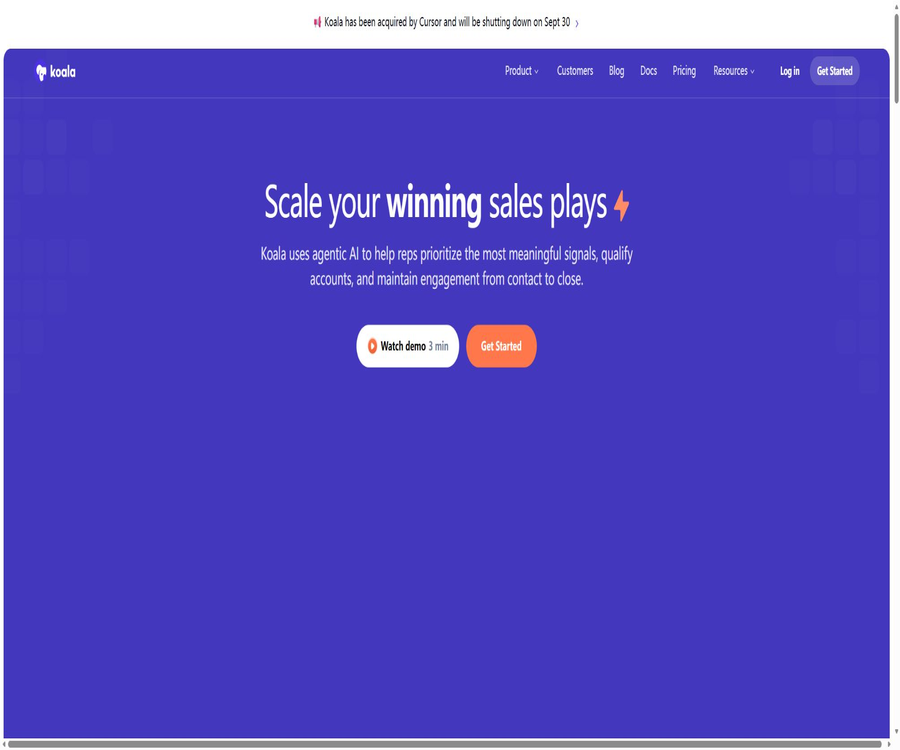
Koala
Koala, an intelligent tool focused on improving AI efficiency
Tags:AI improves efficiencyA one-sentence summary
Koala is a B2B platform for understanding customer intent and automating sales processes; it combines information from websites, products, communities, CRM systems, and external sources into account and contact views, thereby helping sales teams identify potential customers who are interested in a particular product and take timely action.
What is a koala?
Koala is operated by Konfetti, Inc., and it serves teams responsible for sales, growth, marketing, and Revenue Operations. It collects first-party data on user activities through website pixels, SDKs, analytics tools, and server-side events; this data is then used, along with information about the company, details of contacts, and external signals, to determine purchasing intent.
The product is not an AI chat tool for consumers, nor is it a retail analysis or writing software with the same name. Its AI capabilities are focused on customer research, assessing suitability, developing sales strategies, and delivering personalized outreach; its main goal remains to acquire B2B customers and increase sales pipelines.
Overview of Core Competencies
| Ability | Specific functions | Typical use | Key constraints |
|---|---|---|---|
| Visitor identification | Link websites and product campaigns to individuals or companies | An anonymous access account was discovered. | Corporate identification is not equivalent to personal identity. |
| Intent Signals | Define important behaviors as purchase intention events. | Pricing page, documentation, and access to high-value features | The rules need to be aligned with the actual customer journey. |
| Intent Scores | Calculate account strength, trends, and history | Sales priority ranking | Scores cannot replace human judgment. |
| AI Agents | Automatically determine whether individuals or accounts meet the requirements. | Additional information on sales background and ICP assessment | Each Agent should focus on a single issue. |
| Koala Coach | Provide suggestions for the next steps, wording to use, and actions to take. | Personalized emails, LinkedIn, and calls | It is recommended to be cautious, as errors in the data could have an impact. |
| Plays | Organize clues, conduct research, and automate actions based on conditions | Reuse proven sales strategies | Complex rules need to prevent repeated triggering. |
| Workflow automation | Send Slack, routing, Webhook, and outbound call sequences | Provide real-time follow-up for customers with high intent | Approval and compliance are required before sending out. |
| Analysis report | Monitor visitors, UTM parameters, content, and conversions | Coordination between marketing and sales | Attribution is still influenced by identity and data integrity. |
Website and product data collection
Koala usually starts by installing pixels from marketing websites, blogs, and technical documentation; it is also possible to use SDKs within applications, or to connect to analysis systems such as Segment, RudderStack, Heap, etc. When the client is not available, campaigns can still be sent through server-side integration.
- Records page views and time spent on pages.
- Capture pricing, plan, and competitor page activities.
- Observe technical documentation and product usage events.
- Connect customer behaviors during the trial period, POC phase, and after payment.
- Import existing events from analysis tools.
- Key business events are reported via the server.
- Link cross-site and product sessions to a unified profile.
Koala can only analyze contacts that have already been collected, so the scope of data collection directly affects the results. Before expanding the scope of collection, it is necessary to provide information regarding privacy, obtain consent, minimize the amount of data collected, and review its intended use.
Visitor and company identification
When a user provides an email address via a form, registration, login, or through identified analysis events, Koala can associate the activity with that person. In the absence of an email address, the platform uses the IP address to identify the source of the access and shows it as an anonymous company; it is not possible to determine who the specific visitor is in such cases.
| Identification status | Available signals | Result granularity | Use correctly |
|---|---|---|---|
| An email address has been provided. | Forms, registration, login, or identification events | Employees and Companies | Link sales records for legitimate purposes |
| Access to anonymous companies | Rich IP and companies | Company level | Do not guess the identity of specific employees. |
| Completely unknown access | Page and session activities | Anonymous activities | Used for aggregating trends rather than individual outreach. |
| Contacts already exist in CRM. | CRM fields and historical interactions | People, accounts, and opportunities | Handling duplicate records and owners |
| CSV import | Manual lists and fields | It depends on the data quality. | Confirm list permissions and update date |
| Richer results | Company, email, phone number, and public professional information | Additional attributes | Verify accuracy and provide error correction. |
IP identification can be affected by issues such as shared networks, VPNs, remote work arrangements, and carrier exits. Sales professionals should consider company visits as priority leads, rather than as definite information about a specific individual.
Intent Signals – Purchase intent signals
Intent Signal represents important moments in the customer journey that deserve attention from the sales team. Administrators can define conditions based on any recorded behaviors; when such conditions are met, they are highlighted in the records and real-time alerts are sent to Slack.
- Staying on the pricing or plan page for longer than the set time.
- Browse the content comparing with competitors.
- Read technical documentation or information on corporate features in depth.
- Start the trial and complete key product events.
- Multiple members of the same company visited together.
- Existing customers can view options to upgrade or cancel.
- Coming from the target channel and meeting ICP requirements.
- Related activities appear on social media, in communities, or through external channels.
The rules must be in line with the actual purchasing processes of the company. Accessing the pricing page can indicate an intention to make a purchase, but it may also be related to job hunting, competitive research, or checking account details for existing customers; therefore, it is necessary to take into account factors such as the company, the user’s role, the frequency of access, and other activities.
Intent Scores: Account intent scoring
Koala calculates the intensity of intent for an account on a scale from 0 to 100, and expresses this intensity as Low, Medium, High, or Very High. The system also displays trends such as Surging, Heating, Neutral, or Cooling, along with historical curves that show changes over time.
| Scoring section | What does it represent? | For sales purposes | Risk of misjudgment |
|---|---|---|---|
| Intent Strength | Current intent strength | Arrange follow-up priorities | High scores may come from non-purchase visits. |
| Intent Trend | It has been getting warmer or cooler recently. | Choose the right time to follow up. | Short-term fluctuations may be amplified. |
| Intent History | Long-term account activity curve | Distinguish between new interests and ongoing evaluations | The collection gap can cause a false decrease. |
| Intent Signals | The key actions that lead to a hit | Explain the composition of scores | The rule configuration itself may be inaccurate. |
| Page Views and Time | Browse content and stay on site | Assess the depth of research | Background tags or accidentally opened pages affect the time. |
| External signals | Activities such as communities, social networks, G2, or GitHub | Supplement first-party data | Companies with the same name and public data may be outdated. |
The intent score is updated multiple times throughout the day, but it does not represent the probability of a real-time sale. Companies should use historical conversion rates to determine the relevant weights, and allow sales staff to see the various factors that influence this score rather than just focusing on a single figure.
Diverse customer base and search capabilities
Koala offers functions for searching companies and individuals, importing data in CSV format, enriching information related to emails and phone numbers, adding additional details about companies, as well as advanced features for expanding this information. It enables the combination of website activities with details such as the company’s industry, size, job positions, contact information, and CRM records, thereby creating more comprehensive sales profiles.
| Operation | Credits consumed | Use value | Precautions |
|---|---|---|---|
| IP companies are abundant. | 0.1 Credits each time | Identify visits from anonymous companies | It’s not personal-level identification. |
| The Waterfall email address is abundant. | 2 Credits per time | Look for a usable work email address. | The results need to be verified and in compliance with the outreach rules. |
| There are a wealth of waterfall phones. | 4 Credits per time | Provide additional phone contact information | High costs and stricter compliance requirements |
| AI research or qualification assessment | Price changes | Add account background and ICP information | Check the estimated consumption before running. |
| Koala Coach | Price changes | Generate sales strategies and information | Costs can vary depending on the context. |
| Slack reminders | No Credits are consumed. | Real-time sales notifications | Still subject to the limits set by the plan’s reminders. |
| Webhook automation | No Credits are consumed. | Connect to external processes | Still subject to the limit on the number of Webhooks. |
Credits are replenished on a subscription basis, and the specific amount used can be viewed in the account. There is no fixed fee for AI research and coaching; it is advisable to conduct tests on a small scale before running tasks in bulk, in order to prevent the credit limit from being exhausted rapidly due to automation.
AI research and qualification assessment
The Research Agent is used to answer a specific question posed by an individual or a company, while the Qualification Agent evaluates whether a particular lead or account meets the required standards. The research results can be displayed on the Play list, in the editor, and on the pages related to individuals or accounts; they can also be provided to the Coach.
- Select the sales Play that needs to be supported.
- Define a clear task for each Agent.
- Specify the companies, individuals, and CRM contexts that are allowed to be used.
- Choose between text, boolean, graded, or structured response formats.
- Test with known customers and non-target customers.
- Check research evidence, errors, and Credit consumption.
- Include reliable results in the qualification rules or Coach context.
- Regularly update the issues and acceptance samples.
Including multiple issues within a single Agent reduces the stability of the results; officials recommend breaking them down into individual data points. Qualification assessments should also allow for unknown outcomes – the model should not be forced to give a positive or negative answer when there is insufficient evidence.
Koala Coach Sales Strategy Assistant
Koala Coach takes into account the reasons that prompted the action of playing a message, information about accounts and contacts, CRM insights, past communications, relevant public events, as well as predefined sales strategies, in order to provide recommendations for the next steps and personalized outreach strategies. It does not simply rewrite text; rather, it helps sales professionals understand why it is necessary to take action at that particular time.
- Summarize why the clues were given priority.
- Summarize the latest background information for accounts and contacts.
- Check the CRM stage, owner, and last contact.
- It is recommended to postpone meetings, materials, internal collaboration, or similar activities.
- Generate email, LinkedIn message, and call scripts.
- Ensure that the wording is in line with the team’s sales strategy and the brand’s tone.
- Prevent different sales teams from contacting the same account repeatedly.
The company facts, contact information, and recommendations generated by Coach may be inaccurate. Sales staff should verify the information in CRM systems, public sources, and past interaction records, and review the commitments, tone of message, cancellation policies, and rules regarding outreach in different regions before sending any messages.
Plays and Magic Inbox
Play combines signals, ICP conditions, research Agents, routing, and subsequent actions to create a process that can be reused for sales purposes. Leads that meet the criteria are sent to the Magic Inbox, where sales staff can view the reasons for their inclusion, the results of the research, and suggestions from Coach.
| Composition of Play | Function | Key configuration points |
|---|---|---|
| Trigger | Define when to trigger it | Avoid noise caused by broad conditions. |
| Audience and ICP | Limit the target companies and individuals. | Use understandable and legitimate attributes. |
| AI Agents | Supplementary research and qualification assessment | Each Agent focuses on a single issue. |
| Routing | Assigned to the CRM Owner, via polling, or to a designated person | Handle missing owners and vacations |
| Alerts | Send real-time alerts via Slack and similar tools | Control the channel and reminder frequency |
| Actions | Create tasks, Webhooks, or outbound call sequences | Idempotency, approval, and exit mechanisms |
| Coach | Generate strategies and personalized messaging. | Manual review before sending |
| Reporting | Track triggering, acceptance, and conversion | Reconcile CRM opportunities and revenue |
Automation and routing
Koala can trigger Slack alerts, route leads, use Webhooks, execute automatic actions, and integrate with external Sales Engagement Platforms based on Play. Different solutions offer varying levels of support for alerts, Webhooks, automatic outbound calls, and advanced routing options.
- Define a high-value and interpretable trigger condition.
- Exclude employees, existing customers, or traffic that is not suitable for outreach.
- Specify CRM Owner, polling, individual, or regional routing.
- First, enable only the Slack alerts and observe the noise level.
- Verify the target and content before enabling Webhooks or automated actions.
- Sends frequency of joining, unsubscribing, and duplicate checks to the outside.
- Record each trigger, owner, action, and result.
- Adjusted according to rules for meetings, opportunities, and income.
Automation should not be used solely to optimize the number of messages sent. Companies should limit the frequency of interactions from the same account, and manage multiple contacts, existing opportunities, and customer relationships, in order to prevent premature outreach as a result of just one visit to a website.
CRM and Integration
| Integrated categories | Representation method | Primary uses |
|---|---|---|
| CRM | HubSpot, Salesforce | Synchronize companies, contacts, owners, opportunities, and activities |
| Collaboration reminders | Slack | Real-time push of intents and Play |
| Product analysis | Segment, RudderStack, Heap, and others | Import website and application events |
| Sales sequence | Sales Engagement Platform | Add qualified leads to the outreach sequence. |
| Data warehouse | Warehouse connection | Use internal business and product data |
| Webhook | External automation endpoint | Trigger a custom workflow |
| Chrome extensions | Browser-side tools | View and use Koala information on the work page. |
| CSV | Import lists and manual lists | Batch research and enrichment |
The public comparison of Growth includes support for a single CRM system, while Business offers support for multiple CRMs as well as advanced customization options. The specific objects, fields, directions of data writing, conflict resolution rules, and API limits must be confirmed prior to activation.
Reports and Attribution
Koala offers visitor analysis, UTM reports, and content reports that help identify which pages, channels, and types of content are associated with high levels of intent, conversions, or revenue. Marketing teams can use it to understand the path from anonymous visits to trials, opportunities, and actual customers.
- View the access timeline for companies and individuals.
- Compare the quality of channels and UTM campaigns.
- Identify the content that corresponds to accounts with high intent.
- Observe the sales response following a Play trigger.
- Link meetings, opportunities, and income back to behavior.
- Distinguish between PLG and sales-led purchase journeys.
- Monitor the increase and decrease in account activity intentions.
The relationship between website visits and sales is not necessarily the sole factor to be considered. When analyzing this relationship, it is necessary to take into account offline activities, the brand, sales relationships, and the impact of multiple touchpoints, while also comparing these aspects with CRM and financial data.
Pricing and Packages
The price information was verified on August 23, 2026; the actual amounts, taxes, exchange rates, and discounts may vary, and the final figures will be those displayed on the settlement page.
Koala offers a permanent free plan; the Starter and Growth plans come with fixed monthly fees, while the Business plan is customized based on the number of seats, credits, as well as the scope of integration and support provided. The Growth plan includes a 14-day trial period.
| Plan | Price | Billing cycle | Seats and Credits | Suitable for users |
|---|---|---|---|---|
| Free | Free | Continuous use | 2 seats, 100 Credits per month | A small team tasked with finding the first customers |
| Starter | 200 dollars | Monthly | 2 seats, 1000 Credits per month; additional seats can be purchased | Set up early sales Play |
| Growth | 1000 dollars | Monthly, a 14-day trial period is available. | 3 seats, 5000 Credits per month; additional seats can be purchased | Team to expand the sales workflow |
| Business | Custom quote | Custom contract | Custom seats and Credits | Enterprises that require advanced routing, multiple CRM systems, and dedicated support |
All package cards list “All features”, but the comprehensive comparison table still categorizes them into automation, reporting, CRM, data retention, routing, and support as planned; it should not be assumed that the free version offers exactly the same features as the Business version. The discount amount for annual payment is not clearly displayed on the current page, so it is necessary to check the available options in real time before making a purchase.
Differences in plans
| Project | Free | Starter | Growth | Business |
|---|---|---|---|---|
| Data retention | 1 month | 1 month | 3 months | Customization |
| Support | Document | CSM and dedicated Slack channels | ||
| Seats | 2 | 2, can be purchased additionally | 3, can be purchased additionally | Customization |
| Credits | 100/month | 1000/month | 5000/month | Customization |
| CRM | Restricted | Restricted | 1 CRM | Multiple CRMs |
| Routing | Foundation | Basic polling or designated persons | CRM Owner, polling, or designated person | Region, CRM Owner, and Advanced Fields |
| Automated credit limit | Foundation | Restricted by comparison table | Higher alert levels, Webhooks, and call quotas | Customization |
| SSO | Not specified | Not specified | Not specified | SAML and approved logins |
Some icons from the complete comparison table cannot be fully displayed on the text page; the selections regarding automation and specific functions should be based on the current pricing table. Corporate contracts usually also involve additional seats, extra usage amounts, as well as costs for implementation and support.
Safety and compliance
Koala states that it maintains SOC 2 Type II compliance, adheres to GDPR and CCPA regulations, and undergoes annual third-party penetration testing as well as external code audits. The Business plan allows for the use of SAML via Okta; other accounts can take advantage of Google SSO or Magic Link, with username and password login being disabled in such cases.
| Control | Public status | Purchase inspection |
|---|---|---|
| SOC 2 Type II | It has been stated that this remains the case. | Request the current report, period, and exceptions. |
| GDPR and CCPA | Declare compliance | Sign the DPA and verify the roles of controller and processor. |
| Penetration testing | Third-party testing every year | Confirm scope and issue resolution |
| Code audit | External audit | Confirm coverage of clients, the backend, and the supply chain. |
| Google SSO and Magic Link | Provide | Forced domain names, privilege revocation, and session policies |
| SAML | Business is provided through Okta. | Identity mapping, SCIM, and emergency accounts |
| Data retention | According to the plan: 1 month, 3 months, or customized | Delete, backup, and export scope |
Privacy and visitor data
Koala’s privacy policy outlines contact information, approximate location data, social media details, device and IP addresses, website analytics, employment-related data, as well as information derived from such data. The platform may also obtain company details from suppliers such as Clearbit, and it processes data related to Google Workspace, CRM systems, and analytics tools used by customers.
- Reveal Koala tracking on websites and apps.
- Configure cookies by region or agree to their management.
- Do not describe visits by anonymous companies as the actions of specific individuals.
- Restrict sensitive pages and events that are displayed to sales staff.
- Set legitimate uses for email, phone numbers, and social information.
- Confirm that Google Workspace data is used only for core functions.
- Establish processes for data retention, access, correction, and deletion.
- Provides options for unsubscribing and handling objections regarding the contact list.
The privacy policy states that Google Workspace data is not used for developing, improving, or training general AI models. Companies should still assess which CRM, email, calendar, and public data are used by Coach and Research Agent, and whether this data is sent to external model services.
Terms of Service and Refunds
For corporate orders, the costs, number of seats, usage volume, level of support, and deadline are determined in accordance with the Order Form. Unless otherwise specified in the order, the fees are to be paid in advance on an annual basis, invoiced in US dollars, and settled within 30 days. Paid fees are generally non-refundable; any excess usage beyond the designated limits may incur additional charges.
The monthly self-service payment page and the corporate Order Form may use different billing cycles. Before making a purchase, it is necessary to verify the options related to automatic renewal, cancellation, effective dates, support services, pricing for excess usage, data export, and access rights after termination.
API, SDK, and open-source status
Koala offers website SDKs, server-side events, Webhooks, and various integration options; however, the source code of its core platform as well as its open-source license are not made publicly available by the company. The fact that the browser code and technical documentation are accessible to everyone does not mean that features such as visitor identification, intent scoring, Coach, and automated backend functions are also open source.
| Technical capabilities | Current status | Correct understanding |
|---|---|---|
| Web pixels and SDK | Provide | Used for client activity collection and identity events |
| Server-side events | Provide | Suitable for back-end business activities |
| Webhook | Provided as per the plan | Used to trigger external automation |
| CRM and analytics integration | Provide | Objects and write permissions vary depending on the scheme. |
| Official core GitHub | Not verified. | The platform cannot be marked as open source. |
| Core algorithms and backend | Not disclosed | It belongs to commercial SaaS services. |
Which users are it suitable for
- B2B SaaS teams that receive a high number of visits from anonymous websites.
- PLG companies that wish to identify intents on pricing pages, documents, and products.
- SDR teams that require real-time Slack alerts and sales routing.
- It is hoped to unify Revenue Operations across first-party data, CRM, and external signals.
- Sales teams that require AI research, qualification assessment, and personalized strategies.
- Marketers who wish to analyze the relationship between content, UTM parameters, and revenue.
- Companies that are capable of managing privacy, data, and complying with automated external regulations.
Product advantages
- It covers intents ranging from anonymous access to product usage and the customer stage.
- People, companies, activities, and CRM are presented in a unified view.
- Intent Signal and Score make it easy to understand priorities.
- Research Agents and Coaches convert data into sales actions.
- Plays supports the reuse of proven team strategies.
- Slack, routing, Webhooks, and sequences can create real-time workflows.
- A free version is available, along with clear, fixed pricing tiers.
- The Public Security page lists SOC 2 Type II and privacy compliance.
- The rules regarding Credits consumption are relatively clear for common advanced operations.
Main limitations
- Anonymous IP identification is only reliable at the company level; it is not possible to identify specific individuals.
- Rating and AI research efforts can be affected by incomplete or outdated data.
- Automatic outreach can lead to spam messages and compliance risks related to local regulations.
- Free and Starter retain data for only 1 month.
- Growth costs $1,000 per month, which is expensive for small teams.
- The AI research and Coach’s Credits consumption are not fixed values.
- The descriptions of benefits on price cards and comprehensive comparison tables can be easily confusing.
- Advanced CRM, SSO, and sophisticated routing require more sophisticated solutions.
- The core platform is not an open-source software that has been officially confirmed.
- Access tracking, enrichment, and inference require strict privacy governance.
Deployment and Acceptance Checklist
- Define high-intent behaviors and final conversion events.
- Complete the privacy notice and consent setup before installing the pixels.
- Exclude employees, tests, bots, and irrelevant traffic.
- Connect to CRM and resolve company, contact, and Owner mapping.
- Create a small number of interpretable Intent Signals.
- Verify the Score and ICP rules using historical customers.
- Small-scale testing of email, phone, and AI research costs.
- Enable Slack alerts first, and then gradually introduce automated actions.
- Set approval rules, frequency, and cancellation mechanisms for outreach.
- Reconciliation triggers, meetings, opportunities, revenue, and Credits.
- Check the package features, retention policies, excess usage rules, and renewal terms.
- Regularly conduct random checks for misidentifications, incorrect suggestions, and user objections.
Frequently Asked Questions
What does a koala mainly do?
It gathers information on websites, products, CRM systems, and external activities, identifies the intentions of individuals or companies, and helps with timely follow-up in sales through functions such as research, coaching, action-taking, reminders, and automation.
Can Koala identify all website visitors?
It’s not possible. Users who have an email address can be associated with specific individuals, but in the absence of an email address, the company can usually only be identified through its IP address; in such cases, some accesses remain completely anonymous.
Is Koala free?
There is a continuous free plan that includes 2 seats and 100 Credits per month. The Starter plan costs $200 per month, the Growth plan costs $1,000 per month, and there is also a custom Business plan available.
How are Credits consumed?
Each use of IP costs 0.1 Credits, Cascade Email costs 2 Credits, and Cascade Phone costs 4 Credits; the cost for AI research and coaching varies depending on the task. Slack notifications and Webhook triggers do not consume any Credits.
What is Koala Coach?
It takes into account the reasons for the trigger, research findings, CRM data, past communications, and sales strategies to explain to sales staff the priority of each lead, and to suggest the next steps, appropriate phrases to use, and actions to take.
Which CRMs are supported?
The public prices and documentation outline the CRM capabilities of HubSpot, Salesforce, and others. Growth is designed for use with a single CRM, while Business supports multiple CRMs as well as more advanced features such as objects, fields, and routing.
Does Koala meet SOC 2 standards?
The security page states that SOC 2 Type II compliance is maintained, and annual third-party penetration testing as well as external code audits are carried out. Companies should request the current reports to verify the scope of application.
Is Koala open source?
No official public core sources for visitor identification, intent scoring, Coach, or the backend have been found; therefore, it should be classified as a commercial, closed-source platform.
Summary
Koala is suitable for teams that wish to transform websites, products, and external activities into actionable B2B sales intentions. Visitor identification, Intent Signals, Scores, AI Agents, Coach, and Plays cover the entire process, from identifying accounts to providing personalized follow-up.
Successful deployment relies on accurate data collection, CRM mapping, interpretable signals, and controlled automation of outreach efforts. The rules regarding prices and credits are clear, but identity inference, privacy issues, data retention, and AI-generated recommendations still require ongoing human oversight.
Tools similar to Koala



 Guigong Network Security Registration No. 45132202000164