






Jsonify
Jsonify, an intelligent tool focused on improving AI efficiency
Tags:AI improves efficiencyA one-sentence summary
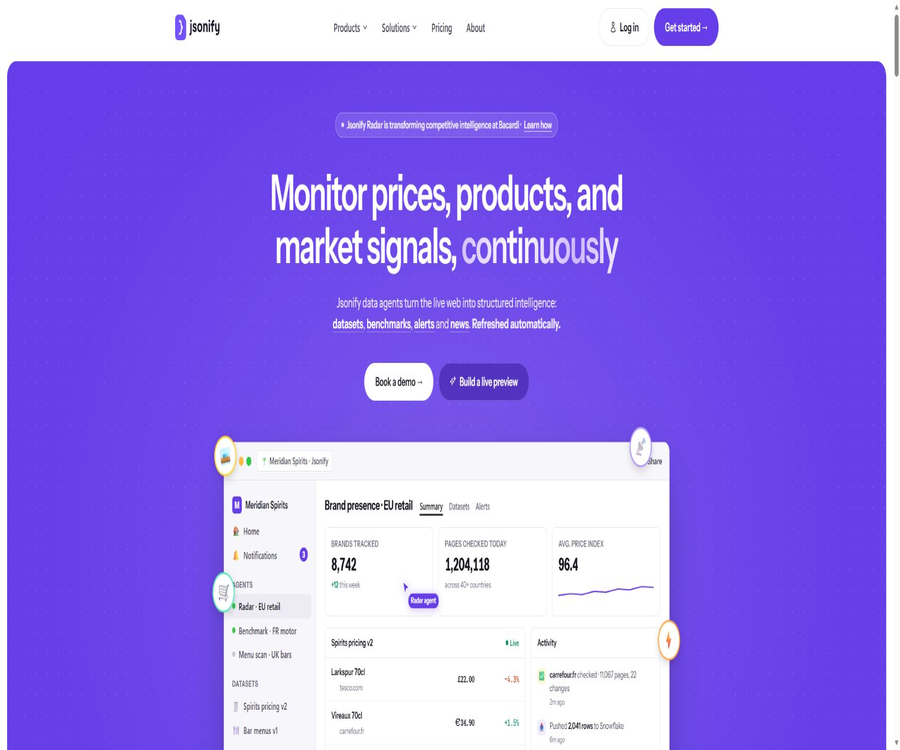
Jsonify is an enterprise-grade competitive intelligence platform that uses AI-driven data agents to continuously retrieve information from public web pages or simulate customer quotation processes, thereby organizing prices, products, promotions, inventory levels, and market trends into structured data that can be easily queried.
What is Jsonify?
Jsonify is operated by Trailing Comma Inc., a company based in Delaware, United States. It primarily serves teams responsible for pricing, product categories, market intelligence, and strategy. Its focus is not on one-time web scraping, but rather on continuous operation, quality verification, historical tracking, and integration with enterprise systems.
The client first defines the competitors, the market, the relevant fields, and the update cycle; the Jsonify team is responsible for configuring, running, and maintaining the agents. The results can be integrated into existing work environments such as dashboards, Google Sheets, CSV, Excel, APIs, Webhooks, Snowflake, and more.
Change in product positioning
| Product stage or entry point | Current location | How should it be understood? |
|---|---|---|
| Jsonify Radar | Continuously read public pages and monitor market signals. | Current core enterprise products |
| Jsonify Benchmark | Simulated forms and multi-step quotation process | Current core enterprise products |
| Jsonify Factory | Describe data requirements in natural language and establish proxy-based collection. | Current new entry point |
| Jsonify Studio | Enterprise Data and Business Intelligence Workspace | One of the current login portals |
| Jsonify Workflows | Visual AI for web automation and data extraction | The homepage has been marked as Legacy. |
The older version of the documentation still provides detailed information on workflows, blocks, and self-service agents, but the current main site marks Workflows as Legacy. When discussing Jsonify, it is necessary to focus on the role of Radar, Benchmark, and Factory in terms of corporate competitive intelligence; the old self-service features should not be considered as the only current option available.
Two core products
| Project | Radar | Benchmark |
|---|---|---|
| Working method | Read public pages | Fill out the form and simulate the customer process. |
| Data type | View prices, products, promotions, inventory, and reviews | Quotations, proposals, and configuration prices that appear after interaction |
| Common industries | Retail, e-commerce, food and beverage, and real estate | Insurance, communications, utilities, and SaaS |
| Update method | Usually daily or weekly | Run on demand or according to a schedule |
| Scale | Thousands of pages per day | Thousands of customer journeys are run each time. |
| Configuration priorities | Target page and fields to extract | Customer profiles, form steps, and configuration options |
| Joint delivery | Dashboard, APIs, and integration channels | Dashboard, APIs, and integration channels |
Jsonify Radar
Radar allows continuous access to product pages, category pages, price pages, promotional banners, and review pages that are visible to any regular visitor. It is useful for monitoring competitors’ prices, product ranges, availability status, new products, discounts, and any changes in their positioning.
- Track the prices of products at different retailers.
- Identify promotions, discounts, and price reductions.
- Monitor directories, specifications, variants, and inventory.
- Aggregate reviews, ratings, and sentiment signals.
- Discover new products, products that have been removed from the market, and new market entrants.
- Save the time records and change history for each field.
Jsonify Benchmark
Benchmark is used in scenarios where the price is displayed only after the interaction is completed. The user can enter details such as postal code, age, coverage scope, or product specifications, click on the multi-step form, and obtain the final quote.
- Compare quotes for car insurance, home insurance, travel insurance, and pet insurance.
- Monitor broadband, energy, and mobile communication plans.
- Simulate different regions and customer profiles.
- Compare the prices of custom products and package deals.
- Extract the prices for subscription plans and add-ons.
- Standardize fields across multiple countries and competitors.
AI data agent
The data proxies of Jsonify rely on semantic understanding to identify prices, product names, ratings, dates, and lists, rather than depending solely on fixed CSS selectors. They can also handle JavaScript-based rendering, lazy loading, infinite scrolling, cookie notifications, and dynamic pages.
| Agency capability | Specific functions | Value to the enterprise |
|---|---|---|
| Semantic understanding | Identify the content based on the meaning of the fields. | Reduce the number of rewrite rules when the page structure changes |
| Browser navigation | Click, scroll, and navigate to sub-pages | Processing modern dynamic websites |
| Form interaction | Select options and complete the multi-step process. | Get a quote after interaction |
| Automatic retry | Use a fallback strategy in case of failure. | Improve stability during continuous operation |
| Parallel execution | Monitor a large number of pages and journeys simultaneously | Covering multiple markets |
| Quality verification | Missing items, anomalies, and extraction errors detected | Reduce the entry of incorrect data into decision-making systems |
From web pages to structured data
- Define the competitors, websites, applications, and markets to be monitored.
- List specific fields such as price, inventory, promotions, reviews, etc.
- Determinize the update frequency, whether on a daily basis, weekly, or as needed.
- The team configures the Radar page or the Benchmark customer journey.
- The agent visits, reads, or completes interactions as planned.
- The system standardizes currency, dates, categories, and product matching.
- Abnormal quality inspection markers, missing markers, and operational errors.
- Deliver data to dashboards, files, APIs, or data warehouses.
Data standardization and historical tracking
Once the extraction is complete, Jsonify converts currencies, dates, categories, and other fields into a uniform format, and it also matches products that have slightly different names on various websites. Each data point includes time information, which enables the creation of a history of price and market changes.
- Convert the price string into a numerical value and currency code.
- Standardize the dates to a comparable format.
- Map product categories across different websites.
- Match identical SKUs or products across different retailers.
- Mark outliers and missing data.
- Save historical snapshots and trigger change alerts.
Method of data delivery
| Delivery method | Primary uses | Suitable for teams |
|---|---|---|
| Jsonify Dashboard | Filtering, comparison, charts, and reminders | Business and Marketing Team |
| Google Sheets | Real-time updated shared tables | Operations and analysis personnel |
| CSV and Excel | Download, audit, and offline analysis | General office scenarios |
| REST API | Programmatic querying and integration with internal systems | Development and data teams |
| Webhook | Push notifications when data is updated or conditions are met | Automation and alerting systems |
| Snowflake and warehouses | Integrate continuous data into the enterprise analysis stack | Data Platform Team |
| Object storage such as S3 | Batch delivery of structured files | Data Engineering Team |
Dashboard and reminders
The dashboard displays information on brand coverage, price trends, promotions, product changes, and data quality, and it allows for the setting of alerts based on specific conditions. Companies can receive notifications whenever prices drop, new products are introduced, or there are changes in inventory, without having to wait for manual reports.
Reminders still depend on the accessibility of the upstream pages and the accuracy of field extraction. For key business rules, thresholds should be set, duplicates removed, and manual reviews conducted to prevent individual abnormal values from leading to incorrect decisions.
Industry applications
| Industry | Common monitoring contents | Recommended products |
|---|---|---|
| Retail | Prices, promotions, SKUs, and inventory | Radar |
| E-commerce | Directory coverage, sellers, and Buy Box | Radar |
| Catering | Frequency of menus, prices, stores, and brands | Radar |
| Real estate | Properties, prices, and market promotions | Radar |
| Insurance | Premiums and coverage packages for different profiles | Benchmark combined with Radar |
| Communication | Broadband, mobile, and combined packages | Benchmark |
| Public utilities | Energy prices, contract duration, and regional plans | Benchmark |
| SaaS | Quotation after disclosing the package and configuration | Radar or Benchmark |
Price calculation method
Jsonify is priced based on the scope of monitoring deployment, rather than on the number of requests, proxy server traffic, or the number of user accounts. The three main factors that influence the price are market coverage, depth of data, and frequency of updates.
| Pricing factors | Meaning | Situations that lead to increased costs |
|---|---|---|
| Market coverage | Monitor the number of countries, regions, and competitors. | Expansion from a single country to multiple markets |
| Data depth | Number of fields and signals extracted per page | From pricing to promotions, inventory, reviews, and specifications |
| Update frequency | The cycle at which pages and journeys are restarted | From weekly to daily or real-time |
| Target complexity | Public pages or interactive quotation processes | Logging in, forms, and multi-step configuration |
| Delivery method | Tables, APIs, Webhooks, or data warehouses | Custom data models and enterprise integration |
| Service level | Support, SLA, and account management | Production-grade and multi-market deployment |
Pilot and reference prices
Most teams start with a pilot phase in a single market, using a single workflow and with daily updates; the typical cost is around 3,000 euros per month. This pilot phase lasts for several months and is used to assess the quality of the target website and its fields, as well as the feasibility of integrating it with other systems, before deciding whether to proceed further.
| Reference deployment | Page display range | Example scale | Billing instructions |
|---|---|---|---|
| Typical pilot project | About 3,000 euros per month | One market, one workflow, daily updates | Quotation provided on a monthly basis, after the final scope is confirmed. |
| Retail price monitoring | 3,000 to 6,000 euros per month | 6 countries, around 2 million SKUs, updated daily | Examples rather than fixed packages |
| Insurance price benchmark | 5,000 to 10,000 euros per month | 8 countries, 40 underwriting institutions, 200 profiles | Complex interactions increase costs. |
| Surveillance for food service establishments | 8,000 to 15,000 euros per month | 118 regions, approximately 100 million locations, updated weekly | Example of large-scale data deployment |
These figures are merely estimates for a typical deployment and do not constitute binding quotes. The final amount will need to be determined during the pilot planning phase, taking into account factors such as the target pages, country, signal quality, update frequency, data volume, and delivery format.
There is no charge based on the number of seats.
The current pricing model does not increase costs based on the number of team members; the dashboards, exports, and APIs that are deployed can be used by the entire team. Companies should still verify the provisions regarding identity management, permissions, concurrency, and restrictions on external sharing as outlined in the contract.
Procurement and deployment process
- Identify the specific price or market questions that need to be answered.
- List the key competitors, countries, and data fields.
- Choose Radar, Benchmark, or a combination of the two.
- Use the preview or meeting to verify the readability of the target page.
- Launch a pilot for a market and a workflow.
- Verify the accuracy of samples, the matching rate, and the integrity of historical data.
- Connect to dashboards, tables, APIs, or data warehouses.
- After evaluating the results at 4 to 8 weeks, expand the coverage and frequency.
Older versions of Workflows
The older version of Jsonify Workflows allowed users to create web automation tasks using visual blocks, including opening pages, searching for links, interacting with elements, navigating through pages, extracting fields, merging variables, and generating result tables. The homepage now clearly labels this feature as Legacy.
| Older versions of blocks or capabilities | Historical role | Current precautions |
|---|---|---|
| Open Websites | Open addresses in bulk or import a list | It belongs to Legacy documents. |
| Extract Data | Extract data using field descriptions or JSON structure. | It belongs to Legacy documents. |
| Interact with Page | Click, enter, and complete page operations | The current Enterprise version is deployed by agents. |
| Pagination | Handling pagination and infinite scrolling | Do not assume that new customers will still use the old interface. |
| Use credentials | Load existing session cookies | Involves high-risk credentials and third-party terms |
| Workflow Editor | Use block orchestration for self-service agents | The main station has been marked as Legacy. |
The main text of the catalog indicates that Jsonify provides a history of workflows, but the focus of current purchases should be on the deployment of managed competitive intelligence services. The buttons and sections still available in the old documents do not mean that new customers will necessarily receive the same self-service packages.
APIs and Integration
Current enterprise deployments support REST APIs and Webhooks, enabling structured data to be integrated into business intelligence systems, internal applications, and data warehouses. The public website does not specify a fixed price per API call; the costs are included in the scope of the specific monitoring deployment.
- Read the normalized dataset through API.
- Receive Webhooks when the field value changes or the alert conditions are met.
- Sync data to Snowflake, S3, and business intelligence tools.
- Confirm the field format, pagination, and update time before integration.
- Set access keys, minimum permissions, and rotation policies.
- Design fault tolerance for missing, delayed, and duplicate events.
GitHub and the open-source status
No official public GitHub repository, open-source SDK, or license that corresponds to the identity of Trailing Comma Inc. and its Jsonify product was found. There are numerous projects on the Internet named jsonify or agents-json, but they have no connection to this platform.
Jsonify offers APIs and data delivery, but this does not mean that its core proxies, models, or infrastructure are open source; the current product should be classified as a closed-source enterprise SaaS service along with a hosted data service.
Access and technical restrictions
The terms of service state that the agent respects robots.txt and similar technical restrictions, and does not provide any means to bypass login barriers, paywalls, verification codes, rate limits, or security systems. Content that requires authentication can only be accessed when the customer possesses valid credentials and permission for automation.
- The customer is responsible for selecting legitimate and accessible target websites.
- It is not allowed to bypass verification codes, rate limiting, or access controls.
- Agents must not be run in areas where automatic access is explicitly prohibited.
- The authenticated account must be legally held by the customer and have automated authorization.
- It is not allowed to collect personal and sensitive data without a legitimate basis.
- Copyrights, database rights, and commercial contracts must not be violated.
Data roles and compliance responsibilities
When configuring tasks and determining the purposes for processing personal data, the customer is usually the data controller; Jsonify acts as the data processor and carries out the operations in accordance with written instructions. The customer must establish a legal basis for such processing, ensure transparency, verify its necessity, and respect the rights of the data subjects.
The Jsonify statement guarantees that the data processed on behalf of customers will not be reused, sold, aggregated, or utilized for any unrelated commercial purposes. The platform also provides tools for excluding or filtering personal data during the collection phase.
Privacy and retention period
| Data category | Current saving instructions | Points for businesses to note |
|---|---|---|
| Customer and platform user data | To be used for marketing during the contract period and for 3 years after its expiration. | Oppositions and requests for deletion can be submitted. |
| Accounting data | Up to 10 years | Affected by accounting legal requirements |
| Payment data | Usually 13 months; 15 months in the case of delayed deductions. | Confirm the payment service provider and regional rules |
| Analyze data | Up to 13 months | Including website and platform access analysis |
| Business use case data | It is retained as long as the industry use cases remain relevant, which can be several years. | It is necessary to distinguish the data related to customer instructions from other data. |
| Customer data training | It is not used for training models or creating aggregated datasets. | It should be written into the data processing protocol. |
| International transmission | It may be processed in the United States and the European Economic Area. | Ensure protection through adequacy assessments or standard contract clauses, etc. |
Safety measures
The home page indicates that the security controls have passed an independent audit according to SOC 2 Type II, and it offers legal arrangements in line with GDPR requirements for data processing. Data transmission as well as static storage within the technical infrastructure are said to be encrypted.
- Request SOC 2 audit evidence during the procurement phase.
- Confirm the data processing agreement and the list of subcontractors.
- Clarify the arrangements for data residency and international transmission.
- Use enterprise identities, least privilege, and audit logs.
- Agree on data deletion, backup, and procedures for contract termination.
- Set up key rotation for APIs, Webhooks, and repository access.
- Include accuracy, latency, and failure recovery in the SLA.
Which teams are suitable?
- Pricing teams that need to continuously monitor competitive prices.
- Category managers who handle a large number of SKUs and retailers.
- Strategic teams that need data on market changes in multiple countries.
- An analysis department that compares quotes for insurance, communications, and energy.
- Companies that monitor menus, properties, reviews, and the availability of products.
- Companies that prefer to have their data pipelines managed rather than maintaining crawlers.
- Data teams that require APIs, Snowflake, and data delivered via enterprise dashboards.
Product advantages
- Radar and Benchmark cover two types of data scenarios: reading and interaction.
- Use semantic proxies to reduce the effort required for maintaining rules after page updates.
- It offers field standardization, product matching, and a complete history.
- The team is responsible for maintaining proxies, handling retries, and ensuring data quality.
- Delivery methods include tables, APIs, Webhooks, and data warehouses.
- No additional fees are charged based on the number of user seats.
- It can be expanded gradually from single-market pilots.
- Publicly explain the principles of robots.txt, personal data, and not bypassing controls.
- It is stated that it has undergone SOC 2 Type II auditing.
Main limitations
- A typical pilot project costs around 3,000 euros per month, and it is not suitable for individual use or for small, temporary tasks.
- The final price depends on the sales plan; there are no fixed self-service packages.
- Complex markets, fields, and frequent updates significantly increase costs.
- Legal access and personal data are primarily the responsibility of the customer.
- It will not bypass verification codes, paywalls, or technical restrictions.
- Automation of authentication requires customers to obtain third-party licenses.
- The older version of Workflows has been marked as Legacy.
- There is no public open-source SDK or official GitHub repository.
- Business use case data may be stored for many years based on industry relevance.
Corporate procurement checklist
- Convert business issues into clear data fields and update frequencies.
- Verify that the target website and account allow the required automated access.
- Decide on Radar, Benchmark, or a combined approach.
- Use pilot samples to verify coverage, accuracy, and change detection.
- Clarify the market, fields, operation, and support included in the price.
- Confirm the delivery of APIs, Webhooks, repositories, and data schemas.
- Review the controllers, processors, and personal data filtering arrangements.
- Request SOC 2, subcontractor, and international transfer documents.
- Specify SLAs, deletion, termination, and responsibility boundaries in the contract.
Frequently Asked Questions
Is Jsonify just a tool for web scraping?
No. Web page access is just one part of the process; the core values at present also include field extraction, standardization, cross-site product matching, historical tracking, quality inspection, dashboards, and enterprise-level delivery services.
What is the difference between Radar and Benchmark?
Radar reads public pages and is suitable for monitoring products, prices, and promotions; Benchmark involves filling out forms and simulating customer journeys, and is appropriate for insurance, telecommunications, and providing quotes after configuration.
How much does Jsonify cost?
The cost of a typical single-market pilot project is around 3,000 euros per month. In the official examples, retail monitoring costs between 3,000 and 6,000 euros per month, insurance-related services range from 5,000 to 10,000 euros per month, and food service monitoring costs between 8,000 and 15,000 euros per month; the final cost will depend on the quotes provided in the plan.
Is it charged based on the number of user seats?
Currently, the pricing is not based on the number of seats, but rather on the markets covered, the depth of the data, the frequency of updates, and the complexity of the objectives.
Does Jsonify provide an API?
REST APIs and Webhooks are provided; data can also be delivered to Google Sheets, CSV, Excel, Snowflake, and other enterprise systems. The cost of these interfaces depends on the scope of deployment.
Will it bypass verification codes and paywalls?
No. The terms clearly state that respect for robots.txt is required, and no functions are provided to bypass login walls, paywalls, verification codes, rate limits, or security systems.
Will customer data be used for training?
The privacy policy states that customer data will not be used for training models, creating aggregated datasets, or any other unrelated commercial purposes. Companies should reconfirm this in their data processing agreements.
Is Jsonify open source?
No. No official open-source repository or SDK license was found; the core agents, the platform, and the data processing pipelines are part of closed-source commercial services.
Summary
Jsonify is suitable for medium and large enterprises that require structured, auditable competitive intelligence on a long-term basis. Radar continuously monitors public pages, while Benchmark deals with quotes that become available only through interaction; both tools share features such as data standardization, historical data, dashboards, and enterprise-level delivery capabilities.
It is not a low-cost, self-service crawler; the typical cost for a pilot project is around 3,000 euros per month, and this amount increases in cases of deployment in multiple markets. Before making a purchase, it is necessary to verify the accuracy of the system as well as the boundaries of legitimate access through a pilot project, and the contract should specify data storage, security measures, API delivery, SLAs, and procedures for exiting the service.
Tools similar to Jsonify



 Guigong Network Security Registration No. 45132202000164