






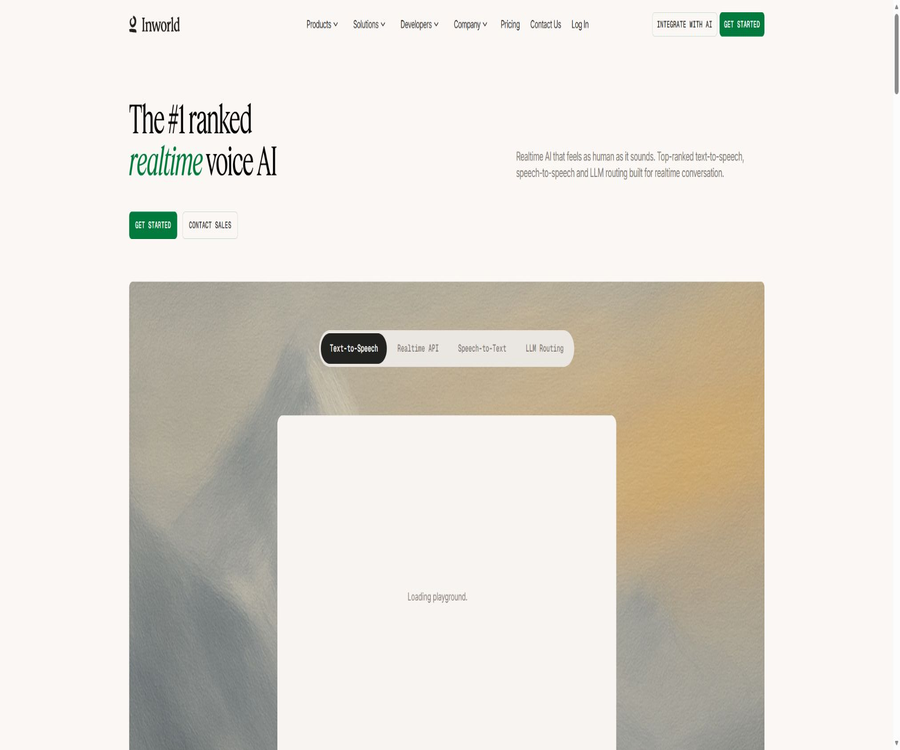
Inworld
Inworld: an intelligent tool focused on improving AI efficiency.
Tags:AI improves efficiencyA one-sentence summary
Inworld AI is a development platform designed for real-time voice applications; it integrates text-to-speech, speech-to-text, full-duplex dialogue, model routing, and hosted inference within a single accounting and billing system.
Tool Introduction
Inworld AI is operated by Theai, Inc. It initially gained attention for its capabilities related to game characters and AI NPCs; today, its focus has shifted to the infrastructure needed for real-time voice processing and low-latency inference in consumer applications. It functions more like a developer API platform rather than a voice-editing tool intended for ordinary users.
The main applications include voice companionship, language learning, games and interactive media, customer service, outbound sales calls, and intelligent phone agents. Developers can use just one voice model, or they can combine various elements through the Realtime API to create complete conversation flows.
Current product composition
| Products | Key capabilities | Input and output | Suitable scenarios |
|---|---|---|---|
| Realtime TTS | Low-latency text-to-speech, cloning, and sound design | Text-to-stream or full audio | Voice assistants, voiceovers, and interactive characters |
| Realtime STT | Transcribe and extract speaking features | Audio to text conversion and voice profiling | Real-time dialogue and call understanding |
| Realtime API | Include STT, LLM, and TTS in continuous sessions | Bidirectional streaming of audio, text, and events | Full-duplex voice agent |
| Realtime Router | Access and route over 220 models through a unified interface. | Convert messages into model text or voice responses | Model switching, load distribution, and failover |
| Realtime Inference | Host and optimize open-weight models | Request the text for low-latency inference results. | High-frequency consumption apps |
| Compute | Provide managed GPU services for customers with high usage levels. | Exclusive reasoning and capacity | Large-scale stable production load |
Realtime TTS
Realtime TTS offers two model options: TTS-2 and TTS-2 Flash. The former focuses on natural language control and expressiveness, while the latter emphasizes lower latency and lower character costs.
| Model | Positioning | Public delay metrics | Language | Suitable for tasks |
|---|---|---|---|---|
| Realtime TTS-2 | High expressiveness and controllable voice | 100 milliseconds saved for the first character of P90 | Over 200 kinds | Characters, customer service, and emotional dialogue |
| Realtime TTS-2 Flash | Low latency and low cost | 20 milliseconds saved for the first character of P90 | Over 200 kinds | High-concurrency real-time assistant and large-scale generation |
The latency metric is measured on the server side and does not take into account the user’s network, application buffering, or the processing time of the playback device. The actual end-to-end response time also depends on text generation, connection quality, and the client implementation.
Voice control and output
- It is possible to control emotions, enunciation, tone, volume, pitch, speed, and speaking style using natural language.
- Instructions, pauses, and non-verbal sounds can be added to the text.
- It supports stream-based generation, making it suitable for synthesis and playback simultaneously.
- It can return word, phoneme, and lip-sync timestamps for subtitles and character lip synchronization.
- It supports control of speech speed, tone, custom pronunciation, and various audio encoding settings.
- Playground makes it easy to listen to a sound first, before using the same sound identifier in the program interface.
Voice cloning and sound design
Instant Voice Cloning allows for the creation of a voice using about 5 to 15 seconds of reference audio, enabling that same voice to be produced in over 200 different languages. Voice Design, on the other hand, generates new voices directly based on textual descriptions such as age, accent, timbre, and energy level.
- Confirm that the recorder has given clear consent to cloning, storing, and the intended use.
- Record clear samples with no background music, no echo, and only one person present.
- After creating a sound, save the identifier of the resulting sound.
- Use short texts to test the original language, cross-lingual capabilities, and various expression instructions.
- Check for similarity, risk of misguidance, sensitive words, and commercial licensing.
- Add identity disclosure, access control, and abuse monitoring to public deployments.
Professional Voice Cloning is available as an additional feature for Developers; Growth includes 1 such option, while Enterprise versions are configured according to the contract terms. Voice cloning involves data that can be considered biometric information, and it is not permissible to copy someone else’s voice without authorization.
Realtime STT
Realtime STT is responsible for converting speech into text, and it can identify characteristics such as age range, pitch, emotion, speaking style, and accent through voice profiling. This product can be integrated with Inworld’s own transcription services as well as other speech recognition providers.
| Ability | Function | Usage notes |
|---|---|---|
| Real-time transcription | Provide continuous text input for voice agents. | Handle network jitter, disconnections, and reconnections |
| Voice profiling | Help the model understand expressions and context. | Its characteristic is that it relies on model inference, and cannot be used as a conclusion regarding identity or medical conditions. |
| Multiple providers | Choose Inworld or other STT services based on capabilities. | Compare languages, delays, costs, and reservation policies |
| Flow connection | Return results while receiving audio. | Control concurrency and session lifecycle |
| Charging based on audio duration | Charges are deducted based on the number of processing hours. | Silencing, retrying, and re-uploading can also affect costs. |
Realtime API
The Realtime API combines speech recognition, large models, and speech synthesis through a continuous WebSocket session, enabling users to interrupt, resume, and speak alternately in a natural manner. It is compatible with the OpenAI Realtime protocol, facilitating the migration of existing clients.
- It features built-in voice activity detection to determine when the user starts and stops speaking.
- Smart Turn helps to distinguish between brief pauses and the actual end of a speech.
- You can use the models available in the Router, or you can choose to integrate your own models as per your design.
- It supports multi-modal sessions that consist of audio, text, and certain image content.
- The underlying TTS, STT, and LLM services are charged based on actual usage.
- A persistent connection requires handling heartbeats, reconnections, cancellations, and session status restoration.
Build a voice agent
- Create accounts, workspaces, and API credentials intended solely for use on the server side.
- First, determine the TTS voice, STT settings, and target model in Playground.
- Design system instructions, tools, user interruption rules, and conversation termination rules.
- Establish real-time sessions and handle audio formats, events, and streaming playback correctly.
- Set fallback paths for network disruptions, model timeouts, and tool failures.
- Record latency, transcription errors, interruption success rate, task completion rate, and cost per minute.
- Launch on a small scale first, then increase concurrency and verify that the billing matches the actual usage.
Realtime Router
Realtime Router provides access to over 220 models through an interface that is compatible with the calling methods of OpenAI and Anthropic. Third-party models are resold at the costs specified by their providers, without any additional charges; however, a fee is applied when proprietary keys are used.
| Routing capabilities | Working method | Applied value |
|---|---|---|
| Conditional routing | Select a model by language, region, package, intent, or emotion. | Match costs and capabilities to different users |
| Traffic splitting | Allocate requests to multiple models in proportion. | Conduct online A/B testing |
| Viscous distribution | The same user continues to use the same experimental variant. | Maintain a consistent experience |
| Automatic failover | Try candidate models in case of failure or speed limitations. | Improve service continuity |
| Auto selection | Filter by price, latency, throughput, or benchmark. | Dynamically optimized model combination |
| Observability | Record the selected model, attempt chain, first token time, and cost. | Analyzing quality and cost |
| Analysis export | Send request-level data to an external analysis system. | Create a custom operational dashboard. |
| Integrated voice | Add audio settings to the chat request | One call returns both text and speech. |
Models and billing methods
The price information was verified on August 23, 2026; the actual amounts, taxes, exchange rates, and discounts may vary, and the final figures will be those displayed on the settlement page.
The Router covers providers such as OpenAI, Anthropic, Google, Meta, Mistral, DeepSeek, xAI, as well as open-weight models optimized for Inworld. The list of models and their respective prices change frequently, so it is necessary to retrieve this information dynamically from the current model catalog.
| Calling method | Charging rules | Precautions |
|---|---|---|
| Third-party models resold in Inworld | Based on the provider’s costs, no extra fee is charged for the router. | It remains affected by the input, output, and caching prices of various models. |
| Bring your own provider key | Provider cost plus 4% | The bills will be issued by both the provider and Inworld. |
| Inworld’s own reasoning mechanism | According to its model rates | It can be optimized for consumption volume and real-time latency. |
| LLM in Realtime API | Measured separately for TTS and STT. | The total cost is the sum of the usage amounts for the three layers. |
Playground and API development
The platform offers playgrounds such as TTS and Realtime, which facilitate testing of sounds, models, and parameters before writing code. For actual applications, integration is achieved through server-side APIs or WebSocket; temporary tokens should be used for real-time browser sessions in order to prevent the exposure of the main key.
- REST is suitable for one-time TTS, STT, and resource management requests.
- Stream-based TTS returns audio content in multiple lines of JSON, which requires decoding line by line.
- WebSocket is suitable for full-duplex real-time voice communication and maintaining a persistent state.
- Routers are compatible with common SDKs; however, it is still necessary to check those extension fields that are not identical during migration.
- Credentials are subject to concurrency limits based on the account, and should be separated by environment as well as rotated regularly.
- Production systems must implement timeout, exponential backoff, quota protection, and log anonymization.
Subscription plans
| Plan | Monthly fee | Integral per cycle | Primary interests | Suitable for users |
|---|---|---|---|---|
| On-Demand | Start for free | Includes a free trial amount | Up to 70 minutes for TTS or 400 minutes for STT, 100 custom voices, API and Router, commercial license | Evaluation and prototyping |
| Creator | $ | 25 dollars in points | 500 sounds; up to 40,000 characters per Playground session; workspace and team management | Content creation and small projects |
| Builder | 100 dollars per month | 100 dollar points | 3000 voices, higher concurrency, workspace sharing, and lower rates | Growth programs and small teams |
| Developer | $ | 300 dollar points | 10,000 voices, 150 concurrent TTS sessions, professional cloning features, and priority email support | Production applications |
| Growth | $ | 1500 dollars in points | 30,000 voices, 500 concurrent TTS sessions, 1 professional clone, and compliance add-ons | Large-scale and compliant deployment |
| Enterprise | Custom quote | In accordance with the contract | Customization restrictions, SLAs, DPA, on-premises deployment, data residency, and dedicated support | Ultra-large scale and customized environments |
The payment options include monthly or annual billing; the annual fee is charged in a single installment. The price of the package is converted into equivalent usage points in dollars, and any additional usage is covered by further purchases at the applicable rate or through automatic top-ups.
Unit prices for TTS and STT
| Plan | TTS-2 per million characters | TTS-2 Flash per million characters | STT 1 per hour |
|---|---|---|---|
| On-Demand | 25 dollars | 15 dollars | 0.15 dollars |
| Creator | 20 dollars | 10 dollars | 0.10 dollars |
| Builder | 17.50 dollars | 9 dollars | 0.10 dollars |
| Developer | 15 dollars | 8 dollars | 0.10 dollars |
| Growth | 12.50 dollars | 7 dollars | 0.10 dollars |
| Enterprise | As low as $5 | Less than $5 | Customization |
Any excess usage under the same plan is charged at the price applicable to that tier. The Realtime API does not have a fixed rate per minute; instead, it charges separately based on the actual number of TTS characters, the duration of the STT audio, and the number of LLM tokens used.
Concurrency and capacity
| Plan | TTS concurrent generation | STT stream concurrent processing | Realtime concurrent sessions | Estimate voice user sessions |
|---|---|---|---|---|
| On-Demand | 5 | 10 | 10 | About 20 |
| Creator | 10 | 20 | 20 | About 40 |
| Builder | 50 | 100 | 100 | About 200 |
| Developer | 150 | 300 | 300 | About 600 |
| Growth | 500 | 1000 | 1000 | About 2000 |
| Enterprise | Customization | Customization | Customization | Customization |
The concurrency limits are shared across accounts and API keys; requests that exceed these limits will be processed only as capacity permits. Capacity planning should be based on peak values and stress tests, and the estimated number of sessions cannot be used as a guarantee for service performance.
Validity period of points and account changes
- Unused credits from a paid plan can be carried over for up to 3 months, as long as the subscription remains active and the value of the plan does not decrease.
- The points issued each month have a separate 3-month validity period.
- The minimum amount to purchase additional points is 10 dollars, and they are valid for 1 year after purchase.
- Automatic top-up can be set up to replenish points when the balance falls below a certain threshold.
- The upgrade takes effect immediately, and the full cost of the new plan plus any unused usage up to that point will be charged.
- The downgrade or cancellation takes effect at the end of the current cycle, and any remaining points will be deleted.
- After consecutive payment failures and 7 days of retry attempts, the account will be downgraded to On-Demand status and its API will be disabled.
Responsibilities for sound and privacy
The privacy policy includes chats, recordings, and voice characteristics derived from sound among the data that may be processed; some of these characteristics may constitute biometric information in certain regions. Voice cloning and analysis require appropriate consent, and mechanisms for deletion and withdrawal must be provided.
| Data | Primary uses | Risk control |
|---|---|---|
| Refer to the recording | Create instant or professional voice clones | Save consent, limit usage, and protect the original audio. |
| Speech features | Maintain the vocal identity or assist in contextual understanding | Not used for identity verification or sensitive inference. |
| Transcribed text | Provided for models and business tools | Mask sensitive data and limit log retention. |
| Dialogue audio | Real-time processing, quality, and service operations | Clear audio notification and regional consent |
| Accounts and Transactions | Authentication, billing, and support | Minimum permissions and audit access |
| Analyze data | Improve products and assess their usage. | Distinguish between customer data and de-identified research data |
Privacy Policy Note: Inworld may use certain information for research and development as well as for model training; it also offers an option that allows companies to avoid any data retention. For sensitive or regulated workloads, the terms related to termination of training, retention periods, and the scope of applicable products must be specified in the contract.
Safety and compliance
| Project | Public status | Applicable reminders |
|---|---|---|
| SOC 2 | Type II | Request the current report and verify the covered services. |
| GDPR | The statement is in compliance. | Customers still need to determine the legal basis and exercise their data rights. |
| HIPAA and BAA | Additional items can be purchased for Growth. | Sign the BAA and define the scope of processing for protected health information. |
| Zero Data Retention | Additional options for Growth can be purchased, and businesses can negotiate these options. | Verify that TTS, STT, Router, and third-party models are all covered. |
| Encryption | Static AES, Transport TLS | Verify the key, backup, and logging environments. |
| Single sign-on | The enterprise supports SAML and OIDC. | Combining role permissions with automatic configuration |
| Local deployment | Provided by Enterprise | Clarify responsibilities for models, updates, hardware, and operations. |
| Data residency | Enterprise offers options for the EU and India. | Verify all sub-processors and backup locations. |
GitHub, SDKs, and open-source status
Inworld has an active official GitHub organization that makes available TTS code, API examples, runtime templates, MCP tools, voice migration tools, as well as various sample applications. The TTS code, API examples, and those templates are licensed under the MIT license.
The public examples and templates do not imply that the hosting platforms, models, or all SDKs are open source. Certain Runtime binaries, as well as older versions of the Unity and Unreal SDKs, are subject to specific licensing terms; it is necessary to check the license for each repository and each component before using them.
| Development resources | Public information | License notes |
|---|---|---|
| TTS warehouse | Public | Mark as MIT |
| API Examples | Public | Mark as MIT |
| Node Runtime template | Public | MIT license; separate terms apply to the binary files. |
| MCP tool | Public | Based on the current license usage of the warehouse |
| Unity and Unreal assets | Some SDKs and examples are available for download. | Subject to SDK or project license restrictions |
| Managed models and cloud platforms | Not open source | Through commercial terms and API usage |
Which users are it suitable for
- Form a team to develop consumer applications for voice-based companionship, social interaction, language learning, and interactive features.
- Developers who need low-latency multilingual TTS and voice cloning.
- The goal is to integrate STT, LLM, and TTS into a single voice intelligence agent for real-time conversations.
- A platform engineering team that is required to handle routing, testing, and failover among more than 220 different models.
- Companies that require large-scale concurrency, dedicated capacity, or on-premises deployment.
- Developers who use Unity, Unreal, Node.js, and common voice frameworks to create interactive experiences.
Product advantages
- TTS, STT, Realtime API, and the model Router share accounts, credits, and development documentation.
- TTS-2 takes into account expression control, while Flash focuses on low latency and low costs at large scales.
- Sound cloning samples are short in length, and they allow the preservation of the voice’s identity across more than 200 languages.
- The Router is compatible with common calling methods and supports conditional routing, testing, and automatic failover.
- The subscription price is converted into available credits; the premium plan sees a reduction in the unit price along with an increase in concurrent usage.
- Options include SOC 2 Type II, enterprise ZDR, on-premises deployment, and data residency options.
- The official GitHub examples and templates cover various programming languages as well as real-time speech frameworks.
Usage restrictions and cost risks
- The total cost of real-time voice processing is composed of TTS, STT, and LLM – it’s not possible to consider only the cost per character.
- Paid points can be carried forward for a maximum of 3 months; any unused balance is cleared in the event of cancellation or downgrade.
- High concurrency, professional voice cloning, ZDR, HIPAA, and local deployment require higher-tier solutions or additional features.
- The server latency metrics do not include network delays, model generation time, or client playback time.
- Voice profiling is a form of probabilistic inference; it cannot replace identity verification, emotion detection, or human judgment.
- Third-party models and proprietary keys may introduce additional contracts, warranties, and costs.
- The core cloud services and models are not open source; the public repositories contain mainly code, templates, and examples.
Go-live checklist
- Determine whether only TTS or STT is needed, or if a full Realtime session and Router are required.
- Test sound quality, transcription, and interruptions using representative languages, devices, and networks.
- Estimate characters, audio hours, LLM tokens, and concurrent sessions based on the peak value.
- Compare package points, unit price, rollover period, and excess fees to set up budget alerts.
- Obtain explicit authorization for voice cloning, and assess biometric and recording regulations.
- The master key is stored on the server, while the browser uses only short-term credentials.
- Verify third-party model retention, ZDR, HIPAA, data residency, and deletion requirements.
- Handle deployment timeouts, reconnections, model rollback, and manual intervention, then gradually increase the scale.
Frequently Asked Questions
What is Inworld AI doing mainly these days?
The current focus is on real-time voice and reasoning infrastructure, including TTS, STT, full-duplex voice APIs, model routers, and hosted computing, rather than just the earlier AI role tools.
Is Inworld AI free?
On-Demand can be started for free, offering up to around 70 minutes of TTS service or 400 minutes of STT service. Beyond this free quota, charging applies based on actual usage; some advanced models require a payment method to be linked.
Is Chinese supported?
The TTS-2 series supports over 200 languages, including Chinese. Before putting it into use, it is necessary to test each type of output – standard Mandarin, different accents, numbers, proper nouns, and custom pronunciations.
How many recordings are needed for voice cloning?
Instant cloning typically provides clear audio within 5 to 15 seconds. Professional cloning is part of higher-tier packages or additional services, and it requires compliance with sound licensing requirements.
How is the Realtime API priced?
There is no separate fixed price per minute; the cost for TTS characters, STT audio duration, and LLM tokens within a session is calculated based on the respective rates outlined in the current plan.
Will the Model Router have an additional cost?
Third-party models are routed through Inworld, and billing is based on the provider’s costs; no additional fee is charged for the router. When using an existing key, a 4% service fee is specified in the documentation.
Will the points be carried over?
The monthly points under a paid plan can be carried over for up to 3 months, as long as the subscription remains at the same level or at a higher one; additionally purchased points are valid for 1 year. The remaining points are deleted when the subscription is canceled or downgraded.
Is Inworld AI open-source?
The core platform and models are not fully open source. The official team has made available TTS code, API examples, and various templates under the MIT license, but some SDK binaries are subject to separate licensing terms.
Summary
Inworld AI is suitable for teams that need to integrate natural speech processing, low-latency conversations, and multi-model reasoning into large-scale consumer applications. It can provide TTS or STT as standalone services, or it can be used together with Realtime APIs and routers to create a complete voice intelligence framework.
When selecting a plan, it is necessary to take into account the length of the text, the audio duration, the number of model tokens, the level of concurrency, and the validity period of the credits. In cases involving voice cloning, medical data, or sensitive information, authorization procedures, ZDR rules, contracts, and human oversight must also be implemented in addition to technical testing.
Tools similar to Inworld


 Guigong Network Security Registration No. 45132202000164