






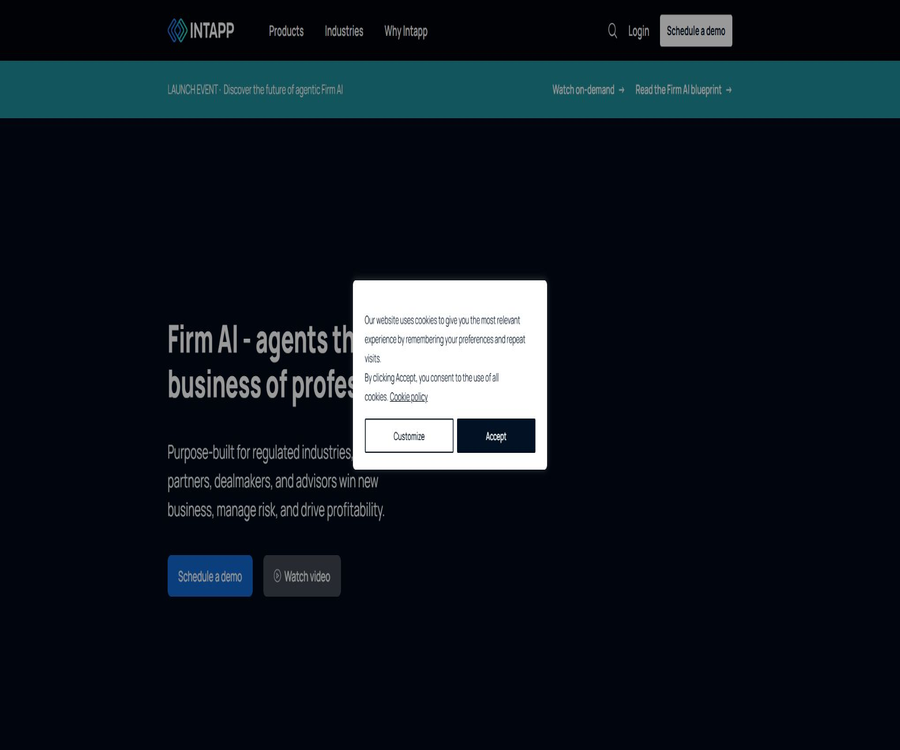
Intapp
Intapp, an intelligent tool focused on enhancing efficiency through AI.
Tags:AI improves efficiencyWhat is Intapp?
Intapp is an enterprise software platform designed for regulated professional service firms, serving law firms, private equity firms, investment banks, accounting firms, consulting agencies, and real estate investment teams. It integrates customer relationships, transaction processes, risk compliance, knowledge collaboration, as well as time and billing management, all within a unified framework that leverages data and AI capabilities.
The platform is currently centered around Firm AI, with an emphasis on enabling AI to understand a company’s customers, transactions, relationships, projects, and rules. It is not a standard chatbot; rather, it is a professional system that requires companies to purchase it, implement it, define its permissions, and manage its data.
A one-sentence summary
Through Celeste, DealCloud, and a range of professional process products, Intapp provides regulatory agencies with a Firm AI work platform that includes features such as access controls, ethical safeguards, and manual approval processes.
Product portfolio
| Product or capability | Main functions | Suitable for teams | Core values |
|---|---|---|---|
| Intapp Celeste | Create, run, and orchestrate organization-specific AI agents | Lawyers, investment specialists, accountants, consultants, and management teams | Integrate corporate knowledge, processes, and compliance rules into intelligent agents |
| Intapp Assist | Generative AI features embedded in existing products | DealCloud, Time, and Terms users | Q&A, summarization, generation, recommendations, and automatic data entry |
| Intapp DealCloud | Transactions, customer relationships, pipeline, and market intelligence | Private equity, investment banks, law firms, accounting firms, and consulting firms | Identify opportunities, maintain relationships, and facilitate transaction execution. |
| Intapp Conflicts and Intake | Conflict checking, risk assessment, and customer acceptance | Risk, Compliance, and Business Acceptance Teams | Shorten the processes for verification and account opening |
| Intapp Walls | Moral walls, access policies, and auditing | Legal, compliance, information security, and IT | Isolation of information across systems, personnel, and AI systems |
| Intapp Terms | Extraction, classification, and enforcement of customer terms | Law firm risks, finance, and business teams | Reduce violations of customer guidelines and billing disputes |
| Intapp Time and Billstream | Working hour tracking, standard verification, and pre-invoice process | Professional staff, finance, and billing teams | Reduce revenue omission errors and speed up bill review |
| Intapp Collaboration | Microsoft 365 workspaces, knowledge search, and archiving | Accounting, consulting, and project delivery teams | Automatically create spaces and preserve institutional knowledge |
What is Intapp Celeste?
Celeste is Intapp’s intelligent agent platform designed for professional organizations, serving as an AI collaborator to assist with business tasks. It creates a context based on data related to customers, transactions, relationships, and projects from Intapp’s products, and then carries out specific tasks using governed workbooks.
Organizations can use pre-built industry scenarios or adjust the agents according to their own processes. Celeste not only provides suggestions but also helps to update records, draft follow-up actions, and drive tasks forward; however, sensitive modifications require manual approval.
Celeste’s main abilities
- Generate context-specific responses based on internal organizational knowledge and industry data;
- Rate the list of transactions based on investment strategies to help identify opportunities;
- Generate briefings prior to client, investor, transaction, and project meetings;
- Track meeting commitments, follow-up tasks, and the progress of transactions;
- Provide assistance with preparing proposals, outreach materials, and recommendations for relationship maintenance;
- Perform conflict detection and customer assessment under risk rules;
- Sensitive writes to business records are controlled through manual approval;
- It is used in work environments such as Intapp products and Microsoft Copilot.
How does Celeste manage AI actions?
Celeste inherits the institution’s access policies, ethical safeguards, rules regarding informed consent, and compliance controls; it is able to process only those pieces of information to which the current user has access. Every write operation requires approval, which helps prevent the AI from altering transactions or customer records without proper authorization.
| Governing body | Function | Key implementation points |
|---|---|---|
| Identity and user permissions | Determine who the agent represents and what access they have. | Connect to the enterprise identity system and apply the principle of minimum privileges. |
| Moral Wall | Prevent the leakage of sensitive information across different customers, transactions, or projects. | Keep the mappings of personnel, tasks, and systems up to date in real time. |
| Rules for informed need | Limit the visible range to the information needed to complete the task. | Define permissions by role and project. |
| Governance Work Manual | Limit the steps, skills, and tools that a proxy can use. | Version control and documentation of change approvals |
| Manual approval | Maintain ultimate control before performing sensitive writes. | Define which actions need to be approved by whom. |
| Audit records | Log access, block, approve, and execution status | Set retention, alerts, and regular reviews. |
What is Intapp Assist?
Intapp Assist is a set of generative AI features integrated into Intapp products, currently used in workflows such as Time, Terms, and DealCloud. It can analyze organizational data, answer questions in natural language, and assist with summarization, generation, recommendations, and structured data entry.
| Ability | Specific functions | Typical scenarios | Human liability |
|---|---|---|---|
| Zero entry | Extract entities, concepts, and emotions from structured and unstructured content and label them. | CRM recordkeeping and activity tracking | Verify entity matching and sensitive fields. |
| Conversational query | Query institutional data using natural language | Ask the customer about terms, transactions, or the relationship. | Check permissions, criteria, and the basis for answers. |
| Summarization | Summarize notices, reports, contracts, and records | Due diligence, client briefing, and term review | Check for omissions and key exceptions |
| Generation | Drafting emails, narratives, and business content | Outreach, proposals, and CRM descriptions | Manually approved facts and tone |
| Recommendation | Hints on companies, relationships, opportunities, and next steps | Business development and transaction screening | Prevent algorithmic suggestions from being regarded as final decisions. |
DealCloud Relationship and Transaction Intelligence
DealCloud is a relationship and transaction intelligence platform designed for professional organizations, covering areas such as business development, pipeline management, due diligence, execution, fundraising, and customer management. It continuously analyzes relationships, communications, transaction flows, tasks, and projects, thereby identifying opportunities, risks, and recommended actions.
Relationship Intelligence
The platform displays the connections between partners, investors, customers, companies, and transactions through relationship maps and signals indicating the strength of those relationships. Teams can identify referral opportunities, areas where coverage is lacking, and opportunities for cross-selling.
Automatic activity capture
DealCloud can capture emails and meetings from Outlook, and create compliant records of contacts, companies, and interactions. Automatic recording reduces the need for manual entry, but it is necessary to manage private communications, duplicate contacts, and incorrect associations.
Configurable workflows
Teams can use rules to trigger tasks, approvals, and escalations, thereby standardizing an organization’s transaction or customer processes. Role permissions and audit trails help maintain governance even when operations are carried out quickly.
Abundant data
Intapp Data allows for the supplementation of company and contact information, and it also enables connection to market data services such as Preqin, PitchBook, and FactSet. Third-party data typically requires separate authorization, and it is necessary to keep track of the date of update, the permissions granted, and the fields covered.
Use cases for DealCloud
| Industry | Main process | Uses of AI and data | Key risks |
|---|---|---|---|
| Private equity | Project acquisition, screening, due diligence, investment committee review, fundraising, and exit | Transaction matching, LP relationships, and action summary | MNPI, valuation bias, and permission isolation |
| Investment banking | Customer coverage, business acquisition, promotion, and transaction execution | Market signals, relationship pathways, and pipeline analysis | Conflicts of interest, confidentiality, and record integrity |
| Law firm | Customer acquisition, bidding, key customers, and marketing | Experience with matters, relationships, and recommendations for cross-service approaches | Moral wall, customer consent, and lawyer’s judgment |
| Accounting and Consulting | Business opportunities, project delivery, and customer expansion | Service usage, capability matching, and recommended outreach | Independence, conflicts of interest, and project data |
| Real estate investment | Project acquisition, development, asset management, and exit | Location, transaction, relationship, and combination analysis | Data timeliness, valuation, and geographic information licensing |
Customer acceptance and conflict management
Intapp Intake converts unstructured intake requests into structured project records, and integrates risk assessment, third-party screening, and approval processes into a unified workflow. Intapp Conflicts searches through customers, tasks, relationships, and corporate hierarchies to assist the risk management team in identifying and addressing potential conflicts.
- Collect information on new customers, new matters, and transaction requests in a centralized manner;
- Link corporate structure, industry classifications, and employee disclosure data;
- Automatically carry out screenings for sanctions, reputation, independence, and other risks;
- Grade the matched items and route them to the appropriate reviewers;
- Record exemptions, conditions, approvals, rejections, and subsequent obligations;
- Continuously monitor for new conflicts as the business environment changes.
Intapp Walls Moral Wall
Intapp Walls is used to define information isolation policies and to synchronize access rules to users, systems, and AI tools. It can verify each permission change, automatically correct any unauthorized alterations in external systems, and maintain a complete audit trail.
| Ability | Function | Application object | Precautions |
|---|---|---|---|
| Centralized strategy | Define and maintain an ethical wall in a control center | Customers, matters, transactions, and internal teams | The basic master data must be accurate. |
| Real-time execution | Sync the changes to the connected system. | Documents, collaboration, business applications, and AI | Test delay and failure compensation |
| Governance of AI tools | Apply the same permissions to Celeste, Copilot, and other AI systems. | Hints, retrieval, and proxy actions | Verify the coverage area of each connector. |
| Member confirmation | Notify the members and record their confirmation. | Teams under isolation and new members | Define overdue handling and escalation. |
| Anomaly detection | High-risk accesses and blocked attempts were detected. | Internal staff and automated agents | Establish alarm classification and investigation procedures |
| Audit reports | Record policies, access, and change history | Audits, customer inquiries, and regulatory inspections | Set retention and export permissions |
Intapp Terms – Terms management
Intapp Terms stores customer guides and supplier agreements in one place, and uses Celeste to extract, match, and categorize the relevant obligations. Users can ask questions about these terms using natural language, and the responses are linked to the corresponding documents, making it easier to review them.
- Receive customer guidelines from Outlook and match them to the correct customers;
- Automatically identify, classify, and summarize business terms;
- Compare the conflicting requirements in supplier agreements and customer obligations;
- Verify the terms extracted by AI through the approval process;
- Set reminders for deadlines and subsequent tasks;
- Carry out duties in Intake, Conflicts, Time, and Billstream;
- When the document is updated, the marked clauses are retained and re-matched.
Intapp Time and Billstream
Intapp Time reconstructs a user’s day based on emails, meetings, documents, and other work activities, generates time-entry suggestions that can be reviewed, and checks the client’s billing requirements when those entries are made. Intapp Billstream integrates bill preparation, compliance verification, collaborative review, and approval into a single process.
| Products | Main inputs | Main output | Business value | Key controls |
|---|---|---|---|---|
| Intapp Time | Calendar, emails, documents, events, and customer rules | Working hours recommendations, descriptions, and profit analysis | Reduce missed entries and improve utilization rates | Personnel verification, privacy, and narrative accuracy |
| Intapp Billstream | Working hours, rates, customer requirements, and pre-invoices | Compliance pre-bills, approval, and audit records | Speed up invoicing and reduce disputes | Rates, write-downs, approvals, and the final financial system |
AI-driven automatic recording cannot replace professional verification of actual tasks, clients, matters, duration, and descriptions. Incorrect time records can lead to disputes with clients, as well as issues related to professional responsibilities and regulation.
Intapp Collaboration
Intapp Collaboration automatically creates Microsoft Teams and SharePoint project spaces, and configures members, permissions, folders, and metadata based on templates. Outlook emails can be archived in the corresponding projects manually or automatically.
Unified search and AI assistants can answer questions, generate summaries, and suggest subsequent tasks by drawing on historical projects, deliverables, and documents. Once a project is completed, the platform retains metadata, ethics records, and audit logs for archiving and knowledge reuse.
Integration and data foundation
Intapp Integrations offers pre-built connectors, code-free integration options, workflow automation, hybrid deployment capabilities, as well as scalable integration services. It enables connections to everyday business software, Intapp’s own products, and data from trusted third parties.
| Integration type | Example | Primary uses | Key implementation points |
|---|---|---|---|
| Microsoft 365 | Outlook, Teams, SharePoint, and Copilot | Activity capture, collaboration, documentation, and AI entry points | Tenant permissions, application consent, and ethical walls |
| Third-party market data | Preqin, PitchBook, and FactSet, among others | Company, contact, and transaction information | Individual licensing, field mapping, and usage restrictions |
| Enterprise data platform | Snowflake, etc. | Analysis, data exchange, and AI context | Region, refresh, access, and cost |
| Intapp Integration Service | Pre-built connections, code-free workflows, and hybrid access | Connecting legacy systems with cloud services | Monitoring, retrying, versions, and responsibility boundaries |
| Open APIs and MCP | Celeste is connected to an external AI stack. | Proxy tool calls and system orchestration | User permissions, write approval, and auditing |
| Partner ecosystem | Data, technology, and service partners | Implementation, expansion, and industry data | Third-party contracts and security audits |
Steps to deploy Celeste
- Select specific scenarios such as transaction filtering, meeting summaries, customer risk assessment, or knowledge Q&A.
- Identify the Intapp products, third-party data sources, and enterprise systems required for the scenario.
- Organize master data for customers, transactions, relationships, tasks, and personnel.
- Configure identities, roles, moral walls, awareness requirements, and write approval.
- Select the underlying model and define the skills, APIs, and MCP tools that can be invoked.
- Use real but controlled data to test responses, suggestions, and write actions.
- Verify unauthorized requests, prompt injection, invalid entities, and tool failures.
- Roll out in phases, with continuous auditing of access, approvals, corrections, and business outcomes.
Steps to implement the Intapp platform
- Identify business issues, product scope, target industry processes, and success metrics.
- Inventory CRM, finance, document, identity, email, and market data systems.
- Unify company, customer, relationship, matter, transaction, and employee identifiers.
- Design data migration, retention, permission, ethical walls, and audit solutions.
- Configure industry blueprints, workflows, forms, rules, and integrations.
- Have business, risk, legal, IT, and security teams work together to carry out the acceptance process.
- Train administrators, professionals, and auditors, and clarify human responsibilities.
- Start by deploying representative teams, and then expand based on data quality and adoption levels.
Which users is it suitable for?
- Private equity and investment banks that require institutional-level relationships and transaction management;
- Law firms that manage client onboarding, conflicts, ethical issues, and terms at the same time;
- Accounting firms that require independence, risk management, and project collaboration processes;
- A consulting company that aims to unify customers, projects, and knowledge;
- Investment teams that require expertise in real estate transactions, development, and portfolio management;
- Professional organizations that wish to use intelligent agents under constraints related to permissions and auditing;
- Enterprises that need to connect to Microsoft 365, third-party data, and internal systems.
In what situations is it not very suitable?
- Only users who need free personal chatting or general writing tools;
- Small teams that wish to see the fixed price directly and activate the service by card immediately;
- Organizations that do not have master data for stable customers, transactions, matters, and relationships;
- Organizations that are unable to allocate resources to business, risk, IT, and security personnel;
- Teams that require all model and platform code to be fully open source;
- Scenarios in which AI is expected to make decisions related to sensitive business matters without human approval;
- Only enterprises that need a simple, general-purpose CRM and do not have any regulatory requirements apply.
Product advantages
- Design data models and workflows for regulated professional service industries;
- Celeste combines the enterprise context, intelligent agents, and governance controls.
- Moral walls can cover people, systems, and AI tools;
- DealCloud provides unified management of relationships, pipelines, transactions, and market intelligence.
- Customer acceptance, conflicts, terms, working hours, and invoices form a cohesive process;
- Microsoft 365 integration reduces the burden on professionals when switching systems;
- Open APIs, MCP, and integration services enable connection to existing technology stacks;
- Various cloud security and privacy certifications are suitable for corporate procurement evaluations.
Usage restrictions
- The product portfolio is complex, with different modules requiring separate selection, licensing, and implementation;
- There is no fixed public price, and the actual total cost must be determined through the sales quote.
- The quality of AI depends heavily on master data, relational records, and permission settings.
- Automatic activity capture may pose risks to private communications and incorrect associations.
- Third-party market data usually requires additional licenses and usage controls;
- The effectiveness of the moral wall depends on all target systems being correctly connected and synchronized.
- Agent-recommended and generated content may still be incorrect, outdated, or lack context;
- Migrating large-scale systems, managing changes, and getting users to adopt them can require a lengthy time frame.
Price and version
The price information was verified on August 23, 2026; the actual amounts, taxes, exchange rates, and discounts may vary, and the final figures will be those displayed on the settlement page.
Intapp does not disclose fixed standard pricing; it primarily relies on scheduled demonstrations, needs assessments, and corporate contract sales. The quotes vary depending on the product modules, number of users, industry sector, data volume, integration requirements, deployment processes, as well as the scope of support provided.
| Product or solution | Price | Billing cycle | Core benefits or quota | Suitable for users |
|---|---|---|---|---|
| Intapp Celeste | Custom quote | Corporate contracts | Firm AI agents, industry use cases, governance, model selection, API and MCP connections | Professional service companies that require agency-level intelligent agents |
| Intapp DealCloud | Custom quote | Subscription contract | Relationships, transactions, pipelines, activity capture, AI, and data enrichment | Private equity, investment banks, law firms, accounting firms, and consulting firms |
| Risk and Compliance Suite | Custom quote | Subscription contract | Intake, Conflicts, Walls, Terms, and Employee Compliance, etc. | Risk and compliance teams of regulatory authorities |
| Revenue and collaborative products | Custom quote | Subscription contract | Time, Billstream, Collaboration, and related integrations | Professional staff, finance team, and project delivery team |
| Implementation and integration services | Quotation by project | One-time or periodic | Migration, configuration, connection, training, and technical support | Customers who require implementation on-site and system integration |
How is the procurement cost evaluated?
| Cost items | Possible contents | It should be confirmed at the time of purchase. |
|---|---|---|
| Software subscription | Products, users, environment, and functions | Minimum duration, scaling up, downgrading, and renewal rules |
| Celeste and AI | Proxy scenarios, model invocation, and governance | Is pricing based on users, usage, skills, or modules? |
| Third-party data | Company, contact, market, and transaction data | Independent licensing, geographical, and redistribution restrictions |
| Implementation | Migration, configuration, testing, and project management | Scope, milestones, acceptance, and change orders |
| Integration | Connectors, IIS, APIs, and legacy systems | Number of interfaces, monitoring, maintenance, and upgrades |
| Training and support | Administrators, users, and advanced services | Support level, time zone, response time, and number of training sessions |
Companies should request quotes that show the costs for the first year as well as those for subsequent years, in order to avoid focusing solely on the software subscription cost. Data cleanup, migration, consulting services, identity management systems, third-party data, and internal change management are also often significant expenses.
Privacy and data processing
The platform may handle customer, contact, transaction, email, calendar, document, time-tracking, financial, risk, and employee information. Organizations need to determine the responsible parties, those who process the data, the legal basis for such processing, the retention period, and the responsibilities related to requests from data subjects, depending on the product and the specific context.
| Matters | Current mechanism | Points for businesses to note |
|---|---|---|
| International transmission | Sufficiency determinations, standard contract clauses, and relevant data privacy frameworks can be utilized. | Confirm tenant area, supported access, and sub-processors |
| Individual rights | Supports requests for access, correction, deletion, restriction, objection, and portability. | Clarify the responsibilities for responses between customers and Intapp. |
| Cookies and website tracking | Preference management is provided, but the approach is not automatically adjusted according to the browser’s DNT setting. | Select the website to manage through Cookie settings |
| Automatic activity capture | Business records can be created from emails and meetings. | Restrict private content and provide transparent notifications |
| Third-party data | Market data can be integrated into the Intapp product. | Comply with licensing, accuracy, and usage restrictions |
| Sub-processor | Make the information related to sub-processors of public products available. | Verify location, role, and change notifications when placing orders. |
Cloud Security and Compliance
The Intapp cloud services are built on infrastructure such as Microsoft Azure, and they incorporate multi-region redundancy, disaster recovery, and continuous monitoring. Regarding product security, the principle of shared responsibility applies; customers need to properly configure identities, users, permissions, devices, and connection systems.
| Authentication or control | Current status | Key points for procurement verification |
|---|---|---|
| ISO 27001 | Authentication | Verify the certificate entity, product, and valid scope. |
| ISO 27017 | Authentication | Check cloud control and responsibility allocation. |
| ISO 27018 | Authentication | Confirm the scope of personal data protection in the cloud |
| ISO 27701 | Authentication | Check the boundaries for the management of private information. |
| SOC 1 and SOC 2 | Provide relevant reports | View periods, exceptions, and customer control items |
| CSA STAR | Authentication | Check the current registration and assessment level. |
| Global PRP | Authentication | Confirm the applicable processing entity and cross-border scenarios. |
| CREST | The Celeste safety instructions list the relevant approvals. | Request the current scope and technical testing materials |
API, MCP, GitHub, and open-source status
Celeste allows integration with enterprise technology stacks through open APIs and MCP, while respecting user permissions when tools are invoked. The Intapp Integration Service also offers pre-built connectors, code-free integration, workflow automation, and hybrid deployment capabilities.
| Technical projects | Current status | Explanation |
|---|---|---|
| Open API | Provide | The specific endpoints and permissions are usually intended for customers and those who implement the projects. |
| MCP | Celeste support | Used to connect tools to the AI stack, and is still subject to permission and approval rules. |
| Pre-built connectors | Provide | Covers Intapp, business software, and third-party data |
| Code-free integration | Provide | Configuration process via Intapp Integration Service |
| Official GitHub organization | It exists. | There are no public warehouses available at the moment. |
| Open-source core platform | No | Celeste, DealCloud, and business applications are all commercial software. |
| Unified public SDK | Not confirmed | Interfaces and toolkits need to be verified according to the specific product. |
Go-live checklist
- Define the industry scenarios, product modules, users, and success metrics;
- Clean up master data for customers, companies, relationships, tasks, and transactions;
- Strategies for verifying identity, roles, ethical barriers, and the need for awareness;
- Check the read/write range, failure occurrences, and audit records for each connector;
- Establish clear manual approval processes and separation of responsibilities for proxy writing.
- The tests cover injection attacks, unauthorized data retrieval, incorrect entity usage, and data poisoning;
- Confirm the contractual boundaries regarding third-party data, models, and sub-processors;
- Obtain the current certifications, SOC reports, and disaster recovery documentation;
- Document migration, renewal, data export, and exit procedures.
Basic information
| Project | Content |
|---|---|
| Tool name | Intapp |
| AI platform | Intapp Celeste |
| Embedded AI | Intapp Assist |
| Relationship and trading platforms | Intapp DealCloud |
| Key industries | Law, private equity, investment banking, accounting, consulting, and real estate investment |
| Deployment mode | Enterprise cloud services and certain hybrid integration solutions |
| Price pattern | Schedule a demo and get a customized quote |
| API and MCP | Available, by product and customer scope |
| Core open source | No |
Frequently Asked Questions
Is Intapp a universal AI chat tool?
No. It is a corporate platform designed for professional organizations, with AI handling aspects related to customers, relationships, transactions, risks, compliance, and revenue streams.
What is the difference between Celeste and Intapp Assist?
Celeste is a Firm AI platform that enables the design and arrangement of custom agents for organizations. Intapp Assist, on the other hand, provides functions for answering questions, generating summaries, and making recommendations, and these functions are integrated into products such as DealCloud, Time, and Terms.
Is DealCloud just a CRM?
Not only that. In addition to relationship management, it also covers the transaction pipeline, fundraising, due diligence, workflows, market data, event tracking, and AI insights.
Can AI bypass moral barriers?
The design goal is to prevent this from happening. Celeste and the connected AI systems should inherit the user permissions and ethical constraints, but companies must ensure that all systems are synchronized and functioning correctly.
What is the price of Intapp?
There is no fixed public price; the cost must be determined by contacting sales, taking into account factors such as the product, the user, AI capabilities, data volume, integration requirements, as well as the scope of implementation and support.
Is Microsoft 365 supported?
It supports scenarios such as Outlook, Teams, SharePoint, and Copilot, and can be used for event capture, collaboration, document management, and AI access. The actual features depend on the product purchased and the permissions granted.
Are API and MCP provided?
Celeste explicitly supports open APIs and MCP, and Intapp also offers integration services. The specific interface documentation and licensing requirements depend on the individual customer project.
Is Intapp open source?
It is not open source. The company has an official GitHub organization, but there are no public repositories at the moment; therefore, it cannot be assumed that the core platform’s code is available publicly.
Summary
Intapp connects relationships, transactions, risks, compliance aspects, knowledge, working hours, and billing processes to a governed Firm AI platform; it is suitable for professional organizations that deal with complex data and are subject to strict regulatory requirements. Celeste provides agent orchestration, while DealCloud and other business-related products offer context and mechanisms for execution.
The value of a platform depends on corporate master data, permissions, ethical safeguards, integration capabilities, and change management – it cannot be assessed solely based on the number of AI functions available. When making purchases, real-world process trials, tests for unauthorized access, business outcomes, and the total cost of the contract should serve as criteria for decision-making.
Tools similar to Intapp


 Guigong Network Security Registration No. 45132202000164