






inPowered AI
inPowered AI: an intelligent tool focused on improving the efficiency of AI.
Tags:AI improves efficiencyWhat is inPowered AI?
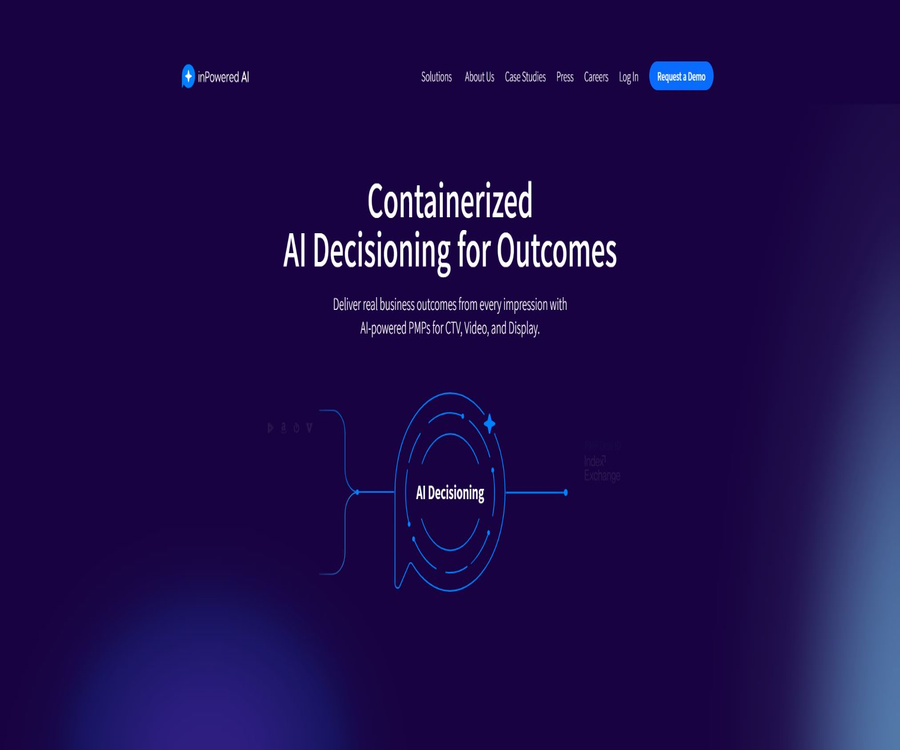
inPowered AI is a seller-side AI decision platform designed for brands, advertising agencies, and media providers. It deploys customized machine learning models on the ad exchange side to predict the likelihood of achieving specific business outcomes each time an ad is put up for bidding.
The platform organizes high-potential display opportunities into private market transactions, and provides a PMP Deal ID that buyers can use to activate them in existing DSPs. It is neither an ad copy generator for individual users nor merely an old-style tool for promoting content.
A one-sentence summary
inPowered AI uses real-time models on the exchange side to filter CTV, video, and display ad inventories; it then packages business outcomes such as brand enhancement, search performance, in-store visits, customer value, and attention into AI PMPs that can be activated directly in DSPs.
How does the seller’s AI decision-making system work?
Traditional DSPs primarily enable the buyer to control the audience, bids, frequency, and budget, whereas inPowered AI filters the supply before it enters the buyer’s bidding process. It has access to information related to the context in which ads are displayed, as well as data on auctions, supply, and attention levels.
| Steps | Platform processing | Output | What needs to be done by the buyer? |
|---|---|---|---|
| Define results | Define brand, search, in-store, value, or interaction goals | Training metrics and feedback criteria | Provide KPIs and measurement methods. |
| Model generation | Combined results, context, auctions, and attention signals | Showcase-level prediction model | Confirm data authorization and time window |
| Seller deployment | Run the model on the exchange or on the supply side. | Display scores in real time | There is no need to replace the existing DSP. |
| PMP curation | Only select inventory items with a high predictive value. | Independent Deal ID | Add and activate in DSP |
| Feedback learning | Send the new result data back to the model | Continuously updated ratings | Maintain measurement and data transmission back |
Main functions
Display-grade real-time scoring
The model analyzes context, auctions, devices, geography, attention, and outcome signals at the ad display level, in order to determine whether a given opportunity is more likely to help achieve the desired goals. Decision-making takes place on the exchange side, making it suitable for large-scale real-time bidding.
Custom AI models
Each PMP can be trained using the specific KPIs and data of individual clients, rather than relying on a generic model to handle all advertisers. The quality of the training data, label latency, and business definitions have a direct impact on the results.
PMP Deal ID activation
The inventory identified by the model is delivered to the buyer via a unique PMP Deal ID, allowing the advertiser to add it directly to their preferred DSPs. Most solutions do not require any separate technical integration on the part of the buyer.
Continuous model learning
Brand enhancement plans are typically updated on a weekly basis using new research data, while strategies related to searches, visits to the store, customer attention, and interaction can be refined at a continuous or daily pace. The actual frequency of updates depends on how quickly the relevant data becomes available.
Cross-format media
The platform is designed for CTV, online videos, and display ads; it allows inventory to be filtered based on results in various media formats. The specific exchanges, regions, devices, and availability options need to be confirmed depending on the campaign.
First-party data training
Customer value and application solutions can be developed by using the advertiser’s own data on conversions, value, or revenue to train models. When transmitting data, it is necessary to avoid including any personal identification information in ads or tracking pixels.
Online reporting and activity analysis
Customers can view online reports that show various performance metrics such as views, clicks, interactions, time spent on the site, and conversions. The data in these reports is intended for internal use by the customers; sharing it with external analysis services is possible only under the terms of a contract.
Work in conjunction with measurement partners
Different outcome scenarios make use of professional measurement data, enabling the model to optimize more than just CPM or visibility rates. The partnership data made available by the platform includes those from Kantar, Cint, EDO, Innovid, PlaceIQ, and Adelaide.
Supported business outcomes
| Solution | Optimization objective | Key data | Common users |
|---|---|---|---|
| Brand Lift | Advertising recall, cognition, preferences, consideration, and purchase intention | Brand research, context, attention, and auction signals | Brand advertisers and agencies |
| Search Lift | Search behavior for brands, products, or categories | EDO search for improving data and displaying signals | Brands that place emphasis on consumers’ proactive intentions |
| Store Visits | Verify in-store presence, increased foot traffic at the store, and additional visits. | Position measurement and display-grade signals | Retail, food and beverage, automotive, consumer goods, and telecommunications |
| App Value | High-quality installation, in-app purchases, subscriptions, ROAS, and LTV | Installation, in-app conversions, revenue, and device signals | Games, finance, health, retail, and entertainment apps |
| Customer Value | Users with high LTV, ROAS, and repeat purchases | Conversion logs, value scoring, and first-party data | Subscriptions, retail, and DTC brands |
| Attention | Screen time, scrolling, interaction, and effective attention | Adelaide attention and supply signals | Brands, videos, and high-quality media |
| Engagement | CTR, video playback, and completion rate | Click, play, skip, exit, and format signals | Effect demonstrations, videos, and CTV events |
| Efficient Reach | More independent reach, a lower effective CPM, and fewer wasted impressions | Minimum bid, CPM at the time of sale, site, geography, device, and attention level | Widespread outreach and frequency-controlled campaigns |
Brand enhancement
The brand enhancement model combines survey results, context, attention, and auction signals to predict which displays are more likely to enhance ad recall, awareness, consideration, and purchase intent. Measurements provided by firms such as Kantar and Cint can offer outcome labels for training and validation.
- It is suitable for brands that do not want to measure the upper stages of the funnel solely based on clicks and conversions;
- Brand research KPIs can be directly linked to media purchases;
- The model manages inventory in real time on the seller’s side and generates a Deal ID;
- The newly updated data can be used in the weekly retraining process;
- The study sample, significance level, and control group design still require independent review.
Search improvement
The search enhancement solution utilizes EDO search to analyze relevant data, in order to predict the likelihood that consumers will search for a particular brand, product, or category after seeing an advertisement. It is suitable for using proactive searches as indicators of brand interest and purchasing intent.
For searches of competing brands and for searches within specific categories, it is necessary to define a clear attribution window, in order to avoid attributing all natural trends or influences from other media sources to PMP. The feedback from the model should be analyzed in conjunction with the grouping of campaigns and the baseline period.
Visit the store in person
The in-store strategy combines location measurement data with contextual, auction-related, and attention signals, giving priority to those displays that are more likely to result in actual visits to the store. The in-store data can be fed into the learning cycle on a daily basis.
- Suitable for retail, food and beverage, automotive, consumer goods, and telecommunications brands with physical stores;
- It is possible to analyze customer flow data by store or event;
- Geographical accuracy, attribution window, and the baseline for natural in-store visits can affect the conclusions;
- Sensitive locations, small sample sizes, and cross-device matching require privacy controls;
- Visiting the store does not equate to a sale; it should be combined with sales efforts or testing strategies.
Application installation and subscription value
The solution in question does not focus solely on reducing installation costs; instead, it makes use of installation logs, in-app conversion data, and revenue information to identify users who are more likely to subscribe or make payments. The model helps to optimize in-app purchases, ROAS, and long-term value.
Games, finance, health, retail, and entertainment applications need to make use of mobile measurement partners, SKAdNetwork, or other attribution methods. Revenue reporting should be carried out using the permitted identifiers and aggregation techniques.
Long-term customer value
The customer value framework uses conversion logs, modeled value scores, and various indicators to identify opportunities with high LTV, repeat purchases, or a high ROAS. It is suitable for subscription services, as well as retail and DTC brands.
Companies should define in advance the criteria for value windows, returns, cancellations, gross profit, and repeat purchases. Short-term conversion rates may conflict with long-term value, so it is not sufficient to rely on only one indicator of immediate revenue for training purposes.
Attention and interaction
| Plan | Key indicators | Training signal | Applicable media |
|---|---|---|---|
| Attention | Screen time, scroll depth, active interaction | Adelaide and its context, auctions, behavioral signals | Videos, CTV, and displays |
| Engagement | CTR, VCR, play, skip, and exit | Active-level interaction and format signals | Native, Display, Video, and CTV |
| Efficient Reach | Independent reach, effective CPM, and frequency waste | Supply, price, locations, geography, equipment, and attention | Widespread awareness and outreach activities |
Attention is closer to actual engagement than mere visibility, but it still isn’t a direct substitute for indicators of brand enhancement or sales. The level of interaction is also influenced by creativity, placement, and differences among the audience members.
Activity implementation process
- Identify the specific business outcomes that need to be optimized, rather than opting for CTR or the lowest CPM by default.
- Select the measurement partner, data fields, attribution window, baseline, and success threshold.
- Ensure compliant integration of first-party data, pixels, mobile attribution, or survey data.
- Showcase models are trained using inPowered AI and deployed on supported exchanges.
- Obtain a unique PMP Deal ID, and configure the budget, target audience, and frequency in the existing DSP.
- Launch a small-scale test to monitor supply, delivery, pricing, and the feedback of outcome data.
- After conducting comparisons and establishing a baseline, scaling up the deployment is carried out, while continuous monitoring of model drift and marginal returns is performed.
PMP activation process
- Create or select the corresponding campaigns and ad groups in the DSP.
- Add the PMP Deal ID provided by inPowered AI and confirm that it is visible on the exchange.
- Retain the advertiser’s audience, creative elements, budget, geographic targeting, and frequency settings.
- Check bid requests, conversion rate, CPM, supply quality, and budget schedule.
- Verify whether the result data is returned as agreed and fed into the model for learning.
- Avoid making significant changes to the creative, audience, and bid at the same time, in order to explain any changes in performance.
- Decide whether to continue, adjust, or stop based on business results rather than just delivery volume.
Data collaboration and input signals
| Data partner or type | Representative signal | What purpose is it used for? | Precautions |
|---|---|---|---|
| Kantar and Cint | Brand research and enhancement | Cognition, preferences, and purchase intention | Check samples and significance |
| EDO | Search participation and search enhancement | Brand and category search behavior | Set the correct attribution window. |
| PlaceIQ | Location and in-store measurement | Store visits and increased foot traffic | Verify location privacy and accuracy |
| Adelaide | Attention signal | Highly monitored inventory | It cannot replace the ultimate business outcomes. |
| Innovid | Advertising and measurement data | Videos, CTV, and event results | Confirm the data range by activity |
| First-party data | Transformation, revenue, value, and customer behavior | ROAS, LTV, and repeat purchases | It is prohibited to import PII into pixels. |
| Auction and supply | Minimum bid, CPM at the time of sale, site, device, and geography | Efficient customer engagement and inventory quality | The supply structure changes in response to market dynamics. |
Relationship between exchanges and DSPs
The models of inPowered AI operate within exchanges or on the supply side, while the PMP Deal ID is entered by advertisers into the DSP of their choice. The ecosystems that are used for public display include Index Exchange, OpenX, Magnite, PubMatic, and Nexxen.
| Hierarchy | Primary responsibility | The role of inPowered AI | Advertisers still need to maintain control. |
|---|---|---|---|
| Exchanges and the supply side | Collecting and selling ad slots | Deploy models and curate inventory with high predictive value | Verify supply, location, and costs |
| PMP transactions | Package the selected inventory under a Deal ID | Create AI-curated transactions based on the results. | Add transactions and monitor deliveries |
| DSP buyer side | Audience, bid, budget, and frequency | As a complementary seller intelligence layer | Creativity, audience, and event control |
| Measurement and Attribution | Record business results | Train and optimize the model using feedback. | Ensure consistency, alignment, and data quality. |
Which users is it suitable for?
- Brands and agencies that manage budgets for CTV, video, and display advertising;
- A team that focuses on optimizing the brand for improvement rather than merely focusing on clicks in the upper stages of the funnel;
- Retail and food service brands that have physical stores and place importance on verifying customer traffic;
- Marketing teams for mobile apps that focus on revenue, subscriptions, and LTV after installation;
- Companies that wish to use first-party conversion or value data to train media models;
- Media and exchange partners who wish to present high-quality offerings as result-oriented PMP services.
In what situations is it not very suitable?
- Only individual marketers who need to automatically write ad copy or generate images;
- Very small advertisers that lack programmed DSP, PMP, and measurement capabilities;
- Users who need to register on their own, have access to public pricing, and can make purchases using credit cards immediately;
- Teams that are unable to continuously send back result data or establish stable KPI metrics;
- It is hoped that this model will directly replace organizations responsible for brand safety, audience management, and creative content review.
- Platforms that require downloading models, viewing training code, or enabling private deployment must be purchased.
Product advantages
- The model makes real-time decision-making at the exchange level for display purposes, closely aligned with supply signals;
- Integrate with existing DSPs via Deal ID, thereby reducing the integration efforts required by the buyer;
- The optimization objectives cover brand, search, in-store visits, value, attention, and reach;
- It can be trained using professional measurement partners and first-party data from advertisers;
- CTV, video, and display ads can use the same result-oriented approach.
- Continuous feedback allows the model to adjust itself based on the performance in new activities;
- The seller’s curation can be combined with DSP parameters such as audience, creativity, frequency, and bidding amount.
Usage restrictions
- There is no fixed public price; the cost depends on the media, PMP, and measurement arrangements.
- The performance of the model depends on the quality of the result labels, the amount of data available, and the speed of feedback.
- Success stories of collaboration do not guarantee that the same results can be achieved in all brands, regions, and campaigns.
- The seller’s AI can only optimize the available supply; it cannot replace the entire media strategy.
- First-party data, location, and mobile attribution raise privacy and consent issues;
- Ongoing retraining may change the inventory structure, so it is necessary to monitor for drift and marginal returns;
- Brand security, fraud, creative quality, and incremental experiments still need to be managed separately.
Prices and billing
The price information was verified on August 23, 2026; the actual amounts, taxes, exchange rates, and discounts may vary, and the final figures will be those displayed on the settlement page.
inPowered AI does not have any publicly specified subscription fees or fixed PMP prices; access is obtained by requesting demonstrations and engaging in business partnerships. The costs are related to media purchases, exchanges, data partners, measurement services, and the specific solutions provided.
| Cost items | Current price | Billing method | Included content | Suitable for users |
|---|---|---|---|---|
| AI PMP Media | Customization | By media transactions and contracts | Model curated inventory and Deal ID | Brands and agents |
| Measurement data | Customization | By research or data collaboration | Brand, search, location, or attention-based results | Activities that require closed-loop measurement |
| First-party model | Customization | By activity or scope of collaboration | Data ingestion, model training, and feedback | Companies that possess conversion and value data |
| Platforms and reports | Subject to the contract. | Included or specified separately | Online reporting and activity analysis | Event Operations Team |
| Demonstration and solution design | Fees not disclosed | Reservation | Feasibility assessment of requirements and data | Customers in the process of making a selection |
The old content promotion service used a CPE model based on billing per 15 seconds of interaction, but the current core products rely on seller AI and PMP decision-making. The historical CPE figures cannot be used as the uniform pricing standard for the present.
Privacy and data usage
The privacy policy was updated on March 28, 2025, and covers website accounts, contact information, devices, IP addresses, page visits, Cookies, as well as marketing purposes. The platform also processes data related to views, clicks, interactions, time spent on pages, and conversions as part of its activity analysis.
| Data or items | Processing instructions | User notes |
|---|---|---|
| Contact information | Name, email, phone number, and address | Used for accounts, contacts, and requests |
| Using data | IP, browser, page, time, and device identifiers | Used for running, analyzing, and diagnosing |
| Cookies and pixels | Necessity, preferences, performance, and retargeting techniques | Management can be selected by browser and region. |
| Activity analysis | Display, clicks, interaction, time on site, and conversions | Pixels must not contain PII such as names or email addresses. |
| First-party data | Services are provided solely in accordance with the contract. | The advertiser retains ownership and is responsible for compliance with the law. |
| Retain | By service, legal obligations, and dispute requirements | There is no fixed number of days. |
| Cross-border | It may be processed outside the user’s region. | It is necessary to verify the mechanisms for ensuring the transmission of corporate data. |
| Delete | You can apply through your account or by contacting the support team. | Legal obligations may require the retention of certain information. |
Regarding third-party AI models
The privacy policy specifies that user data shall not be shared with third-party tools, including AI models; it also allows service providers, affiliated companies, partners, and retargeting suppliers to process personal information under specified circumstances. Enterprises should define the protocols for processing data related to advertising campaigns as well as the processes involved in handling models, through specific data processing agreements.
Restrictions on personal identity information
The terms of service prohibit customers from using ad tags, pixels, or content distribution to insert personal identification information, and they also forbid combining campaign data with PII in order to re-identify individuals. Targeting based on children’s-related inventory and persistent identifiers of users under 13 is also restricted.
Contracts and data rights
| object | Rights or restrictions | Actual impact |
|---|---|---|
| Customer data | Owned by the customer | inPowered can only provide services in accordance with the agreement. |
| Platform and inPowered data | Owned by inPowered | Customers may only use it in the approved services. |
| Activity and business data | Both parties use it for the intended purpose as agreed. | Customers must not re-identify individuals or disclose supply performance details. |
| Online report | For internal customer use only | External analysts must be bound by contracts and must delete copies. |
| Audience tools | Used only for platform event management. | It is not allowed to extract, reconstruct, or resell the underlying data. |
| Billing metrics | Calculated by inPowered | Any discrepancies must be raised within 30 days of the invoice. |
API, SDK, and open-source status
inPowered AI offers enterprise integration for ad exchanges, DSPs, and data partners, but it does not provide any public developer API references, SDK packages, or official GitHub repositories. The platform and the models are considered proprietary commercial technologies.
| Technical projects | Current status | Explanation |
|---|---|---|
| PMP Deal ID | Support | Activate seller-curated inventory in DSP |
| Measurement data integration | Support | Configure by brand, search, location, attention, or attribution partner |
| First-party data | Support | Used for training in accordance with contractual and privacy requirements |
| Public API | Not disclosed | There are no self-service developer documents. |
| Public SDK | Not disclosed | No language packs available for confirmation. |
| Official GitHub | The core warehouse has not been confirmed. | Do not use projects with the same name to determine whether something is open source. |
| Open-source status | No | The models and platforms are proprietary commercial services. |
Suggestions for measuring effectiveness
- Set a unique primary outcome and a limited number of secondary indicators for each activity;
- Establish a control group, a baseline period, or incremental experiments to avoid focusing solely on the differences before and after;
- Fix the attribution window, time zone, as well as return and cancellation rules;
- At the same time, monitor CPM, conversion rate, reach, frequency, and supply composition;
- Break down by creativity, equipment, region, and inventory to identify confounding factors;
- Record the model update date and the Deal ID version to ensure reproducibility of the results;
- Judgments are made based on profits, long-term value, or brand enhancement, rather than solely on the scores predicted by models.
Basic information
| Project | Content |
|---|---|
| Tool name | inPowered AI |
| Tool type | Seller: AI-driven decision-making, programmatic advertising, PMP curation |
| Supported formats | CTV, video, and display ads |
| Activation method | Enter the PMP Deal ID into the existing DSP. |
| Main results | Brand, search, in-store visits, app value, customer value, attention, interaction, and reach |
| Primary users | Brands, agents, publishers, and exchange partners |
| Price | Custom quote |
| Self-service free version | None |
| Public API | No public documents available. |
| Open source | No |
Frequently Asked Questions
Is inPowered AI a tool for generating advertising ideas?
The focus at present is not on creating copy and images, but rather on displaying the prediction results and filtering the available options on the exchange side. Creativity remains under the control of the advertisers or agencies.
Is it necessary to replace the DSP?
It is usually not necessary. Once the client obtains the PMP Deal ID, they can activate it within the existing DSP, while continuing to have control over the audience, budget, bids, creatives, and frequency of exposures.
Which ad formats are supported?
It currently covers CTV, online videos, and display ads. Native displays can also be used for interactive objectives; the specific options available depend on the campaign and region.
How often is the model updated?
The data related to brand enhancement can be retrained on a weekly basis, while feedback regarding visits to the store, level of attention, interactions, and outreach efforts is typically provided on a daily basis or continuously. The actual frequency depends on how quickly the relevant data becomes available.
Can first-party data be used?
It can be used for models related to customer value, revenue from applications, and other customized outcomes, but only the conversion or value signals permitted by the contract should be utilized. Ad pixels and tags must not be used to obtain personal identification information.
What is the price?
There is no fixed, public pricing; the costs for media, data, measurement, and modeling services are determined through business agreements. The prices associated with historical content marketing CPEs cannot be used as a reference for the current seller’s AI PMP services.
Does inPowered AI provide APIs?
The platform offers exchange and data integration capabilities, but it does not provide public self-service API or SDK documentation. The scope of technical integration needs to be determined as part of the cooperation agreement.
Is the platform open source?
No. Models, exchange decisions, and activity platforms are proprietary commercial technologies; there are no licenses available for their core code.
Can case improvements guarantee reproducibility?
It’s not possible. The degree of improvement is influenced by factors such as the brand, creativity, target audience, supply chain, region, budget, as well as the methods used for measurement and setting benchmarks; it should be verified through controlled tests.
Summary
inPowered AI integrates AI-driven decision-making into the programmatic advertising supply chain; it uses actual business results to train the models used for content delivery, and it packages the selected inventory as PMP Deal IDs. It is suitable for brands and agencies that already possess DSP capabilities, measurement tools, and the capacity to manage large-scale media campaigns.
The value of such a platform lies in its ability to enhance the buyer’s experience by connecting brands, search functions, in-store options, as well as various signals related to value and attention. When selecting a platform, it is important to assess factors such as data rights, measurement methods, the scope of coverage provided by the platform, actual costs, and the incremental benefits it offers, rather than relying solely on individual success stories.
Tools similar to inPowered AI



 Guigong Network Security Registration No. 45132202000164