






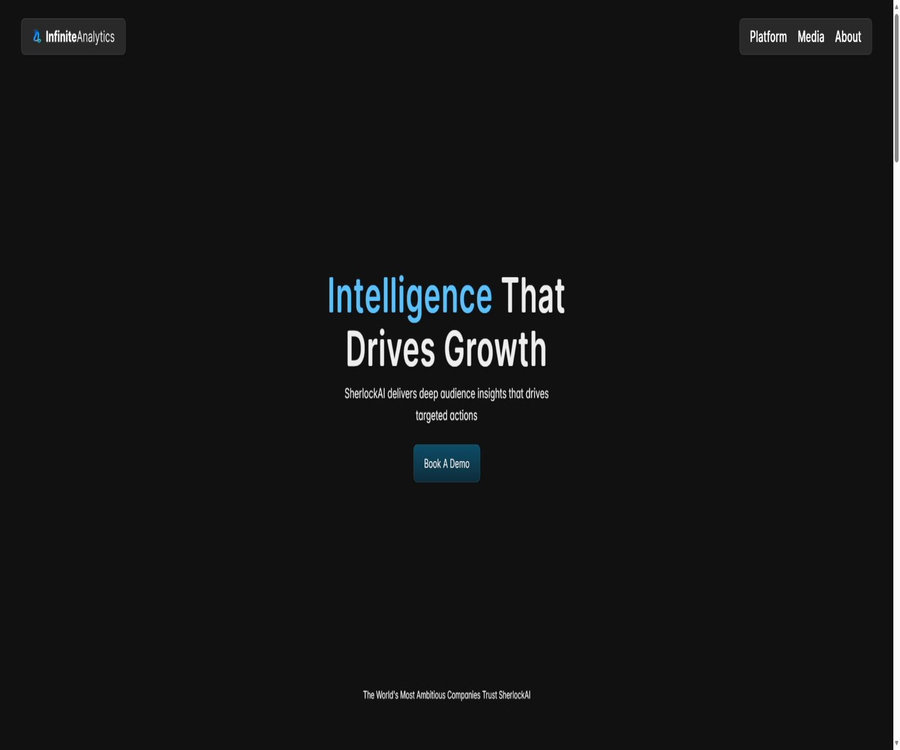
Infinite Analytics
Infinite Analytics: an intelligent tool focused on improving AI efficiency.
Tags:AI improves efficiencyWhat is Infinite Analytics?
Infinite Analytics is a company that provides businesses with AI-driven insights into consumers; its core product is named SherlockAI. By utilizing the OMNIA knowledge graph to combine data on consumers, locations, behaviors, and contexts, it helps marketing and business teams transform fragmented information into actionable strategies for targeting audiences.
It is neither a tool for tracking web traffic for site administrators nor a general-purpose chatbot. This product is designed to assist companies that need to understand their consumers, identify their target audience, and utilize such insights in their media and marketing strategies.
A one-sentence summary
SherlockAI is an intelligent platform for businesses and consumers; it utilizes knowledge graphs, over 40 different data sets, as well as first-party customer data to identify target audiences, generate insights, and then direct those audiences to digital platforms for targeted marketing and optimization.
Company and product background
Infinite Analytics was founded with a technical background from MIT; its headquarters and corporate registration details are located in Massachusetts, United States, while it has operational units in India. The team has been working in the field of AI for over a decade.
| Project | Content |
|---|---|
| Company | Infinite Analytics |
| Core products | SherlockAI |
| Core data layer | OMNIA Knowledge Graph |
| Tool type | Consumer intelligence, audience analysis, marketing AI |
| Data coverage | Over 40 comprehensive datasets |
| National coverage | 38 countries |
| Procurement method | Schedule a demo or via Azure Marketplace |
| Main markets | Corporate marketing, retail, consumer goods, and media |
Main functions
Create marketing briefs and objectives
The team can start with the business objectives and marketing briefs to identify the target audience, market, behaviors, or activities that need to be understood. This allows the scope of the analysis to be linked to subsequent steps such as audience development, engagement, and performance monitoring.
Discovering and identifying the audience
SherlockAI is used to discover, identify, and characterize target audiences, as well as to understand them from various perspectives such as demographics, behavior, actions, and the external environment. The analysis is conducted on aggregated audiences, rather than on individual consumer profiles that users can view.
OMNIA Consumer Knowledge Graph
OMNIA organizes data from various sources into a knowledge graph of consumer behavior, enabling the connection between people, locations, activities, and contexts. The platform emphasizes verifying the target audience through cross-checking multiple datasets, thereby reducing reliance on guesses based on single probability labels.
Over 40 comprehensive datasets
The product integrates over 40 datasets in order to understand who the consumers are, what they do, and the environment in which they operate. Specific suppliers, fields, update frequencies, and the extent of coverage in different countries are not fully disclosed; companies need to verify these details based on their target markets.
First-party data enhancement
Companies can add their own first-party data on top of the platform’s data layer, thereby enabling analyses that are more closely aligned with customer, member, transaction, or marketing scenarios. Before integrating such data, it is necessary to ensure that the identifiers match, that the scope of use is agreed upon, and that mechanisms for minimizing data processing and for deleting data are in place.
Watson AI Assistant
SherlockAI includes a feature named Watson that helps in creating reports, identifying potential areas for analysis, and answering questions. It is not clear whether there is any technical connection between it and IBM Watson; one should not assume anything about the underlying models based solely on the names.
Audience targeting and activation
Once the analysis is complete, the team can direct the target audience to digital platforms for use in marketing campaigns and media initiatives. The specific advertising platforms, DSPs, CRMs, or marketing automation connectors that are supported should be confirmed during the demonstration.
Activity monitoring and optimization
The platform’s workflow covers activity activation, monitoring, and optimization, ensuring that insights into the audience go beyond the stage of reporting alone. Companies should further verify the attribution window, definition of conversions, methods for measuring incremental changes, and the frequency of optimization efforts.
Reports and Insight Exploration
Users can create reports and pose follow-up questions tailored to their target audience; this approach is suitable for assigning the task of data analysis to marketing or business teams. It is still necessary to verify the sample size, time period, region, and definitions of the metrics used to draw key conclusions.
Privacy design
The OMNIA analysis is described as a process of anonymization and aggregation, with it being stated that no personal identification information is used in such analyses. The product also takes GDPR and CCPA into account in its design, but companies still need to verify the specific compliance measures through contracts and technical documents.
Complete marketing workflow
- Create a marketing brief to identify the core business objectives, regions, products, and target audience issues.
- Access or select available data, and combine it with first-party data for the purposes permitted by the contract.
- Use OMNIA to discover and identify audiences, and compare behavioral, action, and environmental characteristics.
- Use Watson to explore issues, organize insights, and generate reports for team discussion.
- Push the approved audience to compatible digital platforms or media buying processes.
- Activate the activities and continuously monitor performance, analyzing and optimizing it using a consistent approach.
- Document the audience definition, data versions, and decision-making process to avoid opaque operations that make it impossible to reproduce the results.
How does the OMNIA knowledge graph understand its audience?
| Dimension | The questions answered | What decisions can it be used for? | Precautions |
|---|---|---|---|
| Behaviors | Who are they and what behavioral characteristics do they exhibit? | Audience segmentation and targeting strategies | It is necessary to understand the rules for generating tags. |
| Actions | What did they actually do? | Analysis of action signals, interests, and purchasing tendencies | Observation does not equate to a causal relationship. |
| Environment | What is their location and the external circumstances surrounding them? | Geography, store locations, event strategies, and scenario planning | Location data requires privacy and precision controls. |
| First-party data | What are the characteristics of known customers and transactions for the company? | Customer enhancement, similar audiences, and personalization | A legitimate purpose and access rights are required. |
The value of knowledge graphs lies in connecting various types of signals, rather than simply stacking fields together. Users should still distinguish between observed correlations, model-inferred relationships, and causative effects that have been verified through experiments.
Consumer data and first-party data
Platform data
SherlockAI combines multiple external datasets to create an understanding of the audience, taking into account factors such as population, location, events, and real-world behaviors. Companies should check the availability of data, its update frequency, the scope of permissions, and the minimum sample size required in each specific country.
Customer first-party data
First-party data enables insights that are more closely aligned with a company’s own customers, but it also raises requirements regarding privacy and security. Before uploading such data, it is necessary to conduct a review of its intended use, minimize the number of fields involved, ensure identity isolation, and set appropriate permissions.
| Data type | Primary value | Check before connecting | Common risks |
|---|---|---|---|
| CRM and member data | Understanding customer relationships and segmentation | Agreement, permissions, and identity fields | Beyond the original purpose of collection |
| Transaction and purchase data | Analyze category, frequency, and value | Returns, currency, and time parameters | Confusing correlation with a motivation to make a purchase |
| Website and app behavior | Linking digital contacts with interests | Cookie consent and device identification | Deviation in cross-device matching |
| Store and location data | Understanding real-world activities and geographical contexts | Precision, time, and aggregation thresholds | Re-evaluating risks associated with sensitive locations |
| Third-party comprehensive data | Expand the dimensions of audience understanding | Licenses, update frequency, and coverage | The data is outdated or lacks representativeness. |
Advertising and media activation
SherlockAI enables the use of audience insights on digital platforms and in programmatic media, and it allows for the creation of private market transactions with media partners. Its OMNIA geolocation and real-world behavior data can help to add new audience segments to media inventories.
Together with PMP from Passion+ Media
The partnership framework combines the OMNIA knowledge graph with data on digital content consumption, targeting audiences with interests in sports, music, luxury goods, and pets. Specific PMPs can integrate into advertisers’ existing DSP workflows through Magnite.
Features of media collaboration plans
- Integrate the costs related to data, technology, and audience expansion into a single CPM;
- Combining online content consumption with physical-world movement or purchasing behaviors;
- It enables the activation of audiences within existing programmed media buying processes;
- The audience matching process is based on aggregation and does not involve any personal identification information;
- The availability of different PMPs, regions, and DSPs needs to be confirmed separately.
Azure Marketplace and enterprise procurement
SherlockAI is now available on the Microsoft Azure Marketplace, and it holds the qualification for Azure IP Co-Selling. Companies can use this marketplace to discover and purchase this product, which reduces the complexities associated with establishing separate procurement processes for suppliers.
| Ability | Current status | Enterprise value |
|---|---|---|
| Azure Marketplace | Available now | It can be evaluated through Microsoft’s existing procurement channels. |
| Azure IP Co-Sell | Qualification obtained | Supports collaboration with Microsoft’s sales framework |
| Deployment speed | Emphasize faster activation. | The specific architecture and regions still need to be verified. |
| Commercial procurement | Enterprise market entry point | It does not mean there is a single, public price. |
Which users is it suitable for?
- Teams responsible for brand marketing and consumer insights need to have an understanding that spans different datasets;
- Media and advertising teams that aim to build and engage high-value audiences;
- Companies that possess CRM, member, or transaction data and wish to improve their analysis capabilities;
- To serve markets in multiple regions, organizations that possess consumer and geographic intelligence are needed;
- Teams in retail, consumer goods, media, finance, insurance, and business strategy;
- Microsoft customers who wish to simplify their corporate procurement processes through Azure Marketplace.
Typical use cases
| Scene | Usage method | Main output | Verification metrics |
|---|---|---|---|
| Audience research | Links various types of behavioral and contextual signals | Audience profiling and segmentation | Coverage, stability, and interpretability |
| Marketing Briefing | Explore consumers starting from the goals. | Reports, assumptions, and strategic directions | Research time and decision adoption rate |
| First-party data enhancement | Combine customer and transaction data | A target audience that better fits the enterprise | Match rate, incremental information, and privacy risks |
| Programmatic advertising | Push the audience to digital platforms | Activatable population and PMP | Reaching, conversion, growth, and CPM |
| Store and geographic strategy | Analyzing locations and real-world behaviors | Regional opportunities and customer insights | Position accuracy and improvement in actual business performance |
| Activity optimization | Continuous monitoring and adjustment | Performance reports and optimization suggestions | Changes in conversion, costs, and profits |
Product advantages
- Integrate more than 40 datasets using knowledge graphs to reduce data silos;
- A comprehensive marketing pathway that includes audience research, activation, monitoring, and optimization;
- It supports overlaying the company’s first-party data on platform data;
- It covers 38 countries, making it suitable for consumer research in multiple markets;
- The analysis is carried out using anonymization and aggregation methods, with an emphasis on not using any personal identification information;
- The enterprise procurement process can be accessed through the Azure Marketplace;
- The Watson Assistant lowers the barriers for non-technical teams to explore and create reports.
Usage restrictions
- The specific names, licensing details, and update frequencies of more than 40 datasets have not been fully made public.
- The inclusion of 38 countries does not mean that all of them have the same fields, scale, and precision;
- At present, there are no publicly available unified package prices or detailed lists of functional permissions.
- External behavioral signals may suffer from sample bias, time lag, and matching errors;
- Audience relevance does not automatically prove that a particular activity has produced incremental effects;
- Integrating first-party data introduces additional requirements regarding contracts, permissions, and cross-border processing.
- Reports and recommendations generated by AI need to be reviewed by marketing, data, and compliance professionals.
Price and trial version
SherlockAI does not have any publicly listed standard pricing plans; it relies mainly on scheduled demonstrations and corporate purchases. Azure Marketplace offers a way to make purchases, but the product page there does not provide any unified prices that can be used for direct comparison.
| Plan or cost item | Price | Billing cycle | Core benefits or quota | Suitable for users |
|---|---|---|---|---|
| Company SherlockAI | Custom quote | In accordance with the contract | Consumer insights, audience analysis, and engagement | Brands, retail, and large marketing teams |
| Azure Marketplace | Subject to market prices. | By order | Purchased through Microsoft Business Marketplace | Companies that already have an Azure procurement system |
| 14-day limited trial | The terms are listed as free. | 14 days | Only a limited set of functions are available. | I hope to first assess the new users of the platform. |
| Media PMP | The fees are incorporated into CPM. | By media transaction | Enhanced data, technology, and audience reach | Programmatic advertisers and agencies |
| Implementing first-party data | Not yet made public | By project | Access, matching, and service configuration | Customers in need of enterprise data integration |
The terms for 2023 state that new registered users receive a 14-day trial period with limited features; payments are made in Indian rupees, and price adjustments are allowed. The current enterprise sales process may involve different contracts, so the trial privileges, currency, taxes, and amounts must be confirmed again before activation.
Cancellation and refund
The terms specify that purchases are non-refundable, and users can cancel their subscription either through their account or by contacting the support team; the cancellation takes effect at the end of the current payment cycle. Enterprise contracts, Azure orders, and media transactions may have separate terms.
Privacy Policy
The privacy policy was dated February 1, 2022, and it covers matters related to the website, accounts, and marketing communications. Before accessing consumers’ data or first-party data, companies should obtain the latest contract attachments that are in line with SherlockAI’s data processing procedures.
| Data or items | Policy Explanation | User notes |
|---|---|---|
| Proactively provide information | Name, email address, and phone number | For contacting, account, and service requests |
| Using data | IP, browser, page visited, duration, and device identifier | It may be collected through cookies and analytics tools. |
| Purpose of processing | Providing services, managing accounts, fulfilling contracts, and conducting marketing communications | It is possible to opt out of marketing emails. |
| Shared objects | Service providers, affiliated companies, business partners, and parties involved in business transactions | It is necessary to verify the scope of data subcontracting for enterprises. |
| Retention period | Retained for purposes, legal obligations, and dispute resolution needs | There is no fixed number of days. |
| International transmission | It may be processed outside the user’s jurisdiction. | Companies should verify the region and transmission mechanism. |
| Safety | Adopt commercially reasonable protective measures. | There is no guarantee of absolute security for internet transmissions. |
| Minors | The service is not available for children under 13 years old. | If an incorrect receipt is detected, deletion measures will be taken. |
GDPR and CCPA rights
Users who are eligible can request access to, correction of, deletion of, restriction on, or objection to the processing of their data, and they can also ask for the portability of such data. Residents of California can also find out what categories of data are collected, request that their personal information be deleted, refuse its sale, and avoid discrimination.
The difference between platform audience data and website personal data
OMNIA emphasizes that its analyses are anonymized and aggregated, and no personal identification information is used; the website’s privacy policy states that personal data may be collected during account creation and access. These two types of data are used for different purposes, and the fact that there is no analysis involving PII should not be interpreted as meaning that no personal information is processed at all within the service.
Data security and compliance verification
- Clarify the use cases, regions, data categories, and the role of the enterprise within the processing chain.
- Obtain the current data processing protocol, list of subcontractors, storage locations, and arrangements for cross-border data transfer.
- Verify the authorization, aggregation thresholds, update cycle, and deletion process for the OMNIA dataset.
- First-party data only uploads the necessary fields that have been approved for use.
- Configure minimum permissions, identity logging, audit logs, and export controls.
- Use test audiences to examine small samples, sensitive locations, and reidentification risks.
- Before the contract is terminated, confirm the deadlines for data export and deletion, as well as the proof of deletion.
APIs, integration, and technical openness
At present, SherlockAI does not provide any public API references, SDK packages, or a complete list of connectors for developers. The ability to integrate first-party data, to target specific audiences, and to activate media content indicates that the platform has capabilities for enterprise integration; however, the specific interfaces need to be confirmed through demonstrations and contracts.
| Technical projects | Public status | It should be confirmed during the selection process. |
|---|---|---|
| First-party data integration | Clear support | Files, databases, cloud storage, and update frequency |
| Audience targeting | Clear support for digital platforms | Specific platforms, matching rate, and synchronization delay |
| Programmatic media | Cooperative PMPs can access DSP. | Region, media inventory, and CPM composition |
| Azure Marketplace | Already provided | Relationship between quotes, deployment models, and Azure commitment consumption |
| Public API | No documents available yet. | Authentication, rate limiting, export, and auditing |
| Public SDK | Not confirmed yet | Language, licensing, and version maintenance |
| Single sign-on | Not yet made public | Identity agreements, role mapping, and departure recovery |
GitHub and the open-source status
Infinite Analytics does not have any publicly available and verifiable repository containing the core code of SherlockAI, nor has it announced that the platform uses an open-source license. The product should be considered a commercial, closed-source service; the presence of public websites, collaborative content, or a presence on Azure does not imply that the code is open source.
- The SherlockAI core platform is not an open-source project;
- The OMNIA knowledge graph and data assets represent specialized capabilities.
- There is no publicly available and verifiable official SDK license;
- Enterprise access rights shall be governed by the contract and interface documentation.
- Do not treat third-party GitHub projects with similar names as official code.
Differences from traditional analysis tools
| Dimension | SherlockAI | Traditional website analysis | General BI tools |
|---|---|---|---|
| Core object | Cross-channel consumers and audiences | Website and app access behavior | Internal business data of the company |
| Data foundation | OMNIA and over 40 comprehensive datasets | Tracking points, events, and cookies | Databases, files, and data warehouses |
| Main output | Audience insights, profiling, and activation | Traffic, funnel, and conversions | Reports, metrics, and dashboards |
| Mode of action | Pushing the audience to be used in media campaigns | Optimize pages and marketing channels | Supports business analysis and reporting. |
| Purchase method | Company presentations and customized quotes | Common self-service subscriptions | Self-service licensing or enterprise contracts |
Pre-purchase checklist
- Does the target country have the necessary data dimensions, samples, and update frequencies?
- Can the audience definition be exported, reproduced, and explained by business staff?
- What identifiers are used for first-party data matching and how to delete them;
- Which DSPs, advertising platforms, CRMs, and data warehouses are supported;
- How are the costs for trials, subscriptions, implementation, as well as data and media fees calculated separately?
- Whether availability, security incidents, and support response commitments are provided;
- To whom do customer data, derived audiences, and reports belong respectively?
- How to export and delete all customer data after the contract ends.
Basic information
| Project | Content |
|---|---|
| Product name | SherlockAI |
| Development company | Infinite Analytics |
| Core technology | OMNIA Consumer Behavior Knowledge Graph |
| Tool type | Consumer intelligence, audience analysis, marketing AI |
| Data size | Over 40 comprehensive datasets |
| Covered areas | 38 countries |
| First-party data | Support |
| Purchase entry point | Schedule a demo, Azure Marketplace |
| Price pattern | Custom quotes for businesses |
| Trial | The terms specify a 14-day limited trial period, and eligibility must be verified. |
| API | Unpublished development documentation |
| Open source | No |
Frequently Asked Questions
What is the relationship between Infinite Analytics and SherlockAI?
Infinite Analytics is the name of the company, while SherlockAI is its current platform for enterprise consumer intelligence. OMNIA represents the knowledge graph of consumer behavior that underlies this platform.
Can it be used for website traffic analysis?
Its primary purpose is not to replace traditional website analysis tools, but rather to help understand consumers and audiences across different datasets. Website or application behavior can serve as part of the first-party data, but it is not the entire source of information.
How much data and in how many countries is it covered?
Currently, over 40 comprehensive datasets and 38 countries are disclosed. The types of data, their depth, and the frequency of updates may vary from one region to another, and it is necessary to determine these aspects based on the target market.
Does SherlockAI use personal identification information?
OMNIA audience analysis is described as being anonymized and aggregated, with no use of personal identification information. Accounts, contacts, and website visits may still involve names, email addresses, phone numbers, IP addresses, and device data.
Is it possible to connect to one’s own customer data?
First-party corporate data can be combined to generate more relevant insights. Before integration, it is necessary to finalize the purposes, obtain consent, define permissions, address cross-border data handling issues, and conduct reviews regarding data deletion.
What is the price?
There is no fixed standard amount at present; the enterprise version comes with demonstration sessions and customized quotes. The costs related to Media PMP can be included in the CPM figure, while orders from Azure Marketplace are subject to the actual quoted prices.
Is there a free trial?
The terms for 2023 specify a 14-day trial period with limited functions for new users, but the current page does not show a link to start this self-service trial. It is necessary to confirm whether these terms are still in effect, which functions are available during the trial, and whether payment information is required, before registering.
Can I get a refund after purchasing?
The general terms specify that purchases are non-refundable, and cancellations take effect at the end of the current payment cycle. Corporate contracts, Microsoft Marketplace orders, or media deals may have different cancellation rules.
Are APIs or SDKs available?
Currently, there are no public API and SDK documentation available. Data integration and audience activation require enterprise-level integration, but the methods of support, the interfaces used, and the licensing requirements should be confirmed with the product team.
Is SherlockAI open source?
No. The platform, the OMNIA knowledge graph, and the data-related capabilities are proprietary commercial products; there are no licenses available for their core code.
Summary
Infinite Analytics connects external consumer data, real-world behavior signals, and corporate first-party data through SherlockAI and the OMNIA knowledge graph. It is suitable for marketing and business teams that wish to carry out audience identification, reporting, activation, and ongoing optimization.
The advantages of this platform lie in its ability to offer intelligent handling of data from different datasets and a comprehensive marketing framework; however, its limitations include publicly available pricing information, limited API access, and few details regarding the data itself. Before making a purchase, it is important to verify the coverage area, data licensing terms, trial and refund policies, the way in which first-party data is processed, and the methods used to assess the effectiveness of the targeting efforts.
Tools similar to Infinite Analytics



 Guigong Network Security Registration No. 45132202000164