






Icon
Icon, an intelligent tool focused on improving AI efficiency.
Tags:AI improves efficiencyA one-sentence summary
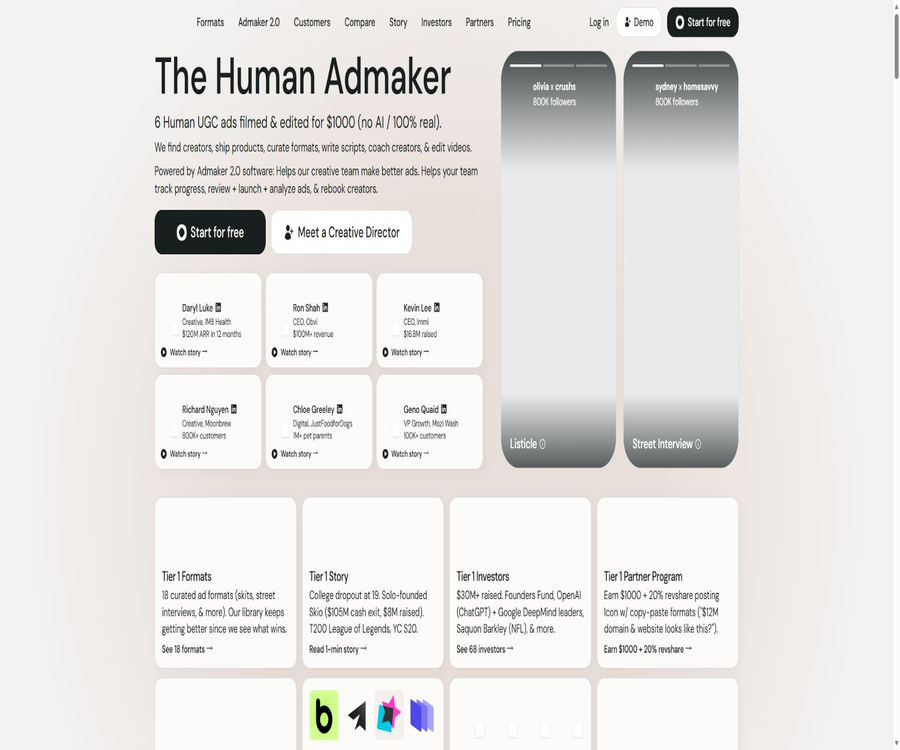
Icon Human Admaker is a managed service for creating real-person UGC ads; it is responsible for matching creators, writing scripts, coordinating the provision of samples, guiding the filming process, editing the final videos, and managing the approval and deployment processes through Admaker 2.0.
Tool Introduction
In the past, Icon focused on AI Admaker and advertising creation software; by 2026 it shifted its main product to The Human Admaker. The homepage now emphasizes human creators, human scriptwriters, human editors, and human creative directors, with the final videos not being produced using AI-generated virtual characters in place of real people.
AI capabilities have not disappeared entirely; rather, they have been integrated into related tools such as Admaker 2.0, AssetGPT, creative analysis, and ad management. It is important to understand this transformation, as the subscription prices for AI-based video generation mentioned in older documentation and search results do not reflect the current pricing for human-driven advertising services.
Positioning of the current product versus the older version
| Phase | Main products | Core delivery | Pay attention when reading. |
|---|---|---|---|
| Current | Human Admaker | 6 real-user UGC ads, original footage, and B-roll | Based on the current project quote of $1,000 and a delivery time of 12 to 16 days. |
| Current supporting facilities | Admaker 2.0 | Progress management, asset reuse, analysis, deployment, and creator management | Certain advanced features are available at an additional cost and come with managed services. |
| Earlier version | AI Admaker | AI scripts, virtual creators, voice, and automatic editing | The help articles are still accessible, but the availability of the account and the old subscription price need to be confirmed again. |
What does the current live advertising service include?
- Select real creators and advertising formats based on the product, target audience, and objectives.
- After researching brands, products, and competitors, 6 separate scripts are written; clients are also allowed to provide their own scripts.
- The creative director communicates the brand guidelines, past successful ads, and failed campaigns at the beginning of the project.
- Coordinate the shipment of physical products to creators, and digital products can also be incorporated into the production process.
- Guide creators in filming voiceovers, situational performances, and additional shots according to the script.
- A live editor adds subtitles, graphics, music, and sound effects, and the creative director reviews them.
- 6 completed sequences, original footage, and B-roll are delivered, along with full usage rights.
- Unlimited revisions by a human expert will be provided until the customer is satisfied.
Suitable for paid advertising and organic content
It is primarily aimed at paid social advertising and organic social content, and is especially suitable for consumer brands that need to continuously test different creative concepts. Whether advertising can be posted there depends on the platform’s policies, the requirements regarding the content, the necessary disclosures, and the brand’s own advertising account.
Real-person production and software collaboration
Icon does not simply provide brands with the contact information of creators; instead, it integrates research, script development, sample delivery, shooting guidance, editing, and quality checking into a single project. The client’s team can use the Command Center to keep track of project summaries, creators, logistics, version status, and any changes made.
Advertising formats
The current platform offers 18 different types of planned advertisements; examples include list-based introductions, street interviews, replies to comments in short videos, records of daily preparations, short skits, and product demonstrations. The specific format should be chosen based on the nature of the product, the target audience, the way in which the content is created, and the channels through which it is distributed.
| Form | Mode of expression | Suitable for tasks | Precautions |
|---|---|---|---|
| Listicle | Explain the reasons, techniques, or advantages according to the numbers. | Product descriptions with a high information density | Every aspect must have verifiable product evidence. |
| Street Interview | Conduct interviews and display reactions in public settings | Social proof, cognitive tests, and light entertainment | It is necessary to handle permissions for passersby, ambient sounds, and filming approvals. |
| TikTok Comment Response | Respond to questions that require commentary. | Addressing objections and answering common questions | This does not mean that the platform provides genuine reviews or posts them automatically. |
| GRWM | Display the product naturally during everyday preparation. | Content on beauty, clothing, health, and lifestyle | Product placements should be clear and in compliance with advertising disclosure rules. |
| Skit | Present problems and solutions through role-playing and situational performances. | Ads that require narrative conflict and memorable moments | The performance content must not claim false benefits or outcomes for consumers. |
| Product Demo | Directly demonstrate the product’s appearance and usage process. | Functional products, applications, and physical goods | Digital products should have demo accounts and relevant materials prepared in advance. |
Brand production process
- Create a project overview by selecting the product, creator type, and advertising format.
- Within the first 24 hours, communicate with the creative director regarding brand guidelines, target audience, past advertisements, and constraints.
- Six separate scripts were received, and each one was examined for product facts, wording, and compliance risks.
- A reminder of the deduction will be sent after 48 hours, and charging will begin at $1,000 after 72 hours.
- According to the project requirements, physical samples, digital product accounts, brand materials, and the necessary permissions must be provided.
- The creator takes the photos after receiving the product, while the creative director is responsible for guiding the script and adding additional shots.
- Professional editors handle the visuals, subtitles, graphics, and audio, while clients can view the versions on the platform.
- Specific modification suggestions were put forward, confirming 6 sequences, original footage, B-roll, and the usage rights documents.
When is time calculated from?
The current page states that delivery will take place 12 to 16 days after the creator receives the product, and not starting from the date of registration or payment. The time required for shipping the product, customs procedures, stock shortages, the need for additional photos, and customer feedback can all affect the overall duration of the process.
Review the script first before making the payment.
Typically, a brand receives 6 scripts within 24 hours, gets a reminder after 48 hours, and the payment is processed after 72 hours. The term “Start for free” means that no charges are applied during the script review period; it should not be interpreted as meaning that the final ad can be obtained for free.
How to review the script after receiving it
- Check the product name, specifications, price, applicable conditions, and any prohibited promises.
- Ensure that each script represents an independent concept, rather than merely a slight variation with a different opening phrase.
- Check whether the creator’s role, tone, and setting are suitable for the brand’s target audience.
- Disclosures, warnings, trademarks, and regulatory requirements that must be indicated.
- Ensure that the brand assets, music, third-party visuals, and user reviews all have legitimate permission for use.
- Submit all the suggestions together to avoid changing the core selling points after filming begins.
Current price and version
As of August 23, 2026, the current homepage indicates that Human Admaker charges $1,000 to create 6 real-person UGC ads. This price is not presented as a monthly subscription; for dedicated creative directors and agencies, custom or bulk pricing applies.
| Plan or version | Price | Billing method | Core benefits or quota | Suitable for users |
|---|---|---|---|---|
| Human Admaker | 1000 dollars | A deduction is made from the project amount after reviewing the script. | 6 real-user UGC videos: script, filming, editing, original footage, B-roll, full usage rights and unlimited revision opportunities | Brands that require end-to-end creative production |
| Dedicated Creative Director | Custom quote | According to the cooperation plan | Deeper creative strategies and exclusive collaboration | Ongoing deployment or a dedicated team required to be in charge |
| Agency Whitelabel | Batch quotation | Based on the volume of cooperation with agents | Create UGC for clients, provide white-label collaboration, and manage the Frame review process. | Advertising agencies and multi-client teams |
| Old version of AI Admaker | The old records were once based on a subscription model. | Historical plans | AI scripts, virtual creators, voice, and automatic editing | It cannot be used as the current purchase price; it needs to be reconfirmed within the account. |
How to understand the cost per unit?
If we simply calculate it based on $1,000 for 6 segments, the average cost comes to around $166.67 per segment; however, this is just an arithmetic calculation. The actual cost includes the script, the creators, management, coordination for sending samples, editing, the original materials, and any revisions, so it cannot be equated directly with the price quoted for just one segment.
Refund guarantee
The current page promises a full refund if the customer is not satisfied with the final advertisement, along with unlimited chances for revisions. Since the terms page does not specify detailed time frames, application procedures, or exceptions, it is necessary to save the details from the payment page and verify the written rules with the team before making the payment.
Deliverables and right to use
| Delivered content | Whether to include | Uses | Key points for acceptance |
|---|---|---|---|
| 6 final ads | Includes | Paid and organic social content | Resolution, format, subtitles, audio, and brand details |
| Original lens | Includes | Subsequent reshoots and derivative versions | File integrity, audio and video quality, and download deadline |
| B-roll | Includes | Additional footage and reuse | Number of lenses, clarity, and product display |
| Full usage rights | Includes | Brand placement and reuse | Written boundaries for licensing region, duration, medium, and creator portraits |
| Unlimited revisions allowed | Includes | Corrected script execution and editing version | Scope of changes, response time, and when it is considered a new project |
The product page describes the delivery terms as “you have access to all materials” and “full usage rights”. The brand should still verify, in the official contract, whether the same licensing terms apply to creator portraits, music, third-party materials, placements on approved lists, global distribution, and permanent use.
Capabilities supported by Admaker 2.0
| module | Main function | Location on the current page | Use boundaries |
|---|---|---|---|
| Command Center | Track overview, creator, sample sending, versions, and revisions | The core of real-person project management | It is not a complete replacement for dedicated project management software. |
| AdGPT | Select the product, type of creator, and ad format. | Used to create profiles for real people’s UGC content | It depends on the account to determine whether all the old AI generation workflows will be retained. |
| Context Engine | Include brand guidelines, competitors, as well as data from Meta and Shopify. | Help the team understand the brand context. | Check authorization and data scope before connecting to external accounts. |
| Creator Management | Reschedule appointments with real creators with whom you have worked before | Managing relationships with historical creators | Prices and available regions may vary by item. |
| Creative Library | Centralize and reuse existing advertising materials. | Provide brand assets for new projects. | It is necessary to ensure that the uploaded materials have the right to be reused. |
| Creative Analytics | Connect the advertising account and analyze performance metrics such as hooks, views, and clicks. | Provide data to support creative decision-making. | Scores are used to analyze signals; they do not guarantee the outcome of the conversion. |
| Adspy | Save competitor ads, landing pages, and opening copy | Used for creative research | Expressions protected by copyright or trademarks cannot be copied. |
| Admanage | Upload the approved ad to Meta | Reduce the number of steps required for deployment | The status of availability on platforms such as TikTok and Google should be checked within the account. |
| AssetGPT | Use various models to generate images and video materials. | Assisting in asset creation | AI-generated content is not the same as real videos created by human filmmakers. |
What is the view on early AI capabilities?
The help center in 2025 will still cover AdCut, AI CMO, AdSpy, and Creative Analytics. It states that Icon boasts capabilities such as AI scripts, automatic shot selection, subtitles, advertising research, and performance analysis; however, this does not mean that each of the old interfaces is still available to all new customers.
AdCut
AdCut used to incorporate AdGPT scripts, virtual creators, and voiceovers into the timeline, automatically divide scenes and suggest three visual elements for each segment. Users could modify subtitles, text, music, and aspect ratios, then share, export the content, or approve its upload to Meta.
AI CMO
AI CMO has generated versions similar to those of competitors, improved ad materials, and suggestions for new concepts by taking into account competitors, the target audience, and the performance of advertisements. The recommendations provided by the model can serve as a basis for creative ideas, but they cannot guarantee that a particular advertisement will increase clicks or generate returns.
Creative Analytics
Creative Analytics can be connected to Meta, TikTok, or Google advertising accounts, and it provides values for Hook Score, Watch Score, and Click Score. These metrics help identify content that merits further refinement, but they still need to be considered in conjunction with conversion rates, cost per acquisition, sample size, and attribution settings.
API, GitHub, and open-source status
- The current core Human Admaker is a commercial hosted service, and no open-source code for the complete product has been made available.
- No public API documentation, authentication guidelines, pricing information, or guarantees regarding stability are available for ordinary developers.
- The Agency Whitelabel page uses the IconAPI name and shows a connection to the Frame review folder; however, this is more indicative of the agency’s integration capabilities.
- No official GitHub repository or open-source license that represents the current product has been identified.
- Third-party warehouses, unofficial packages, and page examples cannot prove that the Icon itself is open source.
If a company needs to automatically create projects, synchronize assets, or retrieve results in bulk, it should first request a demonstration and obtain information regarding the current scope of the interfaces, rate limits, data retention policies, versioning strategies, and terms of technical support.
Privacy and data processing
The privacy policy was issued by Icon, Inc., with the most recent update taking place on March 20, 2026. The platform connects brands with creators to carry out various projects, and the information covered by this policy is considered to be business-related data, rather than data intended for personal or household use.
- It may collect company names, names, email addresses, states, phone numbers, communication content, and marketing preferences.
- When handling subscribers’ names, email addresses, phone numbers, and addresses on behalf of the merchant, the merchant is required to provide its own privacy policy.
- Equipment, browsing activity, duration of visits, IP addresses, general location, cookies, and similar technologies may be recorded.
- Advertising partners may use online activity data to deliver interest-based ads, but phone numbers and SMS consent records are not used for third-party marketing.
- When connected to Google Drive, access is provided to the documents selected by the user, the folder structure, and related personal data.
- Google Workspace data is not used to train general AI or machine learning models, and encryption for transmission and storage, as well as access control and auditing measures, are in place.
- Google users can request the deletion of their data; the policy specifies that this deletion takes place either when the retention period expires or at the request of the user, with a time frame of 90 days mentioned.
- The service is not available for children under 18, and safety measures cannot guarantee that no risks will ever arise.
Before connecting the advertising account to the e-commerce account
Context Engine and Creative Analytics can be connected to Meta, Shopify, Google Drive, and advertising accounts. Administrators should adhere to the principle of least privilege, determining which stores, ads, files, and customer information need to be accessed, and revoking any permissions that are no longer necessary once a project is completed.
Copyright, compliance, and advertising risks
- For medical, health, financial, children’s, food, and functional products, it is necessary to first check the advertising regulations in the respective region.
- Creator reviews must reflect genuine experiences; they cannot present fictional content as unverified consumer facts.
- Paid partnerships, free gifts, and commission arrangements must be clearly disclosed in accordance with the regulations of the platform where they are offered and of the relevant region.
- Competitor ads can be used to study their structure and approach, but their protected copywriting, visuals, music, or trademark elements should not be replicated.
- The supplementary materials generated by AI may contain issues related to portraits, trademarks, copyrights, and factual inaccuracies, and therefore require manual review.
- Brands should keep records of script approvals, material licenses, modification histories, and the final files, to facilitate resolution of disputes and compliance inspections.
Which users are it suitable for
- Consumer brands that need to fix a certain volume of authentic UGC but do not have an in-house creative team.
- A growing team that aims to manage scripts, samples, filming, editing, and review in a centralized manner.
- It is necessary to obtain both the final version of the ad and the original materials, so that the advertising team can continuously test the opening sequence, subtitles, and various edited versions of the ad.
- Advertising agencies that manage multiple clients and require a white-label review process.
- Teams that have already gathered Meta advertising data and wish to use creative analysis to support the planning of the next batch of marketing materials.
Situations that are not very suitable
- It is only necessary to generate an inexpensive AI video instantly, without the need for human creators or services for hosting and production.
- The budget is less than 1,000 dollars, and it’s not possible to launch early-stage projects involving 6 ads per group.
- Brands that are unable to send physical products or to provide access to digital product demonstrations in a timely manner.
- There are urgent campaigns that require ads to be delivered within a few hours, as the standard timeline starts counting from the moment the product arrives.
- Technical teams that require fully self-hosted, open-source code, or public developer interfaces.
- High-risk businesses that are unable to provide statements regarding compliance with relevant standards, information on the rights to the used materials, or details about the creators are not acceptable.
Main advantages
- It integrates creator selection, scripting, logistics, filming guidance, editing, and review into one service.
- You can review 6 scripts before making the payment, which helps to reduce the risk of the creative direction being completely mismatched.
- The final advertisement, the original footage, and the B-roll are delivered to enable the brand to edit and reuse them later on.
- The creative director is involved in communication, shooting guidance, and the review of the final footage.
- Admaker 2.0 connects asset management, competitor analysis, performance evaluation, and ad uploading.
- The current page offers a full refund as well as unlimited revisions by a human expert.
Usage restrictions and precautions
- Delivery takes place between 12 and 16 days from the time the creator receives the product; the time required for shipping the physical item is not included in this period.
- The current price of $1,000 may vary depending on promotions, region, account type, and the scale of the partnership.
- The ability to make modifications unlimitedly does not mean that it is possible to change the product, the creator, or the overall creative direction indefinitely.
- The 18 formats are creative frameworks that do not automatically guarantee click-through rates, conversion rates, or advertising returns.
- Old help articles coexist with the current product; before making a purchase, it is necessary to determine which AI modules are actually available in the account.
- The public page does not provide detailed information regarding refunds; for projects with higher budgets, written confirmation should be obtained prior to making the payment.
- To obtain full usage rights, it is still necessary to check the specific permissions regarding the creator’s portrait, music, and third-party materials as outlined in the contract.
Basic information
| Project | Content |
|---|---|
| Tool name | Icon |
| Current product name | The Human Admaker |
| Operating entity | Icon, Inc. |
| Product type | Platform for creating real-person UGC ads and ad workflows |
| Core delivery | 6 real-user UGC ads, original footage, and B-roll |
| Current main price | $ |
| Delivery cycle | 12 to 16 days after the creator receives the product |
| AI supporting facilities | Admaker 2.0, AssetGPT, Creative Analysis and Ad Management |
| API | There is an agent-specific IconAPI name; it is not clear whether a public developer interface exists. |
| Open-source status | Open source not confirmed |
Frequently Asked Questions
Is Icon still an AI ad generator?
The main product at present is not the bulk creation of advertisements using AI-generated virtual characters; instead, UGC is produced by real human creators, writers, and editors. AI is still used in AssetGPT, for creative research, analysis, and to assist with certain workflow tasks.
What can you get for 1000 dollars?
The current page states that 6 pieces of real-user-generated content will be provided, along with the script, footage from filming, edited versions, original shots, B-roll, full rights for use, and unlimited opportunities for revisions. The details of the project shall still be governed by the settlement page and the contract.
Can I take a look at the script first?
Yes, that’s possible. The process involves providing 6 scripts within about 24 hours, sending a reminder after 48 hours, and carrying out the deduction after 72 hours; alternatively, the brand can provide its own scripts.
How long will it take to receive the advertisement?
The current standard is 12 to 16 days from the time the creator receives the product. Shipping of samples, additional photography, customer feedback, and project complexity all increase the total time required.
Does it support digital products?
Physical and digital products are both supported. Brands of digital products should have stable demonstration accounts, clear procedures for use, defined privacy requirements, and guidelines regarding what information cannot be displayed.
Are there limits on the number of modifications?
The current page promises unlimited revisions by a real person. To avoid disputes, it is still necessary to confirm the time required for revisions before making a purchase, as well as whether changing the creator, shooting the scene again, or altering the core concept constitutes a new project.
Do all the materials belong to the brand?
The product page states that the final advertisement, the original footage, and the B-roll become the property of the client, who also receives full rights to use them. Before launching the campaign, it is necessary to check the contract regarding portrait rights, music usage, media aspects, geographical scope, and duration.
What are the conditions for a refund?
The current page guarantees a full refund in case the final advertisement is not to satisfaction. Since the detailed terms are not specified on the public page, it is recommended to ask about the application process, time limits, and any exceptions before any payment is made.
Does Icon provide a public API?
The agent page shows the name of IconAPI, but there is no available public documentation for ordinary developers, nor are information on how to apply for keys or details regarding pricing for calls. Teams that need automated integration should request a demonstration directly.
Is Icon an open-source tool?
No official open-source repository or license for the current core product has been identified. Human Admaker should be considered a commercial hosting service.
Summary
Icon’s most notable advantage at present is its ability to integrate all elements related to real-person UGC advertising – such as strategies, scripts, creators, sample materials, shooting, editing, and revisions – into a single management process. The pricing is clear: 1,000 dollars per set of 6 ads. Scripts are reviewed before payment is made, and original materials are provided along with unlimited opportunities for revisions, which helps to reduce certain purchasing risks.
It can no longer be simply classified as a pure AI ad generator. When making a purchase, it is important to verify the Admaker 2.0 module available on the account, the point from which delivery begins, the rules regarding refunds, the boundaries of usage rights, and the data access permissions related to connecting to external accounts.
Tools similar to Icon



 Guigong Network Security Registration No. 45132202000164