






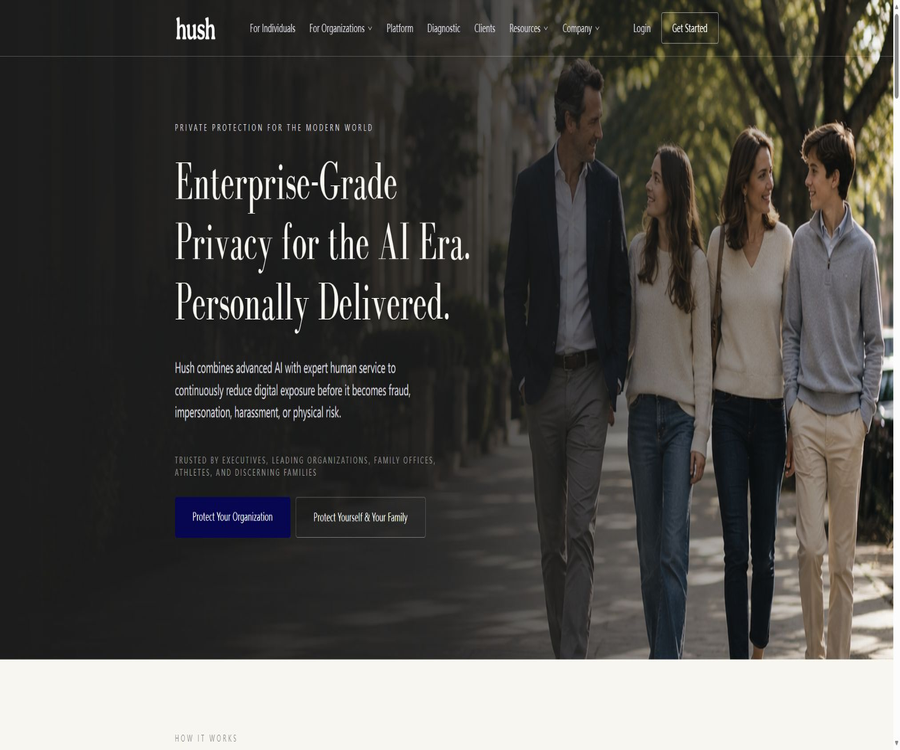
Hush
Hush: an intelligent tool focused on improving AI efficiency.
Tags:AI improves efficiencyA one-sentence summary
Hush is a digital privacy service designed for individuals, families, executives, and organizations; it uses AI to continuously identify personal information that is exposed on the internet, after which the platform along with privacy experts handle the task of deleting such information, suppressing its exposure, reviewing it, and taking action in response to any risks.
Tool Introduction
Hush is operated by PrivacyCheck, Inc., and it focuses on handling home addresses, phone numbers, family relationships, and other types of information that can be used for fraud, impersonation, harassment, or social engineering attacks. It is not a one-time scanning tool; rather, it represents a hosted service that provides continuous monitoring along with manual oversight.
Users need to provide sufficient identification and related information so that the system can distinguish between individuals with the same name and locate the correct record. The platform then shows the number of records that have been found, removed, or had their visibility reduced; however, since data brokers operate independently, any deletion cannot be considered a permanent solution.
Working method
| Phase | Platform actions | The result shown to the user | Key constraints |
|---|---|---|---|
| Search | Scanning data brokers, public records, social networks, and public databases | List of personal information exposures | Having the same name, an old address, and missing information can affect matching. |
| Delete | Submit requests to exit, delete, and suppress on behalf of the user. | Processing status and deleted items | Third-party processing times and rules are not entirely under Hush’s control. |
| Monitoring | New or recurring digital footprints are continually being identified. | New exposure alerts and reprocessing | Public information may be collected and released again. |
| Report | Summary of identified, removed items, and risk changes | Continuous exposure report | Reducing records does not mean eliminating identity or security risks. |
Main functions
AI digital footprint intelligence
The platform continuously maps the data that is visible about individuals on data brokers’ sites, people-search websites, public records, and the open internet. AI is used to link names, addresses, phone numbers, relatives, and related entities, thereby enabling the creation of a comprehensive overview of such information.
Data brokers and the deletion of public records
Hush acts on behalf of users to submit requests to data brokers and other relevant channels for data removal or deletion, and monitors the progress of such requests. The individual Professional plan currently covers more than 2,500 data brokers, as well as public internet and social media platforms.
Ongoing reevaluation and re-suppression
Personal data may reappear after deletion due to new databases, changes in address, or resumption of collection by third parties. Continuous monitoring is used to detect such reappearing records, allowing appropriate actions to be taken once again.
Exposure through social media and multimedia
The instructions on the personal service page state that continuous monitoring can detect new exposures in text, images, videos, and audio. Whether such content can be removed depends on ownership rights, platform rules, legal requirements, and the cooperation of the publisher.
Handling of domains used for impersonation and fraud
The platform identifies fraudulent domain names, fake identities, and deceptive materials related to individuals or organizations, and the team coordinates the platform to take action or remove such elements. This capability is more akin to managed risk response, as it goes beyond simply sending automated emails.
Legal upgrade assistance
When regular deletion requests are ignored or data rights may be violated, Hush can work together with privacy legal advisors to pursue formal channels for resolution. The terms of service specify that Hush does not provide legal representation nor does it guarantee any outcomes regarding lawsuits or deletions.
Protection of family ties
Family members, spouses, children, parents, and those who share the same address can represent relationships involving individuals at high risk. Services can be used to reduce the amount of public information related to these connections, but legal authorization is required in order to add information about other people.
Dedicated privacy expert
Advanced services are handled by dedicated privacy experts who are responsible for monitoring, removal, emergency response, and the generation of personalized reports. Human assistance can deal with anomalies and communications with third parties, but this also means that the costs are significantly higher than those of ordinary self-service data deletion tools.
Diagnosis of tissue exposure
Organizations can request a digital exposure assessment for their executives and leadership team; the report includes information on employee exposure, records of data brokers, a summary of risks, as well as recommendations for action. This assessment is intended to help identify external attack vectors, but it cannot replace internal vulnerability scans.
Identity theft protection and recovery
The current member promotion offers up to $5 million in identity theft protection and recovery assistance. Insurance eligibility, covered events, deductibles, geographic coverage, claims processing, and exclusions are all subject to the terms specified in the actual policy document; the amounts mentioned in the promotion should not be considered as unconditional payouts.
Comparison of individual, Elite, and organizational services
| Plan type | Core object | Main services | Price method |
|---|---|---|---|
| Professional individual member | Individuals and families | Continuous monitoring, cleanup of over 2,500 channels, expert handling, and reporting | Public price for monthly or annual payment |
| Hush Elite | Executives, public figures, and private families | Dedicated experts, priority response, personalized reviews, and in-depth manual processing | Custom quote |
| Organizational services | Enterprises, high-risk employees, and management | Organizational diagnosis, reduction of the attack surface for employees, monitoring of impersonation and credential risks, governance reporting | Contact sales |
Usage process for individual users
Registration and identity settings
- Choose Professional for monthly or annual payment, or contact the team to learn about Elite.
- Accept the invitation and provide your common name, personal email address, and phone number for two-factor authentication.
- Add the age, previous email addresses, name variations, country, and former postal codes as needed.
- Verify the information and complete two-factor authentication to prevent incorrect matching of individuals with the same name.
- Read and accept the limited digital privacy agent authorization, thereby confirming that the platform can submit deletion requests on your behalf.
- Wait for the initial scan and exposure report, and mark any records that are incorrect or do not belong to you.
- Continuously monitor the removal status, alerts for newly exposed items, and regular changes in risks.
Processing after discovering information
- First, confirm that the record indeed pertains to the individual themselves or an authorized family member.
- Check the exposure categories, sites, personal information fields, and potential risks.
- Hush submits requests for withdrawal, deletion, or suppression to the appropriate third parties.
- Comply with the necessary identity verification requests from third parties, but avoid sending information related to unrelated documents.
- States such as in tracking processing, deleted, unprocessable, or requiring an upgrade.
- Contact dedicated experts for high-risk cases of domain name impersonation, fraud, or identity theft.
- Continuously monitor records that reappear, and update names, addresses, and related information.
Organization deployment process
- Identify the executives, high-risk employees, and their family members who require protection.
- Apply for an exposure diagnosis to assess the impact of making personal information public on fraud and impersonation.
- Clarify the roles of enterprise administrators, authorized managers, as well as membership invitations and access permissions.
- Have each member complete the submission of necessary information, carry out identity verification, and grant proxy authorization.
- Establish pathways for impersonation, fraudulent domain names, credential exposure, and emergency escalation.
- Review reports on reduced exposure, records pending processing, and high-risk individuals on a periodic basis.
- Use the results in conjunction with authentication, payment approval, and social engineering training.
Instructions for Limited Proxy Authorization
To submit requests to withdraw from or delete data on behalf of users, Hush asks them to grant limited authorization for such actions. This authorization is focused on digital privacy management, including searching for information, signing relevant applications, communicating with data brokers, and carrying out the necessary deletion procedures.
| Authorization content | Allowed range | It is clearly not included. |
|---|---|---|
| Information monitoring | Search for personal information in public databases, data brokers, and online platforms | Accessing private accounts that are not related to privacy tasks |
| Exit and delete | Submit relevant forms and requests on behalf of the user. | Carrying out financial transactions or banking operations |
| Third-party communication | Negotiations with the platform regarding the removal of personal information | Medical, real estate, and other non-private decisions |
| Sign request | Sign the name for the purpose of deleting digital privacy data | Representing users in legal proceedings |
The proxy authorization generally remains in effect until the account is canceled or terminated as per the terms agreed upon. Users should keep a copy of the agreement and ensure that the process of canceling the account, terminating the proxy authorization, and deleting the data is carried out when they stop using the service.
Authorized manager and family information
- Users can designate an authorization manager to handle account management according to the platform’s verification process.
- The scope of access granted to a manager depends on the specific permissions assigned by the user.
- This may include viewing accounts, modifying or removing requests, receiving updates on progress, and approving service documents.
- Those who have not undergone formal designation and verification will not be considered authorized managers.
- Legal authorization must be obtained before submitting the information of spouses, children, parents, or employees.
- Organization administrators should not, by default, be given access to sensitive personal information that goes beyond what is necessary for their work.
Packages and prices
As of August 23, 2026, individual members can see the public prices for the Professional monthly and annual plans; Hush Elite offers customized quotes. For organizational services, pricing is determined based on the number of employees involved, the level of risk, the depth of services required, and the terms of the contract, and it is discussed with a sales representative.
| Package | Price | Billing cycle | Core rights and interests | Suitable for users |
|---|---|---|---|---|
| Professional Monthly | 550 dollars | Monthly | Ongoing monitoring and reduction of digital footprints, removal from over 2,500 channels, handling by privacy experts, and continuous reporting. | Individuals who need to use it flexibly on a monthly basis |
| Professional Yearly | 6000 dollars | Every year | Similar to the core Professional services, it provides protection throughout the entire year. | Identify individuals or families who use it on a long-term basis |
| Hush Elite | Custom quote | According to the agreement | Dedicated privacy experts, priority response, direct contact, personalized reports, and analysis of exposure incidents | Executives, public figures, and private families |
| Organization | Contact sales | In accordance with the contract | Organizational diagnosis, member protection, hosting monitoring, impersonation response, and governance reporting | Companies, family offices, and investment firms |
Differences between monthly and annual payment plans
The professional plan costs $6,600 for 12 consecutive monthly payments, while the annual payment option amounts to $6,000 – a difference of $600. The average monthly cost under the annual payment plan is $500, but it offers less flexibility compared to the monthly payment option.
Refunds and cancellations
Cancellation, refunds, outstanding fees, and service termination are governed by the terms and the purchase process. Before making a payment, users should verify the renewal period, the deadline for early cancellation, the conditions for refunds, the procedures for initiating manual assistance, and the date on which identity insurance will come to an end.
Which users are it suitable for
- Individuals whose home addresses, phone numbers, and family relationships are made public on multiple websites.
- Executives who are vulnerable to targeted fraud, impersonation, harassment, or threats to their personal safety.
- Families that need continuous protection for their spouses, children, parents, and family members.
- Organizations that wish to include the individual attack surfaces of executives in their corporate security plans.
- Family offices, private equity, wealth management, and professional services firms with a high level of trust.
- Users who do not have the time to submit deletion requests for each site and are willing to purchase manual management services.
Situations that are not very suitable
- The budget option is only suitable for ordinary users who use low-cost self-service data deletion tools.
- Users who wish to have all network records permanently removed after a single scan.
- Materials that are legitimate news reports, content posted by the individual themselves, or materials for which no rights can be claimed need to be deleted.
- Those who are unwilling to provide identity verification information or who do not accept limited agency authorization.
- Users who require full legal representation, litigation services, or guaranteed outcomes.
- The main requirements pertain to teams focused on vulnerabilities in the corporate intranet, endpoint protection, or email gateway security.
Product advantages
- By combining AI recognition with human expert intervention, it addresses anomalies that are difficult to resolve through automation.
- Searching, deleting, continuously monitoring, and reporting form a continuous closed loop.
- The individual plan is available to more than 2,500 data brokers and online platforms.
- It supports family association as well as management of the attack surface at the executive and organizational levels.
- It can handle counterfeit materials, fraudulent domain names, and privacy issues that require upgrading.
- It provides diagnostic information on organizational exposure as well as reports on ongoing governance.
- The privacy policy states that personal information is not sold, and it provides information on security measures in place.
Service restrictions
- Hush cannot control the speed at which third parties delete data, nor can it guarantee that all information will be removed.
- Deleted data may reappear as it is collected again by third parties.
- Public records, legitimate reports, and content posted by the users themselves may not be deleted.
- Same names, changes in addresses, and incomplete information can lead to missed reports or incorrect matches.
- Reducing public data cannot replace strong passwords, two-factor authentication, credit freezing, and fraud detection.
- Protection against identity theft is subject to policy eligibility, location, definition of incidents, and exclusions.
- Whether high-cost professional services are worth it depends on individual risk, time cost, and the extent of exposure.
Privacy Policy and Data Collection
To locate and remove personal information, Hush needs to collect more sensitive identification data than ordinary software. The public policy lists name, email address, phone number, password, address, date of birth, family members, historical records, devices, usage logs, and approximate location.
| Data category | Uses | Risk control recommendations |
|---|---|---|
| Account and contact information | Registration, authentication, notifications, and support | Use a strong password and enable two-factor authentication. |
| Identity and family information | Match records and process digital footprints | Only submit the fields required to complete the service. |
| Payment details | Process bills through Stripe | View the payment processor rules at the same time |
| Public records and broker data | Confirm exposure and submit for removal | Regularly correct mismatched records. |
| Device and usage logs | Safety, troubleshooting, and product improvement | Limit the use of shared devices and log out of the account in a timely manner. |
| Authorized manager information | Allow designated personnel to manage the services. | Adopt the principle of least privilege and revoke permissions regularly. |
Data sharing
According to its privacy policy, Hush does not sell personal information; however, it may share necessary data with service providers, users who have given permission, legal authorities, or recipients in business transactions. Aggregated, anonymized, or de-identified data can be used for analysis, improvement, and business purposes.
Data storage
Personal information is retained as long as the account is active, services are being provided, or as required by law; it is deleted or anonymized within a reasonable period after the account is closed. However, records related to disputes, fraud prevention, unpaid bills, and compliance matters may be kept for longer. The information obtained through broker searches is retained only for as long as it is necessary to provide the services.
Children and age requirements
The terms of service require users to be at least 18 years old. The platform is not intended for children under 13; when parents or guardians register on behalf of minors, they should be aware of the rights to delete, correct, and stop the collection of the child’s data.
Safety measures
- The privacy policy states that data transmission and static storage are encrypted.
- The platform employs access control, regular security assessments, and secure development practices.
- The public page indicates that it has obtained SOC 2 Type II certification.
- The registration process includes two-factor verification using a phone number.
- No network or storage system can guarantee absolute security.
- Users still need to protect their passwords, devices, browser sessions, and authorization manager permissions.
Position in corporate security
| Security sector | Hush can help. | Other controls are still needed. |
|---|---|---|
| Disclosure of senior executives’ personal information | Identify and reduce exposed addresses, phone numbers, and home-related information. | Employee training and personal account protection |
| Business email fraud | Reduce the visible clues that can be used for impersonation and monitor for any abnormalities. | Double verification for payments and email security |
| Fraudulent domain names and identity impersonation | Identify and coordinate the removal or action to be taken by the platform. | Brand monitoring, domain name protection, and legal team |
| Leaking credentials | Enterprise solutions can identify relevant exposures. | Password management, two-factor authentication, and access control |
| Internal system vulnerabilities | It is not within the scope of the main services. | Vulnerability management, endpoint and network protection |
API, GitHub, and open-source status
As of this verification, Hush does not disclose any API pricing details for ordinary developers, nor does it provide an official open-source core platform repository. It primarily offers hosting services and enterprise-level solutions, and therefore should not be classified as an open-source tool.
The open-source projects with the same name that are found may be password managers, tools for silencing noise, or other software; they have no connection to the Hush digital privacy platform operated by PrivacyCheck. Integration requirements should be confirmed with the sales team at the time of purchase by the enterprise.
Basic information
| Project | Content |
|---|---|
| Tool name | Hush |
| Operating company | PrivacyCheck, Inc. dba Hush |
| Tool type | Digital privacy, personal data deletion, digital footprint monitoring, protection for executives |
| Clients/Service recipients | Individuals, families, executives, family offices, and enterprises |
| Operation mode | AI monitoring combined with human privacy experts |
| Price pattern | Monthly or annual individual billing, with Elite and organization-specific options |
| Age requirement | At least 18 years old |
| Security certification | SOC 2 Type II |
| Is it open source? | No |
| Whether to make the API public | Not yet made public |
Frequently Asked Questions
What is Hush?
It is a service for digital privacy and risk management of individuals; it identifies situations in which personal information is exposed, submits requests to have such information removed on behalf of the users, and continuously monitors for any reappearance of that information.
Is Hush a purely AI-based tool?
No. AI is responsible for the large-scale detection and correlation of digital footprints, while privacy experts handle tasks such as removal, review, detection of abnormal communications, handling of impersonation attempts, and providing personalized recommendations.
How much is Hush?
Professional currently costs $550 per month or $6,000 per year. Hush Elite and organizational services come with customized quotes.
How much cheaper is an annual payment compared to a monthly payment?
The total amount due over 12 consecutive months is $6,600, while the annual payment amounts to $6,000; the difference is $600. The average monthly cost when paying annually is around $500.
Can it be guaranteed that all personal information will be deleted?
No. Third-party sites operate independently; the processing time and whether content is deleted are not under Hush’s control, and information that has been removed may reappear.
Why is proxy authorization needed?
The platform is required to sign and submit requests for the withdrawal or deletion of a data broker on behalf of the user. This authorization applies only to digital privacy management and does not cover matters such as banking, healthcare, real estate, or litigation.
Can it protect family members?
It is possible to handle exposures related to relationships with spouses, children, parents, and the family, but the account holder must have proper authorization and must comply with the regulations regarding data of minors.
Does identity theft insurance always cover $5 million?
Not necessarily. $5 million is the maximum coverage amount; actual eligibility, scope of coverage, amount of compensation, and exclusions are determined by the policy terms and the specific circumstances of each case.
Will the data be deleted after cancellation?
The policy states that once cancellation is effected, the relevant data will be deleted or anonymized within a reasonable period; however, legal requirements, disputes, anti-fraud measures, expenses, and other legitimate business needs may require that some data be retained.
Is Hush open source?
It is not open source, and the core platform code or APIs intended for ordinary developers are not made available. Open-source projects with the same name available on the internet do not represent this digital privacy service.
Summary
Hush is suitable for individuals and organizations that are faced with high risks related to privacy, impersonation, and physical safety, and who wish to have experts handle the cleanup of their digital footprints on a continuous basis. Its advantage lies in the combination of AI-based recognition, manual execution, ongoing monitoring, and risk response, rather than merely providing a single scan report.
Before making a purchase, it is necessary to confirm the scope of coverage, agency authorization, scope of data deletion, insurance terms, data storage options, policies regarding refund cancellation, and the enterprise’s management privileges. Premium memberships can reduce the workload associated with manual tasks, but they do not guarantee permanent deletion of data; nor can they replace measures for account security, anti-fraud procedures, or enterprise-level technical protections.
Tools similar to Hush



 Guigong Network Security Registration No. 45132202000164