






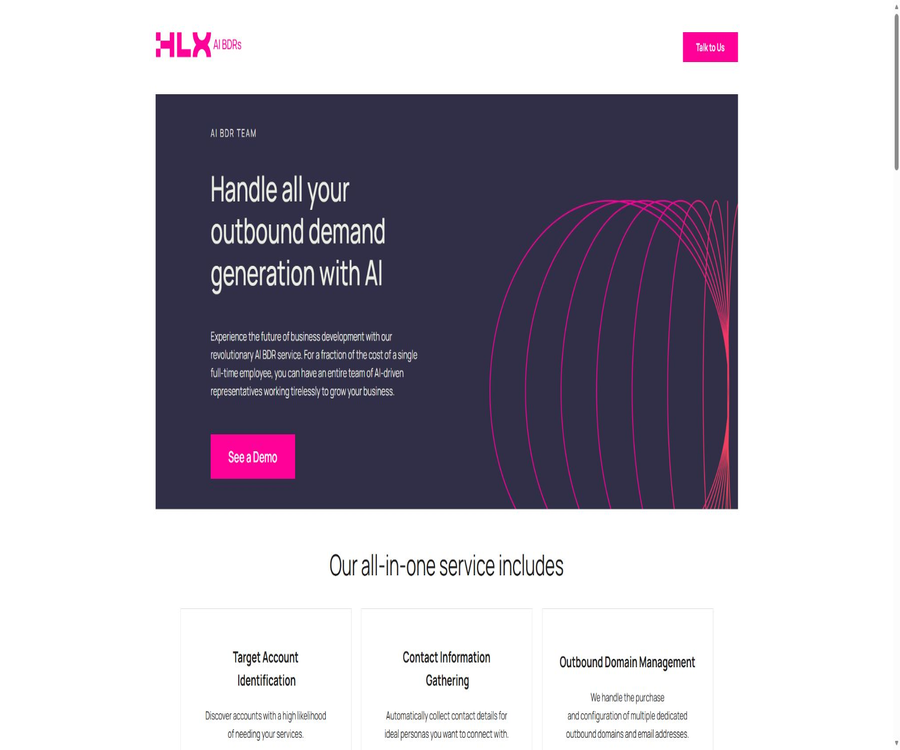
HLX
HLX: an intelligent tool focused on improving AI efficiency.
Tags:AI improves efficiencyA one-sentence summary
HLX AI BDR is a multi-channel lead generation service managed by GTM experts; it allows for the creation of lists based on the profile of ideal customers, and it uses email, LinkedIn, phone calls, and events to reach potential clients, with AI handling the responses, assessing interest levels, and scheduling meetings.
Tool Introduction
HLX is a GTM consulting and execution company based in Irvine, California, USA. It was founded in 2023 and offers services in revenue marketing, sales, customer success, operations, as well as custom AI agents. The AI BDR is part of its sales and lead generation capabilities; it is not a software application that can be downloaded separately.
The early AI BDR pages highlighted one-stop automated outbound calling services, domain name management, and a training portal; the current HLX brand, on the other hand, relies on a consulting and hosting service model. The team analyzes the customer’s revenue model, builds systems, and integrates them into existing processes for ongoing operation, rather than providing customers with standardized templates for them to use on their own.
Product positioning
| Dimension | Current mode of HLX AI BDR | Impact on procurement |
|---|---|---|
| Product format | Managed outbound calling and custom AI agent services | Consultation, plans, and implementation process are required. |
| Delivery team | GTM operation staff and AI engineering partners | It includes both strategies and actual execution. |
| Software account | It’s not a standard self-service SaaS. | There is no unified public registration page or package page. |
| Technical deployment | Integrated with customer CRM, email, LinkedIn, and workflows | The scope varies depending on the existing technology stack. |
| Channels | Email, LinkedIn, phone calls, events, and visitor identification | Compliance and platform rules need to be assessed separately. |
| Billing | Customize by scope, cycle, and team structure | A written quote and a delivery list must be obtained. |
| Delivered results | Target list, outreach system, response handling, meetings, and dashboards | The volume of shipments cannot be equated to sales revenue. |
Main functions
Definition of the ideal customer profile
The process begins with factors such as the target market, company size, industry, region, technology stack, growth stage, and purchase signals, in order to create a detailed profile of the ideal customer. The more comprehensive this profile is, the greater the number of potential customers that can be reached, yet the lower the relevance of those customers; therefore, it is necessary to adjust this profile based on actual sales records and sales performance.
Target account identification
The team uses the company’s data, indicators of interest, and information about customers’ businesses to identify those accounts that are most likely to need the relevant products or services. The results of this identification are used to determine priorities; they do not mean that those customers have agreed to receive marketing messages or that they have a real budget for purchases.
Contact information completion
The system collects work email addresses, phone numbers, as well as information regarding companies and roles, all in relation to the target position and the purchasing committee. Any additions to this data may result in outdated information, incorrect assignments, or the inclusion of personal email addresses; therefore, it is necessary to verify the accuracy of such data and ensure its legitimate use before taking any action.
Creation of target list
HLX uses data completion and intent analysis tools to create a highly targeted list of potential customers, grouping them by position, department, and purchasing role. Existing customers, competitors, those who have unsubscribed, and individuals in unsuitable regions are excluded from this list, in order to avoid wasting marketing resources.
External domain management
Early approaches involved purchasing and setting up multiple dedicated outbound domain names and email addresses, in order to separate marketing emails from the main business domain. Domain isolation helps reduce the risk to the reputation of the main domain, but it does not provide any protection against spam, fraudulent identities, or violations of unsubscribe policies.
Email warming up and delivery
According to the current service description, it is possible to send more than 10,000 emails per month using preheated domain names, with the delivery capacity serving as an indicator of the quality of hosting services. The volume of emails sent should be increased gradually, taking into account factors such as the age of the domain name, the number of returned emails, complaints related to spam, levels of interaction, and the policies of the email service provider; it is not sufficient to focus solely on numerical figures.
AI personalized emails
AI generates personalized messaging by taking into account the role of the contact, company information, LinkedIn profile details, and the assigned demographic tags. The personalized elements must be accurate and relevant, and excessive disclosure of data should be avoided; incorrect references to a person’s experiences can undermine trust and raise concerns regarding privacy.
Multi-contact email sequence
The team develops initial emails, follow-up messages, value-proposition emails, and closing emails tailored for different audiences, and adjusts the timing of these communications based on the responses received. Sending messages too frequently, failing to indicate the sender’s identity clearly, or not providing a way to unsubscribe can increase the risk of complaints and domain suspension.
LinkedIn account optimization
The LinkedIn process starts with optimizing the profiles of the individuals to whom contact is to be made, including the title, banner, content, and elements that convey credibility, before sending connection requests. The profiles must reflect the actual identity of the account holders; it is not allowed to present AI-driven operations as fake employees or to fabricate customer relationships.
Automated LinkedIn connections
The current approach takes at least 5 accounts as an example; each account sends around 19 connection requests per day, resulting in a total of about 95 requests. Automation is still subject to LinkedIn’s user agreement, restrictions on account behavior, and local laws, and no specific number guarantees approval by the platform.
LinkedIn follow-up
Once the potential customer accepts the connection, the system can send multiple personalized message sequences and proceed to the next step based on the level of interaction. The rules regarding invitations, messages, and manual intervention need to be standardized, so as to prevent the same contact from being bombarded with emails, phone calls, and messages via social media at the same time.
Website visitor identification
The service includes the ability to anonymize website visitors; it allows for the identification of up to 30% of the traffic, after which company or potential customer information can be used to reach those individuals. The actual rate of identification is influenced by factors such as the structure of the traffic, location, Cookie limitations, and the data provider – therefore, probability matches should not be considered as confirmed identities.
AI response processing
The AI BDR reads the responses from potential customers, identifying positive reactions, rejections, delays, referrals, cancellations, and other intentions, and provides recommendations for subsequent actions. In cases involving pricing, contracts, security, legal issues, or complex product aspects, it is necessary to have sales staff handle those matters.
Assessment of intended eligibility
The system determines whether it is worth proceeding with the sales process by taking into account factors such as audience matching, expressed needs, time, permissions, and intended next steps. The eligibility criteria should be in line with the customer’s own sales methods; a polite response cannot be considered to indicate a high level of interest just because of certain keywords used.
Meeting scheduling and handover
Potential clients who meet the criteria are directed to the sales team’s calendar, and the relevant details are passed on to the client’s account executive or contact person. This information should include the history of interactions, key requirements, objections, approval status, and scheduling details, so that the sales team does not have to ask questions from scratch.
CRM integration
Agents can connect to CRMs such as HubSpot and Salesforce to write in contacts, activities, qualification results, and meeting statuses. During implementation, it is necessary to define unique identifiers, field ownership, duplicate merging, stage mapping, and error rollback.
Training portal and human feedback
The early versions of the AI BDR page provided a portal for viewing each interaction with potential clients as well as for directly training agents, allowing teams to adjust messages and decisions accordingly. The current main site places more emphasis on customized deployments; it should be determined whether to continue providing this same portal as part of the project scope.
Reports and continuous optimization
HLX provides metrics such as activities, connections, responses, qualifications, meetings, and conversions, while also continuously adjusting the lists, channels, and messaging used. A truly meaningful assessment should focus on tracking opportunities, pipeline values, deals closed, and customer acquisition costs, rather than merely considering the number of messages sent or responses received.
Phone and event support
In addition to emails and LinkedIn, HLX can also handle tasks such as outbound calls, reservations before events, and follow-ups after events. Phone scripts, recordings, automatic dialing, time zones, and rejection lists need to be configured separately according to each region and customer policies.
Current multi-channel outbound calling solution
| Channels | Public service capabilities | Example scale or metrics | Key constraints |
|---|---|---|---|
| Lists, preheated domain names, sequences, and AI personalization | Over 10,000 per month | Delivery, acceptance, cancellation, and complaint rates | |
| Data optimization, connection requests, and automatic follow-up | The 5 accounts together result in approximately 95 connection requests per day. | Platform automation policies and account security | |
| Website | Visitor anonymization and intent detection | Up to approximately 30% of traffic can be identified. | Probability matching, Cookies, and privacy rules |
| AI response | Intent recognition, eligibility assessment, and routing | Run continuously | Complex problems require manual intervention. |
| Calendar | Schedule highly interested prospects with the sales team | Configure by project | Time zone, calendar capacity, and handover quality |
| Phone | The team can add additional outbound call services. | Fixed call volume not disclosed | Automatic dialing, recording, and rejection rules |
| Event | Reach out before the event and follow up after it | By scope of activity | List approval, time window, and attribution |
LinkedIn’s six-step process
- Create a target list based on the ideal customer profile, company data, intentions, and purchasing roles.
- Select at least one real employee account to optimize the title, banner, content, and perception of credibility.
- Start by sending highly relevant connection requests on a small scale, and monitor the acceptance rate as well as any restriction messages.
- After the connection is established, multi-contact messages are sent, which are personalized appropriately based on role, company, and interaction history.
- AI identifies the intention to respond, carries out initial qualification checks, and hands over complex conversations to human agents.
- Schedule qualified leads in the sales calendar, and record the full context of the engagement in CRM.
- On the dashboard, compare the performance in terms of connections, responses, and meetings for different lists, messages, accounts, and time periods.
- Adjust the profiles and messages based on actual opportunities and feedback from transactions, rather than simply increasing the number of requests.
Email outreach workflow
- Extract industry, scale, technology, region, and purchase triggers from existing customers and transaction records.
- Retrieve and verify company and contact data, and remove records related to cancellations, invalid entries, personal email addresses, and duplicates.
- Configure a dedicated domain name, sender identity, authentication records, as well as email forwarding and monitoring.
- Gradually warm up the email address, control the number of messages sent, replies received, and complaints per day, and avoid a sudden increase in activity on the new domain.
- Create a value proposition, problem assumptions, evidence, and clear next steps for each role.
- Let AI generate personalized drafts based on public business information, and then conduct a sample review of the facts and tone.
- Send multi-touchpoint sequences, and set different actions for cancellation, rejection, postponement, and positive responses.
- Send responses with a high level of intent to a human agent; after the requirements are confirmed, schedule a meeting and update the CRM accordingly.
- Check weekly the health of the domain name, the quality of responses, meeting attendance, as well as contributions in terms of opportunities and pipelines.
- Stop using the ineffective lists and messaging, and focus the budget on those combinations that actually generate sales opportunities.
The delivery method of HLX
| Phase | Main tasks | Typical product | Customer participation |
|---|---|---|---|
| Model | Analyze revenue models, objectives, gaps, and priority channels | GTM model, ICP, target and input estimation | Provides historical data and business insights. |
| Build | Set up domains, lists, sequences, proxies, CRM, and dashboards | A functional multi-channel outbound calling system | Approval of brands, compliance, and field design |
| Run | Integrated into team operations, responses, qualifications, and optimization | Ongoing meetings, reports, and iterations | Sales takes over and provides feedback on the quality of opportunities |
| Transfer | Custom agents and process knowledge transfer | Agents, documents, and training retained by the client | Receive permissions and establish internal operations |
Discover, Build, and Deploy
For custom AI agent projects, the client’s GTM process is first audited to identify the areas that are most suitable for automation; thereafter, agents are developed using HubSpot, Salesforce, Slack, Gong, email, and LinkedIn, and they are put into use. The service ensures that the client retains ownership of the agents and the results they produce, while the ownership of the specific code, accounts, and infrastructure is specified in the contract.
AI Agent Evaluation
For B2B SaaS companies that have not yet determined where to start, HLX and its engineering partners provide a structured evaluation using AI agents. The project typically lasts 4 to 6 weeks; a limited number of slots are available each month. The goal is to identify 5 to 10 use cases, prioritize 3 to 5 of them, and develop a deployment roadmap for the year.
| Evaluation module | Content | Delivered value |
|---|---|---|
| Use case discovery | Streamline marketing, sales, customer success, and operational processes | Long list of candidate use cases |
| Impact and feasibility | Compare value, risk, dependency, and implementation difficulty | 3 to 5 priority items |
| AI readiness | Check data, infrastructure, security, and organizational capabilities | Gaps and action checklist |
| Technical adaptation | Test suitable cloud-based AI services and architectures | Performance and cost estimation |
| Business cases | Create investment returns, budgeting, and management materials | One-year roadmap for submitting decisions |
Prices and cooperation models
HLX does not provide fixed prices for AI BDR services or custom agents; all solutions require consultation and clarification of the scope of work. According to the company’s FAQ, leadership support services are usually billed on a monthly basis as consulting fees, while project-based services can be offered at a fixed price or based on time and materials spent, or they can also be structured as ongoing management services.
| Cooperation model | Billing method | Common cycles | Suitable scenarios |
|---|---|---|---|
| AI BDR hosting service | Custom quote | By activity or ongoing operation | Complete outsourcing of lists, outreach, responses, and meetings is required. |
| Score GTM Leader | Typical monthly consulting fee | It is commonly seen after 6 to 12 months. | There is a lack of senior officials in charge of revenue, marketing, or sales. |
| Implementation via project-based approach | Fixed fee or time and materials | About 6 weeks to 6 months | CRM, agency, or development of individual processes |
| AI Agent Evaluation | Quotation after application or special quotas for eligible candidates | 4 to 6 weeks | A roadmap and business cases are needed. |
| Blend mode | Consulting fees plus project or hosting costs | By range | Both strategy and long-term implementation are necessary. |
What should be included in a quote?
The written plan should specify the target market, the channels to be used, the number of accounts and domain names, the monthly volume of messages sent, the data providers, the roles of the staff members, the definitions related to meetings, CRM integration, reporting requirements, technical costs, compliance obligations, and procedures for exiting the partnership. Without these details, it is difficult to compare the actual costs of HLX with those of internal teams or other agencies.
There is no public free version.
HLX is not a self-service software; there is no permanent free plan or standard trial account available. While the initial consultation may be free, whether fees apply for concept demonstration, evaluation, implementation, and ongoing maintenance depends on the project proposal.
Which users are it suitable for
- B2B SaaS companies that already have defined products and target markets, but lack a stable outbound calling infrastructure.
- Companies in the Series A to B stage that need to grow rapidly but do not want to expand their SDR team immediately.
- A revenue team that hopes to operate email, LinkedIn, phone calls, and campaign outreach simultaneously.
- Companies that already have HubSpot or Salesforce but lack data, processes, and automated integrations.
- Founders and revenue managers who need a GTM strategy as well as the responsibility for its implementation should be part of the same team.
- Organizations that wish to develop custom AI agents for their existing processes, rather than purchasing off-the-shelf template software.
- Companies that need to transfer the AI agents to their in-house teams and provide knowledge training.
- Teams that are willing to measure telemarketing efforts in terms of opportunities, leads, and closed deals, rather than focusing solely on the number of emails sent.
It is not very suitable for which users
- Individual users who simply want to register for a low-cost, self-service email tool right away.
- There are no early-stage projects with a matching product market, target customers, and the ability to deliver sales.
- Teams that are unable to provide historical pipeline, CRM, or customer feedback data to define customer profiles.
- Companies that regard bulk sending as their only goal and are unwilling to implement compliance and delivery management measures.
- There are buyers who need fixed transparent packages, those who place orders by seat, and those who can proceed with purchases without any consultation.
- Organizations that do not allow external service teams to access CRM, email, or lead data.
- The sales team is unable to take over complex responses and scheduled meetings in a timely manner manually.
Typical use cases
- Develop the first set of repeatable multi-channel outbound actions for new products or new markets.
- It replaces fragmented list purchasing, manual personalization, and unsolicited mass email sending.
- Run a LinkedIn connection and follow-up plan for five real business professionals.
- Identify accounts with a high intention to visit the website, and incorporate them into the compliant process for reaching target audiences.
- Let AI handle common responses first, and then pass conversations with high intent to AE.
- Convert the list of participants in an event into pre-event reservations and post-event system follow-ups.
- Consistently record contacts, qualification status, and meeting outcomes in HubSpot or Salesforce.
- Automatically research accounts, update CRM, and generate follow-up drafts through a custom agent.
Sales data and external compliance
AI BDR handles company information, contact details, work email addresses, phone numbers, LinkedIn profiles, insights derived from website visits, interaction data, and CRM records. It is necessary for customers and HLX to clarify who decides on the purposes of processing, who carries out that processing, where the data comes from, for how long it is stored, and how requests to withdraw consent or delete data should be handled.
| Risk areas | Possible problems | It is recommended to exercise control. |
|---|---|---|
| Contact data | Expired, mismatched, or personal email addresses have been included. | Verify the fields and retain the justification for legitimate use. |
| Email regulations | Lack of identity, address, or unsubscribe mechanism | Configure templates and blocklists by region |
| LinkedIn automation | Account restrictions or violation of platform rules | Control the pace and have it supervised by the actual account holder. |
| Visitor identification | Probability matching is used to determine an individual’s identity. | Define labels and restrict usage. |
| AI personalization | Inventing experiences, events, or relationships | Sampling fact verification and disabling of sensitive fields |
| AI response | Giving incorrect promises regarding price, features, or security | Define thresholds for manual takeover and approval. |
| Repetition across channels | The same potential customer is contacted frequently through multiple channels. | Unified contact timeline and frequency limit |
| Data retention | Remains in place after departure, cancellation of subscription, or expiration of the contract | Set up the processes for deletion, export, and exit. |
Email unsubscription and suppression
All rejections, cancellations, and invalid addresses should be added immediately to the cross-channel suppression list, to prevent them from being included again in subsequent lists. Stopping email communications does not necessarily mean that contact can be continued via phone or LinkedIn; the appropriate actions must be taken based on the intended purpose and relevant rules.
Risks associated with LinkedIn accounts
The 19 connection requests disclosed per account per day represent only an example of the usage rate set by HLX; they are not the official allowance permitted by LinkedIn. Account owners should be aware of the automated processes and approval requirements, and ready to stop such activities immediately when restrictions are applied.
Anonymize visitors
A recognition rate of up to 30% represents the upper limit set for such services; in practice, the results may merely identify the company or provide signals regarding the likelihood of use. Websites are required to inform visitors, depending on their location, about data collection, matching processes, marketing purposes, and the available privacy options.
Security and data governance
HLX describes its custom proxy infrastructure as being SOC 2 compliant, with client deployments that are isolated from one another, and it emphasizes that customer data is not shared with any third parties. Compliance with SOC 2 standards does not mean that an independent SOC 2 report has been obtained; buyers should ask for information regarding the current audit status, the scope of controls in place, and any exceptions.
| Control items | Current public statement | It should be confirmed at the time of purchase. |
|---|---|---|
| Security framework | SOC 2 alignment | Are there already Type I or Type II reports as well as a coverage system in place? |
| Customer isolation | Data isolation for each deployment | Tenant, account, storage, and key boundaries |
| Third-party sharing | Claiming not to share customer data | The roles of models, the cloud, data, and external suppliers in this process |
| Engineering cooperation | Collaboration with AllCode and AWS | Contract parties, responsibilities, and sub-processors |
| Access rights | Agents are integrated with CRM, email, and collaboration tools. | Minimum permissions, administrators, and decommissioning |
| Data transfer | The client ultimately retains the agent and the results. | Code, prompts, accounts, logs, and infrastructure ownership |
| Incident response | The detailed process is not disclosed. | Notification deadline, contact person, and liability for remedial actions |
| Retain and Delete | No unified deadline has been announced. | During the project, after its termination, and for backup cleanup |
Boundaries of third-party tools
Any emails, LinkedIn messages, CRM systems, cloud platforms, data completion tools, and calendar-related processes rely on external platforms. Even if HLX does not sell customer data, these suppliers may still have access to it as processors; therefore, a complete list of such processors along with contractual restrictions is necessary.
Insufficient rules for disclosing privacy information
No complete privacy and terms of service documents that can be accessed directly from the HLX AI BDR microsite were found, and the main website does not provide a clear, unified legal information link in its main navigation menu. Companies should not rely solely on marketing pages; they must obtain information regarding privacy policies, data processing agreements, and related security documents before entering into any contracts.
How to interpret indicators
| Public indicators | Page values | Correct understanding |
|---|---|---|
| Send email | Over 10,000 per month | Active capacity is not equivalent to deliveries, responses, or opportunities. |
| LinkedIn request | About 95 times per day for 5 accounts | Running examples does not guarantee a quota on the part of the platform. |
| Connection acceptance rate | Over 21% | The customers, lists, and time periods may vary. |
| Average message response rate | 18% | It is necessary to distinguish between positive responses, rejections, and automated replies. |
| New meeting | About 15.8 per month for 5 accounts | It is necessary to define what constitutes eligibility and who actually shows up. |
| Visitor identification | Up to 30% | It falls within the upper limit, and it may be a company-level match. |
| Boost from old station activities | 700% | Lack of public baselines and test designs |
| Improvement in the conversion rate of old sites | 35% | It cannot be used to promise specific outcomes to customers. |
| Lower costs at old stations | 80% | It should be compared with the costs of full staffing, tools, and services. |
These figures can be used to establish hypotheses for pilot projects, but they cannot serve as guarantees for outcomes beyond the terms of a contract. Companies should first define what constitutes a successful meeting, attendance, an opportunity, the value of a lead, a closed deal, the cost of acquiring customers, and the payback period, and then use their own CRM data to verify these definitions.
Pilot evaluation method
- Choose a niche market with a clear target audience and one that the sales team is capable of serving.
- Validate the ideal customer profile using historical sales data and lost customers, rather than relying solely on third-party data.
- Clarify the respective regional and compliance boundaries for emails, LinkedIn, phone calls, and visitors.
- Define the account, domain name, monthly transmission volume, data provider, user roles, and meeting settings.
- A small control group was established to compare the HLX process with the performance of existing manual or agency methods.
- Check weekly the bounce rates, complaints, cancellations, connection acceptances, response categorization, and the quality of manual handling.
- CRM keeps track of meetings attended, opportunities, amounts involved, sales closures, and the sales cycle, focusing not only on frontline activities.
- Audit AI-generated content for factual errors, excessive personalization, and improper claims.
- At the end of the pilot phase, export the data, documentation, model configurations, and learning records to verify transferability.
- Only when the quality of the pipelines and the economic efficiency per unit meet the preset standards can the account size and the volume of transmissions be increased.
Supported platforms and technology stacks
| Platform or technology | Use cases | Status description |
|---|---|---|
| HubSpot | Contacts, activities, phases, and automation | Custom integration |
| Salesforce | CRM, fields, opportunities, and reports | Custom integration |
| Data, connections, and message delivery | Restricted by platform rules | |
| Domain names, sequences, personalization, and responses | Managed operation | |
| Slack | Agent notifications, internal workflows, and execution assistants | Custom agents can be embedded. |
| Gong | Call content, summaries, and CRM updates | Custom proxy example |
| Clay | Lists, completion, research, and intentions | HLX can be implemented and optimized. |
| OpenAI, Claude, Gemini | Custom AI inference and content | A generalized set of implementation technologies, with projects able to select those as needed. |
| Make, Zapier, n8n | Workflow orchestration | General AI implementation capability |
| Self-service mobile app | Not provided | The services are delivered primarily through existing tools and a dedicated support team. |
API, GitHub, and open-source status
HLX enables the creation of custom interfaces and connectors, and it can also be integrated with clients’ technical stacks through automated platforms; however, no public HLX AI BDR APIs, unified SDKs, or developer consoles have been identified. The project’s interfaces are tailored for specific use cases and should not be considered as ready-to-use public products.
No verifiable official HLX open-source AI BDR code libraries, model weights, or self-hosted community versions have been found. The service emphasizes that customers retain ownership of the customized agents, but the specific code licensing terms, infrastructure accounts, and rights to make further modifications must be specified in the contract.
Product advantages
- Place the GTM strategy, system setup, and actual operation under the same delivery team.
- It covers email, LinkedIn, phone calls, events, and website signals simultaneously.
- AI is responsible for large-scale research, personalization, response categorization, and eligibility assessment.
- Operations experts are responsible for creating customer profiles, formulating information strategies, taking over operations manually, and carrying out ongoing optimizations.
- It can be integrated with HubSpot, Salesforce, Slack, Gong, and customer email addresses.
- It provides a complete implementation approach from Model, Build to Run.
- The custom proxy can ultimately be transferred to the customer, reducing the likelihood of permanent reliance.
- It can be combined with revenue marketing, sales, customer success, and RevOps services.
- It is suitable for growing companies that do not have a full SDR team but already possess strong sales capabilities.
- The metrics cover connections, responses, meetings, and CRM pipelines, enabling a closed-loop evaluation.
Usage restrictions and precautions
- HLX is a consulting and hosting service, rather than a standard self-service software that can be registered immediately.
- AI BDR does not have a fixed public price, a free version, or a standard trial package.
- The positioning and functional description of the old AI BDR micro-station differ from those of the current main brand.
- 10,000 emails and 95 daily connections represent the scale of the program; they do not guarantee sales results.
- A 21% acceptance rate, an 18% response rate, and 15.8 meetings are the indicators for marketing cases.
- Automating activities on LinkedIn can lead to account restrictions; it is necessary to comply with the platform’s rules.
- The maximum percentage of website visitors that can be identified is 30%, and this may be based on probability or at the company level.
- Contact information completion, cold emailing, phone calls, and social media outreach are subject to privacy and marketing regulations in various regions.
- AI can generate personalized facts or give misinterpreted responses, which requires sampling for review and human intervention.
- CRM, email, and collaboration tools grant high levels of access; therefore, the principle of minimum permissions and the recovery of access rights upon departure are essential.
- SOC 2 alignment does not equate to having an independent certification that covers all systems.
- There is no public, unified privacy policy, nor public APIs, SDKs, open-source, or self-hosted versions available.
- The code, account credentials, data, and ownership rights related to the custom proxy must be specified in the contract.
- When there is no sales team available to take over meetings in a timely manner, excessive automated outreach can end up wasting potential customers.
Basic information
| Project | Content |
|---|---|
| Tool name | HLX AI BDR |
| Company name | HLX |
| Date of establishment | 2023 |
| Headquarters | Irving, California, United States |
| Company type | GTM consulting and implementation services provider |
| Product format | Managed multi-channel outbound calling and custom AI agents |
| Core channels | Identification of email, LinkedIn, phone calls, event attendees, and website visitors |
| Core competencies | Lists, personalization, eligibility for replies, meeting and CRM synchronization |
| Pricing | Custom quote |
| Free version | Not provided |
| Deployment | Integrate with the customer’s existing technology stack |
| Public API | No findings were detected. |
| Is it open source? | No |
Frequently Asked Questions
What is HLX AI BDR?
It is a managed AI-driven telemarketing service provided by HLX, which integrates target lists, emails, LinkedIn, phone calls, AI-based response handling, qualification assessment, meeting scheduling, and CRM synchronization.
Can I register and use it on my own?
It is not possible to purchase it directly through the standard SaaS process. Currently, it is necessary to seek consultation first; HLX will then determine the scope of cooperation based on the objectives, channels, technical stack, and capabilities of the team.
Is HLX just a software company?
No. HLX positions itself as a GTM consulting and implementation company; it makes it clear that it does not sell generic AI software, but rather develops and deploys customized agents and processes that suit the client’s business needs.
What is the price?
There is no fixed public price. Leadership roles are usually compensated on a monthly basis as advisory fees; projects can be billed at a fixed price or based on time and materials used. For AI BDR hosting services, a customized quote is required.
Is there a free trial?
No standard free version or self-service trial account was found. The initial consultation may be free, while subsequent evaluation, implementation, and maintenance will incur costs depending on the proposal.
Which channels are supported?
The current AI-based outreach solution takes into account emails, LinkedIn messages, phone calls, events, and website visitor data, and schedules qualified leads in the sales calendar.
How many emails can be sent per month?
The current plan specifies that more than 10,000 emails should be sent each month by using preheated domain names, but the exact number should be determined based on the domain name, the list of recipients, the region, and the delivery efficiency.
Will LinkedIn suspend my account?
Risks exist. The 19 connection requests per account per day that are shown as examples are merely illustrative; they do not constitute a guarantee provided by the platform. Automated methods and message frequencies must comply with LinkedIn’s rules.
Can AI automatically respond to potential customers?
AI BDRs can handle responses, assess customer intent, and arrange appointments, but complex products, pricing issues, security concerns, contracts, and sensitive matters should be referred to human agents.
Can it be integrated with HubSpot or Salesforce?
Yes, HLX can integrate the proxy and outbound calling functions into existing systems such as HubSpot and Salesforce. The specific fields, permissions, and scope of synchronization are determined based on customized implementation.
Will the customer eventually end up owning an AI agent?
The current instructions emphasize that the customer should retain the agent after deployment and carry out the transfer, but the code licenses, cloud accounts, instructions, data, and maintenance responsibilities still need to be specified in detail within the contract.
Has HLX obtained SOC 2 certification?
It is stated publicly that the system is in line with SOC 2 standards; it should not be said outright that certification has been obtained. The purchaser needs to request information regarding the type of report, its date, scope, and any exceptions.
Are APIs provided?
Custom interfaces can be developed for clients, but no public AI BDR APIs, SDKs, or developer consoles have been found. Custom connectors do not equate to an open platform.
Is HLX AI BDR open source?
It is not open source; no official open-source repository, model weights, or community versions that can be deployed on one’s own have been found.
Summary
HLX AI BDR is suitable for growing companies that already possess clear B2B products and the capability to handle sales tasks, but lack a reliable outbound calling system as well as qualified operational staff. It assigns tasks such as managing lists, domain names, emails, LinkedIn accounts, visitor data, AI-driven responses, scheduling meetings, and CRM operations to an integrated team.
When choosing HLX, it is not sufficient to compare only the number of emails or meetings; instead, one should consider the full range of services offered, the quality of the pipeline, compliance responsibilities, technical costs, data ownership, and the feasibility of transferring rights upon withdrawal. The most reliable approach to making a purchase is to start with a small-scale pilot project, using the opportunities and successful deals recorded in the CRM to assess the effectiveness, before deciding whether to expand the partnership and extend the contract period.
Tools similar to HLX



 Guigong Network Security Registration No. 45132202000164