






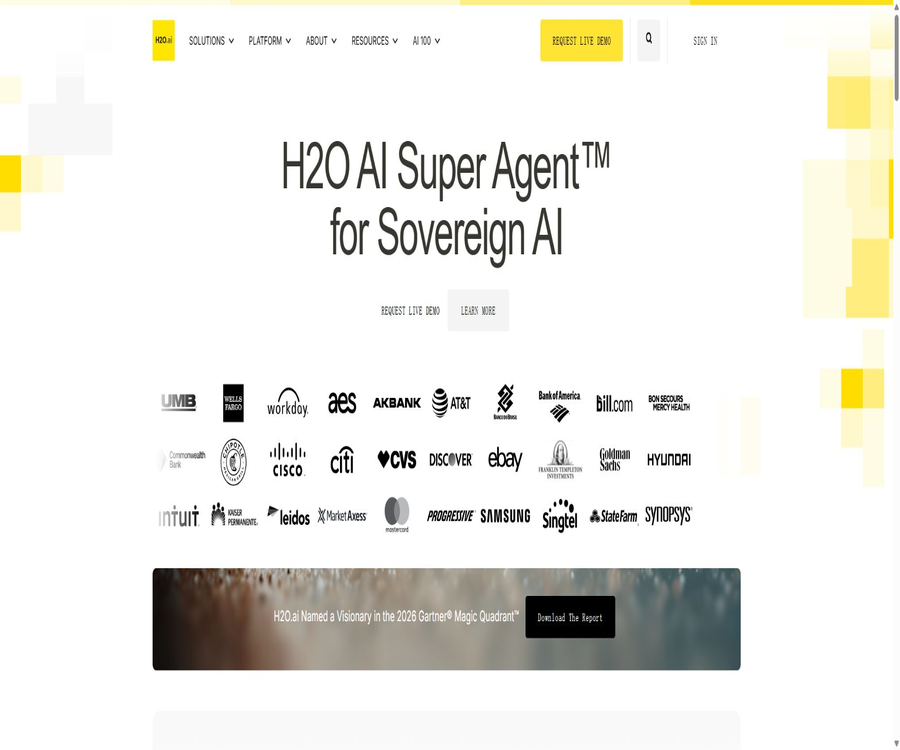
H2O AI
H2O AI: an intelligent tool focused on improving the efficiency of AI.
Tags:AI improves efficiencyA one-sentence summary
H2O.ai is a product ecosystem that covers traditional machine learning, AutoML, model deployment and monitoring, enterprise RAG, intelligent agents, LLM fine-tuning, and AI application development; it offers both free open-source components as well as commercial platforms designed for production and compliance scenarios.
Tool Introduction
H2O.ai was founded in 2012 by Sri Ambati, with its headquarters located in Mountain View, California, United States. The company started out with the open-source distributed machine learning platform H2O-3; today its product portfolio has expanded to include predictive AI, generative AI, intelligent agents, and enterprise AI cloud solutions.
“H2O AI” is not the name of a single chat tool. Users may be referring to H2O-3, Driverless AI, H2O AI Cloud, Enterprise h2oGPTe, H2O LLM Studio, Wave, or other components; it is necessary to clarify the tasks and licensing requirements before making a choice.
Open-source projects share some technologies and branding with enterprise products, but they differ in terms of licensing, deployment, support, security, and functional capabilities. The fact that H2O-3 is open source does not mean that H2O AI Cloud is free; similarly, the fact that h2oGPT is open source does not imply that Enterprise h2oGPTe is also open source.
Overview of the product portfolio
| Products | Positioning | Open-source status | Primary users | Current method of acquisition |
|---|---|---|---|---|
| H2O-3 OSS | Distributed memory machine learning and AutoML | Apache 2.0 | Data scientists, ML engineers, and researchers | Free download and self-management |
| H2O-3 Secure | Supported, auditable production version of H2O-3 | Commercial closed-source enhancements | Regulated enterprises and production teams | Contact sales |
| H2O Driverless AI | Automatic feature engineering, modeling, interpretation, and deployment | Commercial products | Data Science and Business Analysis Team | Request a demonstration and quote |
| H2O AI Cloud | End-to-end AI development, deployment, monitoring, and application platform | A commercial platform that includes some open-source components. | Large enterprises, governments, and platform teams | For Managed or Hybrid deployment, please contact sales. |
| Enterprise h2oGPTe | Private RAG, intelligent agents, and generative AI | Commercial products | Corporate knowledge, research, and agency teams | Contact sales |
| H2O AI Super Agent | Multi-step enterprise proxy with code priority | Enterprise h2oGPTe capabilities | Complex research and automation teams | Assessment along with the enterprise solution |
| H2O LLM Studio | Code-free or low-code LLM fine-tuning | Apache 2.0 | Researchers and model engineers | Install by yourself |
| Enterprise LLM Studio | Multi-user, governance, automation, and deployment versions of the fine-tuning platform | Commercial closed-source | Enterprise Model Team | Contact sales |
| H2O Wave | Develop real-time AI web applications using Python or R | Apache 2.0 | Data scientists and application developers | Install it yourself or use it on AI Cloud. |
| Open-source h2oGPT | Local document Q&A and RAG | Apache 2.0, but the repository has been archived. | Historical self-hosted project users | It can read historical codes, but it is not the best choice for new projects. |
H2O-3 open-source machine learning platform
H2O-3 is the most important open-source project of H2O.ai; it relies on in-memory distributed computing to enable the training and evaluation of models on either a single machine or a multi-node cluster. Users can work with it using Python, R, Java, Scala, the Flow graphical interface, or REST APIs.
The current stable version of the document is 3.46.0.12. The open-source version is free and is licensed under Apache 2.0; however, the user is responsible for installation, upgrades, bug fixes, capacity management, monitoring, backups, and handling any production issues.
Algorithms and AutoML
- Supervised learning: GLM, GBM, XGBoost, random forests, deep learning, support vector machines, and rule-based models, etc.
- Integrated learning: Stacked Ensembles allow multiple base models to be combined in order to improve generalization ability.
- Unsupervised learning: K-Means, PCA, anomaly detection, and other data exploration algorithms.
- Time and distribution modeling: generalized additive models, time-dependent features, and various probability distributions.
- H2O AutoML: Train multiple algorithms, adjust parameters, integrate them, and generate rankings within the budget.
- Model explanation: Methods such as variable importance, partial dependence, and SHAP vary depending on the algorithm and version.
- Data interface: Supports integration with common file systems, object storage services, Hadoop, Spark, and cloud environments.
H2O-3 typical workflow
- Install H2O-3 that matches the client version in a controlled environment.
- Start a single node or cluster, and restrict network access to the Flow and REST ports.
- Import data from files, databases, object storage, or Spark jobs.
- Check column types, missing values, category cardinality, leakage, and target distribution.
- Split the training, validation, and testing sets to prevent information leakage based on business timing and entity boundaries.
- Run a single algorithm or AutoML, and set the time, number of models, and resource budget.
- Compare rankings, stability, fairness, interpretability, and reasoning cost.
- Select server rating, supported model artifacts, or enterprise upgrade based on the current license and production requirements.
Open-source security boundary
The H2O-3 documentation specifies that the platform should be deployed within secure data centers; Flow and REST services must not be exposed directly to the public internet. The default Web port is usually 54321, while cluster nodes use adjacent internal communication ports.
Open source does not imply inherent security. Teams need to configure network segmentation, TLS, authentication, file permissions, data masking, dependency patches, logging, keys, and trust between nodes on their own.
H2O-3 OSS and H2O-3 Secure
H2O-3 Secure represents the commercial approach for production management within the product line slated for 2026; it maintains compatibility with the H2O-3 code, APIs, and pipelines, while adding long-term support, fixes for commercial-related vulnerabilities, enterprise packages, and audit assistance features.
| Ability | H2O-3 OSS | H2O-3 Secure |
|---|---|---|
| License | Apache 2.0 | Business license |
| Core algorithms and AutoML | Includes | Includes |
| Multi-node training | Included, self-managed operation | Includes and provides commercial support. |
| Python and R packages | Includes | Maintain compatibility |
| Community support | Yes | Yes, and advanced support is available. |
| Hadoop and Kubernetes enterprise packages | Does not include business packages | Includes |
| Generate MOJO score | The current comparison page is not included. | Available for Hadoop, Spark, Teradata, Oracle, and others. |
| Automatic model documentation | Commercial AutoDoc is not included. | Includes |
| Reproducible control of the model | The team builds it on its own. | Includes corporate capabilities |
| SSO and key management | The team builds it on its own. | Provides enterprise-level control |
| RBAC and auditing | The team builds it on its own. | Provides audit support capabilities. |
| Commercial vulnerability fixes and long-term support | No SLA | Includes |
| Compliant positioning | No compliance guarantees are provided. | Designed to support alignment with FedRAMP High as well as SOC 2 and ISO audits. |
H2O-3 Secure does not automatically enable customers to pass SOC 2, ISO 27001, or ISO 42001 audits. It provides product capabilities that can support evidence and controls; organizations still need to establish their own processes, personnel, data management practices, and risk governance frameworks.
H2O Driverless AI
Driverless AI is a commercial AutoML platform that handles automatically tasks such as data visualization, feature engineering, model selection, parameter tuning, validation, interpretation, and preparation for deployment. After the user defines the target columns and experimental preferences, the system searches for and compares various candidate pipelines.
Core competencies
- Automatically identifies data quality issues, potential ID columns, strong leakage signals, and available features.
- Perform advanced feature transformation and identify variable interactions.
- Automatically selects algorithms, parameters, validation methods, and scoring criteria.
- It supports various types of experiments, including those involving time series, NLP, images, and structured data.
- Provides global and single prediction explanations, bias checks, and model documentation.
- It allows models, converters, and scorers to be extended through Python recipes.
- It can generate REST services, Python scoring pipelines, or standalone Java scoring components.
- It supports CPU and GPU environments; the actual level of acceleration depends on the data, algorithms, and hardware.
Applicable boundaries
Driverless AI reduces the need for repetitive modeling tasks, but it does not help users define the correct business objectives, labels, cost functions, or criteria for determining success after deployment. Even the model that achieves the highest score can suffer from data leakage, drift, bias, or unreasonable decision-making.
H2O AI Cloud
H2O AI Cloud is an end-to-end platform based on Kubernetes, which can operate in H2O’s hosting environment, a customer’s private cloud, or on local infrastructure. It integrates modeling, Notebooks, MLOps, an application store, permission management, and various H2O products within a single workspace.
| Deployment method | Operation location | Operation and maintenance responsibilities | Suitable for organizations | Focus on verification |
|---|---|---|---|---|
| Managed Cloud | H2O.ai hosting environment | H2O is responsible for the operation and maintenance of numerous platforms as well as Kubernetes. | Companies that wish to reduce the costs associated with infrastructure management | Data areas, networks, SLAs, and subcontractors |
| Hybrid Cloud | Customer cloud account, VPC, or local environment | The customer and H2O divide the tasks according to the contract. | Companies with strict regulations regarding the network, data sovereignty, or existing platform teams | Clusters, upgrades, backups, monitoring, and support boundaries |
| Completely isolated environment | Depends on the enterprise solution and product components. | Special implementation is required. | Government, defense, and highly sensitive industries | Offline upgrades, models, licenses, and dependency supply chain |
Default core components
- AI App Store: Distributes and runs AI applications for business users.
- AI Engine Manager: Manages computing engines such as H2O-3, Driverless AI, and Notebook.
- H2O Driverless AI and H2O-3: responsible for AutoML and predictive models.
- H2O MLOps: Managing, deploying, serving, and monitoring models.
- Wave SDK: Build low-code AI applications using Python.
- Workflows and platform services: covering permissions, tokens, keys, model centers, and telemetry.
- Components such as H2O Drive, LLM Studio, and Admin Analytics can be selected based on version or configuration.
Additional paid components
| Components | Main tasks | Typical input | Output or effect |
|---|---|---|---|
| Enterprise h2oGPTe | Enterprise RAG, Q&A, proxy, and multi-model routing | Documents, knowledge bases, databases, and tools | Answers with references, JSON, task results, and proxy actions |
| H2O Hydrogen Torch | Code-free deep learning | Images, text, time series, and other unstructured data | Training models and inference pipelines |
| H2O Label Genie | Auxiliary data annotation | Text, images, or project samples | Manually confirmed label set |
| H2O Document AI | Document classification and field extraction | Scans, PDFs, and forms | Structured fields, categorization, and review processes |
| H2O Feature Store | Centralized management of reusable features | Training and online business data | Consistent training and service features |
| H2O LLM Data Studio | Generative AI data preparation | Documents, instructions, and samples | Cleaning, organizing, and training data |
| H2O LLM Eval Studio | RAG and LLM evaluation | Models, prompts, answers, and test sets | Quality, risk, and comparison indicators |
Getting started with AI Cloud
- Apply for a demonstration and confirm with sales the Managed or Hybrid deployment option.
- Define the workspace, identity provider, network, keys, data areas, and administrator responsibilities.
- Create a Driverless AI, H2O-3, or Notebook engine, and configure the CPU, memory, GPU, and disk.
- Upload or connect sample data; first complete data classification and access approval.
- Run experiments and evaluate performance, stability, interpretability, and fairness on an independent validation set.
- Register the candidate models in MLOps, and set up approval processes, services, monitoring, and rollback mechanisms.
- Use Wave or the app store to create business interfaces, and restrict the permissions for each workspace and application instance.
- After going live, monitor models, applications, resources, logins, costs, and security events.
Enterprise h2oGPTe and AI Super Agent
Enterprise h2oGPTe is a generative AI platform designed for corporate private data; it enables the integration of document repositories, knowledge bases, databases, predictive models, and business tools into RAG and intelligent agents. It supports multiple models, model routing, safeguard rules, cost control, as well as local, cloud, or isolated deployment options.
Enterprise RAG and Document AI
The platform enables questions and answers, summarization, searching, and the generation of structured JSON data based on authorized materials; it is suitable for extracting information from contracts, compliance metrics, and audit documents. Answers that are backed by evidence still require verification to ensure that the search was complete, that the used snippets are not outdated, and that the model has understood them correctly.
The combination of predictive AI and generative AI
h2oGPTe can pass the prediction results from H2O-3 or Driverless AI, Shapley values, and business data to an agent for analysis. This enables the generation of business recommendations based on the probability of certain events occurring, but it does not allow language models to modify the original model evidence.
H2O AI Super Agent
Super Agent is the default proxy in Enterprise h2oGPTe; it enables the selection of tools, the writing and execution of code, error correction, and the completion of multi-step tasks. The same request can follow different paths depending on the context and the tools used, which requires a sandbox environment, approval processes, and thorough auditing.
- Suitable for in-depth research, predictive analysis, document processing, data querying, and cross-system workflows.
- Complex goals can be broken down into sub-tasks, and multiple dedicated agents can be coordinated.
- It supports various approaches to deploying sovereign AI, including in the cloud, within VPCs, on local systems, and in fully isolated environments.
- Tool calls and code execution increase the risk related to permissions, so minimal authorization should be granted based on each task.
- The baseline ranking reflects performance on a specific test set; it does not mean that this system is superior to others for every business task.
- High-risk decisions, write operations, and external communications should require manual approval and the ability to revert.
Differences between the open-source and enterprise versions of h2oGPT
The open-source h2oGPT offered local document querying, RAG, model inference, and multimedia input; it was licensed under the Apache 2.0 license. Its official GitHub repository has been archived, with the last code update dating from 2025; the most recent official release remains version 0.2.1 from 2024.
Enterprise h2oGPTe remains H2O.ai’s key commercial product, with its functions, architecture, and support continuously evolving. The archived version of h2oGPT should not be referred to as the full open-source version of the enterprise platform just because of similar names.
| Ability | Open-source h2oGPT | Enterprise h2oGPTe |
|---|---|---|
| License | Apache 2.0 | Business license |
| Warehouse status | Archived | Ongoing maintenance of commercial products |
| Basic chatting, document search, and RAG | Provide historical implementations | Provide |
| Deployment on local and public clouds | It can be built on your own. | Offer supported solutions. |
| Managed and Hybrid Cloud | No official enterprise hosting available | Provide |
| Multi-tenant and enterprise security | The team builds it on its own. | Includes corporate capabilities |
| Verification, safeguarding, and model risk management | Limited or self-implemented | Provides integration capabilities. |
| Expansion and installer | Reliance on community code | Provide commercial implementation and support. |
| LLM MLOps | Combine by yourself | Corporate capabilities |
| Suitable for new business projects | It is necessary to assess the archiving risks. | Purchase based on business needs |
H2O LLM Studio
H2O LLM Studio is an open-source framework and graphical interface licensed under Apache 2.0, used for preparing data, fine-tuning, evaluating, and exporting large or small language models. Its official repository remains active, with version 1.15.0 released in August 2026.
Capabilities of the open-source version
- Configure datasets, models, training parameters, and evaluation through a graphical interface.
- It supports Hugging Face models as well as various efficient parameter fine-tuning methods.
- Save experiments, metrics, checkpoints, and inference configurations.
- Suitable for single-team research, prototyping, and self-managed fine-tuning environments.
- Training requires a suitable GPU, drivers, video memory, storage, and model licenses.
- Open-source software is free, but computing power, data preparation, maintenance, and security are not.
Enterprise LLM Studio
Enterprise LLM Studio is a licensed version built on an open-source training framework, designed for multi-user production environments behind firewalls or in private clouds. It offers centralized storage for models and datasets, role-based permissions, version control, a full set of REST APIs, as well as capabilities for data generation and automatic fine-tuning.
The Enterprise version is entirely closed-source and not a simple hosting option for Apache 2.0 projects. The experimental multi-modal training and object detection features should not be used in critical production processes without first being tested.
H2O Wave and AI application development
H2O Wave is an open-source framework for developing real-time web applications and dashboards using Python or R, licensed under the Apache 2.0 license. Developers can use existing UI components to display models, data, forms, and interactions, without having to set up a complete front-end technology stack first.
The Wave application can run independently, or it can be imported into the H2O AI Cloud app store and shared across workspaces. The official repository is currently active; version 1.8.12 was released in August 2026.
Create a Wave app
- Install a Python or R environment, as well as the Wave SDK, that is compatible with the project.
- Define pages, cards, forms, tables, and visualization components.
- Connect to H2O-3, Driverless AI, external models, or business APIs.
- Add input validation and permissions for upload, query, prediction, and download actions.
- Test locally and record the dependencies, environment variables, model, and data versions.
- It can be deployed independently or the application can be packaged and uploaded to the AI Cloud App Store.
- Configure instance hibernation, resources, access groups, logging, updates, and rollbacks.
Developing interfaces and enabling integration
| Interface or tool | Applicable products | Primary uses | Authorization and Precautions |
|---|---|---|---|
| Python client | H2O-3, Driverless AI, AI Cloud, etc. | Data, experiments, models, and automation | The version must be compatible with the server. |
| R client | H2O-3 and certain ecosystems | Statistical Modeling and Data Analysis | Check the package and server version. |
| REST API | H2O-3, Driverless AI, Enterprise LLM Studio, and others | Programmed training, management, and services | Different products have different certification and licensing requirements. |
| Flow | H2O-3 | Interaction between data in the browser and the model | Do not expose yourself to untrusted networks. |
| MOJO or POJO | H2O-3 Secure and Driverless AI production pathways | Independent or embedded model scoring | The rights to generate and deploy are determined based on the current commercial license. |
| Wave SDK | H2O Wave and AI Cloud | Build AI web applications | Apache 2.0 core; the cloud platform is licensed separately. |
| AI Cloud CLI and platform API | H2O AI Cloud | Application, workspace, file, and platform automation | Based on enterprise deployment and role-based authorization |
| Python recipes | Driverless AI | Custom models, converters, and scorers | The recipes repository is open-source, while the Driverless AI core is commercial. |
Which users are it suitable for
- Data scientist: Uses H2O-3 or Driverless AI for structured data modeling and AutoML.
- Machine learning engineer: Deploys, monitors, and updates predictive models or generative AI services.
- Researchers and students: Conduct free, self-managed experiments using H2O-3 and LLM Studio.
- Enterprise Platform Team: Unifies computing, workspaces, models, applications, and governance through AI Cloud.
- Regulated industries: Assessing H2O-3 Secure, Driverless AI explanations, and enterprise security controls.
- Knowledge Management Team: Uses Enterprise h2oGPTe to create private RAG and document assistants.
- Model team: Use Enterprise LLM Studio to fine-tune, evaluate, and deploy domain models.
- Application developers: Use Wave to transform model capabilities into business interfaces.
- It is not suitable for individual users who simply want to obtain an inexpensive, general-purpose chat robot immediately; H2O is intended primarily for technical or corporate use cases.
Typical use cases
- Prediction of fraud, credit, churn, demand, risk, and equipment failures.
- Run AutoML on structured data and compare various algorithms with integrated models.
- Automatically generates features, validation strategies, explanations, and model documentation.
- Register, deploy, monitor the prediction model, and retrain it after drift occurs.
- Build evidence-based Q&A and structured extraction around corporate documents and databases.
- Enable agents to carry out complex research by combining prediction results, tools, and code.
- Tune LLMs or SLMs in the domain, and compare quality, latency, and cost.
- Use Wave to combine models, forms, reports, and business processes into AI applications.
Product advantages
- It also boasts a mature portfolio of predictive AI, AutoML, generative AI, and agent technologies.
- H2O-3, LLM Studio, and Wave come with permissive open-source licenses, which facilitate learning and self-management.
- Python, R, Java, Scala, REST, and graphical user interfaces cater to different types of technical users.
- From experimentation and explanation to deployment and monitoring, a relatively complete enterprise life cycle is formed.
- It supports managed clouds, customer clouds, on-premises environments, and some fully isolated environments.
- Driverless AI focuses on feature engineering, explanation, validation, and scoring pipelines, rather than merely training a single model.
- Enterprise h2oGPTe can integrate RAG, predictive models, tools, and multi-model routing.
- The authorities have GitHub organizations that have undergone domain verification, allowing for the verification of open-source repositories, licenses, and maintenance status.
Constraints and selection risks
- With a large number of products that have similar names, it is easy to make mistakes when referring to open-source components, commercial enhancements, and cloud platforms.
- Companies do not disclose fixed prices for their products; the costs related to licenses, support, computing resources, and implementation need to be quoted separately.
- H2O-3 is a in-memory distributed system; large-scale data training may require significant memory resources as well as specialized cluster setup.
- AutoML can reduce the time required for experiments, but it cannot replace goal definition, data governance, causal reasoning, and responsibility for deploying the system.
- AI Cloud comprises a large number of components, and system implementation is required for aspects such as identity management, networking, storage, upgrades, and support.
- The open-source h2oGPT repository has been archived; continuing to use it for new projects entails risks related to maintaining dependencies and addressing vulnerabilities.
- Models, datasets, and third-party base models each have their own licenses; the Apache 2.0 license does not cover all model weights.
- Enterprise AI outputs may contain errors or lead to unfair results; the latest contracts require final manual review by humans.
- Uses such as medical diagnosis, biometric identification, critical infrastructure, weapons, and high-risk finance are subject to corporate licensing restrictions.
- The history page still states a 90-day free trial, but the main entry point now leads to a request for a demonstration; therefore, the old trial offer should not be considered as an ongoing commitment.
Price and licensing
As of August 23, 2026, H2O.ai does not have a fixed, uniform price listed for its enterprise-level products. The open-source versions of H2O-3 OSS, H2O LLM Studio, and Wave can be used free of charge, while the commercial versions are priced based on deployment, components, users, computing power, support, and the scope of the contract.
| Product or version | Software price | License | Additional costs | Current purchase methods |
|---|---|---|---|---|
| H2O-3 OSS | Free | Apache 2.0 | Own computing, storage, operations, security, and support | Download or install via package manager |
| H2O LLM Studio OSS | Free | Apache 2.0 | GPU, models, data, storage, and operations | Install from the official repository |
| H2O Wave | Free | Apache 2.0 | Application hosting and operations management | Install from the official repository or package manager |
| Open-source h2oGPT | The code is free. | Apache 2.0, the repository has been archived | Models, GPUs, dependency maintenance, and security | It is not recommended as a choice for new production without evaluation. |
| H2O-3 Secure | Custom quote | Business license | Infrastructure, implementation, and support scope | Production review or contact sales |
| Driverless AI | Custom quote | Business license | CPU/GPU, deployment, support, and recipe management | Apply for a demonstration |
| H2O AI Cloud | Custom quote | Commercial subscription | Managed or Hybrid infrastructure, components, and implementation | Apply for a demonstration and get a corporate quote |
| Enterprise h2oGPTe and Super Agent | Custom quote | Commercial subscription | Model inference, vector storage, tools, and implementation | Contact sales |
| Enterprise LLM Studio | Custom quote | Commercial closed-source license | GPU, model licenses, data, and deployment | Contact sales |
Trial status
The official website’s historical tutorials and old solution pages mentioned a 90-day free trial of H2O AI Cloud; the earlier Driverless AI page also indicated a 21-day trial period. The current main entry point displays “Request a Demo”, and there is no available trial period that can be verified at present.
Enterprise evaluations should specify in the written trial or POC documents the components, data capacity, GPU resources, concurrency levels, support services, duration, procedures for deletion, as well as the terms of the formal contract. The costs associated with infrastructure or images in the cloud market may also need to be settled separately from the H2O software licensing fees.
GitHub and open-source projects
H2O.ai has an official GitHub organization that has been verified through domain validation, and currently around 195 repositories are available publicly. Not all projects within this organization fall under the same licensing terms, and the public recipes or example codes cannot be considered part of the open-source components of Driverless AI and AI Cloud.
| Official warehouse | Uses | License | Status during verification |
|---|---|---|---|
| h2oai/h2o-3 | Distributed machine learning and AutoML | Apache 2.0 | Active, stable document 3.46.0.12 |
| h2oai/h2o-llmstudio | LLM and SLM fine-tuning GUIs and frameworks | Apache 2.0 | Active, latest release 1.15.0 |
| h2oai/wave | Real-time Web Applications with Python and R | Apache 2.0 | Active, latest version 1.8.12 |
| h2oai/sparkling-water | Using H2O in Apache Spark | Apache 2.0 | Not archived; the update schedule needs to be determined based on the compatibility matrix. |
| h2oai/datatable | Processing of two-dimensional table data | MPL 2.0 | Not archived; it was officially released quite recently. |
| h2oai/driverlessai-recipes | Driverless AI custom models and converters | Apache 2.0 | Active, but requires a commercial Driverless AI for operation. |
| h2oai/h2ogpt | Local GPT, document Q&A, and RAG | Apache 2.0 | Archived; the latest release is 0.2.1 |
Precautions for using open-source software
- First, read each repository’s own license, NOTICE, dependencies, and model card.
- Record the version used for submission, the published version, the version of Python or R packages, and the server version.
- Check whether the warehouse is archived, the latest security patches, unresolved issues, and the compatibility matrix.
- The Apache 2.0 license for open-source frameworks does not automatically grant rights to the training data or model weights.
- Manage forks, examples, recipes, and core products within official organizations separately.
- In a production environment, it is necessary to establish SLAs, mechanisms for responding to vulnerabilities, procedures for upgrades and rollbacks, as well as provide long-term support.
Privacy, Security, and Compliance
According to H2O.ai’s current privacy policy, the input data, metadata, and model data provided by customers are not used to train H2O.ai’s models, unless there is a separate written agreement between the parties. Free, trial, or API services may process input data in real time, but they may still retain limited amounts of metadata for security, debugging, or to prevent abuse.
Enterprise DPA was updated in April 2026; it covers paid, free tiers, trials, API, and testing functions, and requires customers to be responsible for the legitimacy of the data as well as for the final manual review of AI-generated outputs. H2O.ai commits to maintaining technical and organizational measures that meet industry standards.
| Security or privacy projects | Current official statement | Deployment recommendations |
|---|---|---|
| Customer data training | It shall not be used for training H2O.ai models without written consent. | At the same time, verify the rules of third-party models and those of the built-in models. |
| Encryption | Transmission and static encryption | Confirm the scope of each deployment, backup, logging, and object storage. |
| Access control | Role-based identity and permissions | Integration with enterprise IdP, workspaces, and application permissions |
| Security audit | Maintain SOC 2 Type II | Request the current report, scope, period, and exceptions. |
| ISO 27001 | Officials say progress is being made. | Do not mark it as certified before completion. |
| DPA | Applicable to products, APIs, free tiers, and testing features | Review together with the order list, area list, and subcontractor list. |
| Security incidents | Without undue delay; within 72 hours upon becoming aware, if possible. | Agreed contact person, severity level, and evidence collection support |
| Subcontractor | Maintain the list in the Trust Center | Subscribe to change notifications and check the data area. |
| Telemetry and logging | It may be processed outside the selected customer data area. | Implement classified management to prevent sensitive content from appearing in logs. |
| Data deletion | Handle in accordance with DPA, contractual, and legal requirements. | Specify deadlines for proactive data, models, logs, and backups. |
Security deployment process
- Select an open-source self-managed, managed, hybrid, on-premises, or fully isolated solution based on data classification.
- Sign the order, EULA, and DPA, and list all components, models, subcontractors, and data areas.
- Place the management side, Flow, REST, model services, and node communication within a controlled network.
- Integrate enterprise identities and assign the minimum necessary permissions based on work areas, projects, models, applications, and operations.
- Place the keys, object storage credentials, model tokens, and database accounts in the Secure Key Service.
- Verify privilege escalation, prompt injection, data leakage, malicious models, and dependency risks in the testing environment.
- Manual access controls are established for training, approval, deployment, proxy tool calls, and high-risk outputs.
- Continuously monitor for vulnerabilities, model drift, abnormal calls, resource costs, and audit logs.
Commercial and high-risk applications
The H2O open-source projects can be used for commercial development under their respective licenses, but commercial products are subject to a limited license intended for internal business use only, during the duration of the subscription. Using them on behalf of third-party clients, granting sub-licenses, providing hosting services, or distributing model artifacts require approval as stipulated in the contract.
The current enterprise EULA explicitly prohibits the use of AI in systems that could lead to loss of life, serious injury, or catastrophic damage, including areas such as medical diagnosis and treatment, biometric monitoring, emergency services, critical infrastructure, aviation, autonomous driving, weapons, and high-risk financial decisions.
- Licenses for data, models, dependencies, and third-party APIs must be checked separately.
- Models that have legal or significant impacts on individuals require fairness, explainability, the ability to file appeals, and human review.
- Generative AI and agent outputs may be incorrect, and therefore cannot be used as a basis for professional or high-risk decisions.
- Model cards, experiments, features, data versions, approvers, and deployment records must be traceable.
- Baselines, customer cases, and performance multiples only indicate specific conditions and do not guarantee actual results.
- Regulatory industries should incorporate risk models, data protection, verification, and change control into formal processes.
Supported platforms
| Platform or environment | Support status | Representative products | Precautions |
|---|---|---|---|
| Linux server | Widespread support | H2O-3, Driverless AI, LLM Studio and Wave | Verify the versions of Java, Python, GPU, and containers. |
| Development for Windows and macOS | Support for open-source components such as H2O-3 | Local experiments and clients | Enterprise server products are typically based on Linux and Kubernetes. |
| Web interface | Support | Flow, Driverless AI, AI Cloud, h2oGPTe, and LLM Studio | Proper identity and network control are required in all cases. |
| Kubernetes | Core deployment methods for AI Cloud | Managed and Hybrid Cloud | Plan for storage, GPU, networking, upgrades, and backups |
| AWS, Azure, and Google Cloud | Supports multi-cloud | AI Cloud, h2oGPTe and various components | Service and market availability vary by region. |
| On-premises and private clouds | Supports enterprise deployment | AI Cloud, h2oGPTe, and Enterprise LLM Studio | A business contract and implementation are required. |
| Hadoop and Spark | Supported by product and version | H2O-3 Secure, Sparkling Water, and evaluation components | Check the compatibility matrix and commercial packages. |
| Mobile version | The h2oGPTe page provides an entry point for mobile chatting. | For use in corporate chats | It is not considered equivalent to a fully functional management client. |
| Edge or standalone scoring | Supported by workpiece and license | Driverless AI and H2O-3 Secure | Verify hardware, dependencies, and distribution rights |
Basic information
| Project | Content |
|---|---|
| Brand name | H2O.ai |
| Company | H2O.ai, Inc. |
| Founder and CEO | Sri Ambati |
| Date of establishment | 2012 |
| Headquarters | Mountain View, California, United States |
| Product type | Machine learning, AutoML, MLOps, generative AI, intelligent agents, and AI application platforms |
| Core open-source products | H2O-3, H2O LLM Studio, H2O Wave, and Sparkling Water, among others. |
| Core business products | H2O-3 Secure, Driverless AI, H2O AI Cloud, Enterprise h2oGPTe and Enterprise LLM Studio |
| Free to use | Open-source components are free; you are responsible for the infrastructure and maintenance yourself. |
| Corporate prices | Not available; please contact sales. |
| Current trial access link | It is mainly for application purposes; the old 90-day trial period cannot be considered a current commitment. |
| API | Provides Python, R, REST, CLI, and product-specific APIs |
| Official GitHub | Yes, and the organization has verified control over the H2O.ai domain name. |
| Is it all open source? | No, open-source and commercial products coexist. |
| Main deployment | Self-management, Managed Cloud, Hybrid Cloud, on-premises and private clouds |
| Safety | SOC 2 Type II; ISO 27001 is still in the process of implementation. |
| Customer data training | It shall not be used for training H2O.ai models without a written agreement. |
| Verification date | August 23, 2026 |
Recommendation score
Recommendation score: 4.6 / 5. H2O.ai offers a rare and comprehensive set of capabilities that include open-source distributed machine learning, AutoML, explainability, model lifecycle management, and enterprise-level generative AI.
It is most suitable for organizations that possess skills in data science, platform engineering, and governance, rather than individual users who are looking for a cheap, ready-to-use messaging solution. The large number of available products, the lack of transparency regarding pricing for enterprises, and the complex boundaries between open-source and commercial solutions represent the main challenges in making a decision when choosing such a product.
Frequently Asked Questions
What is H2O.ai?
H2O.ai is a company as well as an ecosystem of AI products that includes H2O-3 for machine learning, Driverless AI for automated modeling, AI Cloud, enterprise RAG and agents, LLM fine-tuning, and Wave for application development.
Is H2O.ai free?
Some components are available free of charge. Open-source tools such as H2O-3, H2O LLM Studio, and Wave can be used freely, while Driverless AI, H2O AI Cloud, H2O-3 Secure, and enterprise-generated AI products require a commercial license.
Is H2O-3 the same as H2O AI Cloud?
They are different. H2O-3 is an open-source machine learning engine, while H2O AI Cloud is an enterprise environment that combines multiple engines, MLOps tools, Notebooks, applications, permission controls, and platform services.
Can H2O-3 OSS be used in production?
Technically, it can be deployed by the team itself, but currently the vendor includes production support, fixes for commercial vulnerabilities, enterprise packages, model artifacts, and audit assistance in H2O-3 Secure. Critical production systems should be evaluated based on the existing requirements regarding functionality and support.
Will driverless AI replace data scientists?
No. It automates feature engineering, parameter tuning, validation, interpretation, and preparation for deployment, but business objectives, data quality, causal reasoning, risk assessment, and production responsibilities remain the duty of professionals.
Is h2oGPT still an active open-source project?
The official h2ogpt repository is now archived; the latest official release is version 0.2.1. The older versions of this code can still be used under the Apache 2.0 license, but new projects should consider alternative solutions in terms of dependencies, vulnerabilities, and maintenance.
Is Enterprise h2oGPTe open source?
It is not open source. It is a commercially maintained platform that offers features such as RAG, agents, guardianship, multi-tenancy, MLOps, and support; it cannot be considered equivalent to the archived open-source version h2oGPT.
Is H2O LLM Studio open source?
The open-source version uses Apache 2.0 and is still receiving regular updates. Enterprise LLM Studio, on the other hand, is a proprietary product that offers multi-user support, centralized management, REST APIs, and automation features.
What is the price of the company’s products?
The official website does not specify a fixed price. The costs vary depending on the product components, the method of deployment, computing power, the number of users, support services, the amount of data, and the scope of implementation; therefore, it is necessary to request a demonstration and a quote from the company.
Is there still a 90-day free trial available?
The old tutorials still mention a 90-day trial period for H2O AI Cloud, but the main entry point nowadays is to request a demonstration. The old 90-day rule should not be considered as an existing benefit unless confirmed in writing by sales.
Will customer data be used to train the H2O model?
The current privacy policy states that the data entered by customers, along with metadata and model data, will not be used to train H2O.ai models unless there is explicit written consent from both parties. Third-party models, models provided by the customers themselves, and testing functions still require verification in accordance with the specific contracts in place.
Is H2O AI suitable for Chinese users?
The H2O-3 algorithm does not rely on any interface language; the capability of generative AI in Chinese depends on the model chosen, the data used for fine-tuning, as well as various embedding and evaluation methods. The official documentation and guidance for implementation are primarily available in English.
Summary
The advantage of H2O.ai lies in its ability to connect open machine learning tools with enterprise production platforms. Teams can start with H2O-3 or LLM Studio prototypes, and then evaluate Secure, Driverless AI, AI Cloud, or enterprise generative AI solutions based on their needs regarding security, support, deployment, and governance.
When making a selection, it is necessary to check each specific product in terms of its license, warehouse status, model weights, deployment options, model artifacts, APIs, price, and support. A common mistake is to assume that since a company started as an open-source entity, all its products are also open source; or to consider the archived version of h2oGPT to be the current free version of Enterprise h2oGPTe.
Tools similar to H2O AI



 Guigong Network Security Registration No. 45132202000164