






GrackerAI
GrackerAI: an intelligent tool focused on improving AI efficiency.
Tags:AI improves efficiencyA one-sentence summary
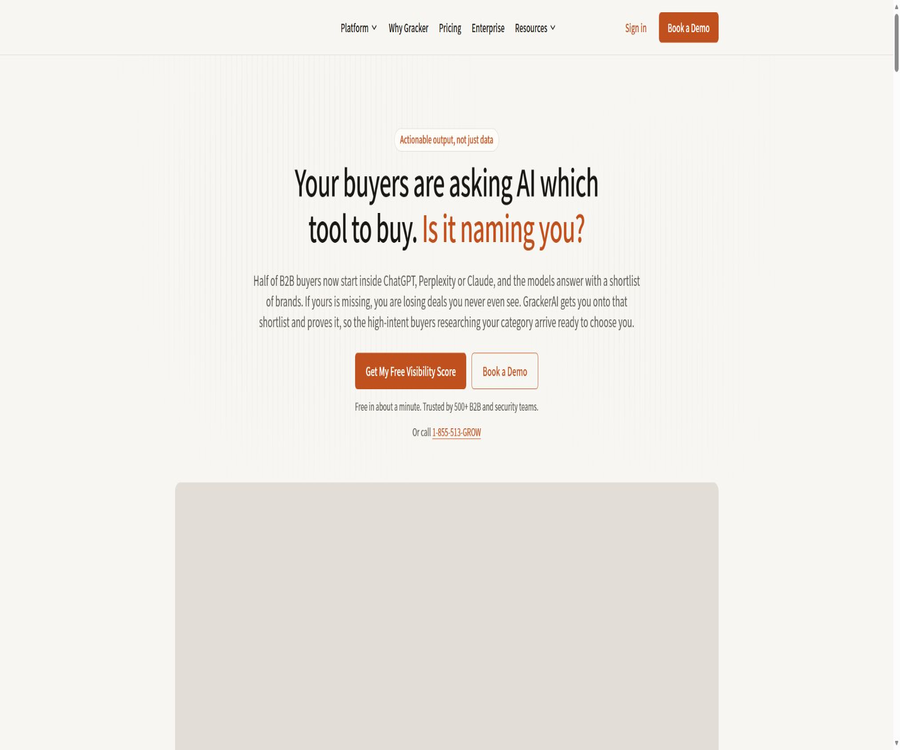
GrackerAI is an AI search visibility and GEO optimization platform designed for cybersecurity and B2B SaaS teams; it helps brands determine whether they are mentioned, cited, or recommended in AI-generated answers.
Tool Introduction
GrackerAI is operated by Technokeen Inc., and it is positioned by its developers as a platform for optimizing generative engines. It does not merely track traditional search rankings; instead, it periodically runs prompts that reflect the questions buyers might ask, in order to analyze how different AI engines describe a brand and its competitors.
The platform connects monitoring, diagnosis, and execution together. Users can view visibility, mention rates, sentiment, citation domains, and the gap compared to competitors, and then convert these issues into content suggestions, AEO fixes, tasks, or articles that can be published.
Product positioning
| Comparison items | Traditional SEO tools | GrackerAI | Applicable decisions |
|---|---|---|---|
| Objects of monitoring | Search results page and keyword rankings | AI answers, mentions, citations, and recommendations | The two types of tools need to be used together. |
| Core issue | What is the ranking of the webpage? | Whether the brand is involved in AI-generated answers | Suitable for GEO and AEO |
| Data unit | Keywords, Display, and Clicks | Tips, answers, brands, and citations | It is not possible to directly compare the same indicator. |
| Competitor analysis | Rankings, external links, and traffic | Mentions and positions within the same AI response | AI recommendation biases can be detected. |
| Optimize output | Keywords, pages, and technical SEO recommendations | Reference signals, content gaps, and resolution of ambiguities | It is necessary to combine this with manual review. |
| Primary users | SEO and website management team | B2B growth, content, and brand teams | Network security is a highly specialized field. |
Main functions
AI visibility monitoring
Users can set custom alerts for the brand, define buyer roles, specify regions, and identify competitors; monitoring can then be carried out on a weekly, daily, or hourly basis. The number of AI engines supported and the frequency of monitoring depend on the chosen package.
Mentioning and citation tracking
The platform keeps track of the brand mentions, locations, emotions, and related pages in the AI-generated responses. Users can view why a particular brand was recommended or ignored, based on criteria such as suggestions, engine used, country, or time.
Visibility and share metrics
The dashboard provides indicators such as visibility score, frequency of occurrence, sentiment, share of volume, and trends. These scores are based on relative measurements of the configured prompts and monitoring samples, and they do not represent the actual share of user queries in the entire market.
Competitor comparison
The platform allows for comparing the frequency of appearance, sentiment, mentions, and placement of responses for a brand and its competitors within the same set of prompts. Users can also identify new competitors that appear frequently alongside their own brand, even though they haven’t been added manually.
Fact distortion and emotion monitoring
GrackerAI compares the descriptions provided by AI regarding a brand’s price, features, team, and positioning with verified product information, identifying any possibly outdated or incorrect statements. This feature helps brands to correct their public information promptly, though human judgment is still needed to determine whether the AI’s responses are indeed incorrect.
AEO website audit
The platform can check whether website pages are easily accessible, parseable, and understandable by AI crawlers, and provide suggestions for improvements. The current packages offer auditing of up to 50 pages for the Starter version and up to 200 pages for the Scale version; the Enterprise version is designed for large websites.
Visibility diagnosis and recommendations
Users can run an immediate diagnosis on a specific prompt to see how various AI engines respond and to identify possible reasons for the absence of a particular brand. The recommended engines will sort the findings and indicate the content and technical elements that need to be created, updated, or improved.
Content engine
The current content engine is capable of creating news articles, blogs, lists, product comparisons, and optimized content. It organizes this content by taking into account monitoring insights, differences compared to competitors, and the brand’s voice, with the goal of increasing the likelihood that it will be cited in AI-generated responses.
Tasks and reports
It is recommended to convert these items into tasks that include a responsible person, priority level, deadline, and checklist. The platform also allows for the export of reports; Scale and enterprise customers can take advantage of more comprehensive scheduling and reporting functions.
MCP and developer access
GrackerAI offers services based on a model context protocol, which enables compatible AI assistants to query data related to visibility, mentions, citations, competitors, and suggestions using natural language. Current MCP queries are read-only, subject to brand-specific permissions, and the number of requests allowed per month varies depending on the package chosen.
Workflow
Establish the first AI visibility monitoring system
- Create a workspace and select the brand or product mode.
- Add the brand’s domain name, core products, main regions, and target markets.
- Define the buyer role, requirement stages, and key use cases.
- Add competitors and ensure that brands with the same name will not be confused.
- Manually enter the buyer’s actual questions, or use the suggestion generation feature to expand the list of possible options.
- Select the AI engine, country, and monitoring frequency based on the package.
- Run the initial monitoring to establish baselines for visibility, mentions, sentiment, and citations.
- Check the quality of sample responses and hints, and eliminate irrelevant or artificially biased issues.
- Convert high-impact gaps into content, site repair, or brand-related tasks.
Use MCP to query workspace data.
- Select the MCP connection entry in the account settings.
- Add the service configuration to the AI assistant that supports MCP.
- Log in to GrackerAI through your browser and authorize the brands that have access.
- Specify the date range, AI engine, country, and target metrics in natural language.
- Ask about the abnormal figures to find out which indicators and filtering criteria were used.
- Control broad split requests to prevent premature consumption of the monthly MCP quota.
- Remember that MCP cannot currently access the AEO audit scores or the articles that have been generated.
Which users are it suitable for
- Network security vendors: Monitor security categories, vulnerabilities, compliance issues, and competitive challenges.
- B2B SaaS marketing team: Assess whether the brand is a candidate for AI procurement.
- GEO and AEO personnel: issues related to tracking citations, visibility, and AI readability.
- Content marketers: Plan topics by identifying gaps in the market and by referencing competitors.
- Brand and PR teams: Identify incorrect facts or negative sentiments in AI responses.
- Growth and Product Marketing Team: Compare the visibility of multiple products and buyer roles.
- Marketing agents: Serve multiple clients through separate workspaces and white-label reporting services.
- Enterprise data team: Introduces visibility data into existing workflows via MCP or enterprise interfaces.
Typical use cases
- Compare the presence of various brands in ChatGPT, Perplexity, and other AI engines.
- Identify the issue of buyers for whom AI often cites competitors but not its own products.
- Track the performance in the categories of EDR, SIEM, XDR, zero trust, and cloud security.
- Monitor for AI’s incorrect descriptions of product prices, features, founders, or security capabilities.
- Evaluate the differences in visibility by country, city, buyer role, and product line.
- Identify content gaps and opportunities for updates on the competitor’s reference pages.
- Generate weekly reports, trend reports, and repair priorities for management.
- Ask the AI assistant directly about recent changes in visibility and insights on wins by competitors.
Product advantages
- Bring AI monitoring, issue diagnosis, repair suggestions, and content execution together on one platform.
- Special designs are made for issues related to buyers in the field of network security, product categories, and compliance requirements.
- Not only is the total score provided, but the hints, AI responses, citations, and context of competitor comparisons are also retained.
- It supports breaking down metrics by engine, region, audience, and time.
- It can identify factual errors in prices, features, and brands within AI responses.
- It includes built-in suggestions and task workflows to help turn analysis results into assignable tasks.
- It offers a read-only MCP service that enables access to workspace data across various AI assistants.
- The Enterprise version offers organizational features such as single-tenant architecture, SSO, white-label reporting, and custom integrations.
Usage restrictions and precautions
- The responses provided by the AI engine are influenced by factors such as time, location, account details, personalization settings, and platform updates.
- The monitoring score reflects only the selected hints, the engine, and the sampling frequency; it does not represent all user behaviors.
- Different AI platforms may impose restrictions on automatic queries, and the coverage level will vary depending on the interfaces and user interfaces provided by those platforms.
- Emotions, brand positioning, and factual biases are analyzed automatically, but important judgments still require manual verification.
- The output generated by the content engine is just a starting point; before publishing, it is necessary to verify the facts, citations, originality, brand voice, and legal requirements.
- The automatic creation of a large number of similar pages can lead to low-quality content, issues related to search policies, and risks to brand trust.
- The availability of certain CMSs, task tools, and enterprise integrations varies across different pages.
- The official pricing page contains contradictions regarding the requirements for trial credit cards and the number of enterprise AI engines.
- The package price is exclusive of taxes, and the average monthly price for annual billing is not the price that can be paid for a single month.
Price comparison and package comparison
As of August 23, 2026, GrackerAI offers three plans: Starter, Scale, and Enterprise. Both the Starter and Scale plans come with a 7-day trial period, while for the Enterprise plan it is necessary to contact sales to obtain the price details.
| Package | Monthly price | Annual price | Monitoring limit | AI engine | Content quota | Seats |
|---|---|---|---|---|---|---|
| Starter | $ | $ | 100 tips, updated weekly | 3 | 3 articles/month | 1 |
| Scale | $ | $ | 200 tips, updated daily | 4 | 10 articles/month | 4 |
| Enterprise | Custom price | Custom price | 1,000+ tips, with updates as often as once per hour | 10 markings are indicated on the page, with 11 in some areas. | Infinity | Infinity |
Comparison of key equity interests
| Functions | Starter | Scale | Enterprise |
|---|---|---|---|
| AI engine | ChatGPT, Perplexity, Google AI Mode | Starter plus Microsoft Copilot | Plus AI Overviews, Gemini, DeepSeek, Llama, Grok, Claude, and more. |
| Number of pages for AEO audit | Up to 50 pages | Up to 200 pages | Large sites, claiming to support up to 100,000 pages |
| Visibility diagnosis | 1 time per month | 5 times per month | 10+ times per month or as defined in the contract |
| CVE and news monitoring | Finite | Finite | Infinity |
| Trust score | Not marked | Includes | Includes |
| MCP request | 100 times/month | 1,000 times per month | Infinity |
| Released by CMS | Not marked | The package card claims to support multiple CMS platforms. | Unlimited articles and a custom CMS |
| Single-tenant deployment | No | No | Includes |
| SSO/SAML | No | No | Includes |
| Full-featured API | Not marked | Not marked | Includes |
| White-label report | No | No | Includes |
| Support duration | Email support | 24 hours | 4 work hours |
The trial version is inconsistent with the page.
The pricing page states that both Starter and Scale offer a 7-day trial period, but it provides conflicting information regarding whether a credit card is required: one section says no credit card is needed, while the frequently asked questions state explicitly that a valid credit card is necessary.
The number of engines available in the enterprise packages is also given as 10 or 11; the difference lies in whether Brave Leo is included or not. It is necessary to check the requirements for the trial period on the settlement page before registration, and enterprise customers should specify the exact number of engines, their usage frequency, and the relevant quotas in the order or contract.
Subscription, cancellation, and refunds
- Paid plans are prepaid on a monthly or annual basis, with automatic renewal at the end of the billing cycle.
- All public prices are expressed in US dollars and do not include value-added tax, sales tax, or any other applicable taxes.
- You can cancel your subscription in the billing settings of the workspace or in the Stripe billing portal.
- After cancellation, it can still be used until the end of the current billing cycle.
- A full refund can be requested for the first payment within 30 days; after 30 days, a refund is generally not provided.
- If the annual plan is canceled after 30 days, no refund will be given for the remaining months.
- After cancellation, the data is retained for 90 days for restoration purposes, after which it is deleted or anonymized.
Integration and data export
| Integration or channels | Primary uses | Current instructions |
|---|---|---|
| Google Search Console | Import real search queries and compare their performance with that of traditional search methods. | The official documentation lists it as available. |
| Bing Webmaster Tools | Introduce Bing search data to assist Copilot in its analysis. | The official documentation lists it as available. |
| WordPress | The article will be published in the CMS. | Integrated Document Annotation Enterprise Edition |
| MCP | Allow the AI assistant to only read visibility data. | Supports multiple MCP clients |
| GraphQL | Query data under MCP connection | Authorization via OAuth, without a separate API key |
| CSV and PDF | Export visibility report | Filtering is available by brand, date, monitoring group, and AI surface. |
| HubSpot and headless CMS | Content publishing | The pricing page states that some packages support it, while the integration documentation still mentions a roadmap. |
| Slack, Zapier, and task management platforms | Alerts, tasks, and automation | The availability of different official pages varies; it is necessary to check this before making a purchase. |
Privacy and security
GrackerAI handles data related to accounts, companies, websites, keywords, competitors, monitoring settings, payments, and support communications. By connecting to Search Console or other tools, the platform can also obtain third-party data for which users have given explicit permission.
The official privacy policy states that content suggestions and generated content may be sent to AI providers such as OpenAI and Anthropic. The platform claims to use only aggregated and anonymized data to improve its own models, but corporate clients should still confirm the purpose of the data through a DPA and contracts.
| Security and Privacy Projects | Official explanation | User precautions |
|---|---|---|
| Transmission encryption | TLS 1.2 or higher | An independent, strong password and MFA are still required. |
| Storage encryption | AES-256; backups are also encrypted. | Companies should request information on the architecture and regions. |
| Infrastructure | AWS, DigitalOcean, and Cloudflare | Verify the data area and cross-border requirements. |
| AI processor | OpenAI and Anthropic, among others | Do not enter keys, customer data, or regulated information. |
| Data after account cancellation | Deleted or anonymized after 90 days of retention | If immediate deletion is required, an application must be submitted in advance. |
| Payment records | Retain for 7 years to meet tax and accounting requirements | It is not equivalent to deleting the workspace. |
| Security log | It is usually retained for 90 days. | Enterprises should identify their audit needs. |
| GDPR and CCPA | The authorities claim to support these rights. | Regulated organizations are required to conduct their own audits. |
| SOC 2 | Type II certification is in progress. | It should not be written as having been certified. |
| Enterprise isolation | The enterprise version offers a single-tenant infrastructure. | Write down the isolation scope and backup methods in the contract. |
Account and content rights
- Users must be at least 18 years old, or have the authority to represent an organization in order to accept the terms of service.
- Users retain the rights to their own uploaded or created content, data, and materials.
- Users grant the platform a limited license to process, store, and use their content in order to provide and improve the services.
- The AI-generated output is only a draft; the user is responsible for verifying the facts, completeness, and purpose before publishing it.
- To the extent permitted by applicable law, users own the AI outputs generated from their own content, subject to the terms set by the provider of the AI.
- Users are not allowed to use the platform to generate spam, misleading content, or materials that infringe on the rights of third parties.
- The terms allow GrackerAI to display the customer’s company name and logo for their reference, with users having the option to opt out in writing.
API, MCP, GitHub, and open-source status
GrackerAI does provide MCP services, but they are not equivalent to traditional public API keys. Current connections are authorized using OAuth, and the permissions of clients are limited to those of their user accounts; queries are read-only and subject to monthly quotas.
The enterprise package claims to offer full access to REST APIs as well as the possibility for custom integrations; the specific endpoints, rate limits, data scope, and SLAs are specified in the contract. The GraphQL queries mentioned in the official documentation are tied to the MCP connection, and no separate keys are provided.
At present, no open-source repositories or licenses for the core products, as confirmed on GrackerAI’s official website, have been found. MCP is an open protocol; it does not mean that the GrackerAI platform, its monitoring models, or the source code of its applications are available in an open-source format.
| Developer capabilities | Current status | Important restrictions |
|---|---|---|
| MCP | Already provided | Read-only, licensed by brand, subject to package limits |
| GraphQL queries | Achieved through MCP | No independent API key. |
| REST API | The Enterprise version claims to offer | For detailed documentation and quotas, please contact sales. |
| Official SDK | No public installation package was found. | Do not treat third-party clients as official SDKs. |
| Official GitHub | The official website does not provide confirmation regarding the warehouse location. | Do not associate projects with the same name. |
| Platform source code | Not disclosed | The product is not open-source. |
| Privatization | The Enterprise version offers a single-tenant setup. | It does not mean that the customer is responsible for deploying the source code themselves. |
Supported platforms
| Platform | Support status | Primary uses | Precautions |
|---|---|---|---|
| Web page version | Support | Configuration, monitoring, analysis, auditing, content, and reporting | Core product format |
| Desktop client | Not provided | Use via a browser | There are no standalone Windows or macOS applications. |
| iOS and Android | No official apps were found. | A mobile browser can be used. | Do not download apps with the same name. |
| MCP client | Support | Query workspace data in the AI assistant | MCP compatibility and OAuth authorization are required. |
| Browser extensions | No findings were detected. | None | No reliance on extensions |
| CMS integration | Available as a package | Content publishing | Confirm that the target CMS is online before making a purchase. |
| REST API | Enterprise Edition | Data warehouse, BI, or custom workflows | Refer to the contract and developer documentation. |
Basic information
| Project | Content |
|---|---|
| Tool name | GrackerAI |
| Operating company | Technokeen Inc. |
| Location of establishment | San Francisco, United States |
| Product type | GEO, AEO, and AI search visibility platforms |
| Core market | Cybersecurity and B2B SaaS |
| Core competencies | AI prompt monitoring, mentions, citations, sentiment, competitors, AEO audits, and content |
| Trial | 7 days – the credit card requirement is contradictory on the page. |
| Payment methods | Monthly, annual, and corporate contracts |
| Starting price | $ |
| Data export | CSV and PDF |
| MCP | Available, read-only, and subject to package quota limits. |
| Public API | The enterprise version provides REST APIs; GraphQL is available through MCP. |
| Official GitHub | Not found |
| Is it open source? | No |
| Current SOC 2 status | Type II is being developed; it has not yet been certified. |
| Verification date | August 23, 2026 |
Recommendation score
Recommendation score: 4.2 / 5. GrackerAI is suitable for cybersecurity and B2B SaaS teams that have already invested in GEO solutions, especially those that need to integrate tasks such as AI utilization, citation, competitor analysis, and content correction into a single workflow.
Its entry threshold is higher than that of basic brand lookup tools, and the pricing page contains a few contradictory statements. It is recommended to first use a set of representative test data to verify the stability of the system, before making a purchase based on factors such as frequency of use, engine type, seats available, CMS requirements, and MCP needs.
Frequently Asked Questions
What is GrackerAI?
It is a GEO and AI search visibility platform designed for B2B brands. It monitors the responses provided by various AI engines to questions related to brands, competitors, and purchasing issues, and offers suggestions for improvements.
What is GEO?
GEO stands for Generative Engine Optimization; its goal is to enable brands to be more easily mentioned, cited, and recommended in AI-generated responses. It shares some similarities with traditional SEO, but the metrics used and the optimization methods differ.
Which AI engines can be monitored?
The Starter version currently offers ChatGPT, Perplexity, and Google AI Mode; Microsoft Copilot is added in the Scale version. The Enterprise version also includes Google AI Overviews, Gemini, DeepSeek, Meta Llama, Grok, and Claude, although the total number of options is listed as either 10 or 11 on the page.
Is GrackerAI free?
It is not a tool designed for long-term free use. The pricing page offers a 7-day trial period as well as the option to obtain a free visibility score; the full monitoring package starts at $99 per month.
Is a credit card required for the trial?
There is a contradiction on the pricing page: one section states that no credit card is required, while another says that a valid credit card is necessary. Users should follow the instructions displayed on the registration and payment pages, and ensure that cancellation is carried out before the trial period ends.
Is it possible to purchase a yearly subscription for $79 as a one-month plan?
No. $79 is the average monthly cost calculated from a yearly subscription price of $948; the official price for a one-month subscription is $99.
What is the refund policy?
The terms of service offer a 30-day refund guarantee for the initial payment. After 30 days, the subscription fee is generally not refundable, nor are the remaining months of an annual plan refundable.
Is it only suitable for cybersecurity companies?
No. Cybersecurity is its main focus, but the capabilities related to core monitoring, citation, and competitive analysis can also be applied in DevOps, fintech, HR technology, and other B2B SaaS products.
Can MCP modify workspace data?
No. The official documentation clearly states that MCP is currently read-only; it is not possible to create, modify, or delete content within workspaces.
Can MCP read AEO audits and generate articles?
It’s not possible at the moment. MCP can retrieve information on visibility, mentions, citations, competitors, and suggestions, but the AEO audit score and the articles that have been created need to be viewed on the web platform.
Has GrackerAI obtained SOC 2 Type II certification?
There is no public indication that the certification has been completed. The security page states that efforts are underway to achieve SOC 2 Type II certification; therefore, it should not be mentioned in the procurement documents as if the certification has already been obtained.
Is GrackerAI open source?
It is not open source. Although the platform supports the open MCP protocol, the core applications, monitoring models, and the source code of the products are not available in any public repositories or under any open licenses.
Summary
GrackerAI is not merely a dashboard for searching for AI brands; it combines multiple engine monitoring, competitor comparison, detection of factual errors, AEO audits, recommendations, task management, and content generation. It is particularly useful for teams working in the fields of network security and B2B SaaS.
When making a selection, it is important to test whether the sample users represented real buyers, whether the monitoring data was stable, and whether the recommendations could be put into practice. Given the inconsistent information provided on the official website regarding trials, the number of engines available, and certain integration options, it is necessary to confirm in writing each of the desired features before making a payment.
Tools similar to GrackerAI



 Guigong Network Security Registration No. 45132202000164