






GoWit
GoWit, an intelligent tool focused on improving AI efficiency
Tags:AI improves efficiencyA one-sentence summary
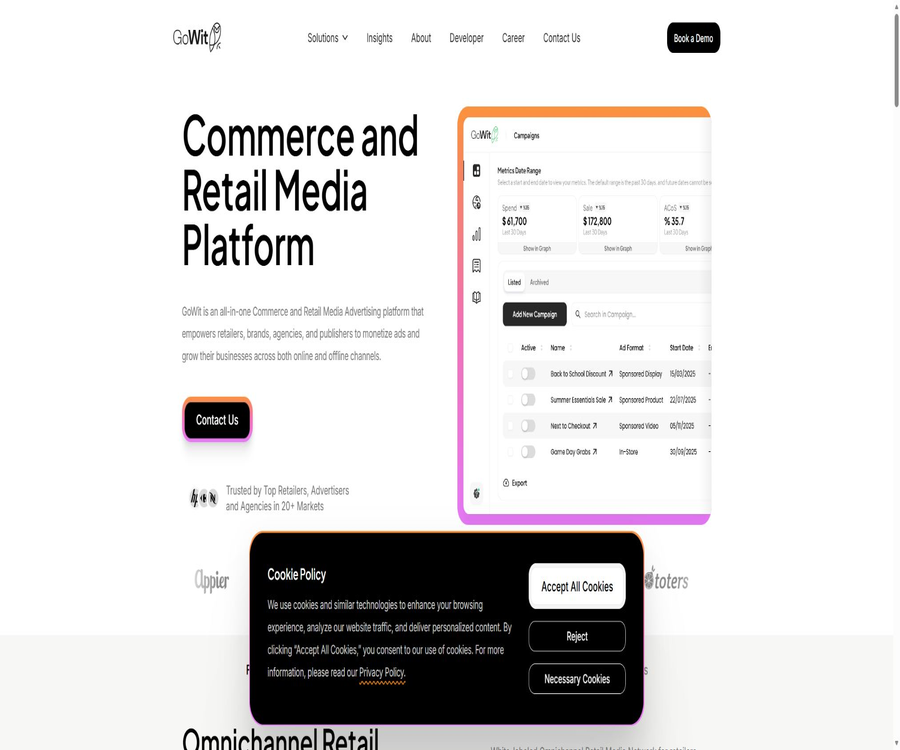
GoWit is an omnichannel Commerce and Retail Media infrastructure designed for retailers, brands, and agents; it utilizes AI to assist in the creation, deployment, monitoring, and optimization of ads on websites, outside those sites, and in physical stores.
Tool Introduction
GoWit Inc. offers a cloud-based retail media advertising platform that helps retailers, marketplaces, and delivery applications transform first-party data and digital assets into advertising networks. Brands and agencies can use this system to reach consumers who are close to the point of purchase, and they can also see the relationship between their advertising spending and sales performance.
The platform offers a white-label RMA system designed for media owners, as well as a capability for delivering ads across various retailers, intended for advertisers and agencies. The latest version of GoWit One includes AI-driven AdOps functions, as well as unified analysis and continuous optimization tools.
Current product composition
| Product module | Primary users | Primary use | Delivery method |
|---|---|---|---|
| GoWit RMA | Retailers, market platforms, delivery apps | Establish a white-label retail media network | Cloud platforms, APIs, and SDKs |
| Advertiser interface | Brands and sellers | Create and manage ad campaigns | Web console |
| Agency workspace | Media agents | Managing activities across retailers and markets | Unified Web interface |
| GoWit One | Brands and agents | AI-guided setup, analysis, and continuous optimization | AI unified operating system |
| Managed Service | Customers that lack a dedicated AdOps team | Proxy execution, strategies, and optimization | Custom services |
Main functions
White-label retail media network
Retailers can offer advertising backends, ad slots, and reports under their own brand, allowing suppliers or brands to run advertisements directly. The platform is responsible for the underlying functions such as bidding, advertising placement, permissions, balance management, and campaign oversight.
In-site advertising
In-site ads appear in search results, the home page, category pages, product detail pages, and other digital channels owned by the platform. Ads can be selected using criteria such as available products, keywords, categories, target audience, and location.
Off-site advertising
The platform enables the activation of retailers’ first-party audience on Meta, Google, and programmatic channels, thereby expanding reach outside the website. When using external platforms, it is also necessary to comply with the data and creative policies of each advertising network.
Store advertising
GoWit integrates digital signage, screens, and other offline touchpoints into a single omnichannel framework, enabling brands to link online browsing, in-store visibility, and sales. The specific hardware, proof of playback, and attribution to stores require project design.
Real-time bidding and various auction formats
The official development documentation states that the platform utilizes a real-time auction architecture based on event-driven mechanisms, and it supports various auction methods such as first-price and second-price auctions. Retailers can configure advertising eligibility and bidding logic in accordance with their business rules.
Precise audience targeting
The targeting dimensions include search keywords, category context, audience segments, stores or regions, time periods, and product signals. Automated targeting powered by machine learning can help identify more relevant products for specific audiences, but it is still necessary to comply with privacy regulations and restrictions on the use of data.
Automatic bidding
Automatic bidding adjusts the bid amounts dynamically based on the budget and objectives, thereby reducing the need for manual intervention. Advertisers should set budget limits, objectives, and alerts for abnormal situations, while also retaining the option to pause campaigns manually.
Real-time reporting and closed-loop attribution
The console allows you to view metrics such as exposure, clicks, CTR, CPC, costs, direct or indirect sales, and ROAS; these metrics can be filtered by campaign, ad slot, product, or audience. The page also mentions reports on sales that occur after clicks versus those that occur after views. The attribution window and incremental methods need to be specified in the contract.
Budget and balance management
The platform allows for the management of advertisers’ balances, campaign budgets, and the timing of ad placements. Media fees, platform fees, service fees, and taxes should be specified separately in the invoice.
Roles and Permissions
The backend documentation outlines the permissions for administrators, advertisers, and various other roles; it allows for restrictions on account management, campaign handling, reporting, and configuration tasks. Large organizations should create a permission matrix that takes into account SSO requirements, approval processes, and the principle of separation of duties.
GoWit One AI features
AI-driven media planning
GoWit One analyzes product categories and their historical performance in order to identify those categories with greater potential and to eliminate those with lower potential. It is recommended to consider this analysis alongside factors such as inventory levels, profits, promotional activities, and business priorities.
AI-assisted activity setup
When creating a campaign, the system provides real-time suggestions regarding format, target audience, bidding amounts, budget, and retailer requirements. An automatic compliance check verifies the materials and budget rules before submission, thereby reducing the need for revisions.
Unified Conversational Analysis
Users can ask questions regarding performance in various campaigns, in order to identify issues such as a decline in conversion rates, inefficient spending, or channels that contribute significantly to growth. The AI consolidates metrics from different retailers and channels, but it cannot replace statistical analysis for attributing causes or quality checks of the data.
Ongoing health checks
The system continuously monitors the pace of deliveries, any delivery issues, compliance risks, material fatigue, inefficient bidding practices, and deviations from KPIs. Alerts require designated responsible persons and set time limits for handling; otherwise, they only contribute to an excess of notification noise.
Real-time budget and bidding optimization
AI can reallocate budgets among retailers, channels, formats, and audiences, and adjust bids based on real-time signals. When large budgets are involved, it is necessary to set up protection thresholds, rollback mechanisms, and manual approval processes.
Multi-retailer activity management
Agents can create, copy, schedule, publish, pause, and modify multiple campaigns for retail media networks within a single workflow. The unified dashboard reduces the need for repetitive actions, but individual retailers may still have different rules.
Ad format
| Ad format | Typical location | Main goal | Access method |
|---|---|---|---|
| Sponsored Product | Search, categorize, homepage or product page | Increase the visibility and sales of individual products | Ad Serving API or front-end components |
| Sponsored Display | Website and app ad spaces | Brand reach and conversion | Display SDK or custom rendering |
| Sponsored Brand Display | High-impact brand advertising slots | Exposure of brand and product combinations | Integration of advertising slots on the platform |
| Sponsored Video | Location of videos within the station | Video explanations and brand promotion | Video SDK or VAST |
| Sponsored Video With Product | Video and product module | Video interaction and product conversion | Video SDK |
| Off-Site Ads | Search, social, and programmatic advertising | Expand coverage outside the station area | Connection via third-party channels |
| In-Store Ads | Store screens and digital signage | Connect to offline contacts | Custom store integration |
Retailer onboarding process
- Schedule a demonstration and define the objectives, market, channels, and business model for retail media.
- Organize data on products, advertisers, audiences, inventory, orders, and sales events.
- Define the white-label domain names, brands, roles, balances, and approval structure.
- Choose the API, file, or other synchronization method for the product catalog.
- Integrate in-site ads through the Ad Serving API or SDK.
- Access to exposure, click, add-to-cart, order, and sales events.
- Verify auctions, targeting, frequency control, attribution, and reporting in the testing environment.
- Set advertising policies, content approval processes, budget protection measures, and failover options.
- Conduct a trial run with low flow rates and reconcile it with the original orders and financial data.
- After passing the acceptance process, the number of advertisers, advertising slots, and channels is gradually increased.
Brand and agent placement process
- Confirm the eligible retailers, markets, ad formats, and target audience.
- Create an advertising account and set up the balance, billing details, and team permissions.
- Select the campaign objectives, products, channels, timing, and budget.
- Use AI to recommend checking product categories, keywords, bids, and budgets.
- Upload designs that comply with the size and brand requirements of various retailers.
- After passing the automatic check, it is submitted for review to confirm the actual time of going live.
- Monitor costs, delivery, sales, ROAS, and asset fatigue.
- Adjust the budget threshold for AI, and keep manual approval in place or suspend it.
- After the event, check the attribution window, refunds, invalid traffic, and invoices.
Which users are it suitable for
- Integrated retailers: Establish their own advertising operations on websites, apps, and in physical stores.
- E-commerce market platforms: allow merchants registered on them to purchase products and display advertisements on their own.
- Delivery and instant retail apps: Monetizing advertising spaces in scenarios involving frequent purchases.
- Brand advertisers: Reach consumers with a high level of intent who are close to the point of purchase.
- Media agents: Provide unified management of multiple retail media networks and markets.
- Publishers and media owners: increasing revenue from Commerce Media.
- AdTech Integration Team: Creates customized advertising experiences through APIs and SDKs.
Typical use cases
- Retailers have launched white-label self-service advertising platforms to supply their brands.
- Brands display Sponsored Products in search results and product pages.
- The agent creates omnichannel campaigns for multiple retailers from a single workstation.
- Use first-party audiences for searches outside the site, as well as for advertising on social media and through programmatic channels.
- Include in-store digital screens and online campaigns within a unified media plan.
- Ad display is controlled based on inventory, location, and the availability of the products.
- Link exposure, clicks, and orders to analyze the relationship between advertising spending and sales.
- Use AI to detect delivery issues, resource exhaustion, and inefficient budgeting.
Product advantages
- It covers in-store, offline, and retail locations, reducing the fragmentation caused by different tools across various channels.
- The white-label capability allows retailers to operate advertising networks under their own brand.
- It serves retailers, brands, and agents simultaneously, linking the supply side with the demand side.
- It offers real-time bidding, automatic targeting, as well as a reporting system.
- GoWit One consolidates the setup, analysis, and optimization of multiple retailers within an AI workflow.
- The publicly available development documentation covers integration, deployment, events, as well as backend APIs and SDKs.
- Various display and video formats can be adapted to different shopping touchpoints.
- Managed services are provided for teams that require AdOps execution support.
Usage restrictions and precautions
- The official website does not list any standard commercial packages; the budget must be determined through a sales quote.
- The terms mention a free basic tier, but do not disclose the amount, duration, or list of functions available.
- Platform fees are not equivalent to media consumption; they may also include costs related to implementation, services, and third-party channels.
- AI optimization relies on the quality of data related to products, inventory, target audience, bidding, and sales.
- Cross-channel attribution does not automatically prove that advertising generates additional sales.
- Automatic bidding and budget reallocation can quickly deplete funds, so it is necessary to set protection thresholds.
- The activation of first-party data requires consent, disclosure, the option to opt out, and restrictions on its use.
- The advertising policies, asset specifications, and attribution methods of different retailers still need to be handled separately.
- The terms state that the service is not designed in accordance with specific regulations such as HIPAA, FISMA, and GLBA.
- The official privacy policy is intended primarily for website visitors and was updated some time ago; the data related to the platform requires separate contractual review.
Price and business model
The GoWit official website does not specify any fixed monthly fee or pay-as-you-go pricing; it only offers the option to contact sales representatives and schedule a demonstration. The terms of service for 2024 state that a free-tier cloud version is available to allow users to experience basic functions, but no details are provided regarding these functions, the duration of access, the usage limits, the geographical areas covered, or whether approval from sales is required.
| Cost or version | Public price | Known range | Confirm before purchasing |
|---|---|---|---|
| Free-tier Cloud | Not announced | The terms state that basic functions can be explored. | Functions, duration, ad slots, and data limits |
| Retailer white-label RMA | Custom quote | Platform, white-labeling, bidding, reporting, and advertiser dashboard | Market, traffic, implementation, and support |
| Brand and agency platform | Custom quote | Multiple retailer activities and AI optimization | Seating, network, media fees and service charges |
| GoWit One | Custom quote | AI settings, unified analysis, and continuous optimization | Available markets, automation permissions, and data scope |
| Managed Service | Custom quote | Activity execution, strategies, and optimization | Human resource scope, response time, and KPIs |
| API and SDK integration | Contract confirmation | Integration, Ad Serving, Events, and front-end SDKs | Call volume, environment, support, and SLA |
| Advertising media consumption | By activity and channel | Actual advertising bidding cost | Minimum budget, taxes, refunds, and invalid traffic |
For formal purchases, quotes should be broken down to show the costs related to software licenses, implementation, data migration, media consumption, hosting services, third-party channel fees, and taxes. For pilot projects as well, it is necessary to specify the costs associated with withdrawal, any remaining balances, data export, and the disassembly of integrations.
Comparison between free tier and enterprise plans
| Project | Public information on the free tier | Customized enterprise solutions |
|---|---|---|
| Activation method | The terms state that there is no clear self-service entry point on the official website. | Contact sales to schedule a demonstration. |
| Core functions | Basic exploration; a complete list is not provided. | Configure according to the needs of retailers, brands, or agents. |
| Ad traffic | Not specified | Based on contracts, market conditions, and advertising space |
| AI capabilities | Not specified | The capabilities of GoWit One require a quote for confirmation. |
| APIs and SDKs | Not specified | The development documentation is available publicly; access is granted using the project key. |
| Services and SLAs | Not specified | The scope of implementation and support is specified in the contract. |
| Data and Compliance | General terms | DPA, security attachments, and platform policies are required. |
Since information regarding the free tier is only mentioned in the terms, GoWit cannot be regarded as a permanent, free advertising platform available to everyone. When applying for a trial, it is necessary to obtain written confirmation from sales regarding the scope of the free service and any subsequent fees that may apply.
APIs and SDKs
Integration API
The Integration API 2.0 is used to synchronize advertisers, products, and audience segments, with the API Key being transmitted via the Authorization request header. Directory integration also supports near-real-time delivery of product and advertiser data.
Ad Serving API
The Ad Serving API 2.1 is used to request ads that meet the criteria related to ad slots, users, and context. Retailers can render the ads on their own, or they can use the display SDK to reduce the workload associated with front-end implementation.
Events API
The Events API 2.1 is used to send events related to impressions, clicks, page interactions, sales, etc., providing data for attribution, reporting, and optimization. The event ID, time, currency, order information, and deduplication rules must all be consistent.
Backend API
The backend APIs cover advertiser balances, user invitations, campaigns, products, and other management elements. High-privilege interfaces should be used only on secure servers with accounts that have the minimum required permissions.
Sponsored Display SDK
The display SDK enables market platforms to show banner ads on their websites, as well as to handle certain aspects of rendering and visibility. Custom styles must not compromise the ad’s identification elements, clickable areas, or the requirements related to measurement.
Sponsored Video SDK
The video SDK enables the display of VAST videos or videos combined with product modules. Before going live, it is necessary to test automatic playback, silent mode, visibility, error handling, and performance on mobile devices.
| Developer components | Current version or status | Primary uses | Authentication or access |
|---|---|---|---|
| Integration API | 2.0.0 | Synchronization of advertisers, products, and segments | API Key |
| Ad Serving API | 2.1.0 | Real-time ad requests | API Key |
| Events API | 2.1.0 | Behavior, exposure, clicks, and sales events | API Key |
| Backend API | The document is available online. | Management of activities, balances, users, and products | Project permissions |
| Sponsored Display SDK | Development guidelines available online | Banner ad rendering | Web integration |
| Sponsored Video SDK | Development guidelines available online | VAST and video product ads | Web integration |
Integrated acceptance checklist
- Create separate development, pre-release, and production environments as well as API keys.
- Verify the addition, update, and deletion of products, advertisers, audiences, and inventory synchronization.
- Confirm the size, format, number of options, and fallback content for each ad slot.
- The exposure check is sent only when the visibility conditions are met.
- Establish unique IDs and deduplication rules for click, add-to-cart, and sale events.
- Use test orders to verify the currency, amount, products, and attribution window.
- Simulate API timeouts, empty ads, out of stock situations, and SDK loading failures.
- Verify the consent status, audience segmentation, and opt-out options for ad personalization.
- Compare the differences between the GoWit report, the order system, and the financial system.
- It goes live after passing reviews for security, performance, accessibility, and ad identification.
Privacy and Data Governance
The privacy policy on the official website was last updated in August 2022; it explains matters related to website visits, forms, and account contact information, including IP addresses, browsers, logs, Cookies, name, company, email address, and phone number. It is not a comprehensive DPA for retail media platforms.
Retail media systems also handle products, audiences, advertising requests, impressions, clicks, orders, and sales transactions; the specific responsibilities depend on the contractual roles defined between the retailer and GoWit. Customers should request information regarding the current DPA, the sub-processors involved, the locations where data is stored, the retention period for that data, and the procedures for its deletion.
- Only the minimum amount of first-party data required for advertising campaigns is synchronized.
- Establish mechanisms for consent, rejection of targeted delivery, and removal of audiences.
- Avoid sending names, email addresses, or original customer identifiers in ad campaigns.
- Compliance assessments are conducted separately for cross-border channels, third-party channels, and audience activation.
- Restrict permissions for API keys, audience export, report download, and budget modification.
- Regularly audit visits from advertisers, agents, retailers, and third parties.
- Upon the expiration of the contract, confirm data export, deletion, and backup cleanup.
Safety, legal, and business considerations
The terms dated August 28, 2024, state that the service is intended for users over 18 years of age; it is governed by the laws of Delaware, and it can be modified or discontinued without any obligation to provide ongoing maintenance. The terms also require users to back up their transmitted data themselves.
The terms state that the platform was not designed in accordance with specific regulations such as HIPAA, FISMA, and GLBA, and that the general limitations on liability are very strict. Companies should clarify their responsibilities through a main service agreement, security attachments, DPA, and SLAs.
- Do not turn the performance figures shown in the sales presentation into contractual guarantees.
- Clarify the responsibilities for ad review, prohibited content, complaints, and removal of content.
- Thresholds, auditing, and emergency suspension are reserved for AI bidding and budget adjustments.
- Define plans for advertising fallback and event resubmission in the event of service disruption.
- Handling of invalid traffic, refunds, unused balances, and billing disputes.
- Define the boundaries of rights regarding ideas, product data, reports, and derived insights.
- Present clear advertising identifiers and privacy options to consumers.
GitHub and open source
No official GitHub organization or core RMA source code repository that is explicitly linked to the GoWit official website was found this time. The available development documentation and SDK integration guides do not indicate that the platform’s code is open source.
The GoWit terms explicitly specify that the source code, databases, functions, and software are properties of the company or are licensed to it, and they restrict copying and reverse engineering. The open-source status in the catalog should be marked as no.
| Project | Current status | Conclusion |
|---|---|---|
| Core source code of the platform | Not disclosed | Closed-source SaaS |
| Official GitHub | No organization that can be verified through its official website was found. | Do not associate with repositories of the same name |
| Public API documentation | Yes | Access via contract and API Key |
| Display SDK documentation | Yes | Used for rendering web page ads |
| Video SDK documentation | Yes | Used for VAST and video product modules |
| Open-source license | Not provided | The product is not open-source. |
| Self-hosting | Not made publicly available | Cloud and custom integration are the main focuses. |
Basic information
| Project | Content |
|---|---|
| Tool name | GoWit |
| AI products | GoWit One |
| Operating entity | GoWit Inc. |
| Tool type | Commerce and Retail Media advertising platforms |
| Primary users | Retailers, brands, agents, market platforms, and delivery apps |
| Primary channels | On-site, off-site, and in stores |
| Core AI | Media planning, setup recommendations, analysis, bidding, and budget optimization |
| Ad format | Products, displays, brands, videos, off-site and in-store advertising |
| Price pattern | Basic exploration tier and enterprise-customized quotes |
| Public API | Yes |
| Front-end SDK | Yes |
| Official GitHub | Not found |
| Is it open source? | No |
| Self-hosting | Not made publicly available |
| Date of information verification | August 23, 2026 |
Recommendation score
Recommendation score: 4.2 / 5. GoWit covers both the supply and demand sides of the retail media landscape, integrating in-house and external platforms, physical stores, real-time bidding, comprehensive reporting tools, APIs, and AI-driven optimizations – making it suitable for organizations that possess established retail data and specific advertising objectives.
The main shortcomings are the lack of publicly defined standard prices, unclear terms regarding the free tier, and the fact that a general privacy policy cannot replace the DPA specific to each enterprise platform. Before making a purchase, it is necessary to test aspects such as attribution, budget protection, data governance, and total cost through controlled pilot projects.
Frequently Asked Questions
What is GoWit?
GoWit is an advertising infrastructure for Commerce and Retail Media; it assists retailers in operating white-label advertising networks, and it also helps brands and agencies to run ads across various retail media networks.
What is GoWit One?
GoWit One is the AI operation layer of the platform, used for setting up activities across multiple retailers, conducting unified analysis, performing health checks, offering real-time bids, and optimizing budgets.
Is GoWit free?
The terms mention a free-tier cloud version that allows access to basic functions, but the official website does not disclose the limits, duration, or full list of benefits associated with it. To use it officially, it is usually necessary to get in touch with the sales team.
What is the price of GoWit?
There is no fixed public pricing plan. The costs related to software, implementation, media consumption, hosting services, and third-party channels all need to be specified in the quote.
Which ad formats are supported?
These include Sponsored Products, displays, brand showcases, videos, videos combined with products, off-site advertising, and in-store advertising. The available formats depend on the retailer and the distribution channels used.
Can it be integrated with existing e-commerce websites?
Yes, it can be integrated through directory integration, the Ad Serving API, the Events API, as well as display or video SDKs. Before going live, data, attribution, and performance testing must be completed.
Does GoWit provide an API?
It offers Integration, Ad Serving, Events, and Backend API services, with API Key authentication being the primary method for authorization. The versions and permissions are specified in the project documentation.
Is an SDK provided?
It provides development guides for Sponsored Display and Sponsored Video, which are used for the rendering of web ads and the integration of VAST videos.
Is GoWit open source?
It is not open source. The public API and SDK documentation only indicate that integration is possible; the core platform code remains proprietary commercial software.
Will AI spend the budget automatically?
GoWit One allows for dynamic adjustment of bids and budgets. Companies should set limits, enable alerts for abnormal situations, implement approval processes, and have the option to pause operations urgently; unlimited authorization should not be granted.
Is it suitable for small, independent sellers?
It is more suitable for B2B organizations such as retailers, market platforms, brands, and agents. Whether small sellers can use it depends on whether the retailer they work with provides access to the GoWit advertising dashboard.
Is the attribution report equivalent to the incremental effect?
It’s not the same. Sales that occur after a click or after browsing only indicate a relationship under the attribution rules; to determine the incremental effect, experimental design, control groups, or other measurement methods are required.
Summary
GoWit is suitable for companies that wish to build their own retail media network, or that need to carry out unified advertising and optimization across multiple retailers. It connects advertising slots, bidding mechanisms, target audiences, campaigns, reports, and AI-driven functions into a comprehensive omnichannel system.
True purchasing decisions should be based on accurate data: verify orders and advertising reports, restrict the capabilities related to AI budgets, confirm the processes for obtaining privacy consent, and include the costs of software, media, implementation, and services within a single overall cost model.
Tools similar to GoWit



 Guigong Network Security Registration No. 45132202000164