






GooseAI
GooseAI: an intelligent tool focused on improving AI efficiency.
Tags:AI improves efficiencyA one-sentence summary
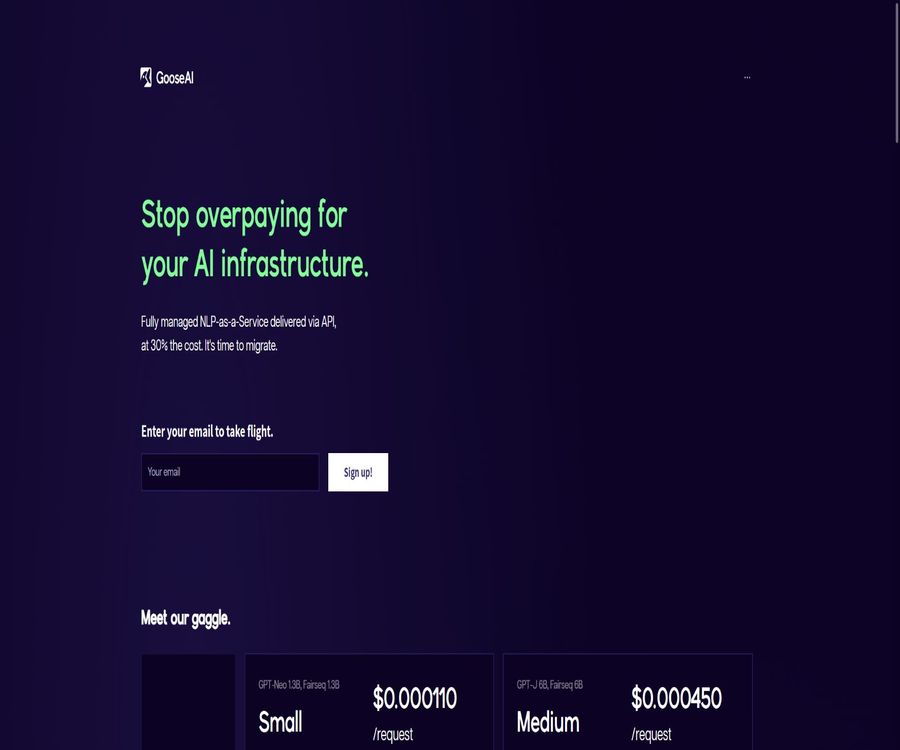
GooseAI is a managed NLP inference service designed for developers; it allows access to various open-source language models through the Completions interface, which is compatible with industry standards, and billing is based on the number of tokens generated.
Current product status
As of August 23, 2026, the GooseAI official website, registration page, Playground, API Key console, and pricing page are all accessible; unauthenticated model interfaces return a message indicating that authorization is required. The platform remains available for registration and use online.
The current official website continues to promote earlier generation models such as GPT-Neo, GPT-J, Fairseq, and GPT-NeoX; its main interface remains the traditional text completion feature. It is not a modern multimodal chat platform, nor should it be confused with the open-source AI agent of the same name, goose.
| Inspection items | Current results | Conclusion |
|---|---|---|
| Official website | Display the prices of products and models as usual. | The service is still in operation. |
| Account registration | The authentication page is accessible. | Accounts can be created. |
| Playground | The page is accessible. | It can be used for model testing. |
| API Key Console | The page is accessible but requires login. | Self-service key support |
| API interface | If no key is provided, an unauthorized status is returned. | The interface is online and protected by authentication. |
| Model update | Early open-source text models remain the primary choice. | Conduct quality testing before purchasing. |
Tool Introduction
GooseAI was developed jointly by CoreWeave and Anlatan, and it is aimed at developers as well as creative technology teams who wish to integrate text generation capabilities into their products. The platform handles the hosting of models and the infrastructure needed for inference; users can submit prompts via API and receive the resulting text outputs.
Its main advantage is the low cost of migration: projects that use the older OpenAI Python client can retain most of their Completions invocation methods, with only the keys, the base address of the API, and the model ID needing to be changed. The actual scope of compatibility still needs to be confirmed through testing.
Main functions
Managed text generation
The Completions interface predicts subsequent tokens based on the prompt provided by the user; it can be used for completing sentences, creating draft articles, generating stories, or producing titles or structured text drafts. It is not a search engine, and its responses do not come with verifiable sources.
Various open-source language models
The current price page lists the options of 125M, 1.3B, 2.7B, 6B, 13B, and 20B based on parameter size, covering GPT-Neo, Fairseq, GPT-J, and GPT-NeoX. The Tokenizer, coherence, speed, and cost vary among different models.
Playground model testing
The web-based Playground allows users to test models and generation parameters before integrating the code, thereby comparing the outputs resulting from the same prompt. The choice of model should be based on real-world business examples, rather than merely considering the number of parameters.
Engine list and details
The Engines interface is used to list the available models, or to retrieve information such as the name, owner, availability, and description of a specific engine. In a production environment, it is necessary to regularly check whether the target engine is still available.
Single or batch prompts
The Completions document allows the Prompt to use strings, arrays of strings, arrays of tokens, or collections of such arrays, and it enables concurrent processing of multiple inputs. Batch input increases the total amount of content generated as well as the associated costs, so strict limits should be set.
Multiple result generation
Requests can generate multiple candidate results for each prompt using the quantity parameter; the number of candidates is equal to the number of prompts, and both the actual charging amount and the size of the response increase accordingly.
Length control during generation
Users can set the maximum and minimum number of tokens that can be generated; the price page indicates that a maximum of 2,048 tokens can be generated in a single operation. The length of the prompt and the output are still subject to the constraints imposed by the context length of the specific model.
Sampling and Token Bias
The interface offers a variety of generation parameters for controlling randomness, the distribution of candidate tokens, termination conditions, and the preference for certain tokens. The Token IDs used in GPT-NeoX are not entirely compatible with those of other models; therefore, re-validation is required when transferring bias settings.
Prepaid balance management
API usage is billed based on the credit quota, and the account must maintain a positive balance. Each invocation of the API Key consumes part of the account balance; therefore, server-side key management is necessary.
Model and Price Overview
The following are the public prices in US dollars as listed on the official website as of August 23, 2026. The base price for each request includes the first 25 generated tokens; any additional tokens are charged at a rate per token, while input tokens are not billed separately at present.
| Parameter settings | Model series | Base price per request | Additional output Token | Suitable for testing directions |
|---|---|---|---|---|
| 125M | GPT-Neo, Fairseq | 0.000035 dollars | 0.000001 USD per Token | Low-cost format and process verification |
| 1.3B | GPT-Neo, Fairseq | 0.000110 dollars | 0.000003 dollars per Token | Lightweight continuation writing and batch prototyping |
| 2.7B | GPT-Neo, Fairseq | 0.000300 dollars | 0.000008 dollars per Token | Small and medium-sized text tasks |
| 6B | GPT-J, Fairseq | 0.000450 US dollars | 0.000012 dollars per Token | Longer content and creative generation |
| 13B | Fairseq | 0.001250 dollars | 0.000036 dollars per Token | Tasks that require larger models |
| 20B | GPT-NeoX | 0.002650 US dollars | 0.000063 US dollars per Token | Highest-grade open-model testing |
A larger model size does not necessarily mean higher accuracy for every task; it may also increase latency and costs. Before deployment, a test set should be defined to evaluate output quality, throughput, error rate, and the cost per task.
Billing rules
| Project | Official rules | Actual impact |
|---|---|---|
| Billing unit | Base request price plus additional tokens generated | There is also a base fee for short outputs. |
| Base inclusion amount | First 25 generated tokens | After exceeding, it is accumulated based on tokens. |
| Enter Token | No charge at the moment | Long prompts are still subject to constraints related to context and performance. |
| Maximum per generation | The price page can display up to 2,048 Tokens. | It should be verified again based on the model context. |
| Payment methods | Pre-order GooseAI Credits | Top up before the balance runs out. |
| Validity period of credit limit | 12 months after purchase | The unused balance will expire. |
| Refund | The credit limit is non-refundable. | First, conduct a small-scale verification before making a top-up. |
| Corporate discounts | Contact sales for bulk credit limits | A separate quote is required. |
The credit limit is used on a first-in-first-out basis; the balance from earlier purchases is deducted first. Platform fees and taxes may vary, and when making purchases, businesses should confirm in the contract the price, validity period, scope of services, and billing responsibilities.
Example of cost calculation
| Example | Model level | Generated length | Estimation method | Items not included |
|---|---|---|---|---|
| Short continuation | 1.3B | 25 Token | Only the base price is 0.000110 dollars. | Taxes and failed retry attempts |
| 100 Token continuation | 1.3B | 100 Token | Base price plus 75 additional Tokens | Concurrent candidates and retries |
| 100 Token continuation | 6B | 100 Token | Base price plus 75 additional Tokens | Network and application costs |
| Multiple candidate generation | arbitrary | Each prompt generates multiple entries. | Accumulation of the amount generated by each candidate | Post-processing costs |
| Batch Prompt | arbitrary | Multiple inputs concurrent | Each request and output are accumulated separately. | Rate limiting and failed retry |
When making estimates, it is not sufficient to consider only the cost per call; it is also necessary to take into account the average output length, the number of candidates, the retry rate, the number of invalid results, and the peak concurrency level. Production systems should keep track of the actual resource consumption associated with each business action.
API Integration Tutorial
Create and protect API keys
- Register for a GooseAI account and complete email or account verification.
- Go to the API Key management section of the Dashboard and create a separate Secret Key.
- Save the key in server-side key management or environment configuration, rather than including it in the frontend code.
- Create separate keys for the development, testing, and production environments to avoid sharing them.
- First, top up a small credit amount and set alerts for internal balance and fees.
- Upon a key leakage, it should be revoked and replaced immediately, while also checking for any abnormal calls.
Migrate from the old OpenAI client
- Verify that the existing applications use traditional Completions and Engine calls, rather than the new chat interface.
- Keep the compatible client library and replace it with the GooseAI Secret Key.
- Change the client’s base address to GooseAI’s first version API address.
- Obtain the current available model ID from the Engines list; do not use the old IDs written down in the documentation.
- Select a model and execute the minimal request using a fixed prompt.
- Verify the response structure, reason for termination, number of tokens, error code, and fees.
- After testing, gradually switch the traffic while keeping the fallback configuration in place.
Design a Completions request
- Prepare concise prompts that specify the output format, tone, and termination conditions.
- Specify the Engine ID and set a reasonable maximum number of tokens to be generated.
- A reproducible baseline can be established starting from lower randomness and a single candidate.
- Configure a stop sequence to prevent the model from continuing to generate irrelevant paragraphs.
- Record the request ID, model, parameters, latency, output volume, and cost.
- Apply security filtering, format validation, and fact-checking to the output.
- Limited exponential backoff is employed in the event of throttling or service errors.
Which users are it suitable for
- The development team responsible for maintaining legacy Completions applications: reduces the workload associated with interface migration.
- Creative writing products: Testing open-models for continuation writing, story generation, and style creation.
- Batch text prototype team: Uses small models to validate formats and workflows.
- Model evaluator: Compares different parameter sizes in a unified hosting environment.
- Education and research users: Observe the behavior of GPT-Neo, GPT-J, and GPT-NeoX.
- Cost-sensitive projects: The budget for generating short texts is determined by the number of tokens produced.
- Backend developers who need compatibility with the old version of the OpenAI client.
Typical use cases
- Generate subsequent paragraphs and candidate versions for article, story, or game text.
- Complete the product description, draft summary, or title based on a fixed template.
- Perform quality and cost evaluations for the same prompt on multiple open models.
- Use the 125M or 1.3B settings to conduct stress testing on low-cost interfaces and queues.
- Switch the old version of the OpenAI Completions prototype to another hosted inference provider.
- Batch generate creative text that requires subsequent manual screening.
- Study different sampling parameters, token bias, and stopping conditions.
Product advantages
- The platform manages the GPU inference infrastructure, eliminating the need to deploy models manually.
- It is compatible with the traditional OpenAI client invocation approach, resulting in a relatively low barrier to migration.
- The price page displays the basic request price as well as the unit price for additional output tokens.
- Charging is applied only to the generation of Tokens; there is no separate charge for input.
- A variety of sizes and model series are available, ranging from 125M to 20B.
- The web Playground makes it easy to quickly compare outputs before coding.
- Users can create API keys on their own, and there are also options for providing bulk credit limits for enterprises.
Usage restrictions and precautions
- The current models are primarily based on early open-text models, and their capabilities are significantly different from those of the new generation of chat models.
- The focus of the service is on Completions; it should not be assumed that support for images, audio, tool calls, or modern Chat interfaces is available.
- The legal and privacy-related content in most documents was last updated in 2022, so it may be outdated compared to current practices.
- The official website claims that a certain percentage of savings can be achieved through marketing comparisons; in reality, the actual cost depends on the amount of data processed and the number of retries required.
- While input is free, long prompts still affect the context, latency, and performance of the model.
- Multiple prompts and multiple candidates can rapidly increase the number of generated tokens and the associated costs.
- The credit limit is valid for 12 months and is non-refundable; it is not advisable to pre-purchase an excessive amount at once.
- The model may generate fictional, biased, harmful content, or output that does not conform to the format.
- Different models use different tokenizers, so token biases and length estimations cannot be reused directly.
- There is no public information available regarding modern SLAs, data residency, or the latest security certifications; companies must verify these details on their own.
Supported interfaces and outputs
| Ability | Support status | Explanation |
|---|---|---|
| Engine list | Support | List available models |
| Engine details | Support | Query the status and description of a single model |
| Text Completions | Support | Generate a continuation based on the prompt. |
| Multiple Prompts | Support | Can be processed concurrently |
| Multiple candidates | Support | Each prompt generates multiple entries. |
| Stream output | The older version of the interface usually provides support; this needs to be tested in practice. | Follow the current response behavior. |
| Chat Completions | Not confirmed in the current core document. | Do not assume based on modern chat interfaces. |
| Embeddings | Not confirmed in the current navigation. | Inaction is already a supported capability. |
| Images and audio | Not supported | Text NLP inference service |
| Fine-tuning | No current self-service documentation was found. | It is necessary to contact the authorities for confirmation. |
GitHub, SDKs, and open-source status
GooseAI has a GitHub organization with the same name, but the three public repositories currently available are forks of other projects, including a GPT-3 client for the Go language, KoboldAI, and Transformers. This does not mean that the backend source code of the GooseAI platform has been made available to the public.
The official documentation recommends using the older version of the OpenAI Python client with the base address modified; no separate GooseAI SDK is provided. The use of open-source models by a service does not mean that the hosting platform itself is open source.
| Project | Current situation | Open-source assessment |
|---|---|---|
| GooseAI cloud platform | The source code is not publicly available. | Closed-source hosting services |
| Hosting model | From various open-source model projects | Licenses are determined separately for each model. |
| Official GitHub organization | There are three public Forks. | It is not the core source code of the platform. |
| Independent official SDK | Not found | Use a compatible client or make a direct request. |
| go-gpt3 Fork | MIT License | It is an older version of the generic client, not the platform’s source code. |
| KoboldAI Fork | AGPL-3.0 License | Different application projects |
| Transformers Fork | Apache-2.0 license | Upstream framework branch |
Privacy and data processing
The current website still displays a privacy policy that was last updated on January 31, 2022. This policy covers account information, usage data, Cookies, device information, and information related to third-party accounts, and it explains which types of information may be shared with service providers, analytics suppliers, business successors, or legal authorities.
The policy states clearly that its general privacy provisions do not apply to the data processed by customers through the service; enterprise users need to examine the DPA and contracts separately. The currently available documents do not provide any clear indications regarding a fixed retention period for prompts and generated results, nor do they specify that such data cannot be used for training purposes.
- Do not submit passwords, keys, identification documents, or regulated data in the prompt.
- Before connecting to the enterprise, request the current DPA, sub-processor details, and data retention guidelines.
- Confirm the methods for cross-border data transfer, deletion, backup, and handling of law enforcement requests.
- Reveal to end-users within the application the involvement of third-party model services.
- Mask the Prompt and output, while retaining necessary access audits.
- Users under 18 years of age should not use this service.
Terms and Compliance
The last date on which the terms of service were updated was also January 31, 2022. The fees can be adjusted, and payments are processed by services such as Stripe. Customers purchase and use credit credits; these credits may be revoked due to violations, incorrect billing information, or illegal activities.
The customer is responsible for its own data, and it grants GooseAI the permissions necessary for hosting, storing, transmitting, and formatting that data in order to provide the services. The terms prohibit reverse engineering, and the applicable laws as well as the jurisdiction for resolving disputes are in New York.
- It is prohibited to generate or disseminate illegal, abusive, infringing, or involuntary private content.
- Services must not be used to violate copyright, trademarks, privacy, or the right to public disclosure.
- The API Key must be protected, and full responsibility for any associated costs lies with the user.
- When generating content for users, procedures for handling complaints and removing such content should be in place.
- When making purchases, businesses need to take into account taxes and fees, limitations on liability, service interruptions, and the handling of remaining balances.
- Read the latest terms again before going live; do not rely solely on the 2022 summary.
Basic information
| Project | Content |
|---|---|
| Tool name | GooseAI |
| Operating entity | GooseAI, Inc. |
| Joint promoters | CoreWeave and Anlatan |
| Tool type | Managed NLP and language model inference APIs |
| Main models | GPT-Neo, GPT-J, Fairseq, GPT-NeoX |
| Core interface | Engines and text completions |
| Price pattern | Prepaid credit limit, billed based on the generated tokens |
| Input billing | No charge at the moment |
| Validity period of credit limit | 12 months |
| Refund | The credit limit is non-refundable. |
| Playground | Yes |
| Public API | Yes |
| Independent official SDK | Not found |
| Is the platform open source? | No |
| Date of information verification | August 23, 2026 |
Recommendation score
Recommendation score: 3.5 / 5. GooseAI offers transparent pricing and simple interfaces, making it suitable for developers who are still maintaining traditional Completion applications or need to evaluate early-stage open models.
The main shortcomings are an outdated model and interface framework, policy documents that were updated a long time ago, as well as a lack of clear explanations regarding modern chat functions, multi-modal capabilities, and enterprise security features. For new projects, it is necessary to first compare the quality and overall cost associated with the updated model APIs.
Frequently Asked Questions
What is GooseAI?
It is a managed language model inference service that offers the capability to generate text based on open models through APIs. It is intended primarily for developers, rather than ordinary chat users.
Is GooseAI still in operation?
Yes. The official website, registration process, Playground, Dashboard, and the API protected by authentication are still available online.
Is GooseAI free?
Creating an account is free, but the API consumes prepaid credits based on the amount of data generated. A free registration does not mean that inference will be available indefinitely at no cost.
Is there a fee for entering a Token?
The current pricing page states that charging is based solely on the number of tokens generated; there is no separate fee for the input provided. Long prompts are still subject to constraints related to context and performance.
How many Tokens are included in the base price?
The base price for each request includes the first 25 generated tokens; any additional tokens are charged at the price specified for extra tokens according to the model tier.
Does the credit limit expire?
Yes, it expires 12 months after purchase, and deductions are made on a first-come, first-served basis. The credit amount is non-refundable.
Which models are supported?
The current price page lists GPT-Neo, Fairseq, GPT-J, and GPT-NeoX, with parameter sizes ranging from 125M to 20B. The actual engines available should be confirmed through the API list.
Is it compatible with the OpenAI API?
It is compatible with the traditional approaches to using Engines and Completions; for older clients, it is usually sufficient to replace the keys, base address, and model ID. The modern Chat interface cannot be assumed to be compatible.
Is an official SDK provided?
No standalone GooseAI SDK was found. The official examples use the older Python client from OpenAI; it is also possible to send interface requests directly.
Is GooseAI open source?
The hosting platform is not open source. The models it supports, as well as the GitHub Fork versions of them, come with their own licensing terms; this does not mean that the code behind the cloud services is available publicly.
What is its relationship with the goose AI Agent?
It doesn’t matter. The latter is another open-source AI agent project; its target market, team, domain name, and code are all different.
Can it be used in commercial products?
The services can be invoked in accordance with the platform’s terms, but it is also necessary to check the license for the selected model, the rights related to the generated content, the AUP, and compliance requirements. Enterprises should sign the applicable contracts and DPA agreements.
Summary
GooseAI is suitable for development teams that need to use open-source models such as GPT-Neo, GPT-J, Fairseq, or GPT-NeoX with low migration costs. Its pricing mechanism for outputs is straightforward, and the Playground makes it easy to test different prompts and models first.
New projects should not be launched merely because of a low initial price; rather, it is necessary to evaluate factors such as model quality, context, concurrency, policy relevance, and maintenance risks. A small credit limit should be used first to conduct actual business tests, before deciding whether to expand its use.
Tools similar to GooseAI



 Guigong Network Security Registration No. 45132202000164