






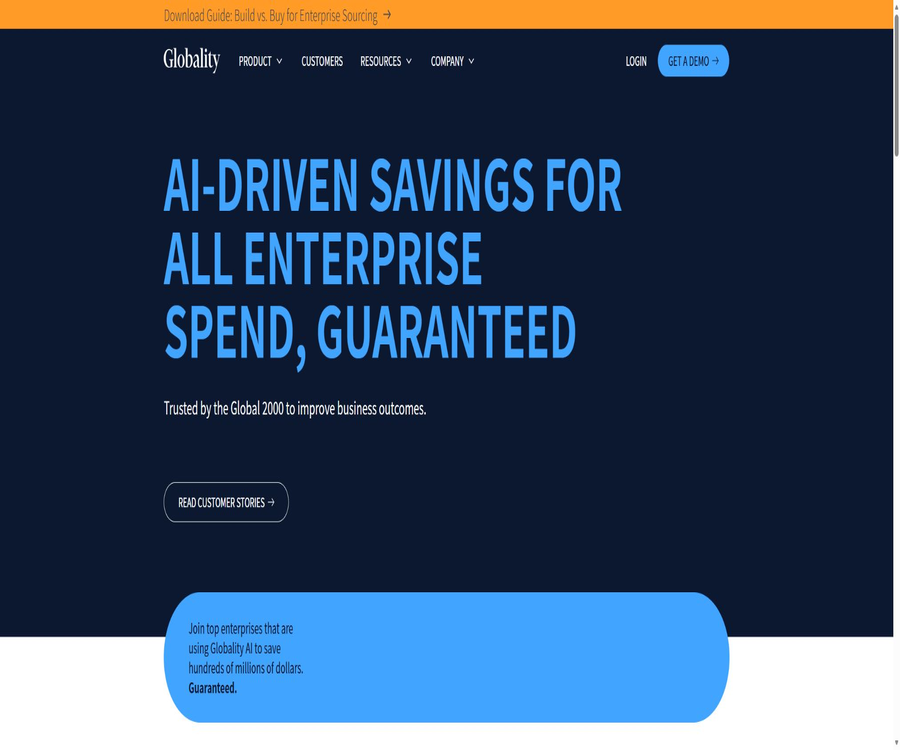
Globality
Globality: an intelligent tool focused on improving AI efficiency.
Tags:AI improves efficiencyA one-sentence summary
Globality is an AI-driven sourcing platform designed for corporate procurement teams; it connects the processes of clarifying requirements, identifying suppliers, requesting quotes, analyzing proposals, conducting electronic negotiations, and awarding contracts through Glo agents.
Tool Introduction
Globality is operated by Globality, Inc., and its main areas of application are strategic procurement, managing expenditures related to niche products, and procuring complex services. It is not a general shopping assistant for individuals; rather, it is a B2B product that requires the integration of corporate processes, suppliers, permissions, contracts, and procurement systems.
Glo assists users by leveraging generative AI, neural networks, machine learning, as well as proprietary data created by procurement experts. AI is responsible for guiding and automating the process, while human procurement specialists remain in charge of identifying needs, selecting suppliers, ensuring fair competition, managing risks, and making the final decisions regarding procurement.
Main functions
Collection of purchase requirements in natural language
Glo gathers information on business objectives, scope, budget, delivery timelines, risks, and evaluation criteria through interactive interviews; it can also extract project details from existing documents. Users should verify each piece of information extracted to prevent incorrect requirements from making their way into subsequent bidding processes.
Multiple sourcing paths
The platform supports scenarios such as RFP, RFI, RFQ, Sole Source, Delivery of Staffing, and Supplier Panel. The system guides the user in selecting the appropriate process, but single-source procurement and procurement exemptions still require internal authorization.
Pricing templates and proposal requirements
Glo can recommend pricing models based on the procurement items and require suppliers to fill out a structured price template. The response options can be set as free text, single selection, multiple selection, or matrix, which facilitates uniform comparison later on.
Supplier discovery and matching
The system can identify candidates from the company’s existing supplier pool and the Globality network, displaying information such as location, certifications, past projects, industry experience, and approval status. The results provided are suggestions; the purchasing party still needs to carry out further due diligence and a conflict of interest assessment.
NDA works in collaboration with suppliers
The project can require suppliers to sign a confidentiality agreement before accessing sensitive briefs. The platform enables the distribution of information to all participants in a unified manner, as well as allows for one-on-one communication regarding specific proposals.
Proposal management and cross-comparison
Purchasing staff can track, revise, and evaluate multiple supplier proposals from a single interface. Glo organizes the key terms and prices into a consistent structure, reducing the need for manual table handling; however, the original proposals remain the basis for making contractual decisions.
Cost analysis
The platform uses the supplier quotes to generate cost comparisons and insights, helping the purchasing team identify structural differences and areas for negotiation. The total cost should also include taxes, implementation fees, renewal costs, exit fees, exchange rates, and internal conversion costs.
Electronic negotiation
Glo enables multiple rounds of electronic negotiations, allowing suppliers to understand their competitive position and to update their prices and terms. The purchaser must establish rules that are fair, understandable, and in line with the company’s policies, in order to prevent the improper disclosure of bidding information.
Multiple supplier ratings
Business, procurement, and other reviewers can assign scores to suppliers based on predefined criteria; the results are displayed together to facilitate transparent decision-making and auditing. Weightings and comments should be determined as early as possible before reviewing the quotes, in order to avoid any bias resulting from adjustments made later on.
SOW and the award process
At the time of awarding the contract, Glo can use a standard Statement of Work template and pre-fill the key information from the brief and the supplier’s proposal into the document. Nevertheless, the final SOW still needs to be approved by the legal team, the procurement department, the business unit, and the supplier.
Automation of long-tail expenditures
Globality is also utilized for those numerous expenses of small value each, which are easy to bypass the standard procurement processes. Companies can implement AI-driven guidance and mandatory controls for business users, but exceptions must still allow for manual intervention.
Origin exploration phase and deliverables
| Phase | Glo’s main tasks | Key output | Human liability |
|---|---|---|---|
| Scope | Interviews, document extraction, and requirement structuring | Brief, requirements, and pricing templates | Confirm the scope and acceptance criteria |
| Select | Match existing and new suppliers | Candidate list and dynamic profile | Due diligence, conflict assessment, and access determination |
| Analyze | Organizing and comparing proposals | Price, quality, and difference analysis | Verify the original proposal and the total cost |
| Negotiate | Organize electronic negotiations and scoring | Update quotes and provide a comprehensive assessment | Set fair rules and approve the results |
| Buy | Generate the SOW and ensure compliance with the awarding process. | Contract work area, purchase requests, and award records | Legal, risk, and final signing |
Complete procurement workflow
- Create a project through the procurement portal or Globality, and select the sourcing type and expenditure category.
- Complete the details regarding scope, budget, timeline, risks, and acceptance requirements through Glo conversations or by uploading documents.
- Select the pricing template, proposal questions, scoring criteria, NDA, and supplier qualification requirements.
- Select candidates from the pool of corporate suppliers and platform recommendations, and conduct due diligence.
- Invite suppliers to submit structured quotes, answer questions in a uniform manner, and keep records of the communications.
- Compare technology, quality, price, and total cost, and initiate fair electronic negotiations if necessary.
- Have the relevant personnel assign scores based on predefined weights, and record the reasons for selection or elimination.
- Generate the SOW and complete the risk, legal, compliance, and approval steps.
- Synchronize the contract work area, purchase requests, and project data back to the enterprise system.
- Continuously evaluate savings, cycle time, competitiveness, compliance, and supplier performance.
Usage tutorial
Create the first sourcing project
- Pilot projects with clear selection criteria, controllable risks, and multiple qualified suppliers.
- Focus on describing business outcomes rather than specifying solutions in advance, to avoid unintentionally restricting competition.
- After uploading the Brief, verify item by item the budget, region, timeline, and delivery conditions extracted by Glo.
- Select RFP, RFQ, or another appropriate option, and specify the approver and deadline.
- Set the scoring dimensions, weights, minimum thresholds, and rules for reporting conflicts, and then issue the invitation.
- Complete the analysis, negotiation, and awarding processes, and compare the cycle time and workload with the original process.
Configure supplier proposals and evaluations
- Select the total price, itemized prices, rate cards, or combination templates based on the purchase details.
- Separate the conditions that must be met from the preferencies that can be scored, in order to reduce ambiguity in evaluation.
- Suppliers are required to submit prices, assumptions, exceptions, and delivery plans in a standardized format.
- Issue a unified and important clarification on the scope of the impact to all suppliers before the deadline.
- After locking the scoring weights, invite reviewers to provide their assessments, while recording both factual information and subjective judgments separately.
- Compare the Glo results with the original documents item by item before proceeding with negotiations.
Integrate with the existing procurement system
- Illustrate the current data flow and system responsibilities, from Intake, source identification, contract formation to purchase requests.
- Choose from pre-built SAP or Coupa connectors, standard APIs, Webhooks, or enterprise middleware.
- Identify the main system for project, supplier, contract, purchase request, and report fields.
- Use a test tenant to verify authentication, field mapping, duplicate events, retry on failure, and permissions.
- Configure service accounts, key rotation, and Webhook receivers with the minimum required permissions.
- Launch on a small scale to verify two-way synchronization, and then gradually expand to include more departments and expense categories.
Which users are it suitable for
- Purchasing departments in large and medium-sized enterprises: streamline complex sourcing processes, manage spending related to niche items, and oversee the awarding of contracts.
- Category Manager: Manages projects by using structured templates, supplier networks, and historical data.
- Business procurement applicant: Generates an executable brief through natural language guidance.
- Finance and Transformation Team: Analyzes the procurement cycle, level of competition, cost savings, and impact on cash flow.
- Legal and risk professionals: Integrate NDAs, due diligence, SOWs, and approvals into the processes.
- Procurement technology team: Integrates with existing ecosystems using connectors, APIs, and Webhooks.
Typical use cases
- Create structured RFPs for consulting, marketing, technical, and human resources services to increase competition.
- Integrate sporadic, small-value, long-tail purchases into a self-service process with mandatory controls.
- Establish a vetted pool of candidates from new and existing suppliers.
- It automatically compares itemized quotes, rate cards, and commercial terms, and then facilitates electronic negotiations.
- After the award is made, a contract workspace and a procurement request are created automatically, reducing the need for repeated data entry.
- Feed the project data into analysis systems such as Tableau to generate corporate procurement reports.
Product advantages
- It covers the entire process of Intake, Scope, Select, Analyze, Negotiate, and Buy.
- Natural language interaction reduces the barriers for business staff to create standardized procurement requests.
- Place the company’s own suppliers within the same matching and comparison process as those on the platform.
- Structured pricing templates, proposal comparison, and electronic negotiation reduce the need for manual spreadsheet work.
- It supports various integration methods such as pre-built connectors, APIs, Webhooks, and enterprise middleware.
- NDA, scoring, risk assessment, compliance, and SOW processes provide the documentation required for audits.
- It is aimed at strategic expenditures and those related to niche areas, covering more than just a single category of purchases.
Usage restrictions and precautions
- Globality is an enterprise-level platform; it does not offer any public self-service packages or fixed prices.
- Implementation requires supplier master data, category knowledge, permissions, approval processes, and system integration.
- AI recommendations may inherit data gaps or biases, and cannot automatically ensure fairness and compliance on the part of suppliers.
- The supplier matching, ranking, and negotiation mechanisms need to be explained to the audit team, legal department, and all relevant parties.
- Automatically generated SOWs cannot replace contract negotiation, legal review, and signing authority.
- Companies must decide which procurement data can be used for AI, integration, analysis, and cross-system synchronization.
- The savings, ROI, and guarantees mentioned on the official website are part of the commercial claims; the applicable conditions are determined by the contract.
- Globality cannot replace sanctions, anti-bribery measures, information security, privacy protection, and financial due diligence.
- International deployment also requires dealing with language, currency, taxation, data localization, and local procurement regulations.
Price and procurement methods
As of August 22, 2026, Globality does not have any publicly available standard packages, pricing per user, or implementation fees. Companies need to request a demonstration and receive a customized quote based on factors such as budget, modules required, location, integration needs, as well as supplier and service requirements.
| Cost items | Public price | Common factors affecting pricing | Requirements before procurement |
|---|---|---|---|
| Platform license | Contact sales | Enterprise size, modules, scope of expenditures, and contract duration | Clarify the billing basis and annual price increases |
| Implementation and configuration | Custom quote | Processes, categories, templates, permissions, and migration | List milestones, responsibilities, and acceptance criteria. |
| System integration | Custom quote | Connectors, APIs, middleware, and bidirectional data | Confirm interface, environment, and maintenance costs |
| Supplier enabled | There is no unified, publicly disclosed price. | Number of suppliers, training, and support | It is confirmed that the buyer or supplier shall bear the cost. |
| Support and successful service delivery | Contractual agreement | SLA, regions, training, and change management | Specify the response and escalation paths. |
The official website claims an AI sourcing ROI that is 15 times the initial licensing fee within the first year, but the public pages do not provide details regarding the criteria for eligibility, the baseline values, the methods used for calculation, or the conditions for refunds. The purchaser should include all such guarantees in the order and define measurable criteria for determining the savings achieved.
Comparison of platform modules
| module | Key capabilities | Primary users | Key data |
|---|---|---|---|
| Intake and Sourcing | Needs, processes, suppliers, proposals, negotiations, and awarding of contracts | Business applicants and procurement | Brief, quote, rating, and SOW |
| Supplier Network | Supplier discovery, documentation, certification, and invitation | Category Manager | Corporate suppliers and platform networks |
| Tail Spend | Automation and control of low-value, high-frequency purchases | Business users and procurement operations | Expenses, rules, and exceptions |
| Orchestration | Coordination between approvals, contracts, and procurement requests | Procurement Operations and Technology Teams | Process status and system records |
| AI and proprietary data | Dialogue, matching, analysis, and recommendations | All procurement roles | Project, category, and procurement knowledge |
Integration capability
| Integration method | Supported objects | Typical uses | Precautions |
|---|---|---|---|
| Pre-built connectors | SAP, SAP Ariba, Fieldglass, and Coupa | Contract work area and purchase requests | The specific version and fields need to be confirmed by the project team. |
| Public API | Enterprise systems and middleware | Create, search, read, and update project data | Customer authorization and technical support are required. |
| Webhook | Customer receiver end | Monitor project status and trigger contracts or reports. | Verify events, idempotency, and retries |
| Procurement Portal | Existing Intake entry point | Guide users to the Globality project. | Handle identity and permission mapping |
| Analysis system | Including Tableau and others. | Synchronized detailed project data is used for reports. | Define master data and refresh frequency |
| Enterprise middleware | Customer’s existing integration layer | Connect to a customized procurement ecosystem | Monitoring failures and version changes |
API and Webhook
Globality offers public APIs that enable the creation of projects by using information pre-filled from enterprise systems; it also allows for the searching, reading, and updating of projects. Webhooks provide real-time notifications when the status of a project changes, and they offer the event time, status, and logs to aid in troubleshooting.
- First, contact Globality support to obtain information about the customer’s environment, the authentication methods, and the current interface documentation.
- Defines the items, fields, roles, and data areas that allow for creation or reading.
- Create credentials with the minimum required permissions in the testing environment, and store them in the enterprise key management system.
- It enables webhook signature verification, idempotent processing, retry on failure, and event auditing.
- Verify the status of items, contracts, and purchase requests in Globality and the procurement system.
- After going live, monitor changes in interface version, latency, error rate, and permissions.
AI and data governance
The Globality disclosure platform utilizes proprietary data created through the use of generative AI, neural networks, machine learning, and expertise in procurement. Companies should further verify the models that are actually used, the sub-processors involved, the boundaries for training and fine-tuning, as well as how prompts are handled and who has access to them manually.
| Governance issues | The official website can be used to verify the information. | Enterprises still need to confirm. |
|---|---|---|
| Uses of AI | Needs assessment, matching, analysis, negotiation, and process guidance | Whether each function can be disabled or manually overridden |
| Training data | Utilize proprietary data created by procurement experts | Are customer data used to improve the model? |
| Model | Generative AI, neural networks, and machine learning | Specific suppliers, versions, and update policies |
| Explanatory | Provides matching, comparison, and scoring information. | Audit evidence on ranking, recommendation, and negotiation logic |
| Retain | Subject to contracts and privacy policies | Deadlines for projects, proposals, chats, and embeds |
| Region | Enterprise deployment requires negotiation. | Locations for storage, processing, backup, and support access |
Safety and compliance
The Globality security page states that its information security programs are based on ISO 27001, and it holds an ISO/IEC 27001:2022 certification. The official information also mentions SOC 2 compliance as well as recent audits; the detailed reports and specifics can be obtained through a security due diligence process.
- Use single sign-on, multi-factor authentication, role-based permissions, and regular access reviews.
- Classify supplier quotes, contracts, personal information, and trade secrets according to their level of sensitivity.
- Identify the data areas for production, testing, backup, logging, and support access.
- Request the current ISO certificate, SOC 2 reports, as well as materials related to penetration testing and incident response.
- Configure key rotation, network control, and auditing for APIs, Webhooks, and middleware.
- Define data export, deletion proof, supplier withdrawal, and business continuity upon contract termination.
Privacy and supplier data
The privacy policy covers personal data of website visitors, customer users, suppliers, etc. Purchase orders may include contact information, proposals, certifications, case studies, communication details, ratings, and contract information; it is necessary for companies to clarify the responsibilities of the controller and the processors.
Business users should not include in the brief any data related to employees, customers, or candidates that is not pertinent to procurement. Suppliers should also submit only the information necessary for the evaluation process, and handle the retention and deletion of such data in accordance with the company’s requirements.
- Provide clear privacy information and details on the scope of access to the project before inviting suppliers.
- An NDA cannot replace personal data processing agreements and cross-border transfer mechanisms.
- Avoid including unauthorized customer lists, employee records, or production data in proposals.
- Restrict access to project fields for business operations, procurement, reviews, and suppliers based on roles.
- Individual data extracted by AI, vectorized, logged, and analyzed is assessed separately.
- Establish internal procedures for access, correction, deletion, export, and legal retention.
GitHub, SDKs, and open-source status
| Project | Current conclusion | Explanation |
|---|---|---|
| Globality Public API | Provide | Used for creating, searching, reading, and updating items |
| Webhook | Provide | Monitor project status and other configuration events |
| Official SDK | Not verified. | The public page does not list the language-specific kits. |
| Official GitHub product repository | Not verified. | The source code of the core platform has not been confirmed. |
| Globality platform | Not open source | Delivered through enterprise hosting software and services |
| Self-hosting | Not made publicly available | The deployment mode must be confirmed in the enterprise contract. |
The availability of APIs merely means that customers can integrate the business platform within the authorized scope; it does not imply that the Glo model, the supplier network, or the procurement logic are open-source. Companies should not assume that they can deploy these elements on a private basis as a result of this.
Basic information
| Project | Content |
|---|---|
| Tool name | Globality |
| AI agent | Glo |
| Operating company | Globality, Inc. |
| Tool type | Companies’ independent sourcing and AI-based procurement platforms |
| Main process | Scope, Select, Analyze, Negotiate, and Buy |
| Origin search type | RFP, RFI, RFQ, Sole Source, Staffing, and Supplier Panel |
| Key customers | Purchasing and business teams in large and medium-sized enterprises |
| Price pattern | Apply for a demonstration and get a quote for custom solutions |
| Pre-built connection | SAP Ariba, Fieldglass, Coupa, and others |
| Public API | Yes |
| Webhook | Yes |
| Official SDK | Not verified. |
| Is it open source? | No |
| Security certification | ISO/IEC 27001:2022 – officially referred to as SOC 2 compliance |
| Date of information verification | August 22, 2026 |
Recommendation score
Recommendation score: 4.4 / 5. Globality covers the entire sourcing process, from identifying needs to awarding contracts; it offers comprehensive functions such as supplier matching, structured quoting, electronic negotiation, SOW preparation, and enterprise integration.
Its procurement requirements, implementation complexity, and cost make it unsuitable for individual users or small-scale, occasional purchases; in addition, the available models and billing details are limited. It is most suitable for companies that possess capabilities in data governance, supplier management, and integration.
Frequently Asked Questions
What is Globality?
It is a platform for enterprises to use AI for source identification; Glo acts as an agent to handle tasks such as demand identification, supplier selection, proposal analysis, negotiation, scoring, preparation of SOW documents, and awarding contracts.
Is Globality suitable for individual purchases?
It is not suitable. The product requires enterprise procurement processes, suppliers, appropriate permissions, contracts, and system integration; it is intended for large and medium-sized organizations.
What is the public price of Globality?
The official website does not provide a standard price list; an application is required to arrange a demonstration and to obtain a customized quote. The costs related to licensing, implementation, integration, support, and vendor activation all need to be determined separately.
Which sourcing methods are supported?
The authorities list options such as RFP, RFI, RFQ, single supplier approach, personnel delivery, and supplier panel. The specific procedures can be configured in accordance with the company’s rules.
Can negotiations be carried out automatically?
Electronic negotiations can be facilitated through Glo, allowing for the comparison of competitive offers. The rules must comply with requirements related to fair procurement, confidentiality, and corporate auditing.
Will the supplier be automatically selected and contracted?
The platform can assist with the matching, scoring, and awarding processes, but the final decisions, risk assessments, and signing authorities remain with the company’s employees.
Is it compatible with SAP Ariba and Coupa?
Pre-built connection methods for SAP and Coupa are available; the official website mentions SAP Ariba, Fieldglass, and Coupa. The specific versions and fields need to be determined during implementation.
Does Globality provide APIs?
Public APIs and Webhooks are provided to enable the creation, querying, reading, or updating of projects, as well as to notify enterprise systems when there are changes in their status. Access permissions must be configured by the customer in collaboration with the authorities.
Is Globality open source?
It is not an open-source product, and the source code of its core platform or the weights of its models have not been made available. The API and Webhook functions serve to enable integration with commercial platforms.
Will AI replace the procurement team?
No. AI can automate organization and provide recommendations, but tasks such as identifying requirements, ensuring fair competition, conducting due diligence, formulating negotiation strategies, as well as handling contracts and awarding responsibilities still need to be carried out by professionals.
How should we understand the 15x ROI guarantee on the official website?
This is the official commercial position; the public pages do not provide a complete list of the calculation methods and eligibility criteria. The purchaser should specify in the contract the baseline values, the criteria for determining savings, as well as the methods for verification and compensation.
Is Chinese supported?
The official website does not provide a complete list of languages on the public product page. For global deployment and Chinese language support, it is necessary to test the interface, conversations, documents, as well as supplier communications and support during demonstrations.
Summary
Globality is suitable for companies that wish to integrate strategic purchasing and spending on niche items into a single AI-driven sourcing system. Glo can assist from the stage of clarifying requirements all the way through to negotiation, the preparation of SOWs, and system updates; however, procurement decisions cannot be fully automated.
Before making a purchase, it is necessary to conduct trials with actual products in order to evaluate the timeline, level of competition, cost savings, supplier experience, and compliance aspects. The final contract should also specify the total price, the use of AI data, security measures, responsibilities related to integration, SLAs, conditions for withdrawal, and ROI guarantees.
Tools similar to Globality


 Guigong Network Security Registration No. 45132202000164