






Flamel.ai
Flamel.ai: an intelligent tool focused on improving AI efficiency.
Tags:AI improves efficiencyA one-sentence summary
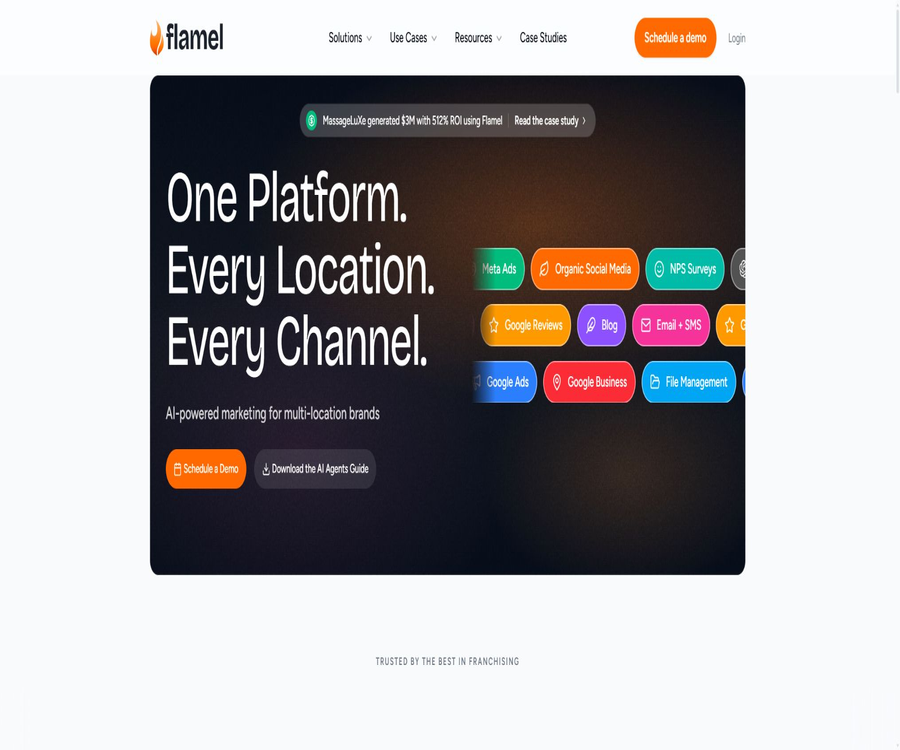
Flamel.ai is an AI marketing platform designed for franchise systems, multi-store brands, and agents; it allows for the creation of localized content for each store, the placement of advertisements, the management of reviews, as well as the analysis of performance across different channels, all under unified rules set by the headquarters.
Tool Introduction
Flamel.ai is operated by Flamel AI, Inc., and its core concept is to integrate brand management at the headquarters with local execution in stores under one marketing framework. The headquarters can manage templates, assets, permissions, and approval processes, while stores can adjust details such as cities, addresses, events, and discounts within the boundaries set by the brand.
The platform covers organic social interactions, paid advertising, Google Business Profile, Google Reviews, email and SMS communications, blogs, NPS surveys, and file management. Luna AI uses this data to generate content, analyze store performance, and propose actions for approval.
Product architecture
| Hierarchy | Primary target | Responsible for content | Typical users |
|---|---|---|---|
| Hub Headquarters Center | Brand or franchise headquarters | Brand guidelines, templates, playbooks, broadcasting, and overall network analysis | Headquarters Marketing Team |
| Workspace store space | Individual store or region | Local accounts, content, ads, reviews, and information | Franchisees and store marketing staff |
| Luna AI | Cross-channel marketing tasks | Content, analysis, routine tasks, signals, and action recommendations | Used jointly by the headquarters and stores |
| Data connector | External marketing platforms | Synchronized ads, social features, reviews, merchant information, and metrics | Administrators and integration team |
Main solutions
| Solution | Core competencies | Suitable scenarios | Important restrictions |
|---|---|---|---|
| Organic Social | Scheduling, publishing, calendar, comments, and approval | Natural social interaction across multiple stores | Authorization from each platform is required. |
| Meta Ads | Approval of cross-store advertising, budgets, and creatives | Advertising on Facebook and Instagram | The spending transaction requires manual approval. |
| Google Ads | Search, display, and local advertising management | Acquiring customers for stores and regional marketing efforts | It is necessary to verify the account and conversion settings. |
| Google Business Profile | Information, hours of operation, images, and posts | Local search visibility | Platform permissions and review rules are governed by Google. |
| Google Reviews | Aggregated evaluations, responses, and sentiment trends | Reputation management for multiple stores | AI responses must be manually checked. |
| Email and SMS | Visualizing activities, clustering, and store localization | Reaching members and customers | Legal consent and an unsubscribe mechanism are required. |
| Blog Writing | Branded local articles | Local SEO content for stores | Facts and search quality require manual review. |
| NPS Surveys | Customer feedback and Net Promoter Score surveys | Experience monitoring and store comparison | Sample and privacy impact results |
| File Management | Brand asset and file management | Distribution of headquarters assets | Permissions and versions must be standardized. |
Main functions
One-to-many localized deployment
Once the content is created at the headquarters, it can be used to automatically update the names, addresses, phone numbers, and local discounts for each store, allowing for bulk distribution. Before publishing, it’s possible to preview each version, exclude certain stores, or allow those stores to decide whether to join.
Multi-platform social media management
The platform supports Facebook, Instagram, LinkedIn, TikTok, and X; it allows for centralized scheduling, simultaneous posting, monitoring of interactions, and management of comments. Each store connects to its own account, while the headquarters retains overall visibility and control over approvals.
BrandCheck AI brand audit
BrandCheck AI analyzes content based on the brand’s tone, logos, color schemes, fonts, prohibited words, and compliance requirements. Any deviations are identified and modifications are suggested, but companies still need to carry out manual and legal reviews.
Luna AI Marketing Agent
Luna utilizes the Claude model and draws on brand guidelines, store information, as well as real-time marketing data; it can answer questions, create content, develop advertising playbooks, assess account health, and draft responses to reviews. It is not an independent chatbot but rather a marketing assistant integrated into the Flamel workspace.
Tools, Skills, and Routines
Tools represent individual actions, Skills are used to carry out multi-step tasks, while Routines execute Skills on a daily, weekly, monthly basis or as one-time plans. Teams can use pre-defined Skills or configure them according to their own working methods.
Signals and Plays
Signals monitors changes such as failed ad deployments, declining ratings, customer decisions to opt in, and local events; based on this information, Luna prepares the necessary actions. Recommendations are displayed in the Dashboard in a Play format, allowing users to approve, modify, or reject them.
Manual approval and expenditure boundaries
Actions that involve publishing content or spending funds require user approval; Routine also allows setting limits on the amount of work that can be handled at one time as well as budget limits. Tasks that exceed these limits are sent back to Play to await a decision, thereby preventing the agent from expanding its activities without confirmation.
Paid Advertising Playbook
The headquarters can create Meta and Google Advertising Playbooks, using which creative elements, copywriting, targeting strategies, and budget rules can be applied to various stores. However, the account status, regional policies, and budgets for each individual store still need to be checked separately.
Evaluation and local SEO
Flamel aggregates Google reviews from various stores, offering the ability to respond directly, AI-generated suggestions, alerts for negative reviews, and insights into sentiment trends. The merchant profile section also allows for centralized management of categories, opening hours, images, and store posts.
Emails, text messages, and customer feedback
Companies can use a visual editor to design campaigns, group them by store or customer behavior, and track opens, clicks, and conversions. The headquarters templates can be supplemented with local information by the stores, or separate campaigns specific to certain stores can be run.
Cross-channel analysis and fEMV
The analysis takes into account interactions, reach, fan growth, advertising spending, conversion rates, as well as the estimated media value per store. The Multi Solution and Enterprise versions offer cross-channel dashboards; the Enterprise version also allows for the customization of reports and quarterly reviews.
Slack collaborates with external agents
Luna can operate within Flamel, in the editor, and in Slack; it can also be connected to external AI tools via MCP. The external interfaces are not self-service features available to all customers – currently, employee or partner access is required.
Luna is in active mode.
| Ability | Status | Function | Control method |
|---|---|---|---|
| Real-time Q&A and editing assistance | Already provided | Rewriting, shortening, translating, tagging, and creativity | The user can choose to insert or replace. |
| Multi-step guidance task | Already provided | Playbook, store information, calendar gaps, and response to reviews | Execute within the workspace area. |
| Tools and Skills | Already provided or configured per account | Single actions and multi-step recipes | Restricted by roles and workspaces |
| Routines | Launched in phases | Run Skill automatically as scheduled. | It is disabled by default; users can choose to enable it. |
| Signals | Launched in phases | Monitor accounts and external changes | It is disabled by default and enabled upon receiving a signal. |
| Dashboard and Plays | Launched in phases | Display suggestions and actions pending approval in a centralized manner. | Publication and spending require approval. |
Headquarters Deployment Tutorial
- Schedule a demonstration and provide the number of brands, number of stores, region, required channels, team roles, and integration requirements.
- Determine whether it is a Single Solution, Multi Solution, or Enterprise setup, and then confirm the contract terms, pilot phase, data migration, and level of support.
- Create Hub and store Workspaces, and import names, addresses, phone numbers, operating hours, and grouping structures.
- Configure the Brand Kit, templates, fonts, color schemes, expression restrictions, compliance rules, and digital asset library.
- Link social media, advertising, merchant profiles, reviews, and other accounts, and assign team roles based on the minimum level of access required.
- First, select a small number of stores to test localization, approval processes, publishing, and reporting functions; once these are verified, the approach can be expanded to the entire network.
Create localized social content
- Select the target channel, date, store range, and event objectives in the headquarters or store content calendar.
- Use an approved template or have Luna generate a draft, specifying the audience, tone, offers, and platform requirements.
- Check the automatically updated names, addresses, phone numbers, dates, and local terms for each store.
- Run BrandCheck AI to process the markings, and then submit them to headquarters, regional teams, or compliance officers for approval according to the established procedure.
- Preview the layout for each platform before publishing or scheduling it, and then compare the interaction and conversion performance across stores.
Use Luna to carry out marketing tasks.
- Open Luna in the current Hub or Workspace, making sure that its scope matches the target brand and stores.
- Explain the objectives, target audience, channels, timeline, budget, and any brand constraints that must be followed.
- Have Luna generate multiple options or execute the supported Skills, and view the range of data it uses as well as the reasons behind its recommendations.
- Check the content, location, list of stores, estimated costs, and potential impacts; modify Play if necessary.
- Approval for release or expenditure is given only after confirmation, and the results are tracked in the Dashboard and analyses.
API and MCP connection process
- First, apply to the account manager for employee or partner permissions, and determine whether to use the Standard or Partner rate tier.
- Register the client using the OAuth 2.1 authorization code flow and PKCE, and choose between public or confidential client mode for the callback address.
- The user is responsible for authorizing the process, exchanging access tokens and refresh tokens, and then verifying the current user, as well as the Workspace and Hub contexts.
- Depending on the task, choose either the REST data endpoint or the MCP tool; the development environment prioritizes performing read-only queries.
- Add field validation, manual approval, retry functionality, revocation tokens, and audit logs for publishing and media uploading.
Which users are it suitable for
- Headquarters for franchise management: standardizes the brand, templates, permissions, and reports, while allowing stores to maintain flexibility in local operations.
- Multi-store retail and service brands: Managing a large number of regional accounts, merchant details, reviews, and advertisements.
- Franchisees and store managers: Use headquarters assets to quickly create local events and community-related content.
- Franchise marketing agents: Manage multiple brands, store levels, and customer approvals from a single center.
- Regional marketing team: Compares performance by region and provides targeted support to underperforming stores.
- Partner development team: After obtaining permission, they can access reports and AI workflows via REST API or MCP.
Typical use cases
- Nationwide promotion rollout: The headquarters creates a unified campaign, which automatically generates the address of each store along with the applicable discount details.
- Store Social Calendar: Luna identifies available time slots and creates drafts that take into account local festivals and community events.
- Cross-store advertising deployment: Use Playbooks to replicate creative elements and targeting strategies, while setting budget limits for each store.
- Evaluate centralized operations: aggregate new reviews, alert to low ratings, and prepare responses that are in line with the brand’s tone.
- New store launch: Fill the Workspace with brand information and publicly available merchant details, then connect it to various marketing channels.
- Regional performance review: Compare expenses, impressions, conversions, interactions, and estimated media value to identify stores that require support.
- Co-creation of content by franchisees: The headquarters provides templates and guidelines, while the stores add local elements to the content before it goes through the approval process.
Product advantages
- The product data model is structured around headquarters, stores, and regional levels, making it more suitable for franchise systems than single-account social tools.
- The nine types of marketing solutions can be purchased in a centralized manner, which helps to reduce the fragmentation that exists between social media, advertising, reviews, emails, and documents.
- One-to-many localization takes into account both headquarters efficiency and store differences; it allows for previewing, excluding, or selecting items to include.
- BrandCheck AI, role-based permissions, and approval processes work together to help companies maintain brand consistency.
- Luna reads real-time data from stores and channels directly, rather than relying on isolated text entries provided by users.
- Spending and publishing require manual approval, and it is also possible to set limits on the volume of processing and budget amounts for Routines.
- REST APIs, MCP, and Slack offer opportunities for expansion, making them suitable for enterprise workflows that involve collaboration.
Usage restrictions and precautions
- The official website does not disclose specific figures for fixed packages; the budget must be determined by contacting sales representatives, taking into account the number of solutions and stores.
- The so-called trial is a paid pilot period of 30 to 90 days, and it is not a permanent free version that can be registered on one’s own.
- Routines, Signals, Plays, and Dashboard will still be rolled out in phases, and specific accounts may not be available yet.
- APIs and MCPs are available only to employees and selected partners; regular customers cannot assume that they will automatically be granted development rights.
- The data structure of the Write endpoint varies depending on the product; developers need to consult the support team for the current field specifications.
- AI-generated content, evaluation responses, and analysis conclusions may be incorrect; brands, facts, compliance aspects, and local expressions still require manual verification.
- Social, advertising, Google, and messaging functions are subject to the permissions, policies, region, and account status of third-party platforms.
- Email and SMS campaigns must address legitimate consent, unsubscribe options, frequency limits, and regional privacy requirements.
- The platform stores customer data in the United States; organizations with requirements for local data storage need to negotiate this matter prior to signing a contract.
- The terms were last updated in 2023, which is clearly earlier than the current product specifications and the privacy policy for 2026; the priority of these contracts should be confirmed in writing.
- The company address listed in the terms of service and privacy policy differs; corporate purchases shall be governed by the order and data processing agreements.
Prices and packages
As of August 22, 2026, Flamel.ai quotes prices based on the number of solutions required and the number of stores to be included in the plan; it does not disclose a fixed monthly fee. The team can choose between monthly payment or an annual rate with a discount. The specific minimum number of stores, the discount amount, and any implementation fees must be confirmed by sales.
| Plan | Price | Included range | Support | Suitable for users |
|---|---|---|---|---|
| Single Solution | Custom quote | Choose a core channel or solution. | Email support, dedicated onboarding specialist | First, address the teams responsible for individual marketing tasks. |
| Multi Solution | Custom quote | Two or more solutions, with a better rate for each individual option | Priority support, cross-channel dashboard | Brands that need to integrate multiple channels |
| Enterprise | Custom quote | Complete platform, custom integration, and enterprise configuration | Dedicated account manager, SLAs, and regular reviews | Large franchise networks and agents |
| Paid pilot program | Quotation based on range | Use real stores, data, and teams to evaluate the entire platform. | Includes settlement support | Customers whose value is verified before signing a long-term contract |
A typical paid pilot lasts between 30 and 90 days. The platform accepts major credit cards and ACH transfers; business accounts can make payments based on net invoices over a 30-day period. The final costs, taxes, and contract duration are determined according to the quote and order details.
Platform support and integration
| Platform or integration | Support status | Primary uses | Notes |
|---|---|---|---|
| Web application | Support | Headquarters, store, and agent work areas | Main management entry point |
| Mobile apps | Mentioned in the policy | Mobile access | No verifiable details of public stores were found. |
| Facebook and Instagram | Support | Natural social interactions and Meta ads | Platform authorization is required. |
| LinkedIn, TikTok, and X | Support | Scheduling, release, and interactive analysis | Capabilities are limited by the interfaces of various platforms. |
| Google Ads | Support | Search, display, and local advertising | Store management and reporting |
| Google Business Profile and Reviews | Support | Materials, posts, reviews, and replies | Processing Google user data |
| Email and SMS | Support | Cluster analysis, activity tracking, and conversion tracking | It is necessary to comply with the rules regarding consent and cancellation of subscriptions. |
| Slack | Support | Talk to and collaborate with Luna | Configure by account |
| REST API and MCP | Limited support | External tools, panels, and AI agents | Employees and selected partners |
API, MCP, and open-source status
Flamel offers REST APIs and MCP servers, both of which utilize the OAuth 2.1 authorization code flow, PKCE, as well as a unified set of permission scopes. These interfaces enable reading data related to Hubs, Workspaces, posts, media, and various types of analyses; they also allow for creating posts and uploading media.
The Standard tier allows 60 requests per minute, while the Partner tier permits 300 requests per minute; if these limits are exceeded, retries must be made after waiting for the specified time. Current access is controlled by employees and is available only to internal staff and selected partners.
| Development capability | Current status | Authentication or restriction | Uses |
|---|---|---|---|
| REST API | Restricted openness | OAuth 2.1, PKCE, full scope of permissions | Work area, content, media, and analysis |
| MCP server | Restricted openness | Share OAuth with REST | Allow external AI clients to call the Flamel tool. |
| Dynamic client registration | Document provided | Public or confidential clients | Establish an authorized client |
| Standard rate | 60 times per minute | If it exceeds the limit, waiting is required. | Regular cooperative access |
| Partner rate | 300 times per minute | Partner qualification is required. | Higher frequency integration |
| Official SDK | No findings were detected. | The document primarily uses REST and MCP. | Implement authorization and requests on your own. |
| Official GitHub | No findings were detected. | A personal warehouse cannot be used to represent a company. | The product is not an open-source project. |
The Flamel platform itself is not open source, and no official SDK or corporate GitHub repository has been found. The publicly available MCP endpoints and machine-readable pages merely provide capabilities for integration and content discovery; they do not indicate that the core source code of the platform is available.
Privacy and data security
As the controller of account, billing, and operational data, Flamel is also responsible for managing customer audiences and marketing content. The platform handles accounts, bills, OAuth tokens, media, posts, comments, advertising settings, store information, analysis inputs, and technical logs.
The privacy policy states that Google’s user data is not used for targeted advertising, sold to data brokers, or for the training of machine learning models; nor is Google’s data or customer content used to train third-party models without proper authorization. Customers should still verify, through the contract, the specific AI applications for other types of data.
- TLS encryption is used for transmitting data, while AES-256 encryption is used for static data.
- Customer data is stored in SOC 2-compliant data centers in the United States, but the FAQ does not indicate that Flamel itself has obtained SOC 2 certification.
- The system offers role-based permissions and audit logs, and claims to conduct regular penetration tests; companies can request security questionnaires.
- The platform shares the necessary data with sub-processors responsible for hosting, storage, payment, security, support, analysis, and communication.
- The privacy policy states that personal information is not sold, nor are Google users’ data sold.
- Deletion requests will be processed within a reasonable time, but legal obligations and regular backups may result in a longer period of retention.
- International data may be transferred to the United States or to the location of the service provider; mechanisms such as standard contract clauses are used when necessary.
- The account is linked to high-privilege social and advertising tokens; these privileges should be reviewed regularly, and they must be revoked immediately when employees leave the company.
Precautions regarding documents and contracts
The FAQ states that data is not shared with third parties, while the privacy policy explicitly allows for disclosure to service providers under contractual obligations, business partners, and legal authorities. A more accurate interpretation is that the data is not sold, rather than there being no processing by third parties at all.
The terms of service were last updated in 2023 and include an address in Indiana; the privacy policy from 2026 lists an address in Kentucky. The terms also stipulate that customer content must be deleted within 60 days after termination, and that the current rules should be confirmed through the latest order and data processing agreements at the time of purchase.
Basic information
| Project | Content |
|---|---|
| Tool name | Flamel.ai |
| Development company | Flamel AI, Inc. |
| Tool type | AI-driven marketing for multiple stores and franchise marketing management |
| Core agent | Luna AI |
| Primary users | Headquarters, franchisees, multi-store brands, and agents |
| Price pattern | Custom quotes based on solutions and the number of stores |
| Trial method | 30 to 90 days paid trial period |
| Is registration required? | A corporate account is required. |
| Chinese support | No clear Chinese interface was found. |
| Web version | Support |
| API | Available only to employees and selected partners. |
| MCP | Available only to employees and selected partners. |
| Official SDK | No findings were detected. |
| Is it open source? | No |
| Data is mainly stored | United States |
| Price verification date | August 22, 2026 |
Recommendation score
Recommendation score: 4.2 / 5. Flamel.ai features a hierarchical structure with headquarters and stores, one-to-many localization options, nine different marketing solutions, as well as a manual approval process – making it suitable for large-scale franchise marketing. Luna, on the other hand, can handle multiple tasks using brand and real-time channel data.
The main shortcomings are lack of price transparency, payment required for trials, limited access to development interfaces, and the fact that some forms of agent automation are being made available in stages. Differences in data storage practices, old terms and conditions, and company addresses in the United States also require companies to verify them before signing a contract.
Frequently Asked Questions
What does Flamel.ai do?
It provides centralized management of a multi-store brand’s social media, advertising materials, business information, reviews, emails and messages, blogs, surveys, and other content; it also uses AI to generate localized content and conduct cross-store analyses.
Is Flamel.ai free?
There is no publicly available permanent free plan. The platform offers paid trials lasting 30 to 90 days, and the official pricing is determined based on the required solutions and the number of stores.
How much is Flamel.ai?
The official website does not specify a fixed monthly fee. For Single Solution, Multi Solution, and Enterprise plans, it is necessary to contact sales; both monthly payment and discounted annual pricing can be negotiated.
What is Luna AI?
Luna is an intelligent affiliate marketing agent integrated into the platform; it uses brand guidelines and real-time store data to create content, analyze performance, carry out multi-step tasks, and generate proposals for approval.
Will Luna automatically spend the advertising budget?
No expenditures can be made without approval. The documentation specifies that the content to be published and any related spending actions must await user approval; Routine also allows for setting limits on the volume of processing and budget thresholds.
Are all Luna features available yet?
No. Routines, Signals, Plays, and Dashboard are being introduced in phases on a selective basis; they are turned off by default, so specific accounts may not be able to see them for the time being.
Which social media platforms are supported?
It supports Facebook, Instagram, LinkedIn, TikTok, and X, allowing for centralized scheduling, publishing, and monitoring of interactions. Paid advertising is available on Meta and Google.
Can I manage Google reviews?
Yes, the platform aggregates reviews from various stores, allows for responses either manually or with the assistance of AI, and provides alerts for negative feedback as well as insights into emotional trends. Before releasing an AI-generated response, it is still necessary to check the accuracy of the information and the tone used.
Is API support available?
REST API is supported, but it is currently available only to employees and selected partners. Customers with regular plans need to submit a request to their account manager; it is not available automatically upon purchase.
Is MCP available?
An MCP server is provided, allowing external AI clients to use Flamel’s content and marketing tools. It shares OAuth 2.1 authentication with REST APIs and is subject to the same eligibility requirements.
Is there an official SDK?
As of the verification date, no official SDK was available. Developers must implement OAuth authorization, requests, retries, and auditing mechanisms on their own, by referring to the REST and MCP documentation.
Is Flamel.ai open source?
It is not open source. The machine-readable pages, REST APIs, and MCP interfaces do not equate to the making of the core platform’s source code available; moreover, no official open-source repository belonging to the company has been found.
Will the data be used to train AI?
The privacy policy specifies that Google’s user data shall not be used for the training of general-purpose models, nor shall Google’s data or customer content be used to train third-party foundational models without authorization. Other categories of data must be addressed in further terms within corporate contracts.
Is GDPR supported?
The platform offers functions such as export, deletion, consent management, and data processing agreements; standard contract clauses can also be used for international data transfers. The data is primarily stored in the United States, and organizations with strict requirements regarding data location should first consult with the sales team.
Is technical expertise required for deployment?
The daily marketing interface is designed for non-technical teams and includes features such as onboarding and training. For more complex store structures, single sign-on, custom integrations, and development interfaces, the involvement of the company’s IT department or external partners is required.
Summary
Flamel.ai is suitable for organizations that need centralized control over their brand at the headquarters level, while still wishing to enable local marketing efforts at dozens or even thousands of stores. Social media, advertising, reviews, local SEO, email marketing, and content management are all integrated into a single framework; Luna is responsible for identifying actions that need to be taken based on real-time data.
Before making a purchase, it is necessary to conduct paid pilot tests to verify the accuracy of localization, the level of approval required, channel permissions, and the format of reports. Additionally, the prices, data retention policies, scope of automation, interface requirements, and any relevant terms must be confirmed in writing. Only in this way can it be determined whether the platform is truly suitable for the existing franchise network.
Tools similar to Flamel.ai



 Guigong Network Security Registration No. 45132202000164