






FinanceOps
FinanceOps: intelligent tools focused on enhancing efficiency through AI.
Tags:AI improves efficiencyA one-sentence summary
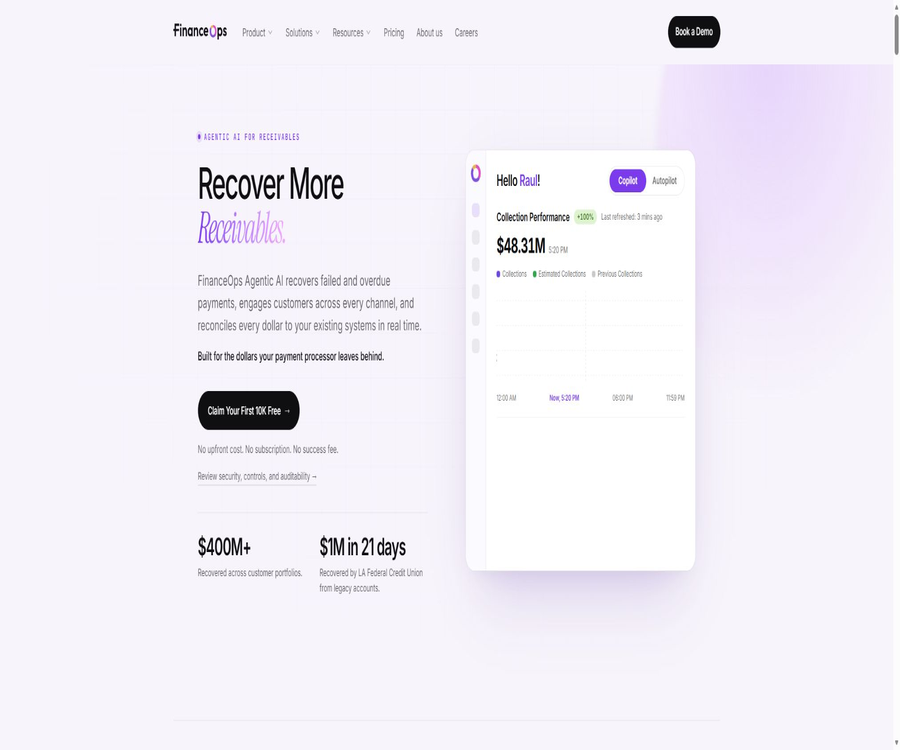
FinanceOps is an Agentic AI platform designed for corporate accounts receivable, early collection, and loan services; it can automate or assist with customer outreach, payment arrangements, invoicing, reconciliation, dispute resolution, and compliance documentation.
Tool Introduction
FinanceOps is operated by FinanceOps, Inc.; its products enable companies to carry out collections in their own brand name, rather than handing over accounts to traditional collection agencies. The platform connects existing payment, billing, loan services, and general ledger systems, allowing for the management of interactions, payments, and audit evidence within a single record.
The product is available in two main modes of use: Autopilot and Copilot. Autopilot handles the automatic management of regular accounts, while Copilot provides real-time suggestions, risk alerts, and payment option support during conversations and messages with human agents.
The platform also includes modules such as Dashboards, Invoicing, Strategy Builder, and Agentic Payments. Companies can start with a controlled set of accounts and gradually expand from there, without having to replace the entire existing financial infrastructure at once.
| module | Main function | Suitable scenarios |
|---|---|---|
| Autopilot | Independently analyze and handle regular overdue accounts. | Aggressive early collection |
| Copilot | Real-time assistance for manual debt collectors | Complex accounts and manual negotiations |
| Dashboards | Check the combination, interaction, and compliance status. | Operations Monitoring and Management Report |
| Invoicing | Invoices, reminders, retries, disputes, and reconciliation | Corporate accounts receivable |
| Strategy Builder | Configure clustering, rules, limits, and upgrades. | Compliance and Operations Strategy Management |
| Agentic Payments | Collection, settlement, recovery, and governance | Complete payment lifecycle |
Main functions
Account priority and real-time scoring
The FinanceOps Score determines the priority for handling an account by taking into account factors such as recyclability, overdue status, level of interaction, and history of payment commitments. This score is useful for arranging operational tasks, but it should not be the sole basis for discriminatory treatment or legal decisions.
Selection of the best time and channel
The system selects the timing and channel for communication based on past responses and account behavior, and it is able to maintain context across messages, emails, Voice AI, web chats, and payment portals. Companies still need to comply with rules regarding customer consent, quiet hours, frequency of contact, and geographical considerations.
Recognition of emotional and difficulty signals
The platform analyzes signals such as payment intentions, dissatisfaction, disputes, and financial difficulties, and adjusts the tone of communication or initiates a manual escalation process. Such assessments can be incorrect; therefore, human judgment and avenues for appeal should be available for determining difficulties and handling sensitive situations.
Payment plan
The system can recommend or offer payment arrangements within limits pre-approved by the enterprise, taking into account historical data, income, expenses, and various interaction signals. Assessing affordability involves sensitive financial information, which requires transparent rules, access controls, and manual verification.
Multi-channel continuous dialogue
Calls, text messages, emails, web chats, and portal interactions can be combined into a continuous record, thereby reducing the need for customers to repeat their information. Each time there is a change, the status of consent, any dispute markers, the details of the proposed solutions, and the person responsible for the next steps should be retained.
Payment collection and real-time reconciliation
The platform supports ACH, bank cards, payment links, and approved payment plans, and it matches invoices with settlements, plans, and general ledger updates. Abnormal payments, refunds, declines, and items that cannot be matched still need to be placed in the manual queue.
Disputes and manual upgrades
Disputed accounts are suspended and sent to the resolution center; complex cases, changes in legal status, requests to withdraw consent, complaints, and decisions with low confidence levels can also be referred to authorized personnel. The threshold for escalation is set by the customer team within the relevant policies.
Invoice workflow
The Invoicing module handles the issuance of invoices, sending of reminders, intelligent retry attempts, handling of disputes, arrangement of payments, and account reconciliation. Companies should first verify the general ledger mappings, tax-related fields, and customer master data before enabling automatic invoice generation.
Strategy and Controlled Autonomy
Strategy Builder is used to configure account grouping, communication rules, negotiation limits, as well as approval and escalation criteria. AI can only choose the next step within the defined boundaries; any action that goes beyond these rules should be prevented or escalated.
Audit and Operations Dashboard
The platform keeps track of messages, decisions, payments, disputes, changes in strategy, and upgrades, and it provides functions for searching and exporting data. The dashboard offers a centralized view of the status related to asset recovery, compliance, and interactions, making it useful for daily operations as well as for audit preparation.
Comparison between Autopilot and Copilot
| Project | Autopilot | Copilot |
|---|---|---|
| Working method | AI for end-to-end processing of regular accounts | Human-led, with real-time AI assistance |
| Primary users | Companies that do not have a sufficient internal collection team | Companies that already have an in-house support team |
| Team management | Not listed as a standard feature | Support |
| Workflow Builder | Not listed as a standard feature | Support |
| Real-time agent assistance | Not applicable | Support |
| Real-time emotion analysis | Used for automatic policies | Used for calls and message guidance |
| Text messages, emails, and Voice AI | Support | Support |
| Call records and transcripts | Supported, additional fees may apply. | Supported, additional fees may apply. |
| Price | 1.5% of the amount recovered | Contact sales |
Working principle
- Enterprises select a combination of controlled accounts and determine which accounts meet the criteria for trial use or formal processing.
- Import accounts, bills, and interaction data via existing system connections, interfaces, or secure file synchronization.
- The financial, operational, legal, and compliance teams are organized into groups; rules regarding channels, time periods, limits, and upgrades are in place.
- The system evaluates each account based on the probability of response, payment behavior, quality of communication, and risk indicators.
- Autopilot carries out the permitted actions, or Copilot provides real-time suggestions during manual interactions.
- Once the customer completes the payment, arranges the plan, raises a dispute, or withdraws their consent, the platform updates the status and triggers the corresponding procedures.
- The receipts are matched with invoices, settlements, and the general ledger; any abnormal items are sent for manual review.
- The team monitors recycling, complaints, compliance, costs, and the effectiveness of strategies by using dashboards and audit records.
Usage tutorial
Launch a controlled Autopilot pilot program
- Select a small number of accounts that are slightly overdue, have low risk, complete data, and a clear legal status.
- Bankruptcies, representation by lawyers, active disputes, fraud, minors, and other special accounts are excluded.
- Check the principal amount, fees, contact person, approval status, time zone, language, and historical payment records.
- Set the frequency of communication with the compliance team, designated quiet periods, limits on payment schedules, and criteria for upgrades.
- First, check the message to be sent and the system’s suggestions in supervision mode.
- Low-risk operations will be gradually opened up, while the capabilities to suspend, cancel, and take manual control will remain in place.
- Check, by account, the attribution of recoveries, actual payments, complaints, reconciliations, and success fees.
Deploy Copilot
- Identify which accounts require manual handling and what assistance AI can provide.
- Links call records, messages, account history, and payment plan details.
- Have senior agents, as well as the legal and compliance teams, review the warning messages and risk rules.
- First, conduct historical or simulated interactions to identify emotions, difficulties, and controversies.
- The training provides agents with guidance, but such guidance is not a mandatory decision; agents are allowed to reject requests manually or to escalate them.
- Continuously compare the agent acceptance rate, plan completion rate, as well as complaints and false compliance reports.
Verify the recycling costs
- Define eligible accounts, cash, recovery events, and excluded items in the contract.
- Verify the account balance at the start and end of platform operation.
- Match each payment with the invoice, payment schedule, and payment method.
- Mark separately refunds, declines, balance adjustments, exemptions, and payments made by third parties.
- Check which balance changes are counted as FinanceOps wins.
- Before issuing the invoice, the details of the success fees must be approved by the finance and business managers.
Which users are it suitable for
- Banks and credit cooperatives: handle overdue loans, negative balances, and early closure of accounts.
- Medical and dental facilities: Reclaim patient balances and process relevant data after signing a BAA.
- Consumer loans and buy-now-pay-later platforms: Early intervention is carried out before the accounts are handed over to external collection services.
- Fintech and payment companies: handle the restoration of payments after automatic retry attempts fail.
- Utilities and government agencies: Manage resident or municipal receivables in accordance with approved policies.
- Subscribed enterprises: Restore failed recurring payments and reduce involuntary churn.
- Financial teams in small and medium-sized enterprises: automatic reminders for invoice issuance, receipt processing, and reconciliation.
- Companies that already have collection agents: use Copilot for unified real-time guidance and compliance alerts.
Typical use cases
- After the payment processor’s retry fails, continue to contact the customer and resolve the payment issues.
- Apply different tones, frequencies, and escalation strategies to accounts with varying numbers of days of overdue payments.
- When the client shows signs of difficulty, sustainable payment options are recommended.
- During a call with a human agent, approval status, time period, disputes, and recommendations for the next steps are displayed in real time.
- Maintain a complete context and record of commitments across messages, calls, and the portal.
- Automatic matching of payments, settlements, invoices, and general ledger postings.
- Export records of messages, decisions, payments, and policy changes for regulatory audits.
Product advantages
- Include collection, payment, reconciliation, disputes, and auditing in the same operational record.
- It supports both autonomous execution and manual assistance modes, allowing for risk allocation based on the account.
- Check rules before sending messages, rather than relying solely on post-event sampling audits.
- Companies can control the channels, timing, negotiation limits, approval processes, and escalation thresholds.
- It covers text messages, emails, Voice AI, web chats, and payment portals.
- Autopilot is charged based on successful recoveries; there is no fixed seat or monthly subscription fee.
- It is possible to start with a controlled combination, without the need to replace existing billing and general ledger systems immediately.
Usage restrictions and precautions
- Collection is a highly regulated activity, and AI cannot replace a company’s legal and compliance responsibilities.
- Inferences regarding emotions, difficulties, affordability, and payment intent may be inaccurate or have unfair consequences.
- Companies must continuously monitor the treatment of different groups, errors in reporting, complaints, and cases of manual overrides.
- Automated messages must still comply with the FDCPA, TCPA, Regulation F, state laws, and local regulations.
- The compliance statements on the official website do not mean that the deployment by the customer will be compliant by default; the responsibility for configuration lies with both parties.
- The 1.5% applied by Autopilot applies only to the amounts that qualify for recycling; the contract must specify the criteria for determining such amounts.
- The terms of service consider any reduction in the account balance to be a recovery by the platform, even if the payment is processed by other individuals or systems.
- The terms require that the account held in place for at least 90 days; this point, along with the statement on the pricing page that no minimum commitment is required, needs to be clarified in the contract.
- The terms include automatic renewal and a requirement to cancel in writing at least one month in advance; the process for withdrawing from the service should not be understood solely based on the information on the marketing page.
- Voice AI, call history, tracking, in-depth insights, payment processing, and third-party services may incur additional fees.
- Disputes, bankruptcies, legal representation, incorrect identities, and accounts with sensitive difficulties should be routed to manual handling by default.
- The identity, credit, and financial information uploaded by customers is highly sensitive; a security assessment must be carried out prior to making any purchases.
Prices and plans
The prices listed below were verified on August 22, 2026. The public pricing is based on successful transactions and sales inquiries, rather than traditional seat-based subscriptions.
| Plan | Price | Billing method | Core rights and interests | Suitable for users |
|---|---|---|---|---|
| The first 10,000 eligible accounts | 0 cost | New customer campaign | No platform fees, subscription fees, or success fees – evaluation is based on real combinations. | First controlled pilot trial |
| Autopilot | 1.5% of the successfully recovered amount | Based on the recovery results | Self-service account management, omnichannel interaction, analysis, and compliance tracking | Teams that require end-to-end automated debt collection |
| Copilot | Contact sales | By project or contract | Team tools, workflows, real-time agent assistance, and sentiment analysis | There is already an internal collection team. |
| Additional services | To be disclosed separately | Based on the contract or usage volume | Voice AI, tracking, in-depth insights, payment processing, and third-party services | Customers who need to expand their capabilities |
Autopilot claims to eliminate the need for credit cards, account fees, setup charges, and minimum transaction amounts; no fee is charged if there is no recovery. However, the official agreement also includes provisions regarding a 90-day account retention period, attribution of recoveries, automatic renewal, and written notifications, and it is necessary to confirm each of these aspects individually before signing the contract.
Platforms, payments, and integration
| Category | Currently supported | Explanation |
|---|---|---|
| Web platform | Support | Dashboard, strategies, accounts, interactions, and audit management |
| Text messages and emails | Support | Subject to rules regarding consent, timing, and frequency. |
| Voice AI and VOIP | Support | Some capabilities may incur additional fees. |
| Web chat and payment portal | Support | Maintain cross-channel context |
| ACH and bank cards | Support | Card data is processed by authorized payment partners. |
| Payment link and payment plan | Support | Limits and approvals are set by the enterprise. |
| ERP and General Ledger | Officials state that they support the main systems. | The specific list and version need to be confirmed by the sales team. |
| API | Officials say it is available. | No complete public API documentation was found. |
| SFTP | Official information states that it can be used for connection. | The file format and security requirements must be confirmed by the project team. |
| Native mobile apps | Not confirmed | The privacy policy mentions the app, but no explicit store page was found. |
Security, Privacy, and Compliance
Security and authentication statements
- Officials state that the SOC 2 Type II report, which ensures independent auditing, can be used for supplier evaluation under confidentiality agreements.
- In medical data scenarios, a BAA can be signed, and encryption as well as access controls can be used to handle protected health information.
- The GDPR is described as a framework requirement in platform design, and it is not equivalent to an independent certification.
- Card processing is carried out through Stripe and Nuvei’s PCI DSS Level 1 infrastructure.
- Officials state that the original card data does not enter the FinanceOps environment directly; instead, tokenized transaction data is used in the internal processes.
- The official website also lists ISO 27001; purchasers should verify the holder, scope, and validity period of the current certificate.
- The data location, retention period, storage site, and subcontractors must be specified in the service agreement and the data processing annex.
Collected data
The information listed in the privacy policy includes name, address, email address, phone number, purchase details, device information, IP address, location, credit rating, credit history, financial reports, social security number, and driver’s license number. The platform may also collect data from forms, communications, surveys, partners, cookies, and other tracking technologies.
The privacy policy states that credit card information is collected, while the compliance page claims that the original card data is processed only by payment partners and does not enter the platform’s infrastructure. When it comes to payment cards, this discrepancy in statements should be resolved by referring to the latest data flow diagrams, the PCI responsibility matrix, and the written terms of the contracts.
Google Account data
- A Google connection can read basic information and emails, as well as send emails on behalf of the user.
- Except for emails sent by the platform and direct responses, any other received emails are processed in real time in accordance with the policy, and are not stored.
- Google does not sell or transfer user data to third parties for advertising, analysis, or other unrelated purposes.
- The data from Google’s interfaces is not used to train or improve general AI or machine learning models.
- Users can request the deletion of Google user data stored by FinanceOps.
Data rights and withdrawal
Users can request access to, correction of, or deletion of their personal information; they can also opt out of marketing communications and adjust their cookie settings. When the platform ceases to operate, the compliance page states that customers have the right to receive a complete export of their data as well as written confirmation of when their data will be deleted, with the specific timelines determined by the service agreement.
APIs, SDKs, and open-source status
The FinanceOps public page states that the main ERP systems and general ledger can be connected directly, and APIs are provided for other systems. At present, there is no publicly available, self-explanatory documentation regarding the interfaces, authentication procedures, rate limits, SDKs, or developer status pages; the implementation details need to be confirmed by the sales and technical teams.
As of the time of verification, no official open-source product repositories or open-source licenses confirmed by FinanceOps, Inc. were found. The platforms Autopilot, Copilot, and the compliance engine should be classified as commercial, closed-source products; projects with similar names available on the Internet cannot be considered as the official source code.
Key points of the contract
| Terms | Public content | Suggestions before signing a contract |
|---|---|---|
| Account retention | The account must be maintained for at least 90 days. | Confirm whether it is applicable to the free trial and all plans. |
| Recycling attribution | A decrease in the balance may be counted as a win for the platform. | List external payments, adjustments, exemptions, and refunds. |
| Automatic renewal | Automatic renewal at the end of the period | Record the current deadline and cancellation window. |
| Cancel notification | Provide written notice at least one month in advance | Confirmed together with the fact that there is no minimum commitment required on the marketing page. |
| The user terminates it for certain reasons. | Material breaches are not subject to the 30-day remediation period; instead, a 90-day notice period applies. | The logic of the notification is explained by the legal department. |
| Use of logo | It is available for customer display by default and will be removed 30 days after a written request to remove it. | I don’t want to withdraw it before signing if it’s meant to be made public. |
| Dispute resolution | Waiver of individual arbitration and class actions: It is possible to withdraw from arbitration within 30 days. | Keep the proof of delivery and consult a legal advisor. |
| Maximum liability limit | It usually does not exceed the amount paid in the first 12 months. | Combining data with regulatory risk assessment |
Basic information
| Project | Content |
|---|---|
| Tool name | FinanceOps |
| Operating company | FinanceOps, Inc. |
| Tool type | AI-based accounts receivable management, as well as a first-party platform for collection and payment processing |
| Main products | Autopilot, Copilot, Dashboards, Invoicing, and Strategy Builder |
| Primary users | Financial services, healthcare, utilities, government, and consumer businesses |
| Price pattern | The first 10,000 eligible accounts enjoy free services; there are no fees for processing requests or for obtaining quotes for sales. |
| Minimum age | Platform users must be at least 18 years old. |
| Chinese support | No clear commitment was found. |
| Main platforms | Web interface, system integration, and APIs |
| API | The authorities state that it is available, but the complete documents have not been made public. |
| Official SDK | No findings were detected. |
| Is it open source? | No |
| Payment partner | Stripe and Nuvei |
| Compliant positioning | First-party collection: the customer and the platform share the responsibility for ensuring compliance with relevant regulations. |
Recommendation score
Recommendation score: 4.1 / 5. FinanceOps integrates interaction, payments, reconciliation, rules, and auditing into one platform, while Autopilot and Copilot provide a clear division of tasks for automated and manual collection efforts.
The main risks stem from the high level of regulation surrounding debt collection, as well as the differences between the marketing materials and the contracts regarding minimum commitments, attribution, and exit procedures. Only those companies that have completed assessments in terms of data, security, legal aspects, costs, and fairness are suitable to be allowed to carry out such activities independently on a gradual basis.
Frequently Asked Questions
Is FinanceOps a debt collection company?
It positions itself as a first-party collection and accounts receivable management platform that operates under the customer’s brand and rules, rather than taking over the account in the name of a third-party organization. The specific legal status depends on factors such as the region, the service model, and the contract terms.
What is the difference between Autopilot and Copilot?
Autopilot handles regular accounts autonomously, while Copilot provides real-time recommendations regarding customer emotions, compliance issues, and payment options during interactions with human agents. Sensitive accounts can be upgraded by Autopilot to teams that use Copilot.
How does FinanceOps charge?
For the first 10,000 eligible accounts of new customers, no fees are charged by the platform, for subscription or for completion of tasks during the campaign period. After that, Autopilot charges 1.5% of the amount recovered; costs for Copilot and additional services require a quote.
Is there a fee even if there is no recycling?
According to Autopilot’s rules, no fee is charged if the eligible cash is not recovered. Payment processing, Voice AI, tracking, advanced analytics, and other third-party services may incur separate fees.
Is it accurate to say that there is no minimum commitment?
The price page states that there is no minimum amount required, but the terms of service require that the account be maintained for at least 90 days, and automatic renewal as well as notification in case of cancellation are stipulated. In cases of formal purchases, it is necessary to have the contract clarify whether these terms apply.
How does the platform determine that a recycling has been successful?
The terms stipulate that as long as the balance in the account decreases while it is on the platform, such a situation can be considered a win for the platform, even if the payments are processed by internal staff, third parties, or other systems. The company should define the items to be excluded and the evidence required for reconciliation in the contract.
Can FinanceOps handle collections entirely automatically?
Autopilot can handle routine accounts on its own, but cases involving disputes, difficulties, regulatory risks, or low confidence levels should be escalated to human intervention. The company remains responsible for setting rules, overseeing operations, and ensuring compliance with legal requirements.
Which communication channels are supported?
The public page lists SMS, email, Voice AI, phone calls, web chat, and a payment portal. The actual availability, regional numbers, recording options, and consent requirements should be verified before deployment.
Is API support available?
The authorities state that the existing system provides API access, but no complete public documentation or official SDK has been found. The capabilities of these interfaces, as well as the authentication procedures and implementation costs, need to be confirmed with the relevant team.
Is FinanceOps open source?
It is not open source; no official open-source repository or license has been identified.
Will the original bank card data be entered into FinanceOps?
The compliance page states that this will not happen; payments are processed by Stripe and Nuvei, with the platform only having access to tokenized transaction data. The privacy policy provides a broader description of credit card information, and companies should confirm this through the latest data streams and contracts.
Does platform compliance mean that customers have no responsibilities?
No. FinanceOps is responsible for platform security, logging, and rule enforcement; the customers still need to decide which rules apply to which accounts, and they must also keep an eye on matters related to fairness, as well as handle complaints and upgrades.
Summary
FinanceOps is suitable for companies that need to improve their ability to achieve early returns while still maintaining their brand identity, existing rules, manual upgrade processes, and audit records. Autopilot is used to manage routine accounts on a large scale, whereas Copilot brings real-time intelligence to internal support agents.
Before launching the pilot, cost attribution, 90-day retention periods, exit procedures, additional fees, data flows, and compliance responsibilities must be specified in an enforceable contract. Autonomous authority should only be granted after the accuracy, fairness, and correctness of low-risk portfolios have been verified through reconciliation.
Tools similar to FinanceOps



 Guigong Network Security Registration No. 45132202000164