






FinanceGPT
FinanceGPT: an intelligent tool focused on improving efficiency through AI.
Tags:AI improves efficiencyA one-sentence summary
FinanceGPT is a financial intelligence and financial modeling platform that enables the conversion of natural language objectives and financial data into readable models, predictions, valuations, scenario analyses, and decision-making materials.
Tool Introduction
FinanceGPT is designed for individual analysts, corporate finance teams, investment institutions, and developers; it emphasizes the separate management of factual data, user assumptions, deterministic calculations, AI-based explanations, and the final outputs. It does not merely generate a financial conclusion based on input prompts, but rather seeks to preserve the model structure, the basis for calculations, and audit trails.
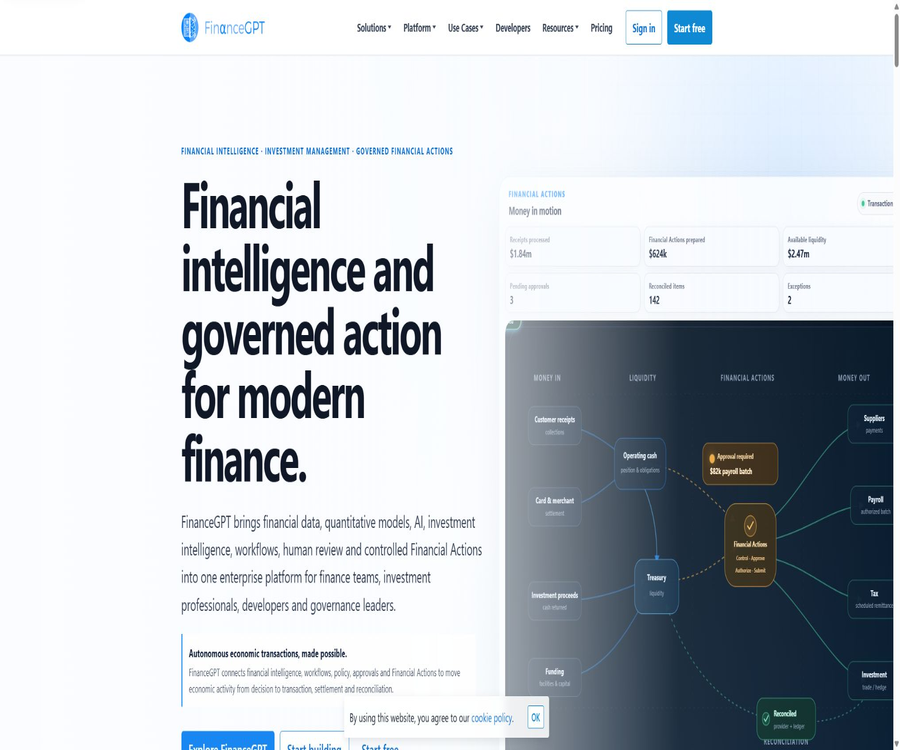
The current product portfolio also includes FinanceGPT Labs, a chat interface, and a set of tools. The main platform is designed for creating financial tasks using natural language, while the full platform encompasses a knowledge base, data centers, an agent space, workflows, APIs, MCP, as well as governed Financial Actions.
It is important to note that purchasing a software package only provides access to the functions associated with that product; it does not automatically grant rights for carrying out transfers, transactions, or any other actual financial operations. Rights related to execution, approval, risk management, reconciliation, and independent operation at an institutional level all require additional governance processes and separate approvals.
| Platform level | Key capabilities | Typical user |
|---|---|---|
| Financial creation | Models, predictions, valuations, budgets, and analysis | Analysts and corporate finance professionals |
| Data and knowledge | Data Hub, Data Studio, and knowledge resources | Teams that need a unified data channel |
| Agents and workflows | Persistent tasks, Agent Spaces, and approval processes | Financial Operations Team |
| Developer Platform | API v2, SDK, MCP, and network callbacks | Software developers and integrators |
| Financial Actions | Preparing or carrying out governed financial transactions | Institutional clients that have undergone separate approval |
Main functions
Natural language financial modeling
Users can describe the business to be modeled, the historical data, the factors that drive operations, and the desired outcomes, so that the platform can organize the structure of the financial model. After it is generated, it is still necessary to check the formulas, time periods, currency, tax considerations, accounting principles, and the assumptions used.
Financial statement analysis
The platform supports standardized financial statements, deterministic ratios, as well as analyses of liquidity and resilience; it presents the calculation results along with explanations. While deterministic calculations aid in verification, errors in input mapping and accounting practices can still affect the conclusions drawn.
Forecasting and scenario analysis
FinanceGPT can generate forward-looking forecasts based on revenue, costs, cash flow, and operational factors, and compare scenarios under different assumptions. When used properly, it is necessary to define baseline, optimistic, and conservative conditions, rather than sticking only to the most favorable outcomes.
Enterprise valuation
The platform offers cash flow discounting, sensitivity analysis, and related valuation tasks, all based on clear assumptions. The discount rate, final value, growth rate, and comparable data have a significant impact on the outcomes, and they must be reviewed by professionals.
Budgeting and FP&A
The finance team can convert business plans into budgets, perform variance analysis, and generate management reports. Features such as shared workspaces, approval processes, and audit export capabilities vary depending on the package offered, and not all free or individual accounts have these functions.
Decision output in multiple formats
The official website states that spreadsheets, PDF files, and presentations can share the same model channel, which helps to reduce the risk of discrepancies between different files. It depends on the actual permissions of the account to determine whether all formats, templates, and export limits are included in the output.
Knowledge, Data, and Agent Spaces
The Professional and higher-tier plans include Knowledge, Data Hub, Data Studio, and Agent Spaces, which are used for organizing materials, data, and persistent workflows. Before using them, teams need to define data owners, update frequencies, and agent permissions.
Governed Financial Actions
The platform can prepare governed financial transactions, and it can be expanded to support real-time transactions and reconciliation as part of more complex institutional solutions. Any actual execution is separated from ordinary subscriptions, and it requires strategies, risk management, approval processes, authorization mechanisms, and institutional controls.
Financial tasks and outputs
| Task | Results that can be generated or managed | Key points of review |
|---|---|---|
| Financial modeling | Structured models and driving factors | Formulas, periods, and assumptions |
| Operational forecasting | Revenue, cost, cash, and operational forecasts | Baseline and prediction error |
| Enterprise valuation | Discounted cash flows, scenarios, and sensitivity | Discount rate, future value, and data sources |
| Report analysis | Ratios, liquidity, resilience, and interpretation | Accounting standards and mappings |
| Budget management | Budgets, variances, and management materials | Responsibility centers and versions |
| Board of Directors Report | Spreadsheets, PDFs, and presentation materials | Digital consistency and disclosure |
| Financial operations | Pending approval actions, records, and reconciliations | Permissions, risks, and execution authorization |
Working principle
- Clarify the financial tasks to be completed, the decision-makers, the time period, the currency, and the delivery format.
- Import or connect historical reports, business data, and authorized evidence materials.
- Distinguish between observed data, external evidence, management assumptions, and model parameters.
- Describe the model, predictions, estimates, or analysis objectives in natural language.
- The platform builds computational structures and generates explanations, scenarios, and sensitivity results.
- Financial staff examine formulas, data lineage, outliers, and key assumptions.
- Output the same model in the form of tables, reports, or presentation materials, while retaining the audit records.
- For financial transactions, separate procedures are required for strategy verification, manual approval, authorization, and reconciliation.
Usage tutorial
Create a cash flow forecast
- Prepare historical data that includes at least income, costs, accounts receivable, accounts payable, and cash balance.
- Standardize the currency, period, and accounting principles, and flag missing or one-time items.
- Define the driving factors such as revenue growth, gross margin, cash collection period, payment period, and capital expenditure.
- The platform is required to generate baseline, optimistic, and conservative scenarios separately.
- Check the formulas for each period, the cash reconciliations, and the ending balances.
- Backtest the model using actual data, and record the prediction errors and any adjustments to the assumptions.
- It can be used for budgeting, financing, or operational decisions only after approval by the responsible person.
Access via API
- Create a sandbox application with the minimum required permissions in the developer console.
- Store the sandbox credentials in a key management tool, without including them in the source code.
- Confirm the operations, paths, request structure, and required scope from the API reference.
- Use sandbox deterministic test cases to verify client processing and error handling.
- Verify the fingerprint of the SDK package and its validation status against the current OpenAPI contract.
- Check for delays, failures, and permission denials on the developer’s observability page.
- Apply for production permissions separately, without considering the application identity as a model or transaction authorization.
Deploy the MCP tool
- Create an AI agent application and determine the financial tools it actually needs to call.
- Grant the minimum scope to MCP and the underlying tools respectively.
- Bind the application to a governed Agent Profile.
- First, read the list of tools to verify that the available operations match the expected permissions.
- Different approval thresholds are set for reading, modeling, and financial operations.
- In the production environment, record tool calls, evidence, results, and human decisions.
Which users are it suitable for
- Personal financial analyst: Building models, making predictions, conducting valuations, and preparing reports for review.
- Corporate FP&A team: collaborative budgeting, variance analysis, and business scenario planning.
- Financial Officer: Integrates data, models, and board materials.
- Investment Research Team: Manages companies, portfolios, risks, and research workflows.
- Financial software developers: Through API, SDK, MCP, and network callback capabilities.
- Regulatory authorities: Assess financial operations under contract, identity, policy, and audit controls.
- Consultants and accounting teams: They prepare models for clients, but professional review and approval are still required.
Typical use cases
- Prepare forecasts for revenue, costs, and cash flow over three years based on historical financial statements.
- Prepare discounted cash flow valuations and sensitivity analyses for financing or M&A purposes.
- Perform variance analysis on budget and actual data to generate management notes.
- Convert the same model into spreadsheets, reports, and presentation materials.
- Synchronize data via accounting or banking connectors and retain channel information.
- Integrate the model’s capabilities into internal financial systems or agent workflows.
- Prepare or carry out governed financial transactions and reconciliations under separate authorization.
Product advantages
- Separate the evidence, hypotheses, deterministic calculations, and AI narratives to facilitate review.
- It covers the entire financial process, including modeling, analysis, forecasting, valuation, budgeting, and reporting.
- It offers a hierarchical range of products, from a free individual version to solutions for institutional financial operations.
- API v2 uses explicit scoping; operations are denied when permissions are lacking, rather than undergoing silent downgrade.
- The sandbox is separated from the production credentials, which reduces the risk of accidental access to production data during testing.
- JavaScript, Python, and PHP client packages as well as an MCP interface are provided.
- It emphasizes the separation of financial execution permissions from ordinary business access, making it suitable for scenarios with high governance requirements.
Usage restrictions and precautions
- Financial content generated by AI may be inaccurate, incomplete, or unsuitable for specific decision-making.
- Incorrect data import, account mapping, or assumptions can directly affect the models and reports.
- Higher-tier packages are more expensive, and some of their features require implementation, evaluation, or separate contracts.
- Buying Team, Business, or Enterprise does not automatically grant actual financial execution rights.
- Some connectors are indicated as being configuration-dependent; the technical pages do not equate to ready-made commercial partnerships.
- The API scope, production access, market data permissions, and trading rights need to be confirmed separately.
- The official terms of service, privacy policy, and compliance policy still indicate the year 2023, which is clearly earlier than the current product and pricing structure for 2026.
- The old terms still describe generative functions as being free of charge, with paid customization options offered, which does not fully correspond to the current range of public packages available.
- The privacy policy does not cover in sufficient detail all the data related to the current APIs, MCPs, agents, auditing processes, and financial operations.
- Real investment, credit, tax, regulatory, and trading decisions must be approved by qualified personnel.
- Users need to be aware of the financial regulation, data protection, and cross-border data transfer requirements in their country.
Prices and packages
The official prices listed below were verified on August 22, 2026, and are expressed in US dollars. The annual pricing corresponds to the cost of 10 months of service, but specific taxes, implementation fees, excess usage charges, and permissions related to financial data still need to be confirmed during the settlement process or in the contract.
| Package | Monthly payment | Annual payment | Members | Monthly AI Credits | Key capabilities |
|---|---|---|---|---|---|
| Explore | Free | Free | 1 person | 25 | Explore workspaces, Copilot, and visibility into financial operations, without execution rights. |
| Professional | 59 dollars | 590 dollars | 1 person | 500 | Financial intelligence, quantitative analysis, knowledge, data, and the agent space |
| Team | 499 dollars | 4990 dollars | 5 people | 4000 | Shared collaboration, approval processes, API v2, MCP, and production network callbacks |
| Business | 999 dollars | $ | 15 people | 12000 | Higher limits, policy control, audit export, and advanced integration |
| Enterprise | Starting from $5,000 | Starting from $60,000 | Contractual agreement | 50000 | SSO, SCIM, corporate governance, custom APIs, and support |
| Financial Operations | Starting from $10,000 | Starting from $120,000 | Contractual agreement | 100000 | Real-time financial transactions, reconciliation, implementation, and institutional controls |
| Restricted Autonomous Operations | Monthly payment is not available. | Starting at $250,000 | Application-based system | Contractual agreement | Independent operation by restricted entities, with additional fees for evaluation and implementation. |
Explore, Professional, Team, and Business are the more common levels of access to software. Enterprise and higher tiers require institutional contracts; Restricted Autonomous Operations demand screening, certification, authorization, and platform approval. The minimum annual price does not mean that the software is available for use immediately upon purchase.
Platforms, connectors, and outputs
| Category | Support status | Explanation |
|---|---|---|
| Web platform | Support | Used for modeling, analysis, data, agents, and workflows |
| Spreadsheet output | Support | Channels for sharing models with reports and presentations |
| PDF output | Support | Used for reviewable reports |
| Presentation output | Support | Used for management and decision-making purposes |
| Xero | Supported based on configuration | OAuth, report generation, and bank transaction synchronization |
| QuickBooks Online | Supported based on configuration | Reports, change synchronization, and signature network callbacks |
| Plaid | Supported based on configuration | Transaction synchronization, balance, and item status |
| Native desktop and mobile apps | Not confirmed | The core products are primarily web pages and APIs. |
API, SDK, and MCP
FinanceGPT offers a workspace-level API v2 that supports Bearer API Keys or OAuth authentication credentials. For each operation, it is necessary to specify the scope of the product; the sandbox environment uses predefined examples and does not access data from production workspaces.
API coverage
- Company financial statements, ratios, analysis, valuation, and scenarios.
- Information on accounting and banking data connectors as well as synchronization channels.
- Investment clients, portfolio performance, plans, risk, and governance workflows.
- Financial data, planning, investment intelligence, and quantitative models.
- Agents, workflows, evidence exchange, and governed financial operations.
- Network callbacks, developer observability, version management, and authentication processes.
Official SDK
| SDK | Version | Minimum operating environment | Packet integrity | Contract proof |
|---|---|---|---|---|
| JavaScript | 0.1.0 | Node.js 18+ | Verified | Not proven |
| Python | 0.1.0 | Python 3.9+ | Verified | Not proven |
| PHP | 0.1.0 | PHP 8.1+ | Verified | Not proven |
| Command-line request | According to the API contract | Environment that supports the relevant tools | Verified by the user | Bind the current OpenAPI fingerprint |
The officials state that these client packages represent the boundary at which source code is generated; they do not include any server-side execution capabilities or embedded credentials. Verification of the package’s integrity does not guarantee that it is fully consistent with the current interface specifications, and it is necessary to check the fingerprint and confirm its status before integrating it into production use.
MCP capabilities
The platform provides an MCP interface; developers need to create agent applications, grant MCP and the underlying tools the necessary permissions, and then associate them with Agent Profiles. Just because MCP can access certain tools does not mean it has the right to read all data or carry out financial operations.
GitHub and open source
FinanceGPT has made the OpenAPI specifications and downloadable SDKs available, but its complete platform has not been released under an open-source license; the product, server side, model orchestration tools, and financial operating system are considered commercial and closed-source.
There are multiple repositories with the same name, FinanceGPT, created by individuals; the content of these repositories has no relation to the official platform. Third-party projects, sample clients, or downloadable SDKs should not be mistaken for the source code of the FinanceGPT platform.
Privacy, Compliance, and Governance
The privacy policy states that names, email addresses, phone numbers, billing information, device details, browser information, IP addresses, and usage patterns may be collected, and shared with payment, quality assurance, and data storage service providers. The data may also be processed in the UK, the United States, South Africa, and Qatar.
- The platform uses information for providing services, personalization, marketing, analysis, as well as for security and anti-fraud purposes.
- Information may be disclosed further when required by law, in the context of merger and acquisition transactions, or with the user’s consent.
- Officials state that technical and organizational measures have been taken, but they cannot guarantee absolute security in transmission and storage.
- The current policy does not specify the exact retention period for various financial data.
- The policy does not specify the rules for deleting workspaces, removing backups, terminating model training, and isolating enterprise data.
- When professional quality assurance is required, the relevant reports may be submitted to certified personnel for review.
- Institutional clients should specify in the contract the data location, subcontractors, encryption, auditing, deletion, and incident notification procedures.
- Financial operations should employ the principle of minimum permissions, separation of duties, dual approval, setting of limits, and reconciliation.
Basic information
| Project | Content |
|---|---|
| Tool name | FinanceGPT |
| Operating entity | The compliance policy is listed for IPOXCap AI Inc. |
| Tool type | Financial intelligence, financial modeling, and governed workflow platforms |
| Primary users | Individual analysts, corporate finance teams, investment institutions, and developers |
| Price pattern | Free version, monthly payment, annual payment, and institutional contracts |
| Minimum age | 18 years old |
| Chinese support | The official website does not explicitly guarantee a fully Chinese interface. |
| Main platforms | Web interface, API, SDK, and MCP |
| API | API v2 is available. |
| Official SDK | JavaScript, Python, and PHP |
| MCP | Provide |
| Is it open source? | The platform is not open source; the availability of public contracts and clients does not mean that the platform is open source. |
| Governing laws | The old provisions followed British law. |
| Professional responsibility | Financial reporting requires professional judgment and proper governance. |
Recommendation score
Recommendation score: 4.3 / 5. FinanceGPT offers a broader range of functions, better developer capabilities, and more robust permission management compared to ordinary financial chat tools; it is particularly suitable for professional teams that need model review capabilities, shared workflows, and interface integration.
The main risks include high costs associated with institutional packages, the need for separate approval for certain capabilities, and the fact that the legal and privacy provisions in place for 2023 do not fully correspond to the product framework of 2026. Before introducing actual financial data or enabling financial operations, companies must complete reviews related to contracts, privacy, security, and regulatory aspects.
Frequently Asked Questions
What can FinanceGPT do?
It can create financial models, make predictions, conduct valuations, prepare budgets, analyze reports, generate scenario and decision-making materials; it also provides data, agents, workflows, and developer interfaces.
Is FinanceGPT free?
The Explore plan is free and includes 1 member along with 25 AI Credits per month. More comprehensive financial intelligence features and persistent workflows are available starting with the Professional plan.
What is the difference between Professional and Team?
Professional is designed for 1 user and includes 500 Credits per month. Team accommodates 5 members, provides 4000 Credits, and adds features such as shared collaboration, approval processes, API v2, MCP, and production network callbacks.
Can automatic trading be carried out after purchasing Business?
No. Business visits are separate from financial execution powers; actual operations require strategies, risk assessment, approval processes, reconciliation, and separate authorization.
Is there a discount for an annual payment?
The annual pricing for Professional, Team, and Business plans is equivalent to paying 10 months’ worth of monthly fees. Enterprise plans and higher require consideration of the initial fee and contract terms, so it’s not possible to simply compare them based on monthly pricing alone.
Does FinanceGPT provide an API?
It provides a workspace-level API v2 that uses API keys or OAuth credentials, and enables control over data, models, and operational capabilities through explicit scopes.
What are the official SDKs?
Currently, client packages for JavaScript, Python, and PHP 0.1.0 are available; request initialization code can also be generated based on the OpenAPI specification.
Is MCP supported?
It is supported, but it is necessary to configure both MCP and the permissions for the underlying tools, along with setting up the configurations for the governed agents. The use of MCP does not bypass the approval processes for financial transactions.
Is FinanceGPT open source?
The platform is not open source. The availability of public API specifications, SDK downloads, and repositories with the same name on the Internet do not constitute proof that the entire product is licensed under an open source license.
Can the data connector be used directly?
Xero, QuickBooks Online, and Plaid are listed as being dependent on configuration. Their availability depends on the plan, region, platform settings, authorization status, and the most recent real-time verification.
Are the generated financial results reliable?
No direct guarantee can be provided. The platform emphasizes the ability to review calculations and processes, but errors can still occur in the input data, mappings, assumptions, and models; therefore, important results must be verified by qualified personnel.
Does the privacy policy cover all current functions?
The existing policies still reference the year 2023, whereas the platform has now been expanded to include API, MCP, agents, and financial services. Institutional clients should review the latest contracts and security documents to obtain updated details regarding data processing.
Summary
FinanceGPT is suitable for professional users who need to combine natural language, financial data, and auditable calculations. It offers features ranging from free exploration to team APIs and institutional financial operations, providing a broader set of capabilities than standard chat tools.
When actually deploying something, it is necessary to start with analysis and sandbox environments, and only then gradually grant access to data, models, and workflows. Any operation that involves real funds, transactions, credit, or regulatory obligations must be subject to separate authorization, professional review, and thorough auditing.
Tools similar to FinanceGPT



 Guigong Network Security Registration No. 45132202000164