






Entendre
Entendre: an intelligent tool focused on improving AI efficiency.
Tags:AI improves efficiencyA one-sentence summary
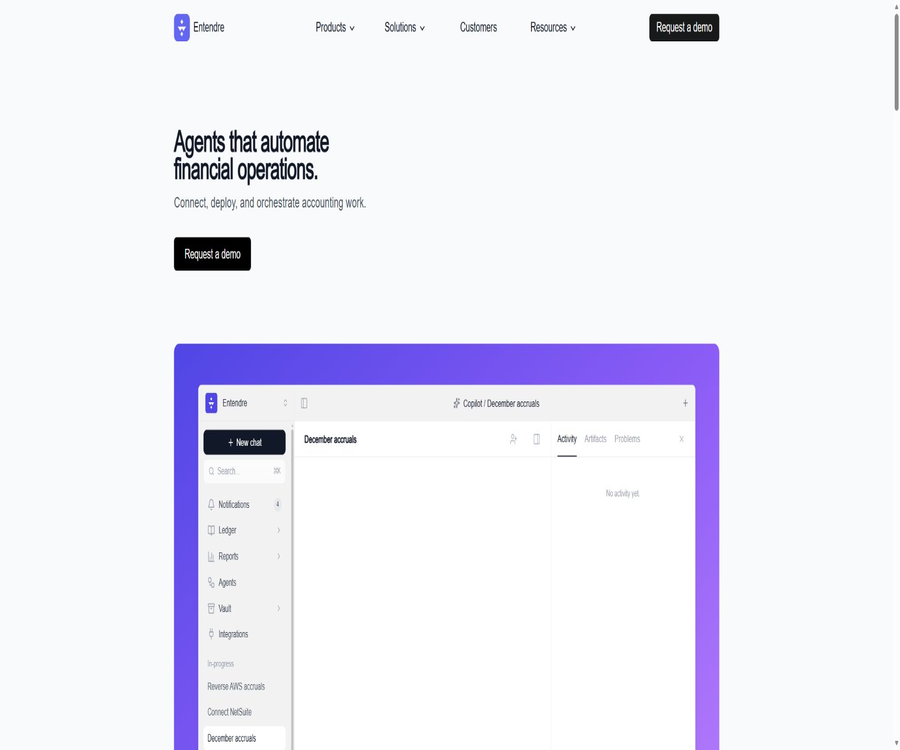
Entendre is an AI-powered operation platform designed for stablecoins, digital assets, and complex corporate finance; it enables financial agents to connect general ledgers, banks, exchanges, wallets, and business systems in order to carry out transaction classification, reconciliation, journal entries, anomaly handling, reporting, and month-end closing.
Tool Introduction
Blockchain can only record the transfer of assets from one address to another; it does not automatically provide information regarding customers, invoices, business purposes, legal entities, accounting accounts, or approval documents. Entendre’s role is to link the transactions on the blockchain with the contextual details of the actual business activities, thereby creating auditable accounting records.
This platform is designed for companies with high transaction volumes, multiple entities, and various currencies; it is particularly suitable for payments using stablecoins, as well as for fintech and digital asset management. On June 22, 2026, Entendre was acquired by MoonPay, with its products and team integrated into MoonPay. Existing customers could continue to use the service, and further integration with MoonPay will be implemented in the future.
Product status after acquisition
| Project | Current status | Information that users need to know |
|---|---|---|
| Company affiliation | It has been acquired by MoonPay. | The transaction was announced on June 22, 2026; the founder joined MoonPay to oversee the use of AI in the application. |
| Current services | Continue running | Officials state that existing customers will not see their services disrupted by the acquisition. |
| Future directions | Deepen MoonPay integration | Focusing on the integration of stablecoin payments, transactions, capital, and financial operations |
| Official website domain name | The independent brand page for Entendre is still accessible. | The old domain name has been redirected to the current brand’s domain name. |
| Price | Unpublished standard package | New customers need to schedule a demonstration or contact sales to obtain a proposal. |
Core workflow
Entendre organizes the multiple financial steps that take place from when a transaction occurs to its recording in the general ledger into reusable agent workflows. The system handles routine tasks, while financial staff are responsible for reviewing rules, exceptions, risks, and the final reports.
- Connects the general ledger, banks, cards, payment platforms, exchanges, wallets, and on-chain addresses used by enterprises.
- Synchronize transactions, balances, receipts, fees, transfers, invoices, and business context, and aggregate them by entity and account.
- AI agents identify the type of transaction, the counterparty, and the purpose of the transaction, and provide suggestions regarding accounts, entities, and accounting treatments.
- The system matches on-chain and off-chain records, handling wallet transfers, bridging, Gas fees, and multi-step fund flows.
- Journal entries are generated in accordance with the approved rules, while items that are abnormal or have low confidence levels are sent to a manual processing queue.
- The finance staff reviews the evidence, adjusts the mappings and approval results, and then synchronizes them to the general ledger and reports.
- At the end of the month, balance verification, discrepancy checks, and closing tasks are carried out, with the transaction records that can be used for auditing being retained.
Main functions
Unified transaction data
The platform integrates the trading of fiat currencies and digital assets within a single financial overview, thereby reducing the need to switch back and forth between block explorers, exchange backends, banking portals, CSV files, and spreadsheets. Multiple accounts, various currencies, and different legal entities can all be managed within a unified workflow.
Classification of transactions on the chain
AI agents can identify transactions related to stablecoin payments and receipts, wallet withdrawals, trading on exchanges, Gas fees, cross-chain bridges, token transfers, and other on-chain activities; they then apply business rules to classify these transactions. Transactions that are complex or lack context still require confirmation by financial staff.
Automatic reconciliation
The system compares the records in banks, wallets, exchanges, payment platforms, and the general ledger to identify any discrepancies in amounts, times, assets, or counterparties/entities. Automatic matching is suitable for handling high-frequency standard transactions, while abnormal cases are sent for manual review.
Journal entries
Transactions that have been classified and reconciled can be converted into journal entries, which are then synchronized with the company’s existing general ledger. The agents are responsible for the repetitive tasks, while the finance team retains responsibility for approval, adjustments, and closing processes.
Exception handling
Transactions that cannot be determined automatically are routed to an exceptional processing procedure, during which the team can provide additional information such as invoices, details of the counterparty, the entity involved, and a description of the business transaction. The outcomes of this processing can be used as reusable rules for future tasks, but important decisions still require review by accountants.
Funding and financial operations
The platform covers balance monitoring, context of fund transfers, stablecoin operations, and multi-account management, enabling teams to understand the entire path of funds between on-chain and off-chain systems. It is not a custodial wallet or a tool for executing transactions; specific funding permissions must be determined based on the integration settings.
Financial reports and closing
Entendre utilizes the verified transactions, entries, and abnormal records for reporting and period closing, enabling the team to conduct account checks more frequently. The quality of the final reports still depends on account mapping, accounting policies, exchange rates, and manual approval.
Reusable AI agents
The finance team can organize repetitive tasks into automated workflows, allowing for the reuse of approved automation solutions within the team. The platform evaluates different models based on accounting tasks, so users do not need to manage model tokens manually or select providers one by one.
MCP extension
The platform allows financial agents to be connected to custom tools and data sources via MCP servers, and it has also become part of the Anthropic connector ecosystem. MCP is used to expand the ways in which access can be obtained; it does not mean that the product code or model weights are made available under an open-source license.
Types of transactions that can be processed
| Transactions or data | Typical context | Main processing |
|---|---|---|
| Stablecoin payments and receipts | Customers, suppliers, invoices, payment accounts | Identify revenues or expenses, match relevant business documents and record them in the accounts. |
| Wallet payment scan | Collection address, target wallet, legal entity | Identify internal transfers and prevent double-counting of revenues or expenses. |
| Trading on exchanges | Transactions, fees, settlement assets, and accounts | Splitting transactions, fees, and asset changes |
| Gas fee | Networks, transaction hashes, and business activities | Aggregate network costs and apply accounting rules |
| Cross-chain bridge | Source chain, target chain, bridging protocol, and time | Link multiple records on different chains and identify asset migrations. |
| Cards and bank transactions | Businesses, receipts, employees, or entities | Cost classification, reconciliation, and voucher association |
| Platform revenue and fees | Revenue systems such as Stripe and business orders | Links receipt, refund, fees, and general ledger. |
| Token movement | Issuance, ownership, holding, or operational use | Mark according to corporate policies and submit for review |
System integration
| Category | The currently available representative system | Uses |
|---|---|---|
| General ledger and ERP | NetSuite, QuickBooks, Xero, DualEntry, Campfire | Synchronize accounts, accounts payable, journal entries, and closing results |
| Expenses and revenues | Ramp, Stripe | Links corporate expenses, receipts, refunds, and fees |
| Stablecoin cards and banks | Rain, Meow, Slash | Activities related to obtaining fiat currency and stablecoin funds |
| Digital asset infrastructure | Wallets, exchanges, and on-chain addresses | Synchronize balances, transfers, transactions, and network fees |
| Collaboration tools | Slack, Gmail | Handle notifications, credentials, communication, and collaborative resolution of exceptions |
| Custom connection | MCP server | Extend the proxy to the company’s own tools and data sources. |
The scope of integration, write permissions, synchronization frequency, and the types of accounts supported may vary depending on the customer’s requirements. Before making a purchase, it is necessary to use actual samples to test two-way synchronization, historical data retrieval, field mapping, and retry mechanisms in case of failures.
Usage tutorial
Scope of implementation preparation
- List all legal entities, currencies, bank accounts, cards, payment platforms, exchanges, wallets, and on-chain addresses.
- Identify the processes that are to be automated in this period, such as receiving stablecoin payments, covering Gas fees, performing internal transfers, or conducting month-end reconciliations.
- Organize the existing chart of accounts, entity mappings, accounting policies, approval rules, and historical exception cases.
- Identify which systems are read-only and which allow write entries, and establish accounts with the minimum required permissions.
- Select an entity and a limited time period as a pilot to avoid synchronizing the entire history at once.
Connect to data source
- With the assistance of implementation staff, connect the general ledger to the main funding channels, first verifying the mapping between accounts and entities.
- Import a small segment of historical data that has been manually closed, using it to verify the completeness of transactions and the opening balances.
- Assign clear names to wallets, exchanges, banks, and business platforms to prevent multiple connections from the same account.
- Check the time zone, currency, token precision, exchange rate source, and transaction date rules.
- After running the initial synchronization, compare the number of records, amounts, and balances in the source system; resolve any discrepancies before enabling automation.
Configure proxies and approvals
- Start by establishing classification rules for transaction types that are frequent, regularly stable, and carry low risk.
- Set validation criteria for accounts, entities, taxes, and counterparties, and define a threshold for low confidence levels.
- Large amounts of money, related parties, unknown assets, and complex token transactions must be submitted for manual approval.
- Check the debit and credit directions, amounts, exchange rates, and evidence links of the proposed journal entry before approving its entry into the general ledger.
- Record the reasons for the corrections and regularly review the occurrences of rule violations, in order to prevent errors from continuing to accumulate automatically.
Complete the month-end closing.
- Freeze the key mappings during the settlement period to ensure that all accounts have been synchronized by the target deadline.
- Check the balances in wallets, exchanges, banks, and the general ledger, and handle unmatched transactions as well as items spanning different periods.
- Examine special items such as gas fees, bridging, internal transfers, fees, refunds, and asset valuation.
- Complete the exception queue and approval processes, then synchronize the final entries to the general ledger.
- Generate period reports and audit records, and save rule versions, reasons for adjustments, and responsible persons.
Which users are it suitable for
- Stablecoin payment companies:It connects payment collection, wallets, banks, and the general ledger to handle large-scale financial transactions.
- Fintech companies:Automatically perform reconciliation and journaling in environments with multiple products, currencies, and entities.
- Web3 and Blockchain Team:Convert wallets, exchanges, Gas fees, and cross-chain records into auditable accounts.
- Corporate Finance Officer:Reduce CSV concatenation and manual sorting, and focus efforts on policies, exceptions, and approvals.
- Accounting and Audit Support Team:Establish a traceable link between transactions and vouchers, classifications, journal entries, and reports.
- Multi-entity group:Provide unified management of multiple legal entities, accounts, and currencies, while preserving the rules specific to each entity.
Typical use cases
- Match the customer’s stablecoin payments with orders, invoices, and revenue accounts, and then generate journal entries.
- Identify transfers between the same enterprise wallets as well as cross-chain bridges, in order to prevent internal transfers from being counted repeatedly as revenue.
- Merge records from banks, cards, exchanges, wallets, and payment platforms to carry out cross-system reconciliation.
- It automatically classifies common gas costs, fees, and supplier expenses, while sending unknown items to the accountant for review.
- Split transactions for multi-entity companies according to their legal entities, and synchronize the journal entries to the corresponding general ledger.
- Replace the end-of-month centralized processing with continuous reconciliation to identify missing documents and balance discrepancies in advance.
- Use MCP to connect an enterprise’s own data sources or workflows to the accounting agent.
Product advantages
- It enables the simultaneous handling of fiat currency and digital assets, without requiring companies to replace their entire ERP systems.
- Link blockchain records to off-chain contexts such as invoices, counterparties, entities, and business purposes.
- It covers the entire financial operation process, from classification and reconciliation to journal entries, exceptions, and closing.
- It supports multiple accounts, various currencies, and different entity structures, making it suitable for enterprise environments with high transaction volumes.
- It can be integrated with mainstream general ledger, expense, revenue, collaboration, and stablecoin infrastructure.
- Financial control is maintained through manual approval and exception queues, rather than leaving everything to the models to decide.
- With the addition of MoonPay, there is further room for integration between stablecoin payments and back-end financial operations.
Usage restrictions and risks
- AI-based classification and accounting suggestions may be incorrect, especially in cases involving complex tokens, tax issues, related parties, and transactions across different entities.
- System automation cannot replace accounting policies, statutory reports, tax advice, and approvals from responsible persons.
- Connecting the general ledger to the funds system involves highly sensitive financial data, so read and write permissions should be strictly restricted.
- The data integrity, timestamps, and asset precision may vary across different chains, exchanges, and wallets.
- Poor quality of historical data, duplicate accounts, or incorrect entity mapping can lead to distorted automated results.
- The public page does not provide information on standard prices, a free version, or self-service trials; the procurement process is more suitable for corporate teams.
- After the acquisition, the brand, the contracting party, the product portfolio, and the scope of integration may change; existing customers should also review the renewal terms.
- Records on the chain are usually irreversible; before writing personal information or sensitive business data onto the chain, it is necessary to conduct a separate assessment.
Security and permission recommendations
| Controls | Recommended practices | Verification is required. |
|---|---|---|
| Account permissions | First, use read-only permissions; write access to the general ledger should be granted separately. | Minimum permissions, roles, and regular reviews |
| Approval | Significant amounts and complex transactions require manual approval. | Thresholds, multi-person approval, and separation of duties |
| Data range | Only the entities and time periods required for implementation are connected. | History review, deletion, and retention policies |
| Audit records | Save rule versions, suggestions, modifications, and approvers | Log export, immutability, and retention period |
| Credential | Set access restrictions for invoices, emails, and attachments. | Encryption, third-party processors, and cross-border locations |
| Integrated key | Use an enterprise key vault and rotate keys regularly. | Cancellation, abnormal alarms, and employee offboarding recovery |
| Business continuity | Retain the source system and the accounting records that can be exported. | Fault recovery, service shutdown, and data migration |
Price and procurement methods
As of August 22, 2026, no publicly available standard plans, free versions, trial periods, or user-based pricing for Entendre have been identified. The platform offers corporate demonstrations and customized quotes; the costs may vary depending on the account, entity, volume of transactions, level of integration, as well as the scope of implementation and support required.
| Plan | Public price | Billing method | Possible ranges included | Suitable for users |
|---|---|---|---|---|
| Product demonstration | Not disclosed | Contact the team | Business assessment, platform presentation, and implementation discussions | The finance team is in the process of making a selection. |
| Enterprise platform | Custom quote | Contract system | Data connections, AI agents, reconciliation, journal entries, reports, and support | Stablecoin, fintech, and digital asset companies |
| Implementation and integration | Not disclosed | By project or contract | System connections, mappings, historical data, and rule configurations | Multi-system and multi-entity organizations |
| Expansion and MCP | Not disclosed | Confirm per the plan | Custom tools, data sources, and proxy extensions | Companies with in-house development capabilities |
What to ask before making a purchase
- The pricing is calculated based on transaction volume, account, legal entity, user, connector, or automated task.
- Are there fees charged for implementation, migration of historical data, custom connections, support, and renewal?
- Which connectors support bidirectional writing, and which can only be used for reading or require additional contracts.
- Data hosting location, retention period, model provider, training purposes, and deletion process.
- Service levels, failure recovery, audit logs, data export, and migration arrangements after contract termination.
- Have there been any changes to the contracting parties, data processing agreements, and product roadmap following the acquisition by MoonPay?
Platforms, APIs, and developer capabilities
| Ability | Support status | Explanation |
|---|---|---|
| Web version | Support | Used for financial operations, exception handling, reporting, and management |
| Enterprise connector | Support | Connects ERP, general ledger, banks, payment systems, wallets, exchanges, and collaboration tools |
| MCP | Support | Used to connect financial agents to custom tools and data sources |
| Public API | No complete public documents were found. | The specific interfaces and permissions need to be confirmed by the sales or implementation team. |
| Official SDK | No publicly available versions were found. | Third-party code libraries cannot be considered official SDKs. |
| Mobile apps | No standalone applications were found. | Primarily aimed at corporate web pages and system integration workflows. |
| Local deployment | No public solutions were found. | Requests regarding data residency or privatization require a separate quote. |
Open-source status
The Entendre products, accounting services, and model orchestration tools belong to proprietary commercial services; no official source code, SDKs, or model weights have been made available publicly. Dictionaries, voice recognition systems, or other applications with similar names available on the Internet are not related to this financial platform.
MCP indicates that the platform adheres to a certain tool connectivity protocol; it does not mean that the platform is open-source, nor does it imply that no contracts are required for any integrations. Companies should determine who hosts the MCP server and what financial data can be read from or written to it.
Basic information
| Project | Content |
|---|---|
| Tool name | Entendre |
| Product positioning | AI-based financial operations and digital asset accounting platform |
| Current affiliation | MoonPay was acquired in June 2026. |
| Core process | Data synchronization, classification, reconciliation, journal entries, exceptions, reporting, and closing |
| Main customer types | Stablecoins, fintech, Web3, and multi-entity businesses |
| Price pattern | Corporate demonstrations and customized quotes |
| Is it free? | No public free version or self-service trial was found. |
| Is registration required? | A corporate account and implementation configuration are required. |
| Chinese support | The complete Chinese-language products and support have not been confirmed. |
| APIs and SDKs | Public APIs and SDKs are not confirmed; MCP and enterprise connectors are supported. |
| Is it open source? | No, commercial closed-source products |
Recommendation score
Recommendation score: 4.3 / 5. Entendre is suitable for corporate teams that already use stablecoins, wallets, exchanges, and multiple financial systems, and wish to convert high-frequency trading into auditable accounting records.
It is not suitable for users who only need to keep personal accounts, track a small amount of encrypted assets, or subscribe to a service at a low cost. Customized pricing, the complexity of implementation, data access rights, and the contractual arrangements after acquisition are aspects that need to be carefully evaluated before making a purchase.
Frequently Asked Questions
What is Entendre tool?
It is a platform for AI-driven financial operations and digital asset accounting, which connects blockchain-based systems with those that are not based on blockchain; it automates tasks such as transaction classification, reconciliation, journal entries, detection of anomalies, and settlement.
Is Entendre still operating independently?
The brands and products continue to exist, but the company was acquired by MoonPay in June 2026. Existing customer service remains uninterrupted, and further integration with MoonPay will be implemented in the future.
Is Entendre free?
No public free version, fixed trial quota, or self-service package was found. New customers usually need to schedule a demonstration in order to obtain a customized quote.
Does it only support encrypted assets?
No. The platform integrates the traditional fiat currency system with wallets, exchanges, and on-chain assets within the same financial framework, making it suitable for companies that wish to manage both fiat currencies and digital assets.
Which accounting systems can be connected?
The available integrations include NetSuite, QuickBooks, Xero, DualEntry, and Campfire; it is also possible to connect to Ramp, Stripe, Slack, Gmail, as well as various digital asset infrastructure platforms. The specific capabilities of these connectors depend on the enterprise solution in use.
Will AI directly enter the journal entries into the general ledger?
The platform allows the creation of entries based on categorization and reconciliation, and it can be integrated with the general ledger; however, companies should reserve manual approval for significant, unusual, or low-confidence items. Whether entries are created automatically depends on the permissions and implementation settings.
Is MCP supported?
Supported. MCP allows accounting agents to be extended to enterprise-customized tools and data sources; however, it is necessary to verify authentication, read/write permissions, and audit logs before establishing a connection.
Are public APIs or SDKs available?
As of the time of verification, no fully available API documentation or official SDKs were found. Enterprise integration interfaces need to be confirmed through sales and implementation processes.
Do you know what OpenSource is?
It is not open source. The platform, proxies, and model orchestration services are considered commercial products; MCP compatibility does not change the fact that it remains closed source.
Can it replace accountants?
No. It is suitable for automating repetitive tasks such as classification, matching, and preparation of entries, but accounting policies, tax decisions, significant exceptions, statutory reports, and final approvals still require oversight by qualified personnel.
Will the acquisition affect existing customers?
The authorities state that existing customers’ services will not be interrupted, and they plan to add more integrations in the coming quarters. Customers should still confirm the main terms of the contract, as well as the scope of data processing and services, when renewing it.
Summary
Entendre addresses the gap in context that exists for digital asset companies between transactions and the general ledger; it organizes data from wallets, exchanges, banks, payment platforms, and ERP systems into categories, enables reconciliation, creates accounting entries, identifies anomalies, and facilitates the closing process. Its functionality is particularly suited to stablecoins and businesses with multiple entities, compared to ordinary accounting software for small businesses.
Following its acquisition by MoonPay, the product is set to be further integrated with payment and stablecoin infrastructure. New customers should use real-world transaction trials to verify the functionality of the connectors, the accuracy of accounting records, permission settings, audit logs, and data processing; moreover, the costs associated with implementation and withdrawal should be clearly specified in the custom quotes.
Tools similar to Entendre



 Guigong Network Security Registration No. 45132202000164