






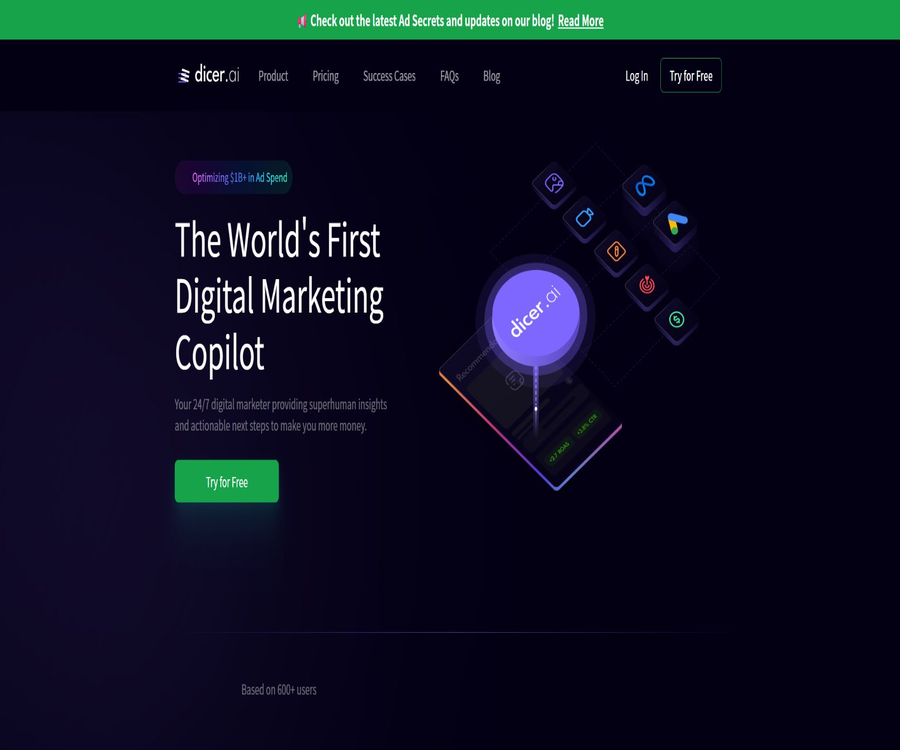
Dicer.ai
Dicer.ai: an intelligent tool focused on improving AI efficiency.
Tags:AI improves efficiencyA one-sentence summary
Dicer.ai is an AI marketing Copilot designed for performance advertising; it can connect to advertising accounts, analyze data related to videos, images, copy texts, target audiences, budgets, and campaigns, and then provide actionable recommendations for optimizing campaigns and creative content.
Tool Introduction
Dicer.ai brings together ad creative analysis, campaign performance data, and media purchase recommendations in one platform, serving primarily advertising agencies, brand growth teams, and those engaged in high-intensity performance marketing. Its purpose is not to act as a general-purpose copywriting tool, but rather to help identify issues and opportunities related to the performance of paid ads.
The official website currently displays the logos of Meta and Google Ads as partners, stating that this platform is used for analyzing large-scale advertising expenditures. Figures such as improved ROAS, reduced CPA, or a tenfold increase in efficiency are part of the marketing goals and customer success stories; they do not mean that all accounts will achieve the same results.
Overview of Core Competencies
| Analysis direction | Main inputs | Identifiable content | Possible output |
|---|---|---|---|
| Video creativity | Advertising videos and performance data | Opening, scenes, objects, subtitles, and audio | Frame-by-frame diagnosis and improvement suggestions |
| Image creativity | Image ads and campaign metrics | Objects, scenes, text, and visual narratives | Composition insights and new directions for images |
| Advertising copy | Short texts, long texts, and emojis | Clarity, engagement, and information presentation | Suggestion for revisions and new text |
| Audience targeting | Custom, similar, and demographic audiences | Region, interests, and detailed performance metrics | Audience Opportunities and Generative Audiences |
| Budget allocation | Goals, audience, placement, and budget | Budget efficiency and allocation issues | Adjusting priorities and action recommendations |
| Advertising campaigns | Meta and Google Ads account data | Performance indicators across creativity and events | Weekly insights and optimization actions |
Main functions
Multimodal ad analysis
Dicer analyzes the combination of visual elements, text, audio, and advertising performance, rather than focusing solely on click-through rates or conversion rates. This helps the team determine whether changes in performance are due to the creative content, the audience, the budget, or the settings of the campaign.
Frame-by-frame video inspection
Video analysis examines the opening elements, scenes, objects, text on the screen, and audio details, which helps to identify issues such as user abandonment in the first few seconds or unclear communication of information. Ultimately, recommendations should still be based on brand guidelines, the landing page, and actual conversion data.
Image creativity analysis
Image analysis focuses on objects, scenes, textual elements, and visual narratives; it can be used to determine why different materials yield different results. AI-based recognition may overlook cultural context, trademark usage, and compliance details, so manual review is necessary before publication.
Copy analysis and generation
The platform is able to assess the clarity and attractiveness of both short and longer ad texts as well as emojis, and to generate new ideas for text content. The team should ensure that the brand’s tone, facts, promotional offers, and prohibited words are all properly checked.
Image generation
The Pro plan includes DALL-E 3 for image generation, which enables teams to create creative concepts quickly. The images produced do not automatically grant brand authorization or approval from advertising platforms; characters, products, and trademarks still need to be verified.
Audience analysis
The platform analyzes custom audiences, similar audiences, demographic characteristics, interests, and geographic targeting, and offers suggestions for generating new audiences. It is advisable to test these audience suggestions with a limited budget first, in order to avoid mistaking correlation for causation.
Budget and placement insights
Dicer takes into account the objectives of the campaign, the target audience, and the budget allocation in order to assess the efficiency of spending; it helps users identify areas where costs are too high, where there is insufficient learning, or where the allocation is unreasonable. Significant changes to the budget should not be implemented automatically without mechanisms for monitoring and reverting to the previous settings.
Insights can be generated weekly.
The Pro package includes weekly action recommendations, which organize the analysis results into ideas, target audiences, or activities that need to be adjusted. Users should record the time, budget, and metrics before and after implementing these recommendations in order to determine whether they are truly effective.
Automation of advertising campaigns
The official website’s FAQ states that the platform can assist with the creation, targeting, launching, and optimization of ads, but the public pages do not provide detailed information regarding the permissions for automated execution and the approval processes. When connecting to a production account for the first time, it is advisable to start with read-only analysis.
Tutorial for connecting an advertising account
Step 1: Organize accounts and goals
- Choose a brand, market, and primary conversion goal to avoid connecting too many accounts at once.
- Record the expenses, conversions, CPA, ROAS, and key events from the past four to eight weeks.
- Remove disabled campaigns, duplicate names, and faulty tracking entries to reduce analytical noise.
- Ensure that the advertising platform’s pixels, conversion interfaces, and attribution windows are in line with the business criteria.
- Identify which members have read-only access and which ones can create ideas or modify activities.
Step 2: Authorize the connection
- Create a Dicer workspace and log in using the authorized credentials for the advertising account.
- Connect to Meta Ads or Google Ads, and select only the account that you want to analyze.
- Check the read, create, manage, and publish permissions on the authorization page.
- For tasks that can be completed in read-only mode, do not grant permission for modification or publication in advance.
- Wait for the historical activities and creative content to be synchronized, then check whether the expenses match those shown in the platform’s backend.
Step 3: Establish an analysis baseline
- First, check the existing best and worst ideas to ensure that the materials and metrics identified by the system are correct.
- Break down the data by country, audience, placement, device, and time, to avoid focusing only on the overall average.
- Let Dicer analyze videos, images, copy, targeting, and budget separately.
- Categorize the suggestions into three types: low-risk modifications, those that require experimental verification, and those that should not be adopted for now.
- Establish a control group, a budget limit, and stop conditions for each adjustment.
- Observe for at least one reasonable attribution period before evaluating the effectiveness of the recommendations.
Creative optimization workflow
- Choose campaigns with sufficient spending and stable conversion tracking, avoiding drawing conclusions based on very small sample sizes.
- Upload or synchronize videos, images, and text separately to enable the system to perform multi-modal analysis.
- Document the best-performing hooks, scenes, promises, audience segments, and calls to action.
- Select one variable from the AI’s suggestions to create a new version; do not change all elements at once.
- New materials and copy are reviewed by the heads of branding, legal affairs, and advertising policies.
- Run A/B tests with a small budget, while keeping other key settings as consistent as possible.
- The results are determined based on conversion rates rather than just the number of clicks, and the successful patterns are then archived.
Main analysis dimensions
| Dimension | Signals that require attention | Common misconceptions | Manual review |
|---|---|---|---|
| Video opening | Retention in the first three seconds, as well as changes in information and visuals | Only imitate highly popular hooks | The brand’s promises are in line with its actual offerings. |
| Image composition | Subject, text, contrast, and information hierarchy | Consider aesthetic preferences as the reason for the transformation. | Readability and trademark guidelines |
| Copywriting | Key benefits, evidence, tone, and call to action | Creating false effects of scarcity | Facts, prices, and policies |
| Audience | Scale, overlap, geography, and conversion quality | Reducing the scope too early leads to insufficient learning. | Discrimination and sensitive attributes |
| Budget | Marginal return, consumption, and learning phases | A significant adjustment at once | Ceilings, cash flow, and rollback |
| Attribution | Differences in windows, events, and channels | Treat platform attribution as a net increase. | Business backend and experimental data |
Which users are it suitable for
- Performance marketing agencies: Manage the advertising creatives and campaigns for multiple brands at the same time.
- E-commerce brands: Quickly compare product videos, images, descriptions, and audience performance.
- Paid Growth Team: Selects the most important issues to address from a large number of activities.
- Creative strategist: Convert performance data into hypotheses for the next round of content.
- Media buyers: Examine the relationship between the budget, targeting, placement, and creative elements.
- Marketing Manager: Receives a weekly action list and monitors the results of experiments.
- Companies with stable advertising spending: use unified analysis to reduce manual aggregation.
- Large clients that require expert support: They can obtain implementation and dedicated support through Enterprise.
Typical use cases
- Analyze multiple videos of the same product to identify high-performing openings and scenes.
- Compare the subjects, text density, and visual narrative as well as the differences in transformation between the images.
- Check whether the ad copy clearly communicates the key benefits, evidence, and call to action.
- Identify opportunities for reducing waste and expanding reach among custom, similar, and interest-based audiences.
- Replan the budget experiment based on the activity objectives and the performance of the advertising slots.
- New image and copy concepts are created, which are then reviewed and tested by the team.
- Each week, the most valuable optimization actions are identified and assigned to the members in charge of creativity and marketing.
- Agents use a unified approach to review the advertising accounts of different clients.
Product advantages
- It focuses on advertising creativity and performance marketing, and its scenario analysis is more precise than that of general AI assistants.
- It covers videos, images, text, target audience, and budget all at once, reducing the need to switch between different tools.
- The video allows for frame-by-frame inspection, enabling specific recommendations to be provided in terms of both visual and audio aspects.
- By connecting Meta and Google Ads, creative decisions can be based on actual campaign data.
- It provides image and copy generation, enabling a quick transition from insights to a new round of testing.
- The weekly action suggestions are suitable for establishing a rhythm of continuous improvement.
- The Pro package includes unlimited members, facilitating creativity, campaign execution, and collaboration with clients.
- Enterprise provides space for setup, technical configuration, and dedicated success support.
Usage restrictions and precautions
- The Pro price is higher for small advertisers, and billing is based on a monthly maximum advertising expenditure limit.
- Monthly advertising expenses of over $25,000 incur additional fees, but the official website does not disclose the rates.
- Agent or multi-account management requires separate contact; it should not be included by default in the standard Pro version.
- The platform recommends making decisions based on historical data and models; it cannot guarantee an increase in ROAS or a reduction in CPA.
- Advertising platforms may count conversions repeatedly or fail to account for them, so it is necessary to verify this with the business backend and experimental data.
- The generated content may pose risks related to facts, copyright, trademarks, or advertising policies.
- Adjusting the creative elements, the target audience, and the budget all at once makes it difficult for the team to determine the real cause.
- The official website only confirms the web platform; no official mobile app available for download has been identified.
- The public FAQ states that the API is not yet available, so production integration cannot be carried out in accordance with the plans for the open platform.
- The terms and certain provisions of the privacy policy are outdated; when placing an order, it is necessary to obtain the current contract and data specifications.
Prices and packages
The following are the public details available on the official pricing page as of August 22, 2026. The pricing page states that Pro is billed on a monthly basis, and additional fees apply when advertising expenses exceed the set limit; however, the formula for calculating these extra fees is not provided.
| Plan | Price | Range of advertising expenses | Primary interests | Suitable for |
|---|---|---|---|---|
| 7-day trial | Free | Subject to the trial account. | Experience the key features of Pro | First assessment team |
| Pro | $ | Up to $25,000 per month | All public features, Meta and Google Ads, unlimited members | Brand and performance marketing teams |
| Enterprise | Custom quote | No public restrictions or excess fees | All Pro capabilities, onboarding, technical settings, and advanced support | Large advertisers |
| Agency | Individual inquiry for pricing | Multi-account scenario | Specific accounts, members, and support details are not disclosed. | Advertising agency |
What is included in the Pro package?
- Analysis of maximum monthly advertising expenses of $25,000.
- Meta Ads is integrated with Google Ads.
- Best idea, best audience, and video analysis.
- Image analysis and DALL-E 3 image generation.
- Copy analysis, copy creation, targeting, and budget analysis.
- New creative ideas and generative audiences.
- Beta integration with Slack and weekly actionable insights.
- There is no limit on the number of members.
Additional benefits for Enterprise
- It includes all the public capabilities of the Pro plan.
- No public limits on advertising spending or excess fees are applied.
- Providing assistance with setup and technical configuration support.
- Advanced support and dedicated account success managers are provided.
- Specific SLAs, the number of accounts, data retention policies, and pricing details must be specified in the contract.
Trial and cost assessment
- Confirm whether a payment method is required for the 7-day trial, as well as the rules regarding automatic charging after it ends.
- Connect only one representative advertising account, to avoid spending the first day on data organization.
- There are five main types of analysis: test videos, images, copy, audience, and budget.
- Record the recommended quantity, the percentage that can be implemented, the time required for manual review, and the actual experimental results.
- Calculate whether the monthly advertising expenses will exceed 25,000 dollars, and ask about the surcharge rate for exceeding that amount.
- The agent also confirms the number of customer accounts, isolation measures, permissions, and the methods for generating reports for customers.
- Decide whether to continue, cancel, or contact Enterprise for a quote before the trial period ends.
Privacy and data processing
The Privacy Policy was last updated in August 2024; it explains that Dicer.ai, Inc. operates platforms for ad management, monitoring, and execution. Registration for certain features may require the provision of name, email address, as well as information from partner organizations, while connecting an ad account also involves data related to a company’s activities, creatives, and performance.
- Websites use cookies and similar technologies to track usage patterns and personalize the user experience.
- The policy states that the automatic collection of data is primarily used to prevent abuse, for traffic analysis, and for the operation of services.
- Personal information can be used to improve processes, troubleshoot issues, ensure quality, enhance security, facilitate communication, and ensure compliance.
- De-identified or aggregated information can be used for research, internal analysis, and other legitimate purposes.
- Data may be transmitted to the United States or to countries other than those where the user is located.
- When EEA data is transferred across borders, policies mention safeguards such as standard contract clauses.
- Users can request the applicable rights such as access, correction, deletion, restriction, or portability.
- To delete an account, you must contact official support; some records may remain due to legal requirements or disputes.
Security and permission recommendations
The official privacy policy states that reasonable administrative, technical, and physical safeguards are in place, but it also makes it clear that online transmissions cannot be made completely secure. The public pages do not specify which options are included regarding authentication, encryption methods, single sign-on, or audit logs.
- Upon the first connection to the advertising platform, read-only permissions are granted as a priority; privileges are expanded only after the value of the platform has been confirmed.
- Use separate working accounts; do not share personal administrator login details.
- Regularly check the permissions and active members of Dicer in Meta and Google accounts.
- Remove employees who have left the company, and differentiate between permissions for viewing, creating, editing, and publishing content.
- Do not include any irrelevant personal information about customers in the prompts or the uploaded materials.
- Confirm data retention, backup, deletion, sub-processors, and security incident notifications.
- Implement dual-review for budget and release settings, while retaining a rollback option in the platform’s backend.
- Enterprise procurement should include availability, support, recovery, and data export in the contract.
Platforms and integration
| Project | Current status | Primary uses | Precautions |
|---|---|---|---|
| Web console | Support | Accounts, ideas, analysis, and recommendations | The entrance is used primarily. |
| Meta Ads | Support | Activities, creativity, and audience analysis | An authorized advertising account is required. |
| Google Ads | Support | Advertising campaign analysis | It is based on what is visible within the account. |
| Slack | Beta | Receiving or collaborating on the processing of insights | The Beta capabilities may change. |
| Image generation | DALL-E 3 | Create an advertising visual concept | Copyright and policies need to be reviewed. |
| Native mobile apps | Not verified. | The terms generally refer to mobile applications. | No valid store entrance available at the moment. |
| Public API | Not yet provided | Officials say in the roadmap | It cannot be used for current production connections. |
APIs and developer capabilities
The official website’s FAQ clearly states that the API service is not yet available; the team is working on its development with the aim of using it to connect existing marketing tools and workflows. A roadmap does not mean that a feature is already in use, so this entry should indicate that the API is not available.
| Development projects | Current conclusion | Can it be used in production? | Explanation |
|---|---|---|---|
| Public API | Not yet provided | No | Included only in the product roadmap |
| Developer documentation | No findings were detected. | No | No information available regarding certification, endpoints, or limits. |
| Webhook | Not confirmed | No | It cannot be inferred from Slack Beta. |
| Official SDK | No findings were detected. | No | There are no verifiable language packs available. |
| Data export | It is not specified on the public page. | Confirmation is required. | Check the format and completeness before purchasing. |
GitHub and open source
No official GitHub organization, source code repository, model weights, or open-source license belonging to the Dicer.ai advertising and marketing platform were found. The product terms also prohibit decompilation and reverse engineering without permission; therefore, it should be classified as a closed-source SaaS solution.
Dicer, made available by Databricks, is an infrastructure tool used for building shard-based services; there is also a software tool with the same name for game-related purposes. Neither of these is related to the ad optimization platform discussed in this entry. One should not include information regarding their GitHub repositories, licenses, or code in the Dicer.ai documentation just because of the similar names.
Basic information
| Project | Information |
|---|---|
| Tool name | Dicer.ai |
| Company | Dicer.ai, Inc. |
| Tool type | AI platform for advertising creative analysis and performance marketing optimization |
| Core competencies | Videos, images, copy, audience, budget, and campaign analysis |
| Primary users | Agents, performance marketers, and brand growth teams |
| Supported platforms | Web cloud |
| Ad integration | Meta Ads and Google Ads |
| Free trial | 7 days |
| Public price | Pro costs $199 per month. |
| API | Not yet available; it is part of the roadmap. |
| Official SDK | No findings were detected. |
| Official GitHub | No findings were detected. |
| Is it open source? | No |
Recommendation score
Its rating is 4.0 out of 5 points. Dicer.ai combines multi-modal creative evaluation with actual advertising campaign data, and it is suitable for teams with moderate to high advertising budgets that wish to speed up the process of reviewing their creatives and establish a weekly optimization routine.
Its main barriers are a monthly fee of $199, a limit of $25,000 on advertising expenses, as well as undisclosed additional fees; moreover, no API is provided. It is recommended to try it out for 7 days to verify account synchronization, the quality of results, and the authenticity of the experiments before deciding to subscribe on a long-term basis.
Frequently Asked Questions
What is Dicer.ai?
It is a performance marketing SaaS tool that analyzes advertising videos, images, copy, target audiences, budgets, and campaign data, while providing suggestions for creative development and optimization of ad placements.
Is Dicer.ai free?
It is not a permanently free tool. The official website offers a 7-day free trial, after which the price for the Pro version is $199 per month; it should be confirmed at the time of registration whether the trial will automatically convert to a paid subscription.
How much is the advertising budget included in the Pro package?
Pro covers up to $25,000 in advertising expenses per month. Any amount exceeding this limit incurs additional costs, though the rate for such excess amounts is not specified on the public page.
Which advertising platforms are supported?
The current pricing page explicitly lists the integration with Meta Ads and Google Ads; other advertising platforms are not included in the available packages.
Can video ads be analyzed?
Yes. The platform will examine each frame in order, looking at hooks, scenes, objects, text, and audio, and it will provide suggestions based on the performance data.
Can advertising materials be created?
Pro includes DALL-E 3 for image generation, text creation, and suggestions for new ideas. The results generated still need to be checked with regard to brand guidelines, facts, copyright issues, and advertising policies.
Can ad campaigns be modified automatically?
The official website provides an overview of creating, targeting, launching, and optimizing automation, but it does not disclose specific details regarding approvals and permissions. When using it for the first time, one should start with read-only analysis and manual verification.
Does Dicer.ai offer an API?
It is not available at the moment. The official FAQ lists the API as a feature under development; there are no available documents or an official release date.
Is Dicer.ai open source?
It is not open source, and no official source code repository has been identified. Databricks’ project with the same name, Dicer, is not the same product as this advertising platform.
Can Dicer.ai ensure an increase in ROAS?
No. The outcomes are influenced by factors such as the product, the market, the available materials, the budget, as well as the methods of tracking and experimental design; customer success stories and marketing figures do not guarantee specific results.
Summary
Dicer.ai is suitable for performance marketing teams that wish to analyze creative content alongside the results of their marketing campaigns. Its main advantages lie in its multi-modal analysis of videos, images, copy, target audiences, and budget, as well as in the weekly recommendations it provides.
Before official adoption, a full trial should be conducted using a real account, in order to verify the cost structure, permissions, any additional charges, and the expected improvements. AI analysis should support advertising experiments that allow for comparison and the ability to revert to previous settings, rather than replacing human judgment in marketing decisions.
Tools similar to Dicer.ai



 Guigong Network Security Registration No. 45132202000164