






Devzery Latest
Devzery Latest: an intelligent tool focused on improving AI efficiency.
Tags:AI improves efficiencyA one-sentence summary
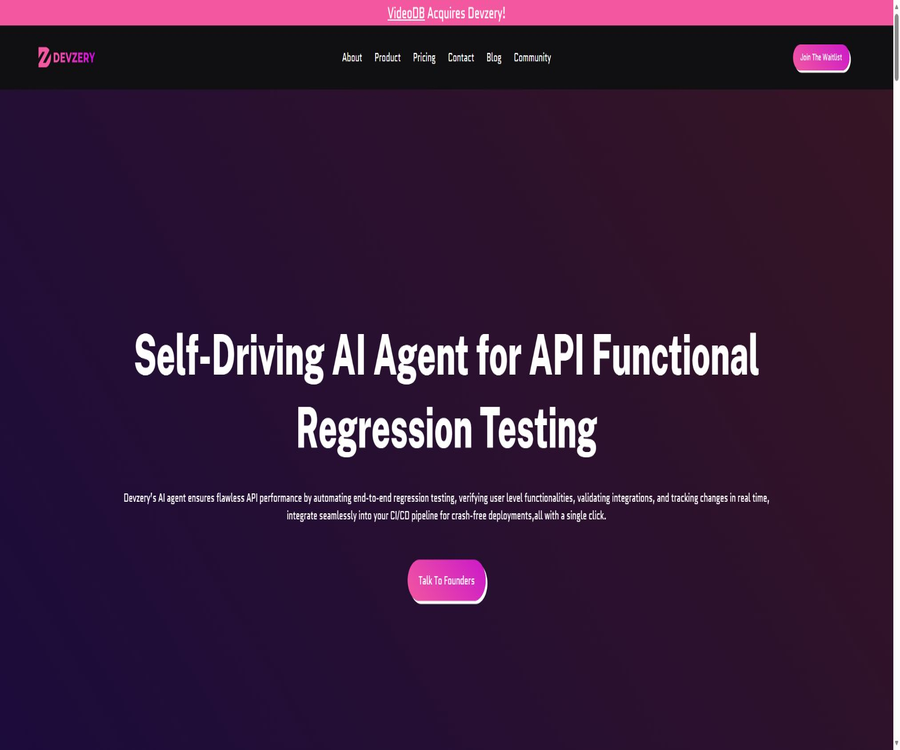
Devzery is a platform for AI API functional regression testing, designed for development and QA teams; it generates test scenarios based on project descriptions, interface structures, and actual requests, and provides centralized management of end-to-end user workflows, defects, coverage rates, as well as CI/CD triggers.
Tool Introduction
Devzery was created by Devzery Technologies Pvt Ltd; it serves primarily small and medium-sized software teams, microservice projects, as well as engineering organizations that need to continuously validate their interfaces. The platform emphasizes code-free or low-code maintenance, allowing tests to be adjusted in line with changes to the API, rather than requiring manual rewriting of scripts with each release.
In November 2025, VideoDB announced the acquisition of Devzery, stating that existing products would continue to receive support, with additional efforts being made to improve the testing and integration of video data pipelines and intelligent applications. Therefore, this product should be described as one that is still in operation, and it is not appropriate to use the ambiguous term “Latest” for it.
What problems can Devzery solve?
- Generate API test cases specific to a particular business from the PRD or project context.
- Sort multiple interfaces according to the actual user workflow, and pass dependency variables between the steps.
- Run regression tests automatically after code merging or deployment to detect changes in interface behavior as early as possible.
- Through testing conducted in conjunction with API adjustments, the maintenance costs associated with the frequent failures of fixed scripts are reduced.
- Generate expected results, actual results, error descriptions, impacts, and related use cases for defects.
- Calculate the coverage of the test suite and the distribution of request methods to identify untested interfaces.
- Generate Swagger documentation from the interface structure, thereby reducing the discrepancy between the documentation and the actual behavior.
- Upload the test results to existing project workflows such as GitHub, Jenkins, and Jira.
Overview of Core Competencies
| Ability | Enter | Handling method | Output |
|---|---|---|---|
| Generated by AI testing | PRD, project description, and API context | Understand business processes and boundaries | Scenario-based test cases |
| Request for collection | Requests and responses captured by the middleware | Record the actual interface interactions | API documentation available for regression testing |
| Process orchestration | Multiple interfaces and dependency variables | Drag and drop to sort and transfer data | End-to-end user journey |
| Regression execution | Test suite and target environment | Triggered on demand or via CI/CD | Pass, fail, and differential results |
| Adaptive maintenance | Changes in API structure and behavior | Adjust the affected tests | Continuous regression coverage |
| Defect management | Failure results and risk information | AI induction and classification | Trackable bug reports |
| Overlay analysis | Interfaces, testing, and request methods | Statistical coverage distribution | Coverage rate and analysis reports |
| Document generation | Complex interface data structures | Generate Schema definition | Swagger API documentation |
Main functions
Generative API testing suite
Devzery’s AI engine can analyze PRDs or project details, and by taking into account the interface structure, it generates tests that are relevant to the product context. The tests created cover not only individual endpoints but also attempt to include cross-interface user workflows and edge cases.
End-to-end regression testing
Teams can execute complete business processes at the API layer, such as registration, authentication, resource creation, payment processing, and status checking. API-level testing is usually faster to carry out than interface testing, but it cannot replace tests related to browser layout, accessibility, and interaction with actual devices.
Interface sequence and variable dependencies
The test management interface allows for adjusting the order of APIs via drag-and-drop, and it enables the passing of response variables from one step to the next in a request. This feature is suitable for validating processes that rely on state, such as tokens, resource IDs, pagination cursors, and multi-stage transactions.
Adaptive test maintenance
The AI Agent detects changes in the API and updates the corresponding tests to ensure continuous regression coverage. Automatic adjustments still require code review, as interface changes may indicate actual defects or they may represent approved new specifications.
Execution in multiple environments
Test suites can be run in different environments, enabling teams to compare the development, pre-release, and production environments. Environment variables, credentials, and test data should be configured separately to prevent production keys or real user data from being copied into non-production systems.
AI defect reports
Failed tests generate bug reports that include the status, related use cases, expected and actual results, as well as descriptions of the errors. The team can also classify these bugs using tags and determine the priority for fixing them based on their impact and risk level.
Swagger documentation generation
Devzery can analyze complex data structures and generate Swagger Schemas, thereby assisting developers in maintaining readable interface references. The automatic documentation should be cross-checked against the official API contracts and the code implementation, with particular attention paid to authentication details, error codes, and optional fields.
Browser extensions
The Basic pricing plan includes a browser extension for bug management, which is useful for quickly recording issues during testing. The public page does not display the current version of the store, its permissions, or the date of updates; it is necessary to check these details on the official website before installation.
Middleware SDK
Devzery offers a Middleware SDK for capturing API requests and responses, supporting Node.js, Java, Python, and Go. Once embedded in an application, this middleware records interactions with the APIs, providing context that is useful for generating AI test reports, creating real-time logs, and conducting continuous regression testing.
| SDK | Support status | Main function | Pay attention during deployment. |
|---|---|---|---|
| Node SDK | Listed by the authorities | Capture requests and responses in Node applications | Avoid recording keys and sensitive content. |
| Java SDK | Listed by the authorities | Interface logs for accessing Java services | Evaluating threads and performance overhead |
| Python SDK | Listed by the authorities | Connect to Python backend and services | Confirm the middleware order according to the framework. |
| Golang SDK | Listed by the authorities | Collect API interactions of Go services | Check concurrency and error handling. |
The official website refers to these components as SDKs, but the available public information does not provide a clear list of the versions, licenses, supported frameworks, and compatibility ranges for each repository. Before integrating them officially, it is necessary to check the relevant repository documentation, as well as the latest submissions and the security status of the dependencies, rather than relying solely on the marketing pages.
Integration of CI/CD with project management
| Integration | Key capabilities | Typical trigger | Output location |
|---|---|---|---|
| GitHub Actions | Include AI regression in the workflow. | Code merging or deployment | GitHub workflow results and Devzery |
| Jenkins | Run tests automatically within Pipeline | Build, publish, or manual tasks | Jenkins Jobs and Devzery |
| Jira | Problems identified during synchronous testing | Test failed or manual confirmation required | Jira Issues and Devzery defects |
- When connecting to GitHub, you can select a project repository and map the workflow to the corresponding microservice.
- GitHub Actions can trigger targeted regression tests each time code is merged or deployed.
- The Jenkins connection is used to run Devzery tests within an existing build pipeline and view the results.
- Jira can create issues based on test results, thereby reducing errors that occur from manual copying of information.
- Basic lists CI/CD integrations, but only Pro includes common project management tools as well as CI/CD integrations; the actual scope must be confirmed upon account activation.
- Enterprise allows for the customization of project management and pipeline integration in line with an organization’s existing systems.
Complete working principle
- Create a project and describe the product, the main user workflows, and the scope of APIs that need to be validated.
- Devzery obtains requests, responses, and business context through the Middleware SDK, interface documentation, or project inputs.
- AI generates test cases and organizes the relevant interfaces into processes that include dependency variables.
- QA or developers check the expected results, test data, validation, and boundary conditions.
- Select a development or pre-release environment to run the suite, and record coverage, failures, and behavioral differences.
- Once a genuine defect is identified, it is forwarded to Jira or the existing process for correction by the team.
- Add the tests to GitHub Actions or Jenkins so that they can be executed continuously during subsequent merges and deployments.
- When the API changes, review the test updates suggested by AI to ensure that such changes do not hide any regressions.
Devzery usage tutorial
Step 1: Define the scope of the test
Start by selecting a service or key user process with well-defined boundaries; do not attempt to integrate the entire production system from the very first attempt. Prepare the current API contracts, test accounts, PRDs, and known boundaries so that the AI can understand the expected behavior.
Step 2: Submit the request data
- Select the middleware as Node, Java, Python, or Go based on the backend language.
- Install the SDK in a non-production environment and configure separate credentials for Devzery connections.
- Establish masking rules to exclude passwords, tokens, payment information, and unnecessary personal data.
- Run a set of known business processes so that the middleware can capture the sequence of interfaces and data dependencies.
- On the platform, it checks whether the request method, path, status code, and response Schema are correctly identified.
- Only after confirming that the collection overhead and error handling meet the requirements should the scope of coverage be expanded.
Step 3: Generate and review tests
- Upload or enter the PRD, interface objectives, and key user stories.
- After generating the test cases, they are filtered based on business risks; not all AI-generated results are accepted outright.
- Handle edge cases such as additional permissions, concurrency, duplicate requests, invalid input, timeouts, and rollbacks.
- Check the dependent variables for each step as well as the cleaning of test data, to prevent one execution from affecting the next.
- Run in the pre-release environment to verify the expected values, and remove any assertions that are unstable or lack business relevance.
- Tests that have passed manual review will be marked as the regression baseline.
Step 4: Proceed with the publishing process
- Connect to GitHub Actions or Jenkins, and select the code repositories and deployment environments that need to be protected.
- Start by using a small number of high-risk use cases for non-blocking checks, in order to observe the execution time and any false positives.
- After correcting the unstable tests, set the key processes as merge or deployment gates.
- Connect to Jira and define when to automatically create issues, tags, assignees, and priorities.
- Regularly review failure trends, coverage gaps, and automatically updated tests to keep the suite maintainable.
Which users are it suitable for
- Backend development team: Automatically checks for interface regressions before merging and deploying code.
- QA Engineer: Quickly establish a test baseline based on requirements and request data, and then add in the relevant professional constraints.
- DevOps and platform teams: Include API validation in GitHub Actions or Jenkins pipelines.
- Microservices team: Orchestrates user workflows across multiple services and manages dependency variables.
- Startups: Use the free Basic tier to test a single project, thereby reducing the costs associated with testing tools in the initial stages.
- Growth-oriented software team: Pro supports up to 5 users and continuous regression for 2 projects.
- Corporate engineering organization: Gain more users, projects, reports, and dedicated support through customized solutions.
- Video and AI infrastructure developers: Take advantage of the reliability features of VideoDB and the intelligent pipelines that are part of the post-acquisition plan.
Typical use cases
- Verify identity processes such as login, token refresh, permissions, and account settings.
- Test the cross-interface workflows for shopping carts, orders, payments, refunds, and status callbacks.
- After the microservice is released, check the upstream and downstream contracts as well as the key user journeys.
- The first version of tests is generated from the PRD, after which QA adds details regarding regulations and business boundaries.
- Perform the target regression after each merge to prevent damage to known critical functions.
- Automatically convert failed results into Jira issues, retaining the expectations, actual outcomes, and related use cases.
- Statistical interfaces and request methods are analyzed to identify endpoints that have not been tested for a long time.
- A draft of the Swagger documentation is generated based on the existing API structure, for review by the developers.
Product advantages
- It focuses on API functionality regression and user workflows, and is not just a generic interface client for sending individual requests.
- Tests can be generated from PRDs, project context, and actual requests, thereby reducing the barriers to creating the first version of a suite.
- It supports interface sorting and variable dependencies across steps, making it suitable for real-world business workflows.
- Bring testing, defects, coverage, and documentation together on the same platform to reduce context fragmentation.
- It provides middleware for Node, Java, Python, and Go, covering common backend technology stacks.
- It can be connected to GitHub Actions, Jenkins, and Jira, enabling integration into existing delivery processes.
- Basic offers free access to a single user, a single project, and 150 AI test cases per month.
- After the acquisition by VideoDB, the official team confirmed that the product will continue to be supported, with plans for further integration of AI infrastructure.
Usage restrictions and precautions
- Tests generated by AI may overlook business rules or produce incorrect assertions, and they cannot replace the review by QA professionals and developers.
- The API layer alone is not sufficient to constitute a complete product; testing is still required for the interface, devices, accessibility, and the actual network functionality.
- Adaptive testing might treat unauthorized interface changes as a new baseline; it is necessary to verify the contract and change orders before making any updates.
- Middleware handles requests and responses; it is necessary to first mask passwords, tokens, payment information, and personal data.
- Basic offers only 150 AI-generated use cases per month, with a limit of 1 user per project.
- Although Pro lists an unlimited number of use cases for AI generation, the limits regarding execution, environment, number of interfaces, or other resources are not fully detailed on the pricing page.
- The official website indicates that one should join the waiting list or contact the founder; account creation may not involve immediate self-service purchasing.
- The path following a product acquisition may change, and the planned integration of VideoDB should not be considered a feature that is already available to all users at present.
- The efficiency multipliers and cost reductions listed on the pricing page are marketing metrics; they cannot be used as a direct indication of the ROI for a particular project.
- Testing production APIs may alter real data or trigger external actions; therefore, isolated environments and test accounts that allow for rollback should be used first.
Privacy and data security
Devzery collects account information, payment data, user inputs, files, feedback, device details, logs, and usage data. The privacy policy states that the general services provided may be used to improve those services or to train relevant models, and it provides options for users to opt out; as for the tasks handled on behalf of corporate clients, the terms of the client agreements apply.
- Before connecting, it is necessary to verify the specific provisions in the customer’s contract regarding request logs, retention, deletion, and model training.
- The privacy policy states that data may be processed and stored in India, and may be transferred to service providers in other regions.
- When dealing with personal data of Europeans or Britons, it is necessary to assess the legal basis, cross-border mechanisms, and DPA.
- Only the minimum fields required for testing are collected, to prevent the full production response from being sent to third parties by default.
- Use separate keys with minimal permissions for SDK and CI connections, and rotate them regularly.
- Prepare synthetic data in a non-production environment, avoiding the use of real customer, patient, or payment records.
- Review logs and export defects to prevent sensitive responses from spreading further via Jira or CI reports.
- The platform employs commercially reasonable security measures, but it does not guarantee absolute security for the Internet and email.
Prices and packages
The following are the public prices as of August 22, 2026. The information regarding monthly and annual subscriptions is available on the same page on the official website: the cost for Pro subscriptions is $25 per month or $250 per year, with a 15% discount indicated on the annual subscription page; Enterprise subscriptions require a customized quote.
| Package | Price | Users and projects | AI testing quota | Functions | Suitable for users |
|---|---|---|---|---|---|
| Basic monthly plan | $ | 1 user, 1 project | 150 AI-generated use cases per month | Email support, CI/CD integration, bug browser extensions, basic analytics | Individuals and concept validation |
| Basic annual plan | $ | 1 user, 1 project | 1,800 AI-generated use cases per year | Consistent with the basic capabilities of Basic. | Long-term free single-item service |
| Pro monthly plan | $ | Up to 5 users, 2 projects | Unlimited AI generation use cases per month | Target regression suggestions, priority support, advanced reporting, common project management, and CI/CD integration | Small development and QA teams |
| Pro annual subscription | $ | Up to 5 users, 2 projects | Unlimited AI generation use cases per month | Full Pro capabilities; the page indicates the annual payment discount. | Continuously use the team |
| Enterprise | Custom quote | Custom users and projects | Unlimited AI generation use cases per month | Customized analysis, dedicated account managers, and custom integrations | Larger-scale project organization |
Pro offers a 2-week free trial, while Basic is the free tier. Fees, execution resources, level of support, and the terms of the Enterprise contract may vary; the final price and the features available will depend on the actual setup and the order placed.
Refunds and cancellations
| Situation | Public rules | Precautions |
|---|---|---|
| Generally for first-time purchases | A refund can be requested within 7 days after purchase. | It is necessary to meet the policy requirements and submit an application. |
| The EU, the UK, or Turkey | A refund can be requested if cancellation is done within 14 days of purchase. | Subject to local rules and eligibility requirements |
| Promotions or discounts | Clearly indicate that refunds are not available in cases where eligibility is not met. | Save the discount terms before purchasing. |
| General rules of the terms | Payments are generally non-refundable. | The special refund policy constitutes a limited exception. |
Price changes usually take effect 14 days after they are announced, but they may apply immediately due to legal reasons or adjustments to the Beta service. Disputes regarding bills must be raised within 30 days from the date of the invoice, and companies should keep hold of their orders, invoices, and confirmation of cancellations.
Platform and output
| Platform or format | Support status | Uses |
|---|---|---|
| Web console | Support | Create projects, manage use cases, run tests, and view analyses |
| Middleware SDK | Node, Java, Python, Go | Collection request responses and connected applications |
| GitHub Actions | Support | Regression testing is automatically triggered within the code workflow. |
| Jenkins | Support | Build and deploy Pipeline tests |
| Jira | Support | Synchronization and defect creation |
| Browser extensions | Listed on the price page | Bug management |
| Swagger | Supports generation | API documentation and Schema |
| Export test results | Support | Further analysis or integration into existing processes |
| Native mobile apps | No findings were detected. | Currently, it focuses on Web and engineering integration. |
GitHub and open source
Devzery’s main API testing platform, AI testing engine, and hosting services are not open-source projects; the terms of service also prohibit reverse engineering as well as the extraction of underlying models, algorithms, and systems. The official GitHub repository includes a separate UI Test-Case Generation Tool, which should not be confused with the commercial API regression platform.
This UI test case generator utilizes Flask, CrewAI, BeautifulSoup, and LangChain to generate functional test cases based on the HTML structure; it is licensed under the Apache-2.0 license. It can replace the models supported by LangChain, but the user still needs to configure the corresponding model keys themselves.
| Project | Open state | License | Positioning |
|---|---|---|---|
| Devzery business platform | Closed source | Commercial terms | Regression, management, and integration of AI API functions |
| Middleware SDK | The official GitHub offers multilingual access points. | Each warehouse needs to be checked individually. | In-app request response collection |
| UI Test-Case Generator | Open source | Apache-2.0 | Generate functional test cases for the HTML-based interface. |
| Underlying models and algorithms | Not open source | Protected by the terms of service | Commercial AI capabilities |
Basic information
| Project | Information |
|---|---|
| Tool name | Devzery |
| Old database title | Devzery Latest |
| Development company | Devzery Technologies Pvt Ltd |
| Current affiliation | Joined VideoDB in November 2025 |
| Tool type | Regression testing and test management for AI API functions |
| Core input | PRD, project context, API request responses, and interface structure |
| Core output | Test cases, regression results, bug reports, coverage, and Swagger documentation |
| Price pattern | Free tier, Pro subscription, 2-week trial, and enterprise customization |
| Minimum payment amount | Pro costs $25 per month or $250 per year. |
| Main integration | GitHub Actions, Jenkins, and Jira |
| SDK | Node, Java, Python, and Go |
| Official GitHub | Yes |
| Is it open source? | The main platform is not open-source; the UI test case generator is licensed under Apache-2.0. |
Recommendation score
The recommendation score is 4.0 out of 5. Devzery combines testing, interface orchestration, adaptive maintenance, CI/CD, and defect management; its free Basic tier along with the Pro version costing $25 per month make it accessible to small teams with low entry barriers.
The main shortcomings are that the available public documentation, SDK versions, and resource quotas are not comprehensive enough; moreover, the account access options are limited to waiting lists or contacting the founders. The team should first verify the actual setup process after the acquisition, as well as the compatibility of data protocols and their own API types.
Frequently Asked Questions
What is Devzery?
It is an AI testing platform used for API functionality regression; it can generate tests related to the product’s context, orchestrate interface processes, automate regression tests, and manage defects. It is not a general-purpose interface debugging client, nor can it cover all UI and device tests.
Is Devzery free?
Basic is free and includes 1 user, 1 project, and 150 AI-generated test cases per month. The annual subscription option provides 1,800 test cases per year; the limits for other resources are determined at the time of subscription.
How much is Pro?
Pro costs $25 per month or $250 per year; it supports up to 5 users and 2 projects, and offers an unlimited number of AI generation use cases. Pro includes a 2-week free trial.
Which development languages are supported?
The official Middleware SDK page lists Node.js, Java, Python, and Go. As for framework compatibility, versions, and licenses for each language, it is necessary to check the respective repositories; one cannot assume that they will be identical.
Can it be integrated with GitHub Actions?
Yes, Devzery allows connection to GitHub projects and enables the automatic initiation of AI-based regression tests within workflows. Before it is officially used as a gate for merging changes, issues such as false positives, execution time, and the cleaning of test data need to be resolved first.
Is it compatible with Jenkins and Jira?
It is supported: Jenkins is used to run tests within pipelines, while Jira is used for synchronizing or creating defects. The Pro version lists common project management tools as well as CI/CD integration options; the Enterprise version allows for customization.
Can Devzery still be used after it has been acquired?
In an official announcement issued in November 2025, VideoDB stated that it would continue to provide support for this product, with plans to achieve a deeper integration of VideoDB. New features may be released gradually, and the current scope of availability should still be determined based on account information and official communications.
Is Devzery open source?
The main platform is not open source. The official UI test case generator is licensed under the Apache-2.0 license, and the Middleware SDK is available on GitHub; however, these components do not constitute a fully open-source commercial service.
Can tests generated by AI be deployed directly?
It is not recommended to use it directly as an access control mechanism. Development and QA teams should examine the business requirements, permissions, boundaries, data cleanup processes, as well as any factors that may cause instability, and then include the tests that have passed these checks in the continuous regression testing.
Will the requested data be used for training?
Standard privacy policies state that users’ content may be used to improve services or train models, and they provide options for opting out; the handling of corporate business data is governed by customer agreements. Before proceeding, it is necessary to obtain clear information regarding the DPA, options for withdrawing from model training, as well as the conditions for data retention and deletion.
Can it replace Postman or manual QA?
Devzery focuses on AI-driven generation and continuous testing; it does not necessarily cover all the debugging capabilities of generic interface clients. Nor can it replace business reviews, exploratory testing, interface testing, or security assessments by specialists.
Summary
Devzery is suitable for development and QA teams that need to integrate API regression testing into their regular delivery processes; it enables the creation of tests based on actual requests, PRDs, and interface structures, while also providing continuous feedback through GitHub Actions, Jenkins, and Jira. The free tier along with multilingual middleware makes it easy to start testing with a single project.
When making a selection, it is important to verify the methods for activation after acquisition, SDK compatibility, the resources required for execution, as well as the rules regarding data training and storage. Both automatic generation and adaptive maintenance should be subject to manual review; in particular, sensitive production data must not be allowed to enter the testing platform without being anonymized first.
Tools similar to Devzery Latest



 Guigong Network Security Registration No. 45132202000164