






Delphi Pricing
Delphi Pricing: an intelligent tool focused on enhancing efficiency through AI.
Tags:AI improves efficiencyA one-sentence summary
Delphi AI is an AI platform designed to create a personal \"digital mind.\" It organizes the creator’s existing articles, videos, podcasts, documents, and interview transcripts into a knowledge and expression system that enables ongoing conversations, and it answers repeated questions on behalf of the creator via text or voice.
Tool Introduction
Delphi AI is operated by Delphi AI, Inc., and its target users include experts, coaches, consultants, authors, educators, business owners, and public figures. The focus of this product is not on creating generic chatbots, but rather on replicating the knowledge base, tone, viewpoints, and way of responding characteristic of specific individuals.
The creator manages the training materials, style of expression, access rights, target audience, conversations, and integrations within Delphi Studio. Once completed, the resulting page can be shared or embedded on a website; it can also be connected to Slack, phone calls, text messages, WhatsApp, and custom applications, after obtaining the necessary licenses and approvals.
What problems can Delphi AI solve?
- Allow experts to continuously answer the audience’s frequent questions, without having to attend each introductory call repeatedly.
- Organize the knowledge scattered across books, articles, podcasts, videos, and social platforms into a conversational personal knowledge base.
- Provide readily accessible Q&A and support resources for courses, member communities, and customer websites.
- Identify potential customers and high-frequency needs through contact collection, conversation analysis, and tag recognition.
- When I am not online, maintain a consistent style of expression and knowledge scope through messaging or voice communication.
- Integrate digital mindsets into business processes to provide a foundation for lead routing, content recommendation, customer follow-up, and internal knowledge queries.
Core product architecture
| module | Main function | Typical content | Output result |
|---|---|---|---|
| Profile | Set the public identity and conversation entry point. | Profile picture, bio, initial message, suggested questions | Identifiable digital mind homepage |
| Mind | Storing and managing training content | Documents, web pages, videos, podcasts, social content, clips | Knowledge layer with channel boundaries |
| Interview | Supplement personal experience through interviews | Oral answers, stories, principles, and working methods | New knowledge fragments and expression cues |
| Experience | Adjust response behavior | Purpose, length, creativity, tone, and unanswered responses | Dialogue experience in different scenarios |
| Launch | Publishing the digital mindset outwardly | Sharing page, website embedding, Slack, phone, and WhatsApp | Interactive entry point for the audience |
| Operate | Analyze and continuously optimize | Dialogs, tags, contacts, revisions, and triggers | Insights, follow-up actions, and training updates |
| API | Integrate with existing applications and processes | Sessions, questions, tags, and usage APIs | Customized digital mental experience |
Main functions
Multi-channel knowledge training
Delphi allows files, text snippets, web pages, YouTube videos, podcasts, Notion content, Google Drive files, Slack messages, and certain social media posts to be included in Mind. The content list can be filtered by status, type, and access group, and it supports folder organization, batch editing, control over publication dates, and display of references.
- Files and snippets: Upload existing materials, or add Q&A entries and text notes directly.
- Website content: It is possible to retrieve the content of a specific link in one go; ordinary websites are not automatically synchronized on a continuous basis.
- Continuous Feed: Supports the synchronization of new content from YouTube channels, podcast series, X accounts, and RSS feeds.
- Work materials: Notion, Google Drive, and Slack can be connected and kept synchronized by adding content entry points.
- Social profiles: On some platforms, it is necessary to export them and upload them; adding social links to the personal homepage does not necessarily result in automatic processing of that information.
- Access control: Data can be assigned to access levels such as Just Me, Insiders, and Public.
Interview training
Users who do not have a large amount of ready-made content can still train their digital mindset through interviews. The interview agent asks open-ended questions related to a specific field of expertise, saves the responses as editable knowledge segments, and adds insights, stories, tone, and reasoning patterns to those responses.
The Interviewer feature is marked as Early Access in the help center and is available to users of all tiers; another official announcement stated that the Interview Mode is intended for users of paid plans. Whether a particular account can use this feature and what its name is may change depending on the release schedule, so it is necessary to refer to the information displayed in the Studio.
Chat and voice calls
Free, Builder, and Scaler all offer Voice Calling and Chat functions; Scaler, when upgraded to Pro version, adds Pro Voice Calling and Chat. The creator can record voice samples so that the digital avatar can provide responses in a voice that resembles their own, but the degree of voice similarity and the accuracy of the content still need to be tested in practice.
Answer style and boundaries
The creator can set the purpose, the length of the responses, the level of creativity required, the initial message to be displayed, suggested questions, and a message to be shown when a question cannot be answered. Different embedding locations allow for customized experiences, enabling the same body of knowledge to serve various functions in courses, official websites, and communities.
Citations and content revisions
The digital mind can include references to the training materials in its responses, and the creator can hide certain references. Operators can locate weak responses in the conversation list and carry out reviews and revisions; the revised responses then become part of the training data again.
Audience and contact management
Delphi can attract users through invitation emails, public links, website embedding, and integration, and it allows for the management of contacts within its Audience feature. Builder enables the collection of up to 1,000 contacts, Scaler allows up to 10,000 contacts, while Immortal has no limit on the number of contacts.
Product recommendations and workflows
Paid plans allow for the configuration of recommended products and custom workflows; for example, it is possible to identify purchase intentions within conversations, recommend courses or services, and use triggers to add tags, send notifications, or schedule follow-up actions. There are 5 such elements available per Builder plan, and 20 per Scaler plan.
Analysis dashboard
Builder offers an Analytics Dashboard that allows one to monitor conversations, the audience, and interaction patterns. The analysis data can help identify common issues and gaps in the content, but the tags generated by AI or the relevance of conversations cannot be considered as actual sales results.
Multiple instances
Instances enable the creation of different instances for various purposes from the same digital framework, with distinct training data, objectives, response settings, and integration methods assigned to each instance. This feature is useful for managing public Q&A sessions, member-specific content, and internal support separately.
The working principle of transforming data into a digital mindset
- Connect or upload articles, files, videos, podcasts, and social media content that you have the right to use.
- Delphi processes the data and creates a Mind map, organizing the content by channel, topic, access level, and date of publication.
- The creator completes the guided questions or interview, adding any missing perspectives, experiences, and expressions in the supplementary information.
- In Profile and Experience, set the identity, purpose, tone, length of responses, level of creativity, initial message, and fallback rules.
- Use chat and voice tests to identify common issues, checking references, factual accuracy, voice quality, and performance when questions cannot be answered.
- It is published through public pages, embedding, or integration, and knowledge and answers are continuously revised via dialogue reviews.
Create a Delphi digital mindset tutorial
Step 1: Create a profile
After registration, set your name, profile picture, biography, professional background, initial message, and suggested questions. The biography is intended to help visitors understand the identity and scope of capabilities of Digital Mind; it should not contain any claims about qualifications that cannot be verified.
Step 2: Add training content
- Go to Mind and select to add files, clips, websites, videos, podcasts, or supported connection channels.
- Assign clear names to the materials, specify the authors, indicate the date of publication, and define access groups, in order to prevent the disclosure of private or unauthorized content.
- Check the Queued, Training, and Needs attention statuses, fix the projects that failed, and conduct random checks on the training results.
- To enable continuous updates, configure a Feed or connect Notion, Google Drive, and Slack, and check the last synchronization time.
- Use the Interview to supplement personal experiences, principles, stories, and address issues that are not covered by existing information.
Step 3: Testing and release
- Prepare 5 to 10 high-frequency questions, boundary questions, and questions that are not present in the materials for a written test.
- Check whether each response is faithful to the training content, whether the citations are appropriate, and whether unknown questions are properly declined.
- After recording the audio samples, the speech rhythm, pronunciation, and any sensitive content are tested, and the stability and similarity are adjusted as necessary.
- Set the access levels and usage quotas for Anonymous, Public, Insiders, and Just Me.
- First, share it with a small number of trusted users, and then deploy it on websites, courses, or approved messaging channels.
- After going live, regularly check the unanswered questions and those with weak responses, and keep them up to date by making revisions and adding new information.
Publication and integration methods
| Channels | Available methods | Package or approval requirements | Primary uses |
|---|---|---|---|
| Delphi public page | Share personal Handle page | Basic capabilities | Public Q&A and personal profile |
| Website | Links, page embeds, or chat bubbles | There are 2 Builders and 10 Scalers. | Official website, landing page, FAQ, and courses |
| Slack | Channel and private message interactions | Builder is included, and an application for review is required. | Community and team Q&A |
| CRM | Contact synchronization and import | Scaler is provided for use. | Clues and audience management |
| Phone and WhatsApp | Text or voice for dedicated numbers | Immortal is included and requires approval. | Consulting, screening, and customer communication |
| Own applications | REST API and custom applications | Immortal | Integration of websites, apps, and business processes |
| Course platform | Embedded in Kajabi, Thinkific, or Mighty | It depends on the embedding quota and access settings. | In-class tutoring and member Q&A |
Access groups and content permissions
Access Groups enable the same digital asset to display different content to various audiences. Visitors can be classified as Anonymous, Public, or invited Insiders, while creators and collaborators use Just Me to manage private content.
- Anonymous is suitable for unlogged-in visitors; it is possible to configure whether it is allowed and how many times it can be used.
- Public is suitable for the general audience that can log in via email; it provides access to public knowledge and ongoing sessions.
- Insiders is intended for course participants, paid members, or users who have been invited specifically; they have access to additional materials.
- Just Me is intended only for owners and authorized collaborators, and it is used for managing private knowledge.
- The same embedding can automatically assign the appropriate access group based on the login email, eliminating the need to redeploy it for each group.
- Before publication, it should be tested as an anonymous user, a regular user, and an internal member respectively, to prevent incorrect permission settings.
Which users are it suitable for
- Experts and consultants: Turn common methods, cases, and frameworks into readily accessible entry points for consultation.
- Coaches and trainers: Provide students with post-class questions and answers, practice guidance, and knowledge review.
- Author and speaker: Encourage readers to engage in personalized discussions based on the content of books, articles, and speeches.
- Content creators: Combine videos, podcasts, and social media content to reduce the need to answer fan questions repeatedly.
- Business managers: Handle product introduction, customer screening, contact collection, and recommendation workflows.
- Public figures: They can create a more comprehensive digital identity, messaging channels, and commercial experience through customized services.
- Teams and communities: Incorporate the knowledge of specific members into Slack, websites, or membership platforms.
- Development team: Under the Immortal approach, digital minds are integrated into their own products via APIs.
Typical use cases
- Place a chat interface on the individual’s official website to answer questions regarding the scope of services, the methodology used, and common issues before starting a partnership.
- A course assistant is embedded on the online course page to assist students in reviewing using the lecture notes and specialized materials.
- Create an interactive content index for podcasts or video channels, enabling audiences to search for opinions across different programs.
- Provide voice or text descriptions before making a sale, collect contact information, and determine the willingness to engage in further communication.
- Configure Insider materials for the member community, so that public users and members receive different ranges of responses.
- Deploy the knowledge of founders or internal experts to Slack in order to address repetitive team issues.
- Identify content gaps through dialogue records, and then add FAQs, operation guides, and new interview insights.
- Create controlled digital avatars for public figures, enabling large-scale interaction through dedicated channels.
Product advantages
- It focuses on training individuals in terms of knowledge, perspectives, and expression, which sets it apart from generic robots that merely rely on brand-specific FAQ.
- It offers both text and voice interaction; the free version includes basic Voice Calling and Chat.
- The knowledge materials include documents, web pages, videos, podcasts, workspaces, and interviews, and are suitable for experts who already have a large amount of content.
- Access groups allow for the categorization of content into public, member-only, and private types, facilitating the management of different audiences within the same digital framework.
- Starting with Builder, it offers analysis, product recommendations, workflow capabilities, Slack integration, and collaboration tools.
- Scaler adds CRM synchronization, contact import, brand customization, and more embedding options.
- Immortal offers white-glove setup, APIs, SSO, and custom applications, making it suitable for complex projects.
- The authorities continuously maintain the help center and public development examples to help teams understand the integration boundaries.
Usage restrictions and precautions
- Digital mental outputs are generated by AI; the official terms specify that no guarantee is provided regarding their accuracy, completeness, or timeliness, and the creators need to verify them independently.
- Sounds, photos, and videos may contain biometric information; prior to uploading, it is necessary to obtain explicit authorization from the individual in question as well as any relevant rights holders.
- Training materials must have legitimate usage rights; client confidential information, unauthorized works, or unnecessary personal data should not be uploaded.
- While Free offers basic chatting and voice functionality, advanced analytics, ongoing content tracking, workflow features, and embedding capabilities require a subscription.
- The API is available only to Immortal, and not all subscribed users can generate keys on their own.
- Channels such as Slack, phone calls, and WhatsApp may require approval or registration; the features listed in the package should not be assumed to be available immediately and automatically.
- Regular websites only support one-time data retrieval; continuous synchronization relies on RSS or other supported content connections.
- Revised dialogues will become new training material; the team should establish an approval process to prevent incorrect answers from being fixed in place.
- The creator can view the conversations or switch to anonymous mode; before deployment, it is necessary to clearly explain to visitors the scope of data processing and manual review.
- For high-risk recommendations in areas such as medicine, law, investing, and mental health, one should not rely solely on digital avatars; professional evaluation and emergency referrals should still be employed.
Data, Privacy, and Security
Delphi’s privacy policy addresses account information, contact details, payment details, device data, interactions, as well as content submitted by users; it may also employ service providers for hosting, analysis, processing of payments, and providing support. The data related to the creators differs from the data entered by end-users, and it is necessary to determine who is the data controller before deploying the system in a corporate environment.
- Personal data is processed for purposes such as providing services, improving products, communication, as well as ensuring compliance and security.
- Photos, videos, and recordings can be used to create digital representations of a person’s mind, and they may also yield biometric information.
- Personal data is usually retained for as long as it is necessary to provide services and for business purposes; some records may remain for longer due to legal obligations.
- The platform employs physical, technical, organizational, and managerial measures to protect data, but it does not guarantee absolute security for data transmission or storage over the network.
- The creator should set strong passwords, restrict collaborators, test access groups, and regularly check public content.
- When dealing with employees, customers, patients, or minors, an internal assessment of privacy, consent, and data retention must be carried out first.
Prices and packages
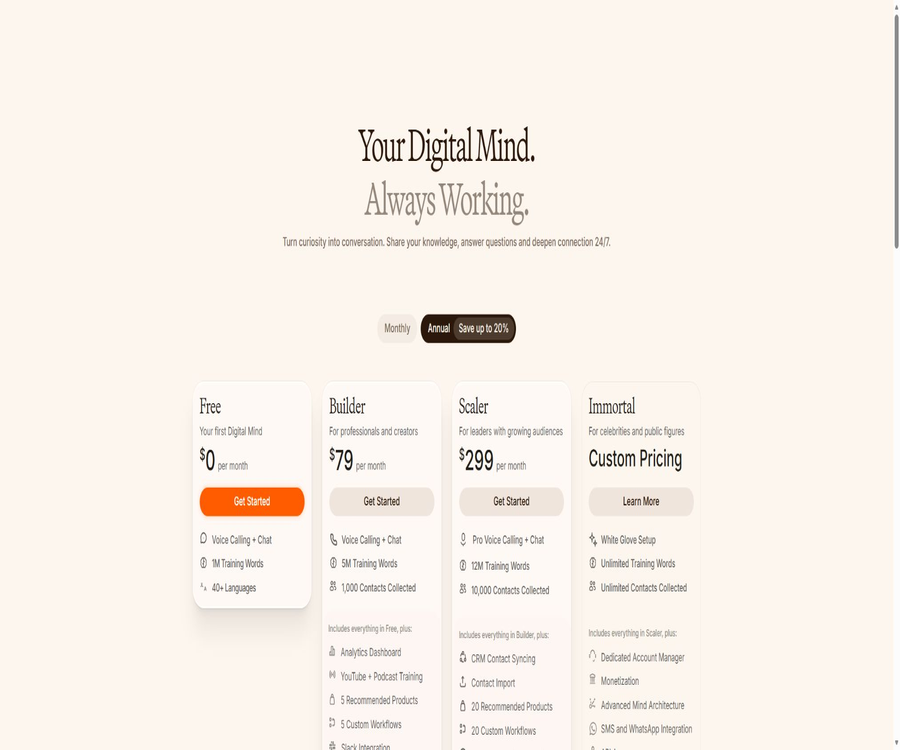
The following are the official monthly payment details as verified on August 22, 2026. The page also offers the option to switch to annual payment, stating that savings of up to 20% can be achieved; however, the exact total cost for each annual payment plan is not clearly displayed in the public text, so it has not been included in the table.
| Package | Monthly price | Training capacity | Contact person | Primary interests | Suitable for users |
|---|---|---|---|---|---|
| Free | $ | 1 million training words | No specific collection limit is specified. | Digital mind, basic voice calls and chatting, over 40 languages | Personal trials and proof of concept |
| Builder | $ | 5 million training words | 1,000 | Analytics dashboard, YouTube and podcast training, 5 recommended products, 5 workflows, Slack, 2 embeds, 1 collaborator | Experts, creators, and small businesses |
| Scaler | $ | 12 million training words | 10,000 | Pro voice and chat, CRM synchronization, contact import, 20 recommended products, 20 workflows, custom domain names and colors, 10 embedding options, 3 collaborators | A team with a continuously growing audience |
| Immortal | Custom quote | No restrictions on training words | No restrictions | White-glove setup, dedicated account managers, commercialization capabilities, advanced mental modeling tools, SMS and WhatsApp support, APIs, custom applications, and SSO | Public figures, brands, and complex corporate projects |
The official prices and features may change, and taxes, voice usage amounts, customized services, as well as the terms of corporate contracts may be calculated separately. Before making a purchase, it is necessary to check on the payment page information regarding annual discount rates, automatic renewal options, cancellation procedures, any extra fees, and the actual scope of services provided.
How to choose a package
| Demand | Recommended package | Reason for selection | Upgrade signal |
|---|---|---|---|
| Experience a personal digital mind. | Free | No monthly fee required; it allows testing of 1 million words, as well as chat and voice functions. | Analysis is required, as well as continuous training via channels or website integration. |
| Managing a personal brand or professional services | Builder | Features analysis, Slack integration, product recommendations, workflow management, and basic collaboration tools. | There are more than 1,000 contacts, or CRM synchronization is required. |
| Managing growing audiences and sales processes | Scaler | Increase the limits for training, contacts, embedding, and collaboration, and add CRM functionality. | API, SSO, phone, or WhatsApp are required. |
| Developing customized digital identity projects | Immortal | Includes exclusive configurations, unlimited training, APIs, and custom applications | The scale and compliance need to be assessed in accordance with the contract. |
Supported platforms and languages
| Platform or entry point | Support status | Explanation |
|---|---|---|
| Web Studio | Support | Used for creating, training, testing, deploying, and operating digital minds. |
| Public Web pages | Support | Visitors can engage in text or voice interactions through the sharing page. |
| Website embedding | Support | The number of embedding locations depends on the package. |
| Slack | Support | Builder is included; connection requires application and authorization. |
| Phone calls, text messages, WhatsApp | Conditional support | Immortal is included; a dedicated number requires approval before it can be obtained. |
| Own web or mobile app | Conditional support | Integrate using the Immortal API or official examples |
| Native desktop client | No clearly defined public products are available. | It is primarily used through browsers and in an integrated manner. |
| Language | Over 40 kinds | Multilingual support does not mean that the voice quality and professional accuracy are the same for every language. |
APIs and developer capabilities
Delphi offers a v3 REST API that enables the creation of sessions in custom applications, platforms, or workflows, streaming of responses, viewing of history, management of tags, retrieval of suggested questions, and tracking of usage. An API key is associated with a single digital account, and every request must include this key.
| Development capability | Current status | Restrictions or explanations |
|---|---|---|
| Session | Support | Create sessions, read history, and manage the lifecycle. |
| Streaming response | Support | Suitable for creating real-time chat interfaces |
| Suggested questions | Support | Guiding questions for reading the digital mental configuration |
| Labels | Support | Organize business tags for audiences and sessions |
| Amount used | Support | Track user consumption and access levels |
| Authentication | API Key | The key is displayed only once and should be stored securely on the server side. |
| Rate limiting | 120 requests per 60 seconds | The calculation is done uniformly for each API key; a 429 response is returned when the limit is exceeded. |
| Package | Immortal | It is necessary to contact Delphi to enable API access. |
API integration process
- Confirm whether the project requires APIs, SSO, or custom applications, and consult Delphi regarding the Immortal solution.
- After approval, create an API key and save it immediately in a secure server-side key management system.
- Create a session using test numeric minds to verify the initial greeting, streaming responses, as well as error and timeout handling.
- Enable anonymization of user identities, tags, usage records, rate limits, and logs.
- Conduct security testing on prompt injection, unauthorized content, private data, and scenarios with no answers.
- After going live, monitor 429 errors, failure rates, and response quality, and regularly rotate the keys.
GitHub and open source
Delphi AI products, the underlying models, digital mind systems, and hosting services are not open-source software. The terms established by their creators reserve intellectual property rights such as platform infrastructure, algorithms, source code, and datasets, and they restrict reverse engineering as well as the use of these elements to train other models.
The official GitHub organization has made available repositories containing examples of TypeScript APIs, examples of SSO integration, examples of React Native integration, as well as web-based voice clients; there are also some auxiliary projects under the MIT license. These repositories are used to demonstrate how to incorporate or use certain components, but they do not represent a way to deploy the entire Delphi platform on one’s own.
| Project type | Whether to make it public | Function | Relationship with product open source |
|---|---|---|---|
| API TypeScript example | Yes | Demonstrating the connection to external API sessions | It’s just a sample application. |
| SSO embedding example | Yes | Demonstrate protected embedded login | Does not include the platform backend |
| React Native examples | Yes | Demonstrate mobile app integration | It is not equivalent to the complete official mobile client source code. |
| Web voice client | Yes | Start a voice call via the web interface | It belongs to the local client components. |
| Delphi hosting platform | No | Training, reasoning, managing, and operating digital minds | Commercial closed-source services |
Basic information
| Project | Information |
|---|---|
| Tool name | Delphi AI |
| Product name | Delphi Digital Mind |
| Development company | Delphi AI, Inc. |
| Tool type | AI digital avatars, personal knowledge bases, and dialogue platforms |
| Primary users | Experts, coaches, consultants, creators, educators, business figures, and public figures |
| Input channels | Documents, text snippets, web pages, videos, podcasts, workspaces, social content, and interviews |
| Interaction method | Text chat, web voice, embedding, Slack, phone calls, text messages, WhatsApp, and APIs |
| Language support | The official pricing page lists over 40 languages. |
| Price pattern | Free version, monthly or annual subscriptions, custom quotes for businesses |
| Minimum payment amount | Builder costs $79 per month. |
| Is registration required? | Creation and management are based on requirements; public access depends on the settings set by the creator. |
| Whether API is provided | Yes, only the Immortal option. |
| Official GitHub | There are public examples of organization and integration. |
| Is it open source? | The product is not open-source; however, some examples and auxiliary repositories are available publicly. |
Recommendation score
The recommendation score is 4.2 out of 5. Delphi offers a fairly comprehensive digital mental workflow that integrates personal knowledge development, voice interaction, hierarchical access, and multi-channel content distribution; the Free version is sufficient to provide a basic chat and voice experience.
The main shortcomings are the high prices of Builder and Scaler; APIs, SSO, telephone support, and WhatsApp services are available only in the customized packages, and some integrations require special requests. When it comes to personal voice recordings, biometric data, and professional advice, the costs associated with content licensing, privacy notifications, and manual review cannot be ignored either.
Frequently Asked Questions
Is Delphi AI free?
There is a free plan available; the official options include a cost of $0 per month, 1 digital mind, 1 million training words, as well as voice calls and chat in over 40 languages. Features such as analysis, ongoing video and podcast training, workflow management, integration with Slack, and website embedding are available starting from the Builder plan.
How much is the lowest pricing plan for Delphi AI?
Builder costs $79 per month at the current rate, while Scaler costs $299 per month. The annual payment page indicates a potential savings of up to 20%, but the actual annual cost, taxes, and terms related to automatic renewal shall be based on what is shown at the time of settlement.
What is the difference between Delphi AI and ordinary knowledge base robots?
Ordinary knowledge-base robots are primarily designed to provide information about companies, while Delphi is trained to adopt individual tones, perspectives, and voices; it also takes into account the target audience, user groups, recommended products, and workflow processes. It remains an AI simulation and should not pretend to be a human being or replace decisions that require human judgment.
Is it possible to create something without articles or podcasts?
Guiding questions can be used during interviews, and personal experiences, stories, and methods can be saved in Mind. The specific scope of access to the interview feature has been described as Early Access or a paid subscription on various official pages; it is necessary to follow the instructions provided on the current account dashboard.
Is Chinese supported?
The pricing page on the official website indicates support for over 40 languages, so it can be used for Chinese content and conversations. However, Chinese voice tones, proper nouns, regional expressions, and complex technical issues should still be tested using actual samples first.
Can it be embedded on websites and in courses?
Yes, Builder offers 2 integration points,Scaler allows up to 10 integration points, and Immortal enables the development of custom applications. The course platform can be deployed through integration, and Insiders can be used to control access to students’ data.
Is phone and WhatsApp support available?
Immortal lists SMS and WhatsApp integration; the help center also indicates that dedicated numbers can handle SMS, WhatsApp messages, as well as voice calls. This functionality requires an application and approval – it is not a feature that becomes available automatically upon subscription.
Does Delphi AI provide APIs?
A v3 REST API is provided, which allows for creating sessions, retrieving content in a streaming manner, viewing history, managing tags, and tracking usage. This API is intended for use with the Immortal solution; currently, there is a limit of 120 requests per key per 60 seconds.
Is Delphi AI open source?
The product itself is not open source; the underlying systems, algorithms, and models remain the property of Delphi. The API, SSO, React Native, and voice client projects available on the official GitHub account are merely integration examples or partial components.
Can the creator see the user conversations?
The creator can view and filter conversations from the management interface, and can also set up a more anonymous experience. The person in charge of deployment should clarify the scope of visibility before users start communicating, and users should not submit unnecessary sensitive information.
Will the training content be updated automatically?
YouTube channels, podcast series, X accounts, RSS feeds, as well as connected Notion, Google Drive, and Slack accounts can be kept in sync continuously. Web page scraping involves a one-time import; without RSS, it is necessary to perform scraping again later.
Can the generated results be used directly for professional advice?
It is not recommended. The official terms specify that the information provided is unverified and cannot be guaranteed to be accurate, complete, or up-to-date; medical, legal, financial, and other high-risk contents must be reviewed by qualified professionals.
Summary
Delphi AI is suitable for converting a person’s public knowledge, experience, and way of expressing themselves into a digitally based mind that can operate sustainably; everything from content training and interview supplementation to chatting, voice interactions, integration, and audience analysis is carried out within the same platform. There are four different plans available, covering aspects such as user experience, personal branding, team development, and custom projects.
Before making a choice, it is important to assess the permissions related to the training content, visitor privacy, accuracy of responses, risks associated with voice identification, and the package that suits the required channels. It is advisable to start with a trial using the Free version on a small scale, and then upgrade based on the needs related to integration, contacts, CRM, or APIs; this approach is usually safer than opting directly for a premium solution.
Tools similar to Delphi Pricing



 Guigong Network Security Registration No. 45132202000164