






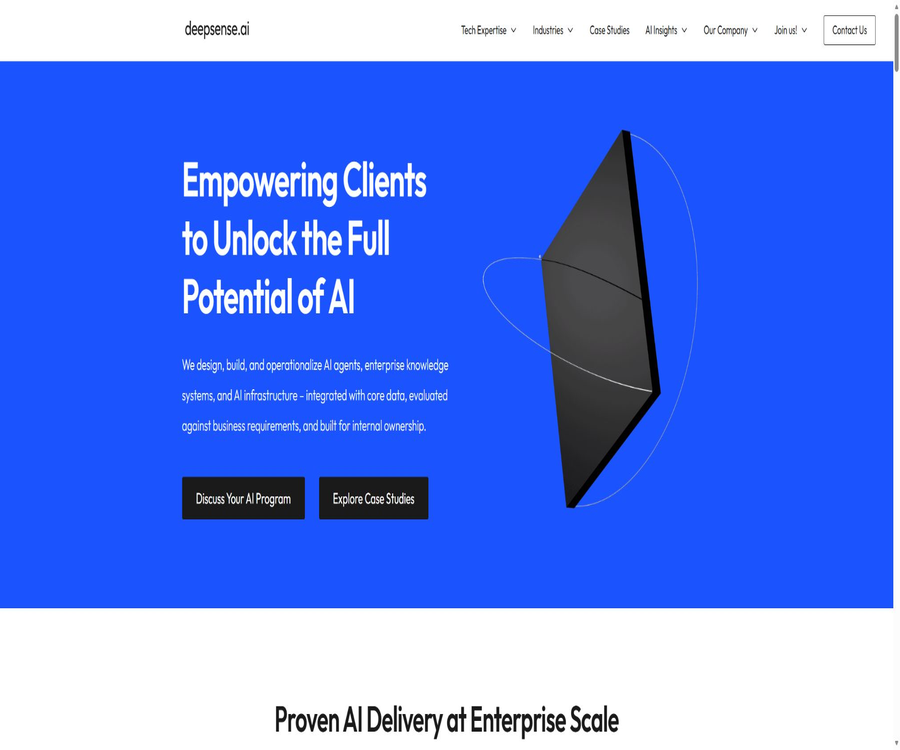
deepsense.ai
deepsense.ai: an intelligent tool focused on improving AI efficiency.
Tags:AI improves efficiencyA one-sentence summary
deepsense.ai is a company that provides AI consulting and custom development services for businesses; it can handle everything from identifying use cases and conducting technical evaluations to the actual deployment of AI agents, enterprise knowledge systems, MLOps solutions, computer vision technologies, and edge AI systems.
Tool Introduction
deepsense.ai is not a generic chat tool that can be used simply by entering a prompt; rather, it is a project delivery team composed of consultants, data scientists, and machine learning engineers. Customers need to submit their business challenges, data conditions, and technical constraints, after which the two parties determine the scope of work, timeline, and pricing.
Its services cover four areas: AI product development, business process automation, production infrastructure, and organizational adoption. The official website lists OpenAI and Anthropic as service partners, while also highlighting collaboration opportunities with platforms such as Google Cloud, AWS, and Anyscale.
Overview of service capabilities
| Service direction | Main tasks | Typical deliverables | Appropriate stage |
|---|---|---|---|
| AI consulting and adoption | Identify use cases, assess feasibility, and manage risks. | Priority roadmap, architecture recommendations, and implementation plan | The direction of the project has not yet been determined. |
| AI agents and corporate RAG | Connect models, knowledge, tools, and business processes | Knowledge assistants, workflow agents, and evaluation systems | From proof of concept to production |
| MLOps | Auditing, building, and improving the model lifecycle | Pipeline, monitoring, version management, and deployment platform | The model needs to be stable and scalable. |
| Computer vision | Detection, segmentation, document processing, and 3D modeling | Visual models, data pipelines, and inference services | Image, video, or sensor projects |
| Edge AI | Model compression, hardware adaptation, and local inference | Low-latency edge models and deployment solutions | High requirements for privacy, networking, or real-time performance |
| Predictive analysis | Train predictive models using historical and real-time data | Prediction interfaces, dashboards, and decision support | Demand, risk, and operational forecasting |
| Team expansion | Add AI engineers to the customer’s existing team | Ongoing engineering capabilities and knowledge transfer | The internal team lacks certain skills. |
AI agents and corporate RAG
Production-grade knowledge system
deepsense.ai enables large language models to be connected to corporate documents, databases, access control systems, and internal tools, thereby creating a knowledge system that benefits from enhanced search capabilities. Unlike simple chatbots, this system handles tasks such as data acquisition, search quality assessment, answer evaluation, access control, and operational monitoring all at once.
Business Process Agent
Agent projects can make use of corporate tools for tasks related to customer service, research, development, operations, or document management, while retaining human oversight at key stages. Official examples include internal knowledge retrieval, employee matching, ticket processing, and the automation of multi-step business processes; however, the capabilities available to each client depend on the systems they can access and their level of authorization.
Voice robot
Enterprise voice robot services cover the stages of prototyping, production, and ongoing optimization, with a focus on managing dialogue flows, latency, interruptions, transitions to human agents, system integration, and regression testing. Projects need to be tested in real telephone environments, taking into account different accents and background noise; it is not sufficient to judge performance based solely on demonstration audio.
Model and System Evaluation
Teams can create LLM or VLM evaluation datasets based on real-world data, edge cases, and business-critical tasks. The evaluation criteria include not only the quality of responses but also costs, latency, security, traceability, and conditions for manual intervention.
MLOps capabilities
MLOps services begin with an audit of the existing infrastructure, identifying bottlenecks in data handling, training, deployment, and monitoring. Once this is done, it becomes possible to establish reproducible pipelines, manage versions of models and data, carry out automated testing, implement release controls, and monitor system performance.
- Assess the maturity of the current machine learning infrastructure, data management processes, and technology stack.
- Transform temporary scripts and manual operations into reproducible, auditable engineering processes.
- Design mechanisms for model training, validation, deployment, rollback, and continuous monitoring.
- Addressing issues related to high-concurrency loads, the costs associated with model services, and the efficiency of deploying large models.
- Establish a traceable relationship between prompts, experiments, data, and model versions.
- Delivered in collaboration with customer’s in-house data science and engineering teams through team expansion.
Computer Vision and Document Intelligence
Computer vision services include detection, segmentation, quality inspection, synthetic data generation, processing of complex documents, 3D scene reconstruction, and point cloud analysis. The team is able to integrate models with cameras, industrial equipment, mobile devices, or cloud services, rather than merely providing code for offline experiments.
| Ability | Common inputs | Possible output | Typical uses |
|---|---|---|---|
| Visual inspection and segmentation | Images, videos, or multispectral data | Category, bounding box, or pixel mask | Defect detection and safety inspection |
| Document Intelligence | Scans, forms, and complex documents | Structured fields and classification results | Review, entry, and knowledge retrieval |
| Generative data augmentation | A small number of samples and condition information | Synthetic training data | Addressing insufficient samples and class imbalance |
| 3D scene modeling | Videos, images, or point clouds | 3D representation and spatial analysis | Digital twins and environmental understanding |
| Real-time video analysis | Continuous camera stream | Events, trajectories, and alerts | Industrial, retail, and equipment applications |
Edge AI solutions
Edge AI is suitable for scenarios where data cannot be continuously uploaded to the cloud, where the on-site network is unstable, or where strict response time requirements apply. Deepsense.ai offers services such as hardware and technology stack assessment, model optimization, device deployment, and long-term technical support.
- Develop an edge AI strategy, prioritize use cases, and create an implementation roadmap.
- Assess the compatibility of GPUs, embedded devices, mobile hardware with the existing software stack.
- Reduce the model’s computational and memory requirements by quantization, trimming, or architectural adjustments.
- Deploy computer vision or small language models on devices with limited resources.
- Acceptance criteria are established for real-time inference, offline operation, privacy, and power consumption.
- Add edge deployment and performance optimization engineers to the client’s team.
AI consulting and project initiation methods
Clients can start with short-term discovery activities, or they can go straight to concept validation, consulting projects, or team expansion. The time frames shown on the official website represent typical starting points and do not constitute fixed deadlines; the actual scope will still depend on the readiness of the data, the complexity of integration, and compliance requirements.
| Cooperation methods | Display period on the official website | Main goal | Suitable situations |
|---|---|---|---|
| AI Discovery Workshop | 1 to 2 days | Organize use cases and compare business value with technical feasibility | There are many directions, so it’s necessary to filter first. |
| Proof of Concept | 2 to 4 weeks | Verify individual AI capabilities using real-world constraints | It is necessary to reduce technical and business uncertainties. |
| AI Advisory Project | 2 to 4 weeks | Evaluate practices and develop a prioritized action plan | There are already AI projects, but no roadmap is available. |
| AI Team Augmentation | It varies by project. | Enhance advanced AI engineering and implementation capabilities | The internal team needs to work together over the long term. |
| Production system development | Customization | Complete architecture, development, integration, deployment, and operation | The demand has been verified and is ready for scaling up. |
Complete delivery process
- Submit business objectives, current processes, data sources, system boundaries, and compliance requirements.
- Work with the team to select high-value use cases and define success metrics such as accuracy, latency, cost, or adoption rate.
- Review data quality, access permissions, model selection, infrastructure, and integration risks.
- Use seminars, technical prototypes, or proof of concepts to determine whether the approach is worth further investment.
- Design a production architecture that includes mechanisms for permissions, evaluation, monitoring, manual review, and failure mitigation.
- Complete development, integration, testing, and deployment, and transfer operational knowledge to the client’s team.
- Continuously optimize quality, cost, latency, and user experience based on actual usage data.
How to determine whether a partnership is suitable
- First, clarify the business outcomes that need to be improved; do not set the goal merely as adopting some popular model.
- Prepare data samples representing real-world scenarios, failure cases, and descriptions of existing processes.
- Identify the internal product owner, domain experts, security personnel, and technical contacts.
- When requesting a quote, it is necessary to specify the scope of work, the intermediate deliverables, the acceptance criteria, and the costs associated with third parties.
- Compare the total costs and maintenance responsibilities of the three approaches: building it in-house, purchasing ready-made products, and custom development.
- Starting with pilot projects on a limited scale, the decision to expand to full production is made based on the quantitative results.
Which users are it suitable for
- Head of corporate innovation: It is necessary to organize the various AI ideas into actionable roadmaps.
- CTO and Engineering Lead: It is necessary to develop AI products, RAG, or agent architectures that are easy to maintain.
- Data and machine learning team: There is a need to improve training, deployment, monitoring, and cost management.
- Manufacturing and industrial enterprises: they require visual quality inspection, inference at the equipment level, or support for decision-making on site.
- Healthcare, pharmaceutical, and financial institutions: It is necessary to include accuracy, traceability, and manual review in the plans.
- Software companies and growing teams: need to acquire advanced AI engineering skills or accelerate the time to market for their products.
- Organizations that possess proprietary data: Generic SaaS solutions cannot meet their requirements regarding processes, permissions, or integration.
Typical use cases
- Integrate corporate documents, SharePoint, databases, and business interfaces into a internally accessible knowledge assistant with controlled access rights.
- Create a customer support agent capable of handling classification, retrieval, approval, and tool invocation.
- Establish an automated pipeline for model training, evaluation, deployment, rollback, and monitoring.
- Cameras and sensors are used for detecting industrial defects, ensuring on-site safety, and monitoring equipment.
- Compress the model and deploy it on edge devices to run in real time in low-bandwidth or offline environments.
- Predict demand, risks, arrival times, or operational metrics based on historical data.
- Assess the security, governance, connectors, and readiness for adoption of an enterprise’s large model platform.
- When the internal team lacks specific expertise, AI engineering experts for long-term collaboration are brought in.
Advantages of products and services
- It covers the entire lifecycle, from use case identification and proof of concept to production deployment and ongoing operation.
- It is capable of handling large models, traditional machine learning, computer vision, MLOps, and edge deployment simultaneously.
- Emphasis is placed on true integration with enterprise data, permissions, tools, and core processes.
- It provides key capabilities for production systems such as evaluation, monitoring, cost control, and manual review.
- Different types of cooperation can be chosen, such as short-term consulting, complete projects, or team expansion.
- The team is responsible for maintaining open-source tools such as Ragbits and db-ally, to facilitate technical teams in assessing possible implementation approaches.
- It is suitable for companies that need a customized architecture and internal control over the system, rather than purchasing standardized robot templates.
Usage restrictions and precautions
- This is a custom service for businesses; it does not offer free, ready-to-use chat services for individual users.
- The official website does not disclose standard packages or fixed prices for various services; inquiries must be made after discussing the specifics of the order.
- The project timeline and costs are affected by data quality, system integration, model invocation, and compliance requirements.
- The success of a proof of concept does not guarantee that the same level of accuracy, latency, and stability will be achieved in a production environment.
- The client still needs to provide a business leader, domain experts, data access rights, as well as operational resources for after-launch operations.
- Third-party clouds, models, vector databases, and monitoring tools may incur separate costs.
- High-risk outputs in areas such as healthcare, finance, and law require verification, auditing, and manual review.
- Public cases are used to demonstrate methods; one should not assume that their own project will achieve the same results.
- Open-source frameworks can lower the entry barrier for development, but they do not automatically resolve issues related to data, permissions, evaluation, and maintenance.
Prices and cooperative quotes
As of August 22, 2026, the official website does not specify a fixed subscription price, a price per seat, or an overall cost for standard packages. Deepsense.ai uses a project-based approach with customized quotes; customers need to get in touch for consultation based on their objectives, team size, timeline, required deliverables, and infrastructure needs.
| Project type | Public price | Billing method | Cost focus | Suitable for users |
|---|---|---|---|---|
| Discover seminars | Not available; please contact for inquiries. | Within the agreed range | Consultant time and preparation work | Teams that need to filter AI use cases |
| Concept validation | Not available; custom quote required. | By project scope | Data preparation, prototyping, and evaluation | Verify the single business hypothesis |
| AI consulting project | Not available; custom quote required. | By range and period | Auditing, roadmap, and knowledge transfer | Strategic or technical improvements are needed. |
| Production system development | Not available; custom quote required. | Milestones or project-based approach | Engineering, integration, testing, and deployment | Companies preparing for large-scale deployment |
| Team expansion | Not available; custom quote required. | By personnel and cycle | Character experience, number of characters, and duration of collaboration | There is already an internal delivery team. |
| Open-source Ragbits and db-ally | The code is free. | MIT License | Models, cloud resources, and maintenance are charged separately. | Teams with Python development skills |
When comparing quotes, it is necessary to take into account costs related to consulting and development, model invocation, cloud resources, data engineering, security audits, third-party licenses, and ongoing maintenance. The fact that open-source code is free does not mean that running the models, hosting the infrastructure, or utilizing DeepSense.ai’s professional services are free as well.
Supported platforms and deployment methods
| Platform or environment | Support methods | Explanation |
|---|---|---|
| Public cloud | Custom deployment | It can be designed around mainstream cloud and hosted AI services. |
| Customer private cloud | Support by project | Meets requirements regarding permissions, networking, and data residency. |
| Local data center | Evaluate by project | It is necessary to verify the hardware, operational maintenance, and model licenses. |
| Edge devices | Key areas of service focus | Supports low-latency, offline, and resource-constrained inference. |
| Web and enterprise applications | Custom integration | Can be integrated into existing products and internal workflows |
| Mobile devices and dedicated hardware | Develop by scenario | It is not the download mode for general store apps. |
| Python open-source ecosystem | Support | Ragbits and db-ally can be installed by developers themselves. |
Ragbits open-source framework
Ragbits is a collection of components for developing generative AI applications, maintained by deepsense.ai and licensed under the MIT license. It includes tools for model invocation, agents, document retrieval, evaluation, safeguards, chat interfaces, and command-line tools; it is suitable for development teams aiming to create custom RAG and agent applications.
- Switch between various cloud or on-premise models using LiteLLM.
- It can handle various types of documents such as PDFs, web pages, tables, and presentations.
- Connect to vector databases, object storage, and custom data sources.
- Construct multi-agent processes and integrate them with protocols such as MCP and A2A.
- Use OpenTelemetry, testing tools, and evaluation components to monitor operational quality.
- It offers development capabilities such as chat interfaces, feedback collection, and project template generation.
db-ally open-source project
db-ally is also licensed under the MIT license; it is used to create a natural-language interface for querying structured data. It allows developers to define the permitted views, filters, and aggregations first, after which the model generates constrained intermediate queries, thereby preventing the model from being given complete control over any database structure or SQL statements.
This approach emphasizes consistency in outputs, query boundaries, security, and the portability of data sources. It is suitable for teams that have Python development skills and can define the scope of business queries; it is not a ready-made analysis platform that allows connection to all databases without any configuration.
API, SDK, and open-source status
Deepsense.ai’s main activities involve providing consulting services and delivering customized software; it does not offer a unified set of commercial API packages available to all users. Whether a particular project will include APIs, SDKs, source code, and deployment scripts should be specified in the contract, along with the terms related to technical scope and intellectual property rights.
| object | Is it open source? | License or status | Explanation |
|---|---|---|---|
| deepsense.ai consulting services | Not applicable | Commercial customization services | Deliver as per the contract |
| Customer-customized systems | In accordance with the terms of the contract | Not publicly disclosed in a unified manner | The source code and intellectual property rights need to be confirmed separately. |
| Ragbits | Yes | MIT | Generative AI and RAG development components |
| db-ally | Yes | MIT | A database for querying constrained natural language data |
| Other official GitHub repositories | Evaluate on a per-warehouse basis | The licenses vary. | It is not possible to cover all projects with a single license. |
| Third-party models and cloud services | It depends on the supplier. | respective clauses | It is necessary to verify the commercial and data policies separately. |
Data Security and Governance
Enterprise AI projects typically deal with internal documents, business data, and system credentials; therefore, security responsibilities must be clearly defined at the architectural and contractual levels. The privacy policies of public websites mainly explain how visitor data is handled, but they cannot replace the data processing agreements specific to individual customer projects.
- Identify the data controller, processors, sub-processors, and locations where the data is stored prior to starting the project.
- Control the data and tools accessible to models, retrieval systems, and agents in accordance with the principle of least privilege.
- Verify whether the third-party model retains the inputs, is used for training, and how deletion requests are handled.
- Add approval processes, audit logs, rate limiting, and security downgrade mechanisms for sensitive operations.
- Before going live, conduct tests for privilege escalation, prompt injection, data leakage, and incorrect tool usage.
- Include accuracy, hallucinations, latency, cost, and manual intervention in continuous monitoring.
- In industries such as healthcare, pharmaceuticals, and finance, it is the responsibility of the customer’s compliance team to identify the applicable regulations and verification requirements.
Basic information
| field | Content |
|---|---|
| Name | deepsense.ai |
| Product format | Corporate AI consulting and custom software development services |
| Key capabilities | AI agents, enterprise RAG, MLOps, computer vision, edge AI, and predictive analytics |
| Clients/Service recipients | Enterprises, software companies, growing teams, and in-house AI departments |
| Cooperation methods | Workshops, proof of concept, consulting projects, full development, and team expansion |
| Price pattern | Contact us for inquiries and a customized quote. |
| Free trial | No standardized free trial is available. |
| Self-registration products | None |
| Public commercial API | No unified package is available. |
| Official GitHub | Yes |
| Representative open-source projects | Rabbits, db-ally |
| Open-source license | The above two projects use MIT. |
| Is the service itself open source? | Not applicable, business professional services |
| Main office location | Palo Alto, United States and Warsaw, Poland |
Recommendation score
Its recommendation score is 4.3 out of 5 points. Deepsense.ai is suitable for companies that already have clear business challenges, proprietary data, and internal stakeholders, and that wish to move AI solutions from a prototype stage to operational production systems.
Its drawback is not a lack of functions, but rather the absence of standardized pricing and ready-to-use individual products; as a result, the cost of selecting an appropriate option is higher than that of ordinary SaaS solutions. Users with limited budgets or simple requirements should first compare existing tools with open-source alternatives that can be developed on their own.
Frequently Asked Questions
What is deepsense.ai? What tool is it?
It is a company that provides AI consulting and custom development services; it is not a general-purpose chatbot. Its services include strategy development, prototyping, production systems, MLOps, and team expansion.
Can individual users register and start using it directly?
The official website does not offer self-registration for individuals nor a ready-to-use workspace. Customers usually need to submit their project requirements and discuss the scope of collaboration with the team.
Is deepsense.ai free?
Business consulting and development services are not free, nor are there any fixed public packages available. The Ragbits and db-ally codes can be used freely under the MIT license, but costs are still incurred for models, cloud resources, and maintenance work.
What is the price of the project?
The official website does not provide standard prices; quotes must be customized based on the scope of the project. The purchaser should request that the costs associated with discovery, validation, development, deployment, third-party services, and maintenance be broken down separately.
How does cooperation usually begin?
It can start with a discovery workshop lasting 1 to 2 days, or a concept validation or AI consulting project that lasts 2 to 4 weeks; team expansion can also be carried out as needed. The actual timeline shall be determined in accordance with the project plan agreed upon by both parties.
Is it possible to develop enterprise RAG and AI agents?
Yes, the authorities have identified AI agents, corporate knowledge systems, RAG, as well as evaluation and security integration as key areas of focus. The ultimate capabilities depend on customer data, permissions, system interfaces, and acceptance requirements.
Is MLOps supported?
Support is available for maturity audits, pipelines, version management, deployment, monitoring, and cost optimization. It can also be implemented in collaboration with the customer’s internal engineering team through team expansion.
Is local or edge deployment supported?
It is possible to design private environments and edge device solutions specific to each project, but these are not unified software packages. Hardware specifications, model licenses, offline capabilities, and maintenance responsibilities need to be assessed separately.
Is deepsense.ai open source?
There is no concept of overall open sourcing for business consulting services; the ownership of the source code for systems customized by clients is determined by the contract. The company maintains several open-source projects, among which Ragbits and db-ally use the MIT license.
What are rabbits?
Ragbits is a set of open-source components used for building generative AI, RAG, and agent applications. It is intended for developers who need to choose their own models, data sources, storage, and deployment environment.
Is it guaranteed that the AI project will achieve the results shown in the examples?
No, public cases only show the results for specific customers, data sets, and certain contexts. New projects need to establish their own baseline, test set, success metrics, and criteria for going live.
Is it suitable for small businesses?
If small businesses have well-defined high-value processes, budgets, and internal responsible persons, short-term testing can be considered. When only basic customer service or text generation is required, standardized SaaS solutions are usually more cost-effective.
Summary
The core value of deepsense.ai lies in linking AI strategies, engineering implementation, and production operations together; it is particularly suitable for use in agent systems, enterprise knowledge systems, MLOps initiatives, as well as visual and edge-related projects. It should be viewed as a project partner, rather than a regular AI tool that requires monthly subscriptions.
When selecting a solution, it is necessary to first define business metrics, data boundaries, internal responsibilities, and methods for long-term maintenance, and then compare the scope of work with the total cost. Ragbits and db-ally can be used for technical validation, but open-source frameworks and commercial solutions need to be evaluated separately.
Tools similar to deepsense.ai



 Guigong Network Security Registration No. 45132202000164