






Dataline
Dataline, an intelligent tool focused on improving AI efficiency.
Tags:AI improves efficiencyA one-sentence summary
Dataline is a Web3 data infrastructure designed for AI agents; it aims to standardize data that exists across spot markets, perpetual contracts, predictive markets, and blockchain networks, and to make this data available to automated agents through unified interfaces along with confidence scores.
Tool Introduction
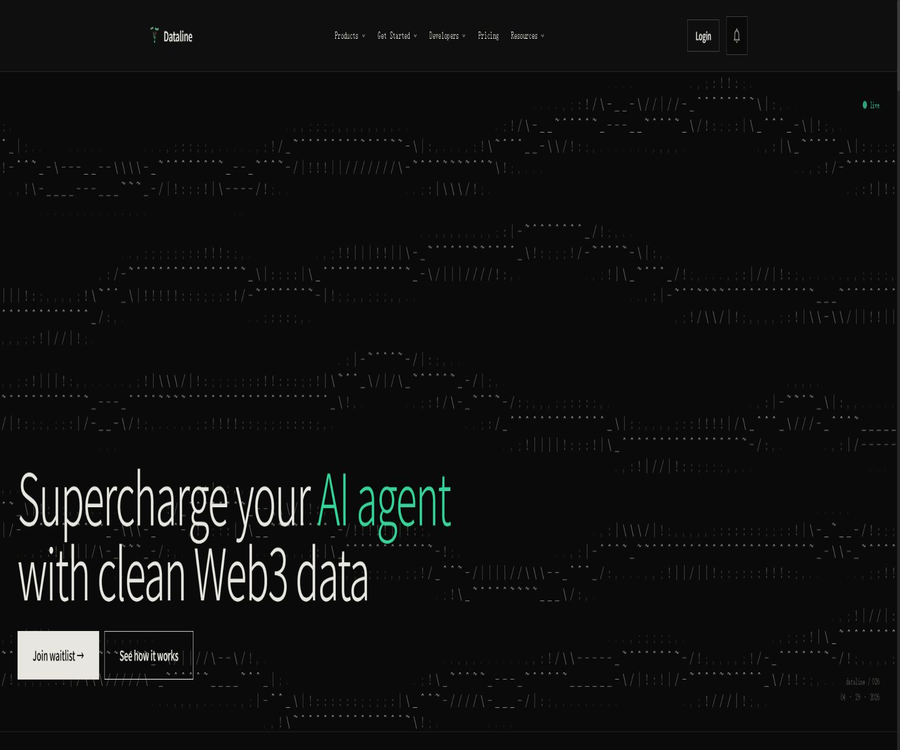
Dataline evolved from the former Tearline brand; its focus has shifted from Web3 task execution to the data layer for AI agents. The main statement on its official website is that it provides clean Web3 data for AI agents.
As of August 22, 2026, the official website is accessible, but the publicly available content is very limited – there are no complete product pages, development documentation, price lists, or a self-service console. The announcements regarding external partnerships state that deeper integration of APIs and SDKs will be carried out after the release of Dataline.
Current product status
| Project | Current verifiable status | Strength of evidence | Directory formatting |
|---|---|---|---|
| Brand positioning | Provide clean Web3 data for AI Agents | The title on the official website is clear. | The location has been made public. |
| Brand channels | Tearline was transformed into Dataline. | The official release matches the brand’s content. | It can illustrate the transformation relationship. |
| Unified data invocation | Description of open planning and collaboration | There is a product description, but endpoint documentation is missing. | Marked as planned capacity |
| API | The partner stated that it will connect after the release. | No public references available yet. | It cannot be written as being open. |
| SDK | The partner stated that it will connect after the release. | No downloads or documents available yet. | It cannot be written as already published. |
| Price | Not disclosed | No pricing page | Contact the team or wait for the release. |
| Registration and trial use | No findings were detected. | No console entry point | It is not possible to experience it publicly at the moment. |
The core capabilities planned
Unified Web3 data entry point
Dataline aims to enable agents to obtain structured information on multiple markets and chains through a single call, thereby reducing the workload for developers who have to connect to different exchanges, protocols, and indexing services separately. The exact number of sources and interfaces involved has not yet been disclosed.
Spot market data
The public collaboration documentation lists Spot as part of the data range; it can be used for price monitoring, market comparison, and decision-making by agents. There is no list of public exchanges, nor information regarding the frequency of updates, latency, or the depth of the market data.
Perpetual contract data
The Perps data may include prices, funding rates, and other derivative indicators. Currently, there are no fields defined for the schema, no information on the historical range, no rules for pricing adjustments, and no guidelines for handling exceptions.
Predictive market data
The platform aims to standardize the odds or probability information available in the prediction market, thereby assisting agents in comparing the pricing of various events. Since different platforms have distinct settlement rules and levels of liquidity, these figures cannot be compared directly without taking into account the specific market conditions.
On-chain status data
Onchain data is used to help agents understand the status of blockchain networks, wallets, protocols, and transactions. The lists of supported chains, the confirmation depth, reorganization processes, and index latency have not yet been made available on the official website.
Standardization and multi-source aggregation
The brand launch materials describe the processing pipeline, which ranges from intent parsing, route selection, schema standardization, multi-source aggregation to structured output. This architecture overview is related to the product direction; there are no public interfaces available for developers to verify each component individually.
Confidence score
The partner stated that the data returned will include a level of confidence, which helps agents determine whether a certain value is suitable for triggering an action. The scoring algorithm, the number of data sources, the thresholds, and historical calibration results are not made public.
Agent native data
Dataline is not a market data website intended for ordinary users; rather, it is designed to serve as a data layer that can be invoked by AI Agents. Its main advantages lie in its structured format, cross-market capabilities, and programmability, rather than providing a manual interface for chart-based trading.
From Tearline to Dataline
Previously, Tearline focused on developing a Full-Chain AI execution stack, which included components for task planning and execution such as FlowAgent and Ghostdriver. After the rebranding to Dataline, reliable data was regarded as a fundamental requirement before any tasks are carried out.
| Phase or component | Main positioning | Public availability | Relationship with the current Dataline |
|---|---|---|---|
| Tearline | Web3 agent execution infrastructure | Cross-chain tasks and automation | Previous brand and technical background |
| FlowAgent | Modular task orchestration | DAG processes, states, and auditable execution | It’s not the data API itself. |
| Ghostdriver | Native browser automation | Operating Web2 and Web3 interfaces | It belongs to the historical execution stack. |
| Dataline | The Web3 data layer of AI Agents | Standardized multi-market data and confidence direction | Current brand positioning |
Expected data processing workflow
- An AI Agent or application must specify the market, assets, chains, or event conditions that need to be queried.
- Dataline analyzes the intent of the request and selects the appropriate data source and routing path.
- The system obtains raw data from various markets or on-chain channels.
- The fields, units, times, and identifiers from different channels are mapped to a unified Schema.
- The aggregation layer compares multiple results and assigns a confidence level to the available data.
- The structured results are returned to the agent for analysis, monitoring, or the generation of recommendations.
- High-risk actions are verified, simulated, and manually approved at the external execution layer.
- Utilize the saved channels, times, requests, and actual results to continuously assess data quality.
Future Access Guide
Evaluation data API
- Wait for the public development documentation to be available, and verify the endpoints, authentication methods, network settings, as well as the field schemas.
- Request the complete list of data sources, scope of permissions, latency, and service levels.
- Compare prices, timestamps, and missing values using the same set of assets with independent price sources.
- Check whether there are clear definitions for the confidence score and reproducible calibration methods.
- Test cut-offs, extreme fluctuations, chain reorganization, market pauses, and conflicts between sources.
- The production agent can only be integrated after passing sandbox validation.
Set security boundaries for trading agents
- Using the Dataline results as an input signal does not equate directly to a trading order.
- Set up an asset allowlist, individual transaction limits, daily limits, and maximum slippage.
- The quotation timestamp must fall within the allowed range, and cross-checking should be carried out using multiple independent channels.
- Automatic execution is prohibited when the confidence level is low, there are channel conflicts, or delays occur.
- Simulate the on-chain results before conducting the transaction, and check authorization, Gas usage, routing, and contract address.
- The manual pause, key revocation, and emergency liquidation mechanisms are retained.
Build a market monitoring agent
- Select a specific range from spot, perpetual, predictive markets, or on-chain indicators.
- Unify asset identifiers, pricing currencies, exchanges, networks, and time granularity.
- Define normal thresholds, abnormal thresholds, and data unavailable status.
- A cooling period is set for repeated alerts to prevent the agent from triggering them continuously.
- The notification shows the data time and input type, rather than just presenting a conclusion.
- Regularly conduct random checks for false positives, missed reports, and delays, and adjust the rules accordingly.
Which users are it suitable for
- Web3 AI Agent developers: Provide the agents with unified cross-market data inputs.
- DeFi application team: Monitors changes in spot, perpetual, and on-chain statuses.
- Predictive market products: Compare the probabilities and liquidity of multiple event markets.
- Quantitative research team: Reduces the effort required for cleaning fields from different data sources.
- Wallet and asset management apps: provide context for risk alerts and market summaries.
- Agent platform: Utilizes standardized Web3 data as an integrated tool capability.
- Research institutions: Assess the value of data with confidence levels for automated decision-making.
Typical use cases
| Scene | Required data | Expected output | Necessary protection |
|---|---|---|---|
| Cross-market price monitoring | Spot prices across multiple platforms | Standardized spread | Timestamp and exception source filtering |
| Monitoring of funding rates | Perpetual contract indicators | Cross-platform rate comparison | Contract rules and delayed verification |
| Comparison of prediction markets | Odds, probabilities, and liquidity | Differences in market responses to the same event | Matching of settlement terms |
| On-chain risk warning | Protocol and wallet status | Abnormal changes indicate | Confirm depth and false alarm handling |
| Trading agent context | Market and on-chain aggregated data | Structured decision input | Simulation, limits, and manual approval |
| Development of agent applications | Unified API or SDK | Callable data tools | Keys, costs, and permissions |
Product advantages
- A data consumption approach specifically designed for AI Agents, rather than merely providing human-operated market pages.
- The target covers spot, perpetual, forecast markets, as well as on-chain states.
- A unified schema can reduce the need to adjust fields and units across different data sources.
- Multi-source aggregation has the potential to reduce the impact of errors made by a single provider on agents.
- The confidence direction allows the agent to choose not to proceed when the data has low reliability.
- This forms the technical background of data accumulation along with execution on the Tearline execution stack.
- It has been included in the BNB Chain AI ecosystem directory, and cooperation on agent platforms has been established.
Usage restrictions and precautions
- The current official website provides very little information, making it impossible to test the data interfaces or the console directly.
- There are no public documentation available for the API and SDK, and the partners have indicated that deep integration is a task to be undertaken in the future.
- There are no public prices, free quotas, rate limits, or enterprise service levels.
- The list of data sources, exchanges, prediction markets, and blockchain covers has not yet been made public.
- The confidence algorithm and calibration methods are unknown, so they cannot be used as a direct guarantee of risk.
- Market data may be delayed, missing, or inconsistent in extreme market conditions.
- Web3 transactions are irreversible, and incorrect data can lead to the loss of real assets.
- The figures regarding scale and success rate listed in the official release are part of the brand’s statements; the audit methods used are not made public.
- Do not include open-source data analysis tools with the same name or other Dataline projects in this entry.
Price and status
As of August 22, 2026, the Dataline website does not provide information regarding a free version, trial credits, subscription plans, pricing for individual calls, or options for corporate quotes. Any prices offered by third parties cannot be considered as the official current prices.
| Project | Current price | Open state | Equity can be confirmed. | Suggestions |
|---|---|---|---|---|
| Visit the official website | Free | Accessible | Only the brand positioning is displayed. | Used to understand the direction of the product. |
| Data API | Not disclosed | No public applications were found. | Planned unified invocation | Waiting for development documentation |
| SDK | Not disclosed | The cooperation notes state that integration will take place later. | No public download available | Do not select published integrations. |
| Corporate cooperation | The details of the customization are not available. | There is already information on ecological cooperation. | Directly confirm the contract and SLA | |
| Chain or transaction fees | Determined by external networks and protocols. | It does not fall under the category of data service fees. | Calculate Gas and transaction fees separately. |
Promotion metrics and validation boundaries
The brand’s release materials list key metrics such as the number of transactions processed on the chain, the success rate of executions, and the level of interaction with AI Agents. These figures may be related to Tearline’s historical performance, and they cannot be used as proof of the availability or accuracy of the Dataline data API.
| Indicator type | What can it illustrate? | It can’t prove anything. | Purchase verification |
|---|---|---|---|
| Historical transaction volume | The team has experience in Web3 implementation. | Current throughput of the data API | Require API stress testing |
| Execution success rate | Statement on historical process performance | Accuracy of the data itself | Define the criteria for success |
| Number of Agent interactions | The product was once used on a large scale. | Current number of paid customers | Verify activity and version |
| Multi-chain coverage | History involves aspects of ecology. | List of the complete chain of new data products | Request real-time coverage table |
Supported platforms and data ranges
| Category | Current instructions | Maturity | Unpublicized information |
|---|---|---|---|
| Official Web Site | Support | Brand display | Console and account |
| Spot market | Plan support | Product description phase | Exchanges and fields |
| Perpetual contracts | Plan support | Product description phase | Contracts and Delays |
| Predictive market | Plan support | Product description phase | Platform and settlement mapping |
| On-chain data | Plan support | Ecological data is available. | Chains, protocols, and confirmation rules |
| API | The planned unified invocation | Unpublished documents | Authentication, endpoints, and rate limits |
| SDK | The partner says integration will take place in the future. | Not disclosed | Language, package name, and license |
| Mobile App | No findings were detected. | Verifiable functions are not supported. | There is no need to write it as a client. |
Data quality and risk control
- All market values retain the input type, trading venue, block height, and timestamp.
- Unify asset addresses and networks to prevent confusion among tokens or packaged assets with the same name.
- Set filtering rules for price deviations, zero liquidity, disconnections, and abnormal spikes.
- Stop automatic actions when there are conflicts across multiple channels, rather than selecting the most favorable value.
- Prediction markets must have exactly the same event definitions and settlement conditions.
- For on-chain states, finality, reorganization, cross-chain bridges, and indexing latency need to be taken into account.
- Save the original response along with the standardized results to facilitate post-event auditing of mapping errors.
- Periodically assess through independent channels whether the confidence score truly corresponds to the error rate.
Privacy and security
The current official website does not provide any publicly accessible privacy policy, terms of service, data processing agreements, or security whitepapers. Before using the API, it is necessary to clarify how account information, query data, wallet addresses, keys, and policy-related details will be stored and utilized.
- Do not submit wallet private keys, seed phrases, or transaction signatures to data services.
- API Keys are stored only on the server, and are isolated by environment, proxy, and permissions.
- Avoid including offline information that can identify an individual’s identity in the query.
- Confirm the logging, caching, backup, cross-border transfer, and deletion deadlines.
- Suppliers are required to list the data sources, sub-processors, and the procedures for notifying of security incidents.
- The agent-based wallet implementation uses a minimum balance, an allowlist, and quota restrictions.
- Separate data reading from signature execution to prevent a single component from controlling the entire asset processing flow.
API, SDK, and open-source status
Dataline focuses on unified data calls as its key priority, and the partnership documents mention that APIs and SDKs will be integrated into the agent development platform in the future. However, no public endpoints, authentication mechanisms, schema definitions, rate limits, package managers, or download instructions are available at present; therefore, this initiative can only be considered as something planned for the future.
No official GitHub organization, source code repository, or open-source license associated with the current Dataline Web3 project was found. RamiAwar’s DataLine, which shares the same name, is an independent AI data analysis project and cannot be considered part of Dataline’s code.
Basic information
| field | Content |
|---|---|
| Tool name | Dataline |
| Previous brand name | Tearline |
| Tool type | Web3 data infrastructure for AI Agents |
| Core data direction | Spot, perpetual, predictive markets, and on-chain status |
| Core processing | Routing, standardization, multi-source aggregation, and confidence |
| Current product stage | During the phase of brand and ecosystem collaboration, there are limited public documents available. |
| Price pattern | Not disclosed |
| Registration requirements | No public account entry was found. |
| Main platforms | Web brand page, future APIs and SDKs |
| API | No public documents were found in the plans. |
| SDK | In the plan, no public downloads were found. |
| Official GitHub | No verifiable warehouse was found. |
| Is it open source? | No |
| Related ecology | BNB Chain collaborates with agent platforms |
Recommendation score
The recommendation score is 3.2 out of 5 points. It provides clear value by aggregating AI Agent data from spot markets, perpetual markets, predictive markets, and on-chain data, along with confidence levels.
The current deduction is due to the fact that the product documentation, APIs, SDKs, pricing information, data sources, and security-related documents have not been fully made available. It is more suitable for developers to focus on and for business discussions; it is not appropriate to use these resources directly without going through a trial phase first.
Frequently Asked Questions
What is Dataline?
It is a Web3 data project designed for AI Agents; it aims to standardize data from various markets and chains and provide it through a unified interface.
What is the relationship between Dataline and Tearline?
Dataline evolved from the Tearline brand. Tearline’s original FlowAgent and Ghostdriver were part of the execution stack and do not correspond to the functions of today’s data APIs.
Can I register and start using it now?
No public self-registration options, API key application processes, or testing console were found. The current official website mainly displays information about the brand’s positioning.
Is Dataline free?
It cannot be confirmed; the official website does not indicate any free quota, per-use pricing, or subscription plans. Any prices will have to await the official determination or a written quote.
Which types of data are supported?
The public exposure areas include spot markets, perpetual contracts, prediction markets, and on-chain states; however, the specific channels, chains, fields, and update frequencies are not disclosed.
Is the confidence score reliable?
At present, there are no public algorithms or calibration reports, so it cannot be considered a guarantee of accuracy. Independent testing with actual data is necessary before it is used in production.
Are APIs and SDKs available?
They are part of the planned core access methods, but currently there are no public API documents, SDK packages, or authentication guidelines, so they cannot be considered officially available.
Is Dataline an investment tool?
It is not an investment advisory product designed for individuals, but rather an infrastructure for agent data. The data provided does not guarantee profitable trading outcomes.
Is Dataline open source?
It is not open source; no official source code repository or license for this project has been found. Do not confuse it with the open-source data analysis software that shares the same name.
Summary
Dataline aspires to become the Web3 data backbone for AI Agents, transforming information from various markets and on-chain sources into unified, structured data with a level of confidence assigned to it, thereby reducing the need for developers to manually combine different data sources.
However, there is still a lack of public details on the product that can be used for verification. Before it can be put into use, it is necessary to wait for the release of the API and SDK, as well as to conduct tests regarding data sources, latency, accuracy, pricing, security, and extreme market conditions.
Tools similar to Dataline



 Guigong Network Security Registration No. 45132202000164