






Dappier
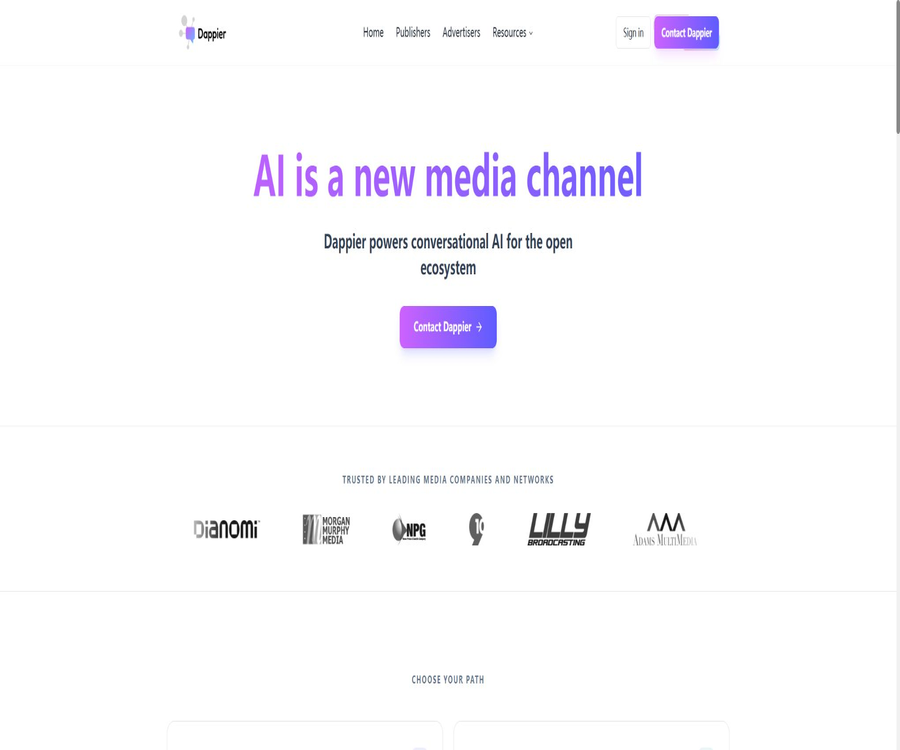
Dappier, an intelligent tool focused on improving AI efficiency.
Tags:AI improves efficiencyA one-sentence summary
Dappier is a data platform that links AI applications with real-time, authorized content; developers can use APIs, SDKs, or MCP to access search data, financial information, and industry-specific content, while publishers can synchronize their data and generate revenue from queries.
Tool Introduction
Dappier serves two types of users: on one hand, AI developers who need the latest information; on the other hand, media and publishers who wish to incorporate their content into AI products in order to generate revenue. It organizes data sources through a model market, eliminating the need for developers to retrain the underlying models.
The platform also offers AI recommendation components, an Ask AI chat component, and AI Mode that can be deployed on one’s own subdomain. By 2026, the homepage of the official website will feature a dedicated purchase option for AI agents without the need for registration; the procedures related to traditional platform accounts and API keys will still be outlined in the development documentation.
Core product portfolio
| Products | Primary users | Key capabilities | Delivery method |
|---|---|---|---|
| Real-time search | AI application developers | Websites, news, weather, travel, and event inquiries | API, SDK, or MCP |
| Financial data | Research and Financial Applications | Stock prices, financial reports, news, and market insights | Query API |
| AI Recommendations | Media and content products | Recommend articles based on semantics, time, or trends | APIs and web components |
| RAG Marketplace | Developers and publishers | Discover or publish vertical data models | Model ID invocation |
| AI Agent | Content owner | Synchronize with RSS or Airtable and configure roles | Hosting platform |
| AI Mode | Brand website | Custom Q&A content, themes, and custom domain names | Hosted page or embedding |
| MCP Server | AI agents representing users | Integrate real-time tools into clients such as Claude and Cursor. | Open-source server |
Main functions
Real-time web search
Dappier Search enables natural language queries for the latest news, weather, travel information, events, trending topics, and shopping details. The official model list classifies this search engine as free, but the scope of the free service, the rate at which it can be used, and any long-term policies are subject to the details displayed in real time on the account or agency store page.
Stock market data
Financial models provide information on stock prices, financial reports, market news, as well as insights that take emotional factors into account. The MCP documentation also states that the data comes from Polygon. The financial figures are up-to-date, but they should not be used as direct trading advice or as unverified transaction prices.
Vertical content recommendation
The AI Recommendations API can return relevant articles based on natural language queries or page content, providing output that includes fields such as title, summary, author, images, publication date, source, and relevance. Users can choose from semantic, latest, recent semantic, or trend algorithms.
RAG Data Market
Developers can select data models from the market and obtain model IDs that start with a specific prefix, after which they can query them through a unified interface. The data sources, prices, licensing scopes, and update frequencies vary among different models.
Publication and monetization of content
Publishers can create AI Agents, synchronize their content, add brand information, and set prices for each query, after which they can apply to have their data models released on the market. The platform also mentions two ways of generating revenue: through queries and through advertisements.
AI recommendation and Q&A components
Websites can incorporate content recommendation or Ask AI components to provide readers with relevant suggestions and instant answers. The increased interactivity brought about by these components is part of the official marketing data; the actual impact depends on factors such as traffic volume, content quality, location, and loading speed.
AI Mode brand page
AI Mode allows you to set a name, description, role, theme, suggestions, link rules, and analysis code for the agent, and to deploy it at a Dappier-hosted address or on your own subdomain. The DNS settings, certificates, and SEO optimization for a custom domain need to be verified before the service goes live.
APIs and asynchronous calls
The real-time search interface accepts queries using the model ID and returns the resulting outputs. The recommendation interface supports pagination, control over the number of results, specification of channel domain names, and various search algorithms. The Python SDK offers both synchronous and asynchronous clients, making it suitable for different concurrent use cases.
Integration of MCP tools
The official MCP Server enables the connection of search, financial, and content recommendation tools to AI clients that support MCP. It requires a Dappier API Key, and the client configuration files and keys must be stored in accordance with local security standards.
Integration with automation and proxy frameworks
The official documentation covers ecosystems such as LangChain, LlamaIndex, OpenAI Agents, Google ADK, CAMEL, Zapier, Activepieces, Replit, Cursor, and Claude. The party responsible for maintaining each of these integrations, as well as their versions and costs, vary.
Developer onboarding process
- Register an account on the platform and create a separate API Key in the personal settings.
- In the model market, choose between real-time search, financial, or vertical content models.
- Record the model ID, unit price, output fields, channel, and license.
- First, use a small number of queries in the testing environment to verify the responses, response times, and error handling.
- Choose to connect via direct REST API, Python or Go SDKs, MCP, or an automation platform.
- Add timeout, retry, caching, rate limiting, cost limits, and channel display.
- After going live, monitor changes in success rate, latency, per-request cost, and data quality.
API Usage Tutorial
Invoke real-time search
- Create an API Key and store it only in server-side environment variables or a key management system.
- Select the real-time search model and copy its corresponding model ID.
- Send natural language queries to the real-time search endpoint, using Bearer authentication.
- Check the status code and message field; provide a degraded response for empty results or timeout situations.
- Retain the query time and original materials for news, price, and weather results.
- Conduct actual stress testing based on the free quota and speed, and then determine the production capacity.
Building article recommendations
- Select a data model that matches the website’s theme and verify the price for each query.
- Use keywords or the content of the current page as the query input.
- Set the number of items to return, the domain name of the channel, and the sorting algorithm based on semantics or time.
- Display the title, abstract, images, channels, and publication date, while handling redirects properly.
- Filter out results that are duplicate, expired, low in relevance, or not suitable for the current audience.
- Record click and dwell time data, but do not treat the relevance scores as actual ratings.
Publish one’s own data model
- Create an AI Agent and synchronize the content to which access is granted via RSS or Airtable.
- Set the name, description, instructions, roles, and example prompts.
- On the monetization page, upload the display image and fill in the publisher details.
- Set the price for each query and assess the platform’s commission as well as market competition.
- Check for updates, deletions, copyright issues, advertisements, and user privacy policies.
- After publication, random checks are conducted along with root-cause analysis to continuously correct incorrect information.
Which users are it suitable for
- AI application developers: Add real-time search capabilities to chatbots and agents.
- Financial Products Team: Access to stock market data, financial reports, and market news.
- Media publishers: Convert articles into queryable data models and generate revenue based on usage.
- Content websites: Deploy relevant recommendations as well as the Ask AI feature within the site.
- Automation team: Access real-time data via Zapier, Activepieces, or MCP.
- Research and travel apps: access to news, weather, events, and updates on destinations.
- Proxy developer: Integrates the Dappier tool with frameworks such as LangChain and LlamaIndex.
Typical use cases
| Scene | Recommendation capability | Main output | Key checks |
|---|---|---|---|
| News Q&A agent | Real-time search | Latest summaries and channels | Publication time and multi-source verification |
| Stock research assistant | Financial models | Prices, financial reports, and sentiment data | Timestamps and non-investment advice |
| Media-related recommendations | Recommended APIs | List of related articles | Copyright, Attribution, and Reproduction |
| Brand knowledge Q&A | AI Agent and AI Mode | Answers based on proprietary content | Knowledge renewal and illusions |
| AI desktop client | MCP Server | Real-time tools can be invoked | Local keys and tool permissions |
| Publishers monetizing | RAG Marketplace | Query data services | Pricing, Licensing, and Revenue Sharing |
Price comparison with models
The following are the prices of sample models listed in the official Python SDK documentation as of August 22, 2026. The models and their prices available on the market may be adjusted by the platform or the publisher; therefore, the production budget should be based on the current prices shown on the model page prior to making any calls.
| Model | Type | Public unit price | Main content |
|---|---|---|---|
| Dappier Search | Real-time search | Free | Websites, news, weather, travel, and events |
| Stock Market Data | Financial data | $ | Stock prices, financial reports, financial news, and market sentiment |
| Sports News | Content recommendation | $ | Sports news and analysis |
| Lifestyle News | Content recommendation | $ | Pop culture, health, and trend content |
| iHeartDogs AI | Content recommendation | $ | Content on dog training, care, and health |
| iHeartCats AI | Content recommendation | $ | Cat behavior, health, and daily life |
| GreenMonster | Content recommendation | $ | Sustainable living and environmental protection topics |
| WISH-TV AI | Content recommendation | $ | Local news, politics, and cultural content |
The official tutorial states that new accounts receive free points for getting started, but it does not specify in the public documents the exact amount of these points, their validity period, or the fact that all models can be used. The free real-time search feature does not mean that there are no additional costs associated with third-party models, LLMs, MCP clients, and automation platforms.
Cost estimation and selection
| Demand | Suggested models or approaches | Cost characteristics | Precautions |
|---|---|---|---|
| Universal real-time Q&A | Dappier Search | The document is marked as free. | Confirming rate and fair use |
| Stock data | Stock Market Data | Low price per use | High-frequency polling still incurs costs. |
| High-value media content | Sports or Lifestyle | $ | First, evaluate the number of queries per user. |
| Vertical pet or local news | Corresponding data model | $ | The channels and geographic coverage vary. |
| Publishers’ own content | Create a data model | It is possible to set a CPM or a one-time price. | The platform’s revenue sharing mechanism is not fully explained in the tutorial. |
| Purchase without registration through an agent | Agent storefront | Set real-time prices for products | Verify authorization and payment approval |
Integration and support platform
| Method | Support status | Primary uses | Notes |
|---|---|---|---|
| REST API | Support | Real-time search and recommendations | Authentication using Bearer API Key |
| Python SDK | Support | Synchronous and asynchronous development | Install the dappier package |
| Go SDK | Listed in the official documentation | Integration with Go projects | Check the version before use. |
| MCP Server | Supported with publicly available source code | Claude, Cursor, Windsurf, etc. | An API Key is required. |
| LangChain and LlamaIndex | Support | Tools and search engines | Reliant on the corresponding integration package |
| Zapier and Activepieces | Support | Low-code automation | Platform fees are charged separately. |
| OpenAI Agents and Google ADK | Support | Proxy workflow | The cost of the model is charged separately. |
| Web components and AI Mode | Support | Website Q&A and recommendations | Hosted or custom domain names available |
Product advantages
- Combine real-time search with financial and licensed vertical content in a unified market.
- It is not tied to any specific large model and can serve as the data layer for different AI systems.
- It offers access methods via REST, Python, Go, MCP, and various proxy frameworks.
- The recommendation results include the channel, publication date, and related fields, which facilitate the presentation of the products.
- Publishers can synchronize their own content and set prices based on searches.
- It supports managed AI Mode, custom branding, domain names, and analysis configurations.
- The official MCP Server is licensed under the MIT license, allowing for the inspection and custom operation of the connection layer.
Usage restrictions and precautions
- Real-time and trusted sources can only reduce illusions; they cannot guarantee that each result is correct.
- In the model market, data coverage, prices, update frequencies, and licensing scopes vary.
- The model prices listed in the document may be older than the current prices available in the retailer stores and accounts.
- Free searches may have undisclosed speed limits, fair use policies, or service capacity restrictions.
- Financial data is subject to delays and errors, making it unsuitable for directly triggering transactions without any verification.
- The recommended APIs may return duplicate, off-topic, or outdated articles, which require filtering on the product side.
- Third-party frameworks, LLMs, and automation platforms incur separate costs and pose security risks.
- Publishers must have the rights to distribute content and use AI, and are not allowed to upload unauthorized materials.
- The exposure of API keys can lead to risks related to data access and billing; therefore, they must not be included in the front-end code.
Privacy, security, and content licensing
Dappier handles API queries, keys, model configurations, content synchronization, and interactions with end users. Before integrating with the service, enterprises should verify in the account agreement details regarding data retention, uses for training, sub-processors, cross-border data transfers, deletion procedures, and notifications for security incidents.
- Create different keys for development, testing, and production, and restrict their scope of use.
- Personal information, tokens, financial accounts, and confidential business data are masked in the logs.
- Set daily budgets, limits for individual tasks, and anomaly circuit breakers for high-frequency agents.
- When displaying third-party content, retain the source, author, and tracking attribution.
- Confirm the scope of caching, redistribution, and generative use allowed for each data model.
- Upon receiving a request to delete or correct data, the index and downstream caches are updated synchronously.
- Configure content review and human feedback channels for AI Mode and embedded components.
API, SDK, and open-source status
Dappier offers public REST APIs, a Python SDK, a Go SDK, and an MCP Server. The Python SDK supports both synchronous and asynchronous search and recommendation functions, while the MCP Server can be used with compatible clients such as Claude Desktop, Cursor, and Windsurf.
The MCP Server repository within the official DappierAI organization is licensed under the MIT license and welcomes contributions; however, this only means that the source code for this connector is open. The Dappier hosting platform, data market, indexes, data models, and commercial content themselves do not become open-source projects as a result of this.
Basic information
| field | Content |
|---|---|
| Tool name | Dappier |
| Tool type | Real-time data APIs, RAG markets, and content monetization platforms |
| Primary users | AI developers, agency teams, media, and publishers |
| Core data | Websites, news, weather, travel, finance, and niche content |
| Authentication method | API Key and Bearer authentication |
| Free method | Some real-time searches are free, and introductory points are available. |
| Payment methods | Charged by model and query |
| API | Provide |
| Official SDK | Python and Go |
| MCP | Provides instructions for local and remote access. |
| Official GitHub | DappierAI organization |
| Is it open source? | The platform is not open-source; the MCP Server is available under the MIT open-source license. |
| Main platforms | Web, REST, SDK, MCP, and automated integration |
Recommendation score
Its rating is 4.3 out of 5 points. Dappier’s advantages lie in its wide range of data types and comprehensive integration methods; it also provides developers and publishers with pathways for real-time data trading and monetization.
Before use, it is still necessary to check individually the price of the model, the data licensing terms, as well as the latency and accuracy. Documents, markets, and new agent stores are evolving in parallel; therefore, production systems should not fix example prices in advance.
Frequently Asked Questions
Is Dappier free?
Some real-time web search models are listed as free in the official SDK documentation, and the tutorials also mention introductory credits; financial and niche content models, on the other hand, are typically charged per query.
What is the difference between Dappier and regular search APIs?
It not only offers real-time web search, but also organizes financial and publisher-approved content into queryable data models, while providing features such as recommendations, monetization options, and AI Mode.
How to obtain an API Key?
After registering an account on the platform, you can create keys in the API Keys section of your personal settings. Keys should be stored only on the server side; they must not be saved on web pages or in public repositories.
Is Python supported?
Support is available; the official Python SDK offers synchronous and asynchronous clients that enable the use of real-time search and content recommendation functions. The documentation also mentions the Go SDK.
Can it be connected to an MCP client?
Yes, the official MCP Server provides configuration examples for Claude Desktop, Cursor, Windsurf, etc., as well as remote access solutions designed for compatible clients.
How do publishers make money?
Publishers can simultaneously use the content they have rights to, create data models, set prices based on queries and release the products in the market; they can also employ ad-supported Q&A functions and product recommendations.
Is all the data real-time?
No, different models have various channels and update schedules; recommended content may also be sorted by semantics, recency, or trends. The product should retain timestamps and verify key facts.
Is Dappier open source?
The Dappier business platform and its data models are not open source, but the official MCP Server is licensed under the MIT license. The fact that connectors are open source does not mean that the data, API services, or content are available free of charge.
Summary
Dappier is suitable for teams that need to integrate the latest web content, financial, or professional media content into AI agents; it also provides publishers with the means to create RAG models, deploy brand-specific Q&A systems, and generate revenue from queries.
Upon official launch, the model prices and licensing terms should be set as dynamic configurations; API keys must be strictly protected, and manual verification mechanisms should be put in place for channels, timestamps, accuracy, and high-risk outputs.
Tools similar to Dappier



 Guigong Network Security Registration No. 45132202000164