






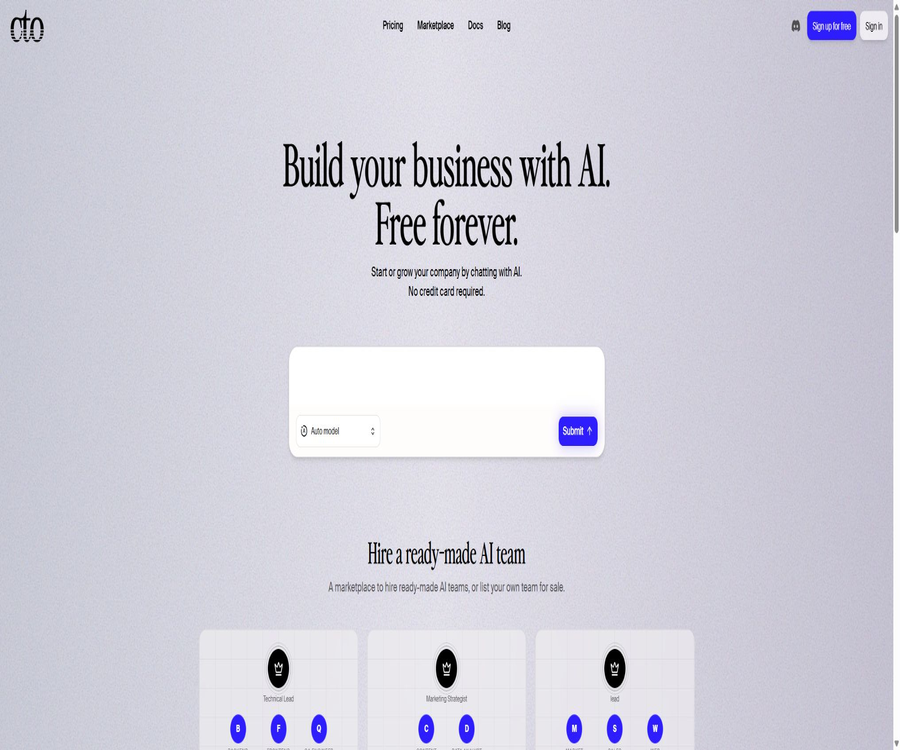
cto.new
cto.new, an intelligent tool focused on improving AI efficiency.
Tags:AI improves efficiencyA one-sentence summary
CTO.New is an AI development platform that operates in a cloud sandbox; it allows individual agents or teams of agents to plan tasks, modify code, run tests, deliver applications, or submit pull requests, all starting from conversations, project requirements, or code repositories.
Tool Introduction
cto.new is operated by Engine Labs; its initial focus was on converting GitHub issues into review-ready pull requests. Today, the product has been expanded to cover web applications, mobile applications, AI teams, as well as the markets for MCP integrations and proxy services.
It reduces the barriers to local setup by utilizing hosting models and remote development environments; free users do not need to have their own model API keys. When it comes to real repositories, deployment credentials, and business automation, a principle of minimum permissions along with manual review should still be applied.
Product format
| Project type | Main inputs | Typical output | Suitable for users |
|---|---|---|---|
| Code repository tasks | GitHub repository, Issue, or task description | Code modifications, test results, and pull requests | Developers and engineering teams |
| Web applications | Requirements for natural language products | Front-end and back-end applications that can be previewed | Entrepreneurs and product teams |
| Mobile apps | Application ideas and interaction requirements | Mobile projects and previews | Prototype and application developers |
| AI Business | Business plans, goals, and roles | A multi-agent team coordinated by a supervisor | Small teams, creators, and entrepreneurs |
| CTOClaw proxy | Ongoing tasks and external messages | Agents that can be awakened and tasked to carry out work | Users who require continuous automation |
| Agency market | Ready-made team or self-built team | Agency teams that can be acquired, purchased, or sold | Users who wish to reuse workflows |
Main functions
Chat-based planning and construction
Users can first describe their goals in a chat, allowing the system to break down the plan, ask for any missing information, and then initiate the execution via agents. For complex projects, it is more reliable to first determine the scope, technology stack, and acceptance criteria, rather than asking for a complete product to be created right away.
Backend code proxy
Code tasks are executed in separate cloud virtual machines; the agent can read from repositories, install dependencies, modify files, run commands, and conduct tests. The result is usually a pull request intended for manual review, rather than the code being merged directly into the main branch on behalf of the user.
Integration of GitHub with task management tools
GitHub App allows the platform to access authorized repositories and create branches as well as pull requests. Tasks can also be assigned from Linear, Trello, Jira, ClickUp, or Slack, enabling teams to distribute work based on existing processes.
Web and mobile app development
Web application projects offer real-time previews, interactive chat, and a hosted development environment, enabling the rapid creation of full-stack prototypes. Official updates indicate that these Web projects use predefined development stacks and provide backend services; however, it is still necessary to examine the security, maintainability, and deployment settings of the resulting solutions.
Multi-agent AI business team
AI Business allows for the creation of a Team Lead along with multiple team members; the leader can plan tasks and assign them to those working in engineering, marketing, research, content creation, or other areas. Each member can choose different models, and they can monitor the progress of tasks through activity records.
Agency Team Market
The market offers ready-made agency teams, and it also allows users to create their own teams and set prices for them. According to the platform’s terms, it generally does not check the quality, safety, or accuracy of the products offered by sellers; buyers are responsible for examining the delivered items and verifying their authenticity on their own.
MCP and skills
The platform pre-configures MCP connections for services such as Linear, Sentry, Vercel, Notion, and Webflow, and allows the addition of custom MCP servers. External tools expand the range of data that can be accessed and the operations that can be performed by the proxy; it is therefore necessary to check the publisher, permissions, and write capabilities before granting access.
Multi-model selection
Users can use models from OpenAI, Anthropic, Google, and other providers, or they can let the Auto mode select a model based on the task at hand. The list of available models is constantly changing; therefore, a model that is available at a certain point in time should not be considered a guaranteed option for the long term.
Code task workflow
- Connect to your GitHub account and grant permissions only to the organizations and repositories that truly need access.
- Configure the proxy to recognize the commands for installation, building, testing, and execution, and make manual adjustments if necessary.
- Specify tasks in chats, task pages, Issue tags, or project management tools.
- Add steps for reproduction, desired behavior, constraints, and acceptance tests.
- The agent creates branches in the cloud task runner, modifies the code, and runs checks.
- View differences, logs, dependency changes, and test results, rather than just reading the proxy summary.
- Propose changes through code review; once security is confirmed, they are merged by authorized personnel.
Create an app from an idea
- Select a web or mobile application project, and describe the target users, core issues, and minimum viable functions.
- The system is required to first output the page layout, data structure, permissions, and delivery plan.
- Verify the technology stack, third-party services, environment variables, and paid dependencies.
- Have the agent implement it in stages, and use previews at each stage to check the interactions.
- Test login, input validation, error handling, mobile adaptation, and data persistence.
- Replace the sample data and temporary keys, and complete the privacy, logging, and backup settings.
- Review the generated code before connecting to the deployment platform, and then proceed with publishing and monitoring.
Create an AI business team
- Prepare a plan that includes objectives, customers, deliverables, constraints, and criteria for evaluation.
- Create a Team Lead, and then add members for engineering, research, content, or operations as needed based on the tasks.
- Assign clear responsibilities, models, skills, and allowed MCPs to each role.
- First, arrange a small task that can be verified in a short time, in order to observe how the person in charge assigns tasks.
- Check each member’s activities, files, and conclusions, and correct any repeated or out-of-scope tasks.
- Enable email, scheduled tasks, and writing to external systems only after confirming the team process.
Which users are it suitable for
- Independent developers: Hand over specific issues to the backend agent for processing, while continuing with other tasks.
- Small engineering teams: Assign tasks for fixes and new features via Linear, Jira, or Slack.
- Non-professional developers: Create verifiable Web application prototypes using chat and real-time previews.
- Entrepreneurs: Use multi-agent teams to carry out tasks related to product development, research, content creation, and initial operations.
- Technical lead: Compare the performance and costs of different models when handling tasks in the same warehouse.
- Automation enthusiasts: Use MCP to connect agents to development, content, and business tools.
Typical use cases
- Identify defects based on the issue that includes reproduction steps, carry out additional testing, and submit a pull request.
- Implement small features, upgrade dependencies, or complete mechanically verifiable refactoring tasks.
- A full-stack prototype is generated from the product description, after which developers take over to enhance it.
- Establish an engineering team composed of a technical lead, front-end developers, back-end developers, and testing agents.
- Have research, writing, and editing agents work together to create draft content, with human oversight for the final review.
- Wake up the agent via email or a scheduled task to carry out tasks that require ongoing follow-up.
Product advantages
- The free plan does not require a credit card or a custom model key, thereby reducing the cost of getting started.
- The remote task runner can install dependencies and run tests, providing more comprehensive output than simple code completion.
- It supports GitHub and various project management tools, allowing integration with existing project workflows.
- It expands from a single code proxy to application development and multi-proxy teams, covering a broader range of tasks.
- Multiple state-of-the-art models can be selected, and external tools can be further expanded through MCP.
Usage restrictions and precautions
- The free version contains ads and is subject to usage limits such as a 24-hour, 7-day rolling limit as well as a daily reset; it does not permit unlimited use.
- AI-generated code may contain security vulnerabilities, incorrect dependencies, license conflicts, or designs that are difficult to maintain.
- The GitHub App requires permissions to access repositories; its installation should be restricted, and authorization should be checked regularly.
- The cloud sandbox handles code, tasks, and logs; production keys or unauthorized customer data should not be submitted directly to it.
- An MCP server can read from or write to third-party systems; the permissions and reliability of each connector must be assessed separately.
- The agency teams and applications available in the market may come from third-party sellers, and the platform does not guarantee their quality, accuracy, or security.
- Models, quotas, and credit consumption will be adjusted; it is important to check the account usage before starting a task for significant projects.
- Without manual review, high-risk actions such as automatically merging code, deploying to the production environment, or processing payments should not be carried out.
Prices and packages
As of August 2026, the official pricing page offers two options: Free Forever and Premium. The Premium plan starts at $20 per month, but the public page does not list all the available price tiers in detail; the information on fixed amounts can be found on the account’s Billing page.
| Plan | Price | Dosage method | Primary interests | Suitable for users |
|---|---|---|---|---|
| Free Forever | $ | Contains ads; restrictions on daily and rolling cycle resets. | Managed models, AI services, web and mobile applications, proxy and MCP integration | Experiences, learning, and lightweight projects |
| Premium | Starting at $20 per month | Higher token limits and rolling 24-hour and 7-day quotas | More high-performance models and higher usage levels | Continuous encoding and heavier projects |
| Market goods | Free or at a price set by the seller | Click on the product page | Ready-made AI teams or applications | Users who wish to purchase third-party results |
Premium credits are typically consumed based on the inputs of various models, as well as the input and output tokens; the outputs of more resource-intensive models deplete these credits more rapidly. Information regarding subscriptions, trial periods, automatic conversions, and refund options should be checked on the billing page along with the current terms before making a payment.
Differences between the free version and Premium
| Comparison items | Free Forever | Premium |
|---|---|---|
| Credit card | It’s not necessary. | It is required when subscribing. |
| Model API key | It’s not necessary. | It’s not necessary. |
| Advertising | Yes | The current plan page shall prevail. |
| Amount used | Lower, with limits based on daily periods and rolling windows | Higher, but there are still 24-hour and 7-day rolling limits. |
| Model | Some state-of-the-art models can be selected. | A wider range including high-performance models |
| Applicable scenarios | Trial and lightweight builds | Frequent tasks and longer agent runtime |
Models and credit consumption
The official documentation uses credits to represent the cost of model tokens, with separate calculations for input, cached input, and output. There are significant differences among different models; tasks that involve long contexts or long outputs generally require more resources than those with shorter inputs.
- Give priority to using Auto or models with lower prices for routine planning and minor modifications.
- Switch to high-cost models only for complex reasoning, architecture, or difficult defects.
- Reduce unnecessary logs and duplicate files, so as to avoid including the entire repository in the context without distinction.
- In the account settings, view the token for a single request and observe the 24-hour and 7-day periods.
- The list of models and their rates will be updated; the exact figures are subject to real-time billing and the relevant documents.
Privacy, Permissions, and Terms
- The entity responsible for operations as specified in the current terms is Era Technologies Limited in the UK, and the products are offered under the Engine Labs brand.
- The content provided by users grants the platform a non-exclusive, royalty-free license necessary for operating and maintaining the services.
- Users must ensure that the code, materials, and products they upload do not violate any laws or the rights of third parties.
- Accounts can be requested to be closed, and the platform can also suspend or delete accounts that are used in violation of rules, in an offensive manner, or improperly.
- The terms require users to keep their own copies of the content they publish and of the data, and not to rely on the platform as the only source for code backups.
- The services are provided as they are, without any guarantee that the content is entirely accurate, will remain available continuously, or will meet all requirements.
GitHub, APIs, and open source status
CTO.new offers officially approved apps that have been verified by GitHub, which are used to connect to authorized repositories and create pull requests. The public terms also specify the rules for using the API, while MCP is used to connect to external tools; however, the exact scope of the public APIs is determined by the current account and the development documentation.
| Project | Is it available? | Primary uses | Open-source assessment |
|---|---|---|---|
| GitHub App | Provide | Authorized repositories, branches, and pull requests | The fact that an application is available does not mean that its source code is open. |
| MCP integration | Provide | Connect tools such as Linear, Sentry, Vercel, Notion, etc. | Each server license is evaluated separately. |
| Custom MCP | Support | Expand external tools and data | Third-party code is not the same as open-source platforms. |
| Platform API | The terms state that the scope is determined by the account. | Access to user-related data or service capabilities | Commercial service interface |
| Engine Labs GitHub | There are public warehouses. | Components, examples, and related projects | It cannot be used as evidence to conclude that the core platform is open source. |
| cto.new core platform | Commercial hosting services | Agents, sandboxes, models, and markets | No open-source license for the core source code was found. |
Supported platforms and languages
| Platform | Support status | Uses | Precautions |
|---|---|---|---|
| Web browser | Support | Chat, Projects, Preview, Team, and Market | The entrance is used primarily. |
| GitHub | Official App | Warehouse tasks and pull requests | Based on warehouse authorization |
| Linear, Jira, Trello, ClickUp | Supports integration | Assign engineering tasks | The range of functions varies depending on the connector. |
| Slack | Supports integration | Initiate tasks and receive results | Check channel and organization permissions. |
| MCP | Support | Linking development tools with business tools | Third-party servers need to be reviewed. |
| Programming languages | It should cover at least nine common languages. | JavaScript, TypeScript, Python, Java, PHP, Ruby, C++, Rust, and Swift | The actual outcome depends on the warehouse and the testing conditions. |
Basic information
| Project | Content |
|---|---|
| Tool name | cto.new |
| Development team | Engine Labs |
| Operating entity | Era Technologies Limited |
| Tool type | AI programming agents, application development, and multi-agent business platforms |
| Price pattern | The free version includes ads; the Premium version starts at $20 per month, with market products having their own pricing. |
| Is registration required? | It is necessary. |
| Does it come with a model built in? | Yes, there is no need to provide your own API key. |
| Primary operation mode | Web and cloud task runners |
| GitHub integration | Yes, there is an officially verified app. |
| MCP | Supports pre-configured and custom servers |
| Is the core platform open source? | No |
Recommendation score
The recommendation score is 4.3 out of 5. The free version allows access to hosted models, cloud sandboxes, and multiple agent teams, making it suitable for users who wish to test code or application ideas at a low cost.
The main shortcomings are the lack of transparency regarding free and paid quotas, the permission risks associated with cloud-based code and third-party MCP services, and the need for development and security expertise to handle the creation of products.
Frequently Asked Questions
Is cto.new really free?
There is a Free Forever option; no credit card or custom model keys are required. The free version includes advertisements and is subject to daily as well as rolling time limits, so it does not provide an unlimited number of tokens.
How much is Premium?
The official website indicates that the Premium plan starts at $20 per month. For details on the different tiers, credit limits, and available models, it is necessary to visit the Billing page.
Can it only be used to write code?
That’s not all. Currently, it also supports web and mobile applications, multi-agent AI teams, MCP tools, as well as a market for agent teams; yet code handling remains a key capability.
Do you need your own OpenAI or Anthropic key?
It’s not necessary; both the free and Premium versions use the models provided by the platform for access. Different models will consume credits at corresponding rates.
Will the codes be merged directly?
Standard code tasks are usually submitted as pull requests for user review. Do not bypass the code review process, automated testing, and the merging procedure carried out by authorized personnel.
Which task management tools are supported?
The official list includes Linear, Trello, Jira, ClickUp, and Slack; users can assign tasks based on existing workflows.
Is cto.new open source?
The core platform does not come with an open-source license, so it should be considered a closed-source hosting service. Engine Labs offers public GitHub repositories or third-party open-source components, but this does not change the nature of the core product.
Can the generated application be launched directly?
It is not recommended to launch a system directly without undergoing review. It is necessary to check identity authentication, data permissions, dependencies, keys, error handling, licenses, as well as testing and production monitoring.
Are the products available on the market guaranteed by the platform?
No. The terms state that third-party sellers are responsible for the quality and safety of the products; the platform generally does not conduct thorough inspections. It is necessary to review the instructions, codes, and authorization documents before making a purchase.
Is it suitable for corporate proprietary code?
It is possible to connect to private repositories, but the security team should first verify the permissions on GitHub, the methods of cloud processing, the retention period, and the organizational compliance requirements, before starting with repositories of lower sensitivity.
Summary
CTO.New brings together managed state-of-the-art models, cloud-based code execution, application previews, and multi-agent teams in a single web workspace, while offering a free access point to lower the barrier to trying it out.
The most reliable way to use it is as a reviewable execution assistant: outline the tasks clearly, grant as few permissions as possible, verify each output item individually, and then decide whether to merge them, deploy them, or purchase ready-made solutions from the market.
Tools similar to cto.new


 Guigong Network Security Registration No. 45132202000164