






ClearML
ClearML, an intelligent tool focused on improving AI efficiency
Tags:AI improves efficiencyWhat is ClearML?
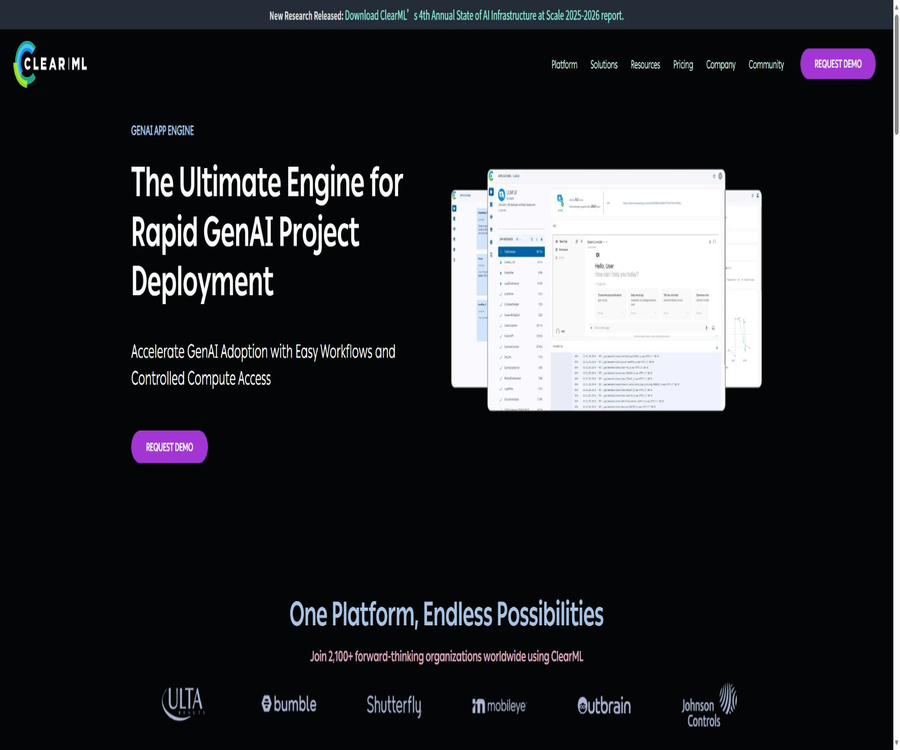
ClearML is an end-to-end MLOps and LLMOps platform designed for teams working in machine learning, generative AI, and infrastructure. It covers experiment tracking, data and model versions, training tasks, pipelines, GPU scheduling, model services, as well as enterprise-level deployment management.
The platform is composed of three layers: the Infrastructure Control Plane, the AI Development Center, and the GenAI App Engine. Users can either use ClearML’s hosting services, host their own open-source code, or purchase commercial solutions for VPCs, on-premises environments, isolated networks, and hybrid setups.
A one-sentence summary
ClearML integrates AI experiments, data, models, computing resources, and production endpoints into a single traceable system; it deploys open-source or fine-tuned large models onto GPU clusters through the GenAI App Engine, handling network, authentication, traffic, and monitoring tasks in a unified manner.
Three-layer architecture of the platform
| Platform layer | Main responsibilities | Suitable for teams |
|---|---|---|
| Infrastructure Control Plane | GPU resources, queues, scheduling, automatic scaling, and multi-cluster management | Platform engineering, DevOps, and IT |
| AI Development Center | Experiments, data, training, models, pipelines, and collaboration | Data scientists and machine learning engineers |
| GenAI App Engine | Deployment of LLMs, RAG, AI agents, and generative applications | LLM engineering, application development, and business teams |
| Platform Management Center | Cross-tenant activity, usage, and cost management | Large enterprises and service providers |
Main functions
Experimental tracking and reproducibility
The ClearML Python SDK can automatically record code versions, unsaved changes, dependencies, parameters, console output, metrics, and system resources. It also supports model snapshots, charts, images, audio, video, and any kind of artifact.
- Organize experiments, models, datasets, and reports by project and sub-project.
- Compare parameters, metrics, environment, and outputs across multiple runs.
- Link the Git version, dependency packages, and the actual commands executed.
- It logs information on the CPU, GPU, temperature, disks, network, and other operational status.
- Create remote tasks or reusable templates from existing experiments.
Dataset version management
ClearML Dataset maintains differential data versions and lineage information on top of object storage. Users can store data in S3, Google Cloud Storage, Azure, NAS, or shared storage, and retrieve it by version through code.
Model repository and lineage
The model repository provides centralized management of model files, their status, tags, projects, and metadata, and it links models to the experiments in which they were created. Teams can take action based on model releases or changes in status.
Task queue and ClearML Agent
The ClearML Agent retrieves tasks from local servers, cloud hosts, containers, or Kubernetes, and reruns them using the recorded code and environment. Queues and worker nodes enable developers to carry out each experiment without having to log in manually to GPU servers.
Pipelines and automation
Users can arrange the steps of data processing, training, evaluation, and deployment into a debuggable pipeline; they can also create tasks based on datasets, deploy models, or have actions triggered by changes in metrics. The Community version comes with basic pipelines, while the Pro version adds triggers and an automation interface.
Automatic scaling of cloud resources
Pro allows for the activation or deactivation of computing resources based on queue requirements in AWS, Google Cloud, and Azure. Scale and Enterprise offer additional features such as hardware-agnostic scheduling, multi-cluster support, resource policies, and more detailed GPU management.
Remote development and application
The paid plans offer remote IDE startup and ClearML Applications, which enable the use of interactive development environments, dashboards, or business applications on managed computing resources. Additional charges may apply to application instances based on the number of hours they are run.
GenAI App Engine features
One-click deployment of LLM
GenAI App Engine allows users to select open-source, custom, or fine-tuned models from repositories such as Hugging Face or ClearML, and to deploy them through a user interface or CLI. The official website lists service engines such as vLLM, Llama.cpp, and Triton.
Security model endpoint
The platform creates authenticated endpoints for the models that have been deployed, and it handles networking, access control, and traffic routing. Enterprises can use RBAC to restrict which models and data can be accessed by different teams, applications, and business units.
Dynamic routing and horizontal scaling
Requests can be dynamically routed between model replicas and computing nodes, and scaling can be adjusted based on the load level. This allows for an increase in available capacity during peak times, while reducing the number of idle GPUs when load is low.
Unified memory and cost optimization
The Unified Memory concept introduced by ClearML allows idle models to remain in CPU memory, thereby freeing up GPU space for active models. The actual amount of space saved depends on the size of the models, the memory available on the nodes, the startup time, and the pattern of usage.
Endpoint monitoring
Administrators can view the volume of requests, latency, CPU usage, GPU usage, memory usage, as well as input/output and network resources. For production use, it is also necessary to include application-level metrics such as service quality, error rate, security aspects, and user feedback.
RAG and vector databases
GenAI App Engine supports retrieval-enhanced generation workloads; Scale and Enterprise offer integration with Hyper-Datasets and vector databases. Teams can deploy embedded models and organize document processing, indexing, retrieval, and answering into a pipeline.
AI agents and custom applications
The platform allows for the deployment of AI agents, with tracking of their calls and performance; it also enables the creation of customized setup wizards and interfaces for internal users. Custom Apps are part of the Enterprise capabilities, and ordinary open-source components as well as hosting packages should not be assumed to include these features by default.
Complete MLOps workflow
- Choose a managed service or set up a ClearML Server, and create workspace credentials.
- Install the Python SDK and initialize the ClearML Task in the training code.
- Run small experiments to check whether the code, parameters, metrics, models, and outputs are all properly recorded.
- Organize the data into datasets with versions, and configure object storage and access permissions.
- Create agents and queues to enable training tasks to be executed remotely on specified CPU or GPU resources.
- Form a pipeline that includes preprocessing, training, evaluation, and model registration.
- The version to be released is approved through the model repository and deployed to the testing endpoint.
- Verify performance and security, proceed to production after rolling back, and continuously monitor resource usage and model performance.
Usage tutorial
Connect to the first Python experiment
- Create a ClearML workspace and generate access credentials.
- Install the clearml Python package in the development environment.
- Run clearml-init and connect the SDK to the target server.
- Create a Task at the entry point of the code, and enter the project name and task name.
- Execute the training script to verify that the console, parameters, metrics, and resource monitoring appear automatically.
- Upload a test model and artifact, and check whether it can be traced from the task page.
- After verifying that no sensitive environment variables or keys have been recorded, proceed to expand it to a full-scale project.
Deploy an LLM endpoint
- Register GPU nodes in the managed cluster and create separate queues for inference tasks.
- Select the model channel, and check the weight license, memory requirements, and quantization method.
- Choose vLLM, Llama.cpp, Triton, or a service engine suitable for the model.
- Set the GPU, CPU, memory, replicas, scale range, and idle policy.
- Configure authentication, RBAC, network entries, and the users or services allowed access.
- Use test requests to check output, latency, concurrency, errors, and resource usage.
- Set up monitoring and alerts, then gradually introduce the feature into production use through a phased rollout.
Set up a self-hosted server
- Prepare an independent host or a Kubernetes environment, and first read the deployment documentation for the corresponding version.
- Plan networks, domain names, certificates, and storage for web, API, and file services.
- Deploy the ClearML Server component and create reliable data directories and backups.
- Disable unnecessary public access points, and set up login authentication as well as the principle of minimum permissions.
- Connect the SDK to the internal server via the Agent, and run test tasks that do not involve sensitive data.
- Verify backup restoration, upgrade processes, log retention, and key rotation.
- Migrate the official experiments, models, and data again, and continuously update security patches.
Which users are it suitable for
- Individual researchers and university teams: free hosting or self-hosting for experiment tracking and data versions.
- Machine learning engineer: Manages training tasks, models, data, and reproducible environments.
- MLOps team: builds pipelines, enables remote execution, automates processes, and handles model deployment.
- LLM Engineer: Deploying open-source or fine-tuned models, RAG, and AI agents.
- Platform engineering team: Coordinates GPU resources across local systems, the cloud, and Kubernetes.
- Large enterprises: Run AI platforms in VPCs, on-premises, in isolated networks, or in hybrid environments.
- AI service providers: utilize multi-tenant management, usage tracking, quota setting, and cost control capabilities.
Typical use cases
- Track deep learning experiments and compare differences in parameters, metrics, and code.
- Migrate training from the notebook to a remote GPU queue.
- Maintain datasets, model versions, and complete lineage.
- The pipeline is executed automatically after data is updated or a model is released.
- Deploy internal large model services and control access by team.
- Build a document processing, vector retrieval, and RAG response pipeline for the enterprise knowledge base.
- Scale up or down replicas based on requested load and monitor GPU utilization.
- Run AI workloads that are not allowed to send data outward in an isolated network.
Product advantages
- It offers a fairly comprehensive range of services, from experiments to model deployment, thereby reducing the need to use multiple separate tools.
- Python code usually requires only minimal integration to automatically record a large amount of runtime information.
- It supports managed, self-managed, VPC, on-premises, isolated networks, and hybrid deployment.
- The ClearML Agent can reproduce tasks across bare metal, the cloud, and Kubernetes.
- GenAI App Engine provides centralized management of the model engine, networking, authentication, routing, and monitoring.
- Open SDK, Agent, Serving, and Web components to facilitate auditing and expansion.
- The Community hosting plan is free for teams of up to 3 members and includes a defined basic data limit.
- Enterprise offers advanced scheduling, quotas, RBAC, LDAP, and professional services.
Usage restrictions and precautions
- ClearML is not a chatbot that requires no configuration; its deployment and maintenance involve knowledge of Python, containers, networking, and GPUs.
- Free hosting is suitable only for teams of up to 3 members, and it is subject to limitations regarding storage space, the number of metric events, and API calls.
- Pro is charged per seat; additional fees apply for storage, metrics, calls, and application usage hours once the free capacity is exceeded.
- Scale and Enterprise do not have fixed public prices; quotes are required based on the GPU capacity, deployment, and support needs.
- All the enterprise features of GenAI App Engine are not available in Community or Pro versions.
- Self-hosting requires taking responsibility for the database, object storage, backups, upgrades, authentication, certificates, and security patches.
- Experimental auto-recording may inadvertently capture code differences, parameters, paths, or sensitive information in the console.
- Third-party models and datasets are still subject to their respective licenses, privacy, and export restrictions.
- Dynamic scaling and CPU offloading involve trade-offs among cost, throughput, and cold start latency.
- Monitoring of model endpoints does not mean that the quality, security, and compliance of the outputs are guaranteed.
- Different code repositories use various licenses such as Apache-2.0 and SSPL, so they cannot be summarized under a single label.
- The official website describes self-hosting as 100% Open Source, but the server actually uses SSPL v1.0; it is necessary to check each repository before purchasing and distributing it.
Prices and packages
The prices listed below were verified on August 21, 2026, and are expressed in US dollars. ClearML’s AI Development Center offers Community and Pro versions; for private environments, Scale or Enterprise options are available. The self-hosted version of the software can be deployed free of charge, but the user is responsible for the costs related to infrastructure and maintenance.
| Package | Price | Team or size | Core limit | Suitable scenarios |
|---|---|---|---|---|
| Community Hosted | $ | Up to 3 people | 100GB of data, 1GB of metric events, 1 million API calls per month | Individuals, research projects, universities, and small teams |
| Pro Hosted | $ | Up to 10 people | 120GB of storage space, 1.2GB worth of data-related events, 1.2 million API calls per month | Teams that require automatic scaling and advanced automation |
| Scale | Custom quote | 8 to 48 GPUs, VPC | In accordance with the contract | Organizations that need vectors, Kubernetes, SSO, and infrastructure management |
| Enterprise | Custom quote | Multiple large-scale projects | In accordance with the contract | Local, VPC, isolated networks, multi-cloud, or hybrid deployment |
| Self-hosted | There is no subscription fee for software licensing. | Plan it yourself | Restricted by its own hardware and storage capabilities | Teams willing to carry out maintenance on their own |
Price for additional Pro usage
| Billing items | Includes quota | Above price |
|---|---|---|
| Artifact Storage | 120GB | A charge of $0.10 is applied for each additional 1GB. |
| Metric Events | 1.2GB | A charge of $0.01 is applied for each additional 1MB. |
| API Calls | 1.2 million times per month | $ |
| Application is running | Operate according to the actual usage of the application | $ |
| Computing resources | Not included in the standard seat price | It is handled by the user’s cloud account or private hardware. |
Community and Pro mainly refer to the pricing for hosting an AI Development Center; they do not include full control over Scale and Enterprise infrastructure or GenAI capabilities. Before making a purchase, it is necessary to take into account factors such as seats, hosting volume, GPUs, object storage, networking, and support.
Deployment method and platform
| Method | Support status | Main features |
|---|---|---|
| ClearML Hosted | Support | Quick registration; the platform handles server management. |
| Self-hosted | Support | Use Docker, virtual machines, or Kubernetes for self-managed operations. |
| VPC | Scale and Enterprise | Deployed in the customer’s cloud network |
| On-premises | Enterprise | Runs on the enterprise’s local cluster |
| Air-gapped | Enterprise | Designed for isolated network environments |
| Hybrid and Multi-cloud | Enterprise | Unified management of various computing resources |
| Develop systems | Windows, macOS, and Linux | SDKs and development tools can run on common systems. |
| Computing environment | Bare metal, containers, Kubernetes, and cloud servers | Orchestrated by agents and the control plane |
APIs, SDKs, and integration
ClearML offers a Python SDK, REST API, and CLI that cover tasks, projects, datasets, models, queues, pipelines, and automation. The Python packages can be installed using common package managers, after which clearml-init is used to configure the target server.
- Machine learning frameworks include PyTorch, TensorFlow, Keras, XGBoost, LightGBM, and Scikit-learn, among others.
- The code can be linked to the environment through Git, Jupyter Notebook, and remote IDE workflows.
- Storage supports S3, Google Cloud Storage, Azure, NAS, and shared file systems.
- Orchestration is supported for bare metal, Docker, Kubernetes, as well as major cloud platforms.
- Model services can be integrated with engines such as vLLM, Llama.cpp, and Triton.
- Enterprise identities and permissions can be managed using SSO, SAML, LDAP, and RBAC, depending on the specific solution.
Open-source status and licenses
Not all components of ClearML are covered by the same license. The core Python SDK, ClearML Agent, ClearML Serving, and the public repositories related to ClearML Web are licensed under Apache License 2.0, which permits their use and modification as long as the terms of the license are followed.
The backend repository of ClearML Server is governed by the Server Side Public License v1.0. Enterprise-specific capabilities, hosting services, and commercial support are not made available automatically just because the underlying components are public; it is necessary to check the license for each component as required before using them.
| Components | Public information | License or authorization |
|---|---|---|
| ClearML Python SDK | Open-source code | Apache-2.0 |
| ClearML Agent | Open-source code | Apache-2.0 |
| ClearML Serving | Open-source code | Apache-2.0 |
| ClearML Web | Open-source code | Apache-2.0 |
| ClearML Server | Open-source code | SSPL v1.0 |
| Scale and Enterprise enhancement features | Incomplete disclosure | Commercial contracts |
Privacy and security
In the self-hosted open-source version, it is the person who deploys the system who controls the location where the data is stored and the paths used to access it. ClearML’s open-source privacy policy states that no personal data is collected from end-users on a regular basis, nor is such data used or cookies employed; moreover, there is no routine access to personal data within the deployment environment. In the hosted service version, ClearML and its service providers are responsible for managing accounts, logs, and platform data.
- Sensitive models, data, and artifacts should preferably be stored in storage solutions and virtual private networks under customer control.
- Experimental parameters, console outputs, and uncommitted code may contain keys, which should be filtered before integration.
- Production endpoints require authentication, RBAC, network isolation, rate limiting, and auditing.
- Enterprise supports SSO, LDAP, Vault configuration, and more fine-grained permissions.
- Deploying in an isolated network can reduce data leakage, but models, images, and updates require an offline provisioning process.
- Self-hosted teams must back up databases, files, and object storage on their own, and verify the recovery process.
- Before using a hosted service, it is necessary to review the current privacy policy, the location where the data is stored, and the sub-processors.
- Do not consider the descriptions of a website’s security capabilities as proof that the company has obtained a certain regulatory certification.
Basic information
| field | Content |
|---|---|
| Tool name | ClearML |
| Tool type | MLOps, LLMOps, GPU infrastructure, and GenAI deployment platforms |
| Core layer | Infrastructure Control Plane, AI Development Center, GenAI App Engine |
| Price pattern | Free hosting, pricing based on the number of seats used, enterprise quotes, and self-hosting |
| Free hosting | Up to 3 users, 100GB of storage, 1 million API calls per month |
| Pro starting price | $ |
| Deployment method | Hosted, Self-hosted, VPC, Local, Isolated Network, and Hybrid |
| Main SDKs | Python |
| REST API | Yes |
| Official GitHub | Yes |
| Is it open source? | Some core components are made public, and the licenses vary. |
| SDK license | Apache-2.0 |
| Server license | SSPL v1.0 |
Recommendation score
Its rating is 4.7 out of 5 points. ClearML extends its capabilities from experiment and data as well as model management to GPU control and GenAI deployment, making it suitable for engineering teams that wish to integrate development and production processes within the same platform.
The main obstacles are the complexity of deployment and governance, the need to obtain quotes regarding GenAI and enterprise infrastructure capabilities, as well as the lack of uniformity in the licenses for open-source components. Small teams can start by testing these technologies through community projects or independent experimental initiatives before deciding whether to expand their use.
Frequently Asked Questions
Is ClearML free?
There is a free Community Hosted option available, which allows up to 3 team members; it provides 100GB of storage for assets, 1GB for metric events, and 1 million API calls per month. Self-hosted components can also be deployed for free, but the user is responsible for providing the hardware and handling the maintenance tasks.
Is ClearML an open-source tool?
The core components are made available publicly, but the licenses differ. The Python SDK, Agent, and Serving use Apache-2.0, while the Server uses SSPL v1.0; not all of the features related to the enterprise version are made public.
Can ClearML deploy LLMs?
Yes, GenAI App Engine supports deploying open-source and fine-tuned models from model repositories or Hugging Face, and it can make use of engines such as vLLM, Llama.cpp, and Triton. The full set of capabilities and deployment methods are subject to confirmation based on the chosen package.
Does ClearML support RAG?
It supports RAG workloads, as well as integration with embedded models and vector databases. Scale and Enterprise also offer data capabilities such as Hyper-Datasets; the specific vector database and architecture are chosen based on the project requirements.
Is the cost for the Pro plan only $15?
No, $15 is the monthly fee per user; in addition, there may be costs associated with product storage, metric events, API calls, application execution, and actual computing resources.
Can it run entirely within the enterprise intranet?
It is possible to host it oneself; Enterprise also offers local, isolated networks as well as hybrid deployment options. Support for the Enterprise version, along with RBAC, LDAP, Vault configuration, and advanced scheduling, requires a commercial contract.
Is it necessary to modify a large amount of the training code?
For basic experimental tracking, it is usually sufficient to initialize the Task, which will then automatically record a large amount of information. However, complex data, pipelines, model services, and resource scheduling still require additional configuration.
Does ClearML provide an API?
REST APIs, a Python SDK, and a CLI are provided to manage tasks, projects, datasets, models, and automation. The hosted version is subject to monthly limits on the number of API calls.
Will self-hosted data be sent to ClearML?
The open-source privacy statement indicates that ClearML does not have regular access to data from self-hosted end users. Deployers still need to examine the images, updates, telemetry settings, as well as any third-party cloud services that are used.
Is it suitable for teams without DevOps experience?
It is easier to get started with managed Community and Pro versions, but GPU clusters, private deployments, and production endpoints still require expertise in platform engineering. Fully self-hosted solutions are not suitable for teams that lack experience in handling containers, storage, networking, and backup.
Summary
ClearML is suitable for consolidating disparate experiments, data, models, and GPU resources into a trackable, schedulable, and deployable AI engineering framework. GenAI App Engine further brings LLMs, RAG, and agents under a single infrastructure control panel.
When making a selection, it is necessary to consider the functional capabilities, deployment methods, licenses, and overall cost. The most prudent approach is to start with free hosting or a small-scale self-hosted setup for testing purposes, and then gradually introduce queueing, pipeline, and production model services.
Tools similar to ClearML


 Guigong Network Security Registration No. 45132202000164