






CIRQL
CIRQL, an intelligent tool focused on improving AI efficiency.
Tags:AI improves efficiencyWhat is CIRQL?
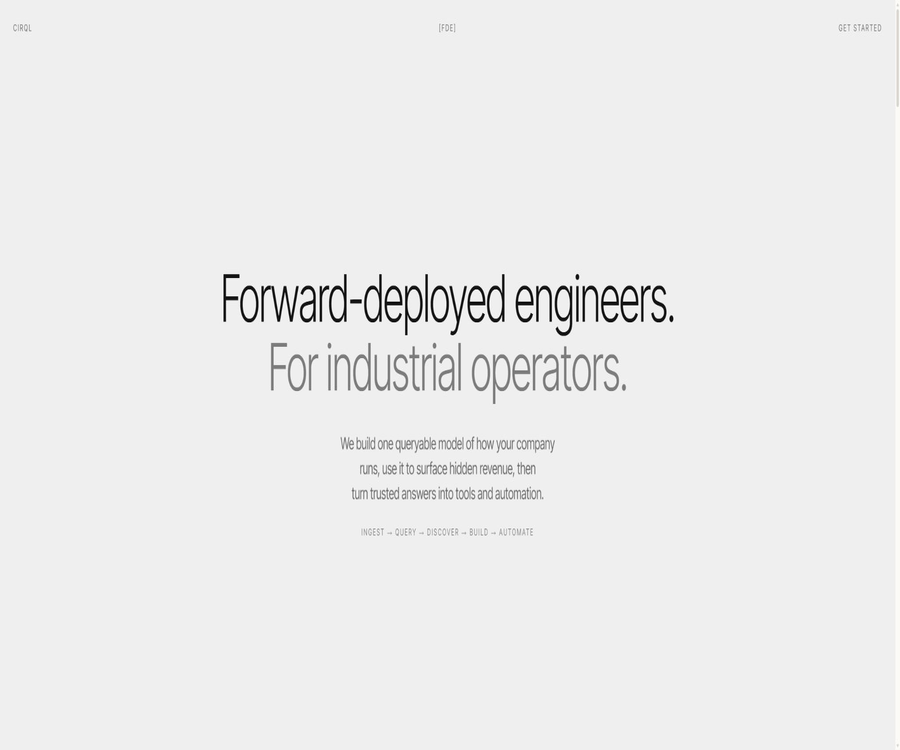
CIRQL is not a standard AI software that can be used immediately after registration; rather, it is a cutting-edge deployment team designed for industrial operators. Engineers go to the sites of these companies and examine their business processes in order to identify losses in terms of time and money, after which they develop and maintain customized tools.
The company is operated by Cirql Inc.; its team is located in Minnesota, United States. It provides services in manufacturing, distribution, on-site support, procurement, and operational management. Its target customers are companies with an annual revenue of between 5 million and 100 million dollars, and a workforce of 10 to 200 employees.
A one-sentence summary
CIRQL organizes an enterprise’s existing ERP, CRM, email, inventory, service, and spreadsheet data into a queryable knowledge graph, and then creates an automated system that enables step-by-step human approval for tasks related to quotes, orders, inventory, sales, customer service, and technical information.
The working method of CIRQL
1. Ingest: Access and unify data
The team first gathers information on systems and processes through analysis, evaluation, and necessary on-site workshops, and then connects it to the company’s existing data sources. The existing systems remain unchanged; CIRQL is used to address inconsistencies related to entities such as customers, products, locations, and transactions.
- Connects ERP, CRM, email, services, e-commerce, inventory, and spreadsheets.
- Standardize names, dates, part numbers, and business objects.
- Consolidate the same customer or product across multiple systems into a single real record.
- Retain the existing system as the source to avoid high-risk replacements from the outset.
2. Query: Build a queryable operation model
The organized entities, relationships, and rules are incorporated into ontologies and knowledge graphs, thereby creating a unified model for business operations. Issues that previously required verification across multiple tables can now be resolved through a single query applied to a large number of records.
3. Discover: Identify hidden income and anomalies
CIRQL usually starts by examining measurable revenue-related issues, such as gaps in cross-selling, a decline in customer spending, abnormal usage of certain products, and opportunities for repair or replacement. The results provide evidence that can be used by company staff for verification.
4. Build: Create tools based on the same foundation.
Once a unified model is established, new tools can reuse the same entities, data, and business logic, eliminating the need to create an integration from scratch each time. The team can then continue to develop applications for sales, quoting, orders, inventory, services, and knowledge management.
5. Automate: Execute automatically step by step
The first version relied entirely on manual intervention: actions were first detected, explained, and recommended, before being approved by employees. Only after the data and rules gained trust did the company decide to gradually automate CRM tasks, emails, or workflows.
Key capabilities and deliverables
1. Business process assessment
It involves using custom tools to conduct adaptive AI interviews with operators, supervisors, and managers, across various positions, shifts, and locations. The results provide a ranked list of opportunities, showing the time loss, frequency of occurrence, and degree of fixability.
- Organize employees, positions, reporting lines, and locations.
- Document the actual work processes such as ERP, shared drives, spreadsheets, and manual handovers.
- Sort the issues based on lost working hours, frequency, and feasibility.
- Four assessments are conducted per year, with indications of the changes relative to the previous assessment.
- Regardless of whether they proceed with the construction or not, customers can retain the assets resulting from the assessment.
2. Fractional-type Frontline Deployment Engineer
Fractional Engineers are integrated into the client’s team; they are responsible for determining the order of construction, developing the systems, and ensuring their ongoing maintenance. The cost of the project is determined based on an assessment of the requirements and the actual scope of work, and no fixed subscription model is used.
3. One-time automation projects
Once a company is aware of the specific bottlenecks, it can skip the evaluation process and proceed directly with assigning individual projects. Typical tasks include entering purchase orders, requesting quotes from suppliers, handling customer emails, and providing quotes for complex components.
4. Profit-sharing partnership
Quantifiable growth-oriented projects may involve a lower fixed fee combined with a share of the results. Both parties establish a baseline based on an assessment, and set upper and lower limits within a specific time frame; there is no indefinite requirement for payment of a share of the profits.
5. Industrial sales and quotation tools
The public projects include pre-populated CRM systems, sales route planning tools, lead websites, bid tracking functions, customer health monitoring, alerts for price changes, and quotation software. The delivery time is usually measured in days or weeks, but it depends on the specific scope of each project.
6. Operations and inventory systems
CIRQL enables the creation of tools for inventory and asset management, supplier rating, warranty claims, automatic reordering, and shipment tracking. These systems are designed to fill in the gaps in existing ERP and warehousing processes.
7. Industrial AI agents
The public projects include customer service emails, purchase order entry, quote follow-up, RFQ responses, call summaries, and technical support bots. Important actions can first be carried out in draft form for review.
8. Industrial knowledge and product data
The team has also developed a searchable technical database, cross-references for components, product recommendations, and a product catalog tailored for large models. The goal is to enable internal employees, customers, or purchasing agents to more easily find reliable product and technical information.
Complete cooperation process
- Briefly describe the company’s size, systems, main bottlenecks, and desired outcomes through a discovery call.
- Choose annual process evaluation, score-based project teams, one-time projects, or a revenue-sharing model.
- Sign a confidentiality agreement that specifies data access, code ownership, and security boundaries.
- If an assessment is conducted, provide a list of employees and participate in cross-functional adaptive interviews.
- CIRQL delivers issue prioritization, loss estimation, and recommended construction sequence within about two weeks.
- Select a measurable project and first develop and validate it through manual effort.
- Once the data, rules, and results are confirmed to be reliable, gradually expand the scope of automatic execution.
- Embedded engineers are responsible for the ongoing maintenance, monitoring, and delivery of subsequent tools.
Project initiation tutorial
Getting ready to discover the telephone for the first time
- Choose a problem that occurs on a weekly basis and can be measured in terms of hours worked or amount of money.
- The records cover personnel, systems, documents, approvals, and exception handling.
- Prepare a set of desensitized examples, such as quotes, orders, inventory discrepancies, or customer service emails.
- Identify the current time consumption, error rate, wait time, and economic impact as the baseline.
- List the high-risk actions that cannot be carried out automatically and the manual approvals that must be retained.
- Confirm the terms of cooperation, expected delivery timeline, data location, and ownership over the phone.
Verify the first automation
- First, connect to the existing system in a replica or testing environment, without directly modifying the production data.
- Compare the manual results with those produced by the new tool using historical examples.
- Record the types of errors, edge cases, and items that cannot be answered.
- Have the business owner approve each suggested action individually and keep audit records.
- Limited automatic execution will be enabled only after the accuracy level agreed upon by both parties is achieved.
- Continuously monitor the effectiveness, and maintain options for rapid deactivation as well as manual rollback.
Which companies are suitable?
- Medium-sized manufacturing companies: need to improve processes related to quoting, orders, inventory, and technical knowledge.
- Industrial distributors: looking to identify opportunities for cross-selling, unusual purchases, and replenishment.
- On-site service company: Integrates work orders, customers, equipment, and maintenance knowledge.
- Purchasing team: Automatically parses purchase orders, compares suppliers, and standardizes quotation requests.
- Companies that already use outdated ERP systems: they wish to incorporate AI without replacing their core systems.
- Companies that lack an in-house software team: they require engineers to be stationed on-site for long-term maintenance.
Typical use cases
- Read purchase orders from emails and enter them into the existing system.
- Generate quotes for review from 3D part files and pricing rules.
- Send requests for a large number of parts to multiple suppliers and compare their responses uniformly.
- Identify declining customer purchases, category gaps, and opportunities for repairs and replacements.
- Track warranty claims, supplier performance, and inventory replenishment.
- Answer internal or customer questions using the company’s technical documentation and experience.
- Transcribe, summarize, and record sales calls in CRM.
- Create a product catalog that makes it easier for AI procurement systems to read.
Advantages of products and services
- Leverage the existing ERP and CRM systems for record-keeping; a complete replacement is not recommended at this stage.
- First, unify the entities and data, then create multiple reusable tools.
- Engineers go to the site and work with the actual processes, rather than just delivering demonstration prototypes.
- In the first phase, human intervention is maintained, allowing automation to expand gradually on the basis of verification.
- The evaluation costs can be deducted from subsequent construction expenses, thereby avoiding duplicate payments.
- Customers retain custom tools, data, and code, reducing supplier lock-in.
- It supports one-time projects as well as long-term maintenance and revenue sharing.
- It is designed for industrial process design, rather than simply applying generic SaaS workflows.
Usage restrictions and precautions
- CIRQL is a custom engineering service, not suitable for individual users who wish to register on their own right away.
- Apart from evaluation, most projects do not have a fixed public price; it is necessary to define the scope first.
- The effectiveness of a project depends on data quality, process stability, and the commitment of business staff.
- The delivery time is a typical range and not a guarantee for all projects.
- Minnesota and neighboring states are more suitable for on-site implementation; for projects over long distances, the method of service delivery needs to be determined.
- Profit sharing is only suitable for growth projects that can establish a credible baseline and whose performance can be attributed to specific factors.
- The ownership of the code and the boundaries for reusing generic components should still be specified in the specific service agreement.
- The tool runs on the customer’s infrastructure, and the customer remains responsible for account management, backups, and security oversight.
- Automatic orders, quotes, reorders, and emails can have real business consequences; therefore, approval processes and the ability to revert changes are necessary.
- The website terms apply only to the website; the scope, responsibilities, and warranties related to paid services are governed by separate agreements.
Prices and cooperation models
The prices listed below were verified on August 21, 2026, and are expressed in US dollars. CIRQL publishes the annual assessment prices; for other projects and works, quotes are provided based on the scope of work.
| Cooperation methods | Public price | Billing method | Main delivery | Suitable situations |
|---|---|---|---|---|
| Annual process evaluation | $ | Annual | Four cross-functional assessments, process maps, and a sorted list of opportunities | Companies that are not yet sure what to do first |
| Fractional Engineers | Quotation based on range | Ongoing cooperation or defined scope | Embedded engineering, development, and maintenance | An operational team whose capabilities need to be developed over the long term |
| One-time projects | Quotation based on range | Project-based approach, no retention fee required | A single automated or customized tool is delivered. | Enterprises whose bottlenecks have already been identified |
| Shared Upside | Lower fixed fee plus revenue share | Mixed billing | Work together to create engines for measurable growth | Ability to define baseline and attributable revenue items |
The FAQ states that the evaluation fee starts at $2,500; the work page indicates $2,500 per year, with four quarterly evaluations included. As further work is carried out, the fees already paid can be deducted from subsequent costs, and the details regarding these deductions and payment arrangements should be specified in the agreement.
Common delivery times
| Task type | Public common cycles | Explanation |
|---|---|---|
| Website update | 1 to 3 days | Applicable to general requests that are already part of a collaboration. |
| New sales materials | 2 to 5 days | It depends on the content and approval. |
| Workflow automation | 3 to 7 days | Complex systems and security requirements will result in a longer duration. |
| Complete integration | 1 to 3 weeks | It depends on the interface and data quality. |
| Customize tools from scratch | 2 to 4 weeks | A separate plan will be made for larger ranges. |
| Process evaluation | About two weeks | Includes about a week of background collection. |
These times represent the typical speeds indicated on the official website; they are not fixed SLAs for every contract. Modifications to the production system, older ERP systems, on-site equipment, and multiple approval processes may require more time.
Data, security, and ownership
The FAQ explains that each project begins with a confidentiality agreement; customer data is stored within the customer’s own infrastructure. CIRQL does not store customer data in its own systems, nor does it share such data among customers. Customized tools run on the customer’s servers or in their cloud accounts.
From the first day, the client has access to the tools, data, and code, and can retain all resulting outputs even after the partnership ends. The website’s terms state that, unless otherwise agreed in writing, the client owns the code versions customized for its own business, while CIRQL can reuse generic methods, frameworks, and components that are not specific to that client.
- List each data source, account, and scope of permissions in the service agreement.
- Use cloud accounts, logs, keys, and backup strategies for customer management.
- Manual approval is required for production writes, email dispatch, and automatic purchases.
- Verify the code repository, documentation, key rotation, and knowledge transfer at the time of departure.
- Distinguish between customer-specific codes and general components that can be reused in CIRQL.
- A written explanation is required for third-party models, hosts, and sub-processors.
Privacy of website visitors
The privacy policy form on the official website collects information such as name, email address, company, industry, company size, income range, as well as any operational details provided by the user voluntarily. The website does not use cookies, targeted advertising, or cross-site tracking; it only gathers data for anonymous use.
The booking page uses Calendly, and the contact information may also be handled by an email service provider. Users can request access, corrections, or deletion; requests for deletion are guaranteed to be processed within 30 days.
System and integration scope
| Category | Connectable examples | Positioning |
|---|---|---|
| ERP | SAP, Oracle, NetSuite, and Epicor | Retain as a system record and complete the process at the outer level. |
| Accounting | QuickBooks and Sage | Synchronize the data required for finance and operations. |
| CRM | Salesforce and HubSpot | Connect customers, opportunities, and sales actions |
| Communication | Email and call details | Handle customer service, order, and sales records |
| Warehousing and inventory | Existing warehouse management system | Enhance visibility, alerts, and automatic reordering |
| Office data | Shared drives and spreadsheets | Integrate into a unified operation model |
The above are examples of integration possibilities; they do not indicate the existence of standard connectors or fixed implementation timelines. Older systems may require file exchange, database access, or custom interfaces.
API, GitHub, and open-source status
CIRQL develops interfaces, automated pricing APIs, and system integrations for clients; however, no unified CIRQL platform API or official SDK available to the public has been found. The specifications for the interfaces of custom projects are determined by the client’s requirements and the service agreement.
No official CIRQL GitHub repository, source code for generic products, or open-source licenses were found. The service itself is not an open-source platform; although customers possess the tools and code they have developed for their own businesses, this does not mean that all CIRQL methods and generic components are made available publicly.
Basic information
| field | Content |
|---|---|
| Name | CIRQL |
| Company | Cirql Inc. |
| Location of the team | Minnesota, United States |
| Service type | Engineering for cutting-edge industrial deployment, AI automation, and custom software |
| Key industries | Manufacturing, distribution, on-site service, procurement, and operations |
| Target company | Typically, an annual revenue of 5 million to 100 million dollars, with 10 to 200 employees. |
| Cooperation methods | Annual evaluation, score-based engineers, one-time projects, and revenue sharing |
| Public starting price | Annual assessment starts at $2,500 |
| Deployment method | Client server or client cloud account |
| Code ownership | Customers have access to customized instances, subject to the terms of the service agreement. |
| Public API | No unified public API is provided. |
| Official SDK | No findings were detected. |
| Is it open source? | No |
Recommendation score
Its recommendation score is 4.4 out of 5. CIRQL has a clear role to play in standardizing industrial data, monitoring processes, managing customer ownership, and automating manual tasks; it is suitable for companies that have many legacy systems, complex processes, but limited internal engineering resources.
The main limitations are that most projects require cost inquiries; geography and on-site integration can affect suitability, and there is no standard matrix of product features. Companies need to verify the quality of delivery through smaller projects, and they must include provisions regarding security, ownership, and maintenance responsibilities in the contracts.
Frequently Asked Questions
Is CIRQL an AI software?
More precisely, it is a team specializing in industrial technology consulting and custom development. The deliverables may include AI agents, data maps, automation solutions, and web tools, but not a unified self-service SaaS platform.
How much is CIRQL?
The annual process assessment starts at $2,500; fees are calculated on a scale for engineers and for one-time projects, depending on the scope involved. For certain projects that involve quantifiable improvements, a fixed fee combined with a share of the profits can be applied.
Can the evaluation fee be deducted?
Yes, the official website states that when CIRQL development continues, the evaluation fees that have already been paid will be deducted from subsequent costs. The specific amount, deadline, and applicable projects should be specified in the agreement.
Is an assessment required first?
It’s not necessary. Most collaborations start with an assessment, but if a company already knows what its bottleneck is, it can directly commission a one-time project.
Will CIRQL replace ERP?
Usually not. It treats the ERP as a system record and adds workflow, integration, and AI capabilities on top of it in order to reduce the risks associated with a complete replacement.
Does the customer have the code?
The official website’s FAQ states that customers possess the tools, data, and code. It is further specified that customers usually have custom code instances, while CIRQL retains the right to reuse methods that are not specific to any customer as well as generic components.
Where are the customer data stored?
The FAQ explanation tool runs on the customer’s server or cloud account, and customer data is not stored in the CIRQL system. For official projects, all third-party services and backup locations must still be specified in the service agreement.
Does CIRQL provide public APIs?
There is no unified public API or SDK. Teams can develop their own interfaces for custom projects, including automatic pricing and integration with existing systems.
Is CIRQL open source?
It is not an open-source product; no official source code repository has been found. The fact that customers receive their own customized code does not mean that the CIRQL framework is available to the public.
How long will it take to deliver?
The automation of common workflows takes 3 to 7 days, while a full integration requires 1 to 3 weeks; customizing tools from scratch takes 2 to 4 weeks. The actual time frame depends on the scope, the existing systems, the data involved, and the approval processes.
Does it support remote enterprises?
The team is based in Minnesota and places emphasis on on-site service; it also serves the neighboring states. It should be confirmed over the phone whether remote delivery is possible for locations further away.
Summary
CIRQL is suitable for transforming the scattered data and manual processes in industrial enterprises into custom systems that can be maintained over the long term. It first creates a reliable operational model, starting with measurable aspects such as revenue, quotes, orders, or inventory.
When making a choice, it should be viewed as a partnership for engineering purposes rather than as a simple subscription to an AI tool. The safest approach is to start with an evaluation or a small project, establishing clear baselines for data, code, maintenance, approval processes, and performance.
Tools similar to CIRQL


 Guigong Network Security Registration No. 45132202000164