






CFRexplorer
CFRexplorer: an intelligent tool focused on improving AI efficiency.
Tags:AI improves efficiencyWhat is CFR Explorer?
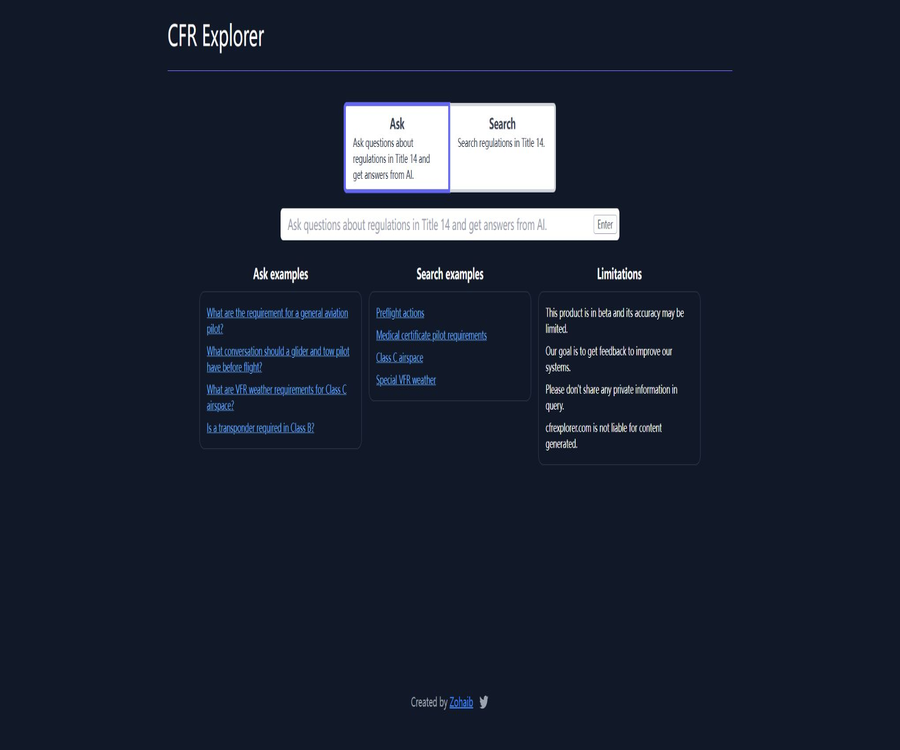
CFR Explorer is an experimental tool for searching regulatory information, designed for pilots and aviation learners; its main source of data is Title 14 of the United States Code of Federal Regulations. Users can pose questions in natural language or use keywords to search for aviation-related regulations.
The official website clearly labels the product as Beta and acknowledges that the accuracy of the responses is limited. It was created by an independent developer identified on the website as Zohaib; it is not an official service provided by the U.S. government, the Federal Aviation Administration, the Office of the Federal Register, or the Government Publishing Office.
A one-sentence summary
CFR Explorer uses AI to transform the aviation regulations outlined in Title 14 into an interface that allows for querying and searching, which facilitates the quick identification of relevant information; however, it cannot replace the current official provisions, official interpretations, or professional legal advice on aviation matters.
What is Title 14?
The United States’ Federal Regulations are organized into various Titles based on topics; Title 14 is dedicated to aviation and space affairs. Requirements such as qualifications, operational procedures, airspace rules, minimum weather conditions, equipment standards, and flight rules that pilots need to comply with can be found there.
Official regulations are structured using hierarchical levels such as Title, Part, Subpart, and Section, with references typically specified to the exact article number. A natural language question may involve multiple Parts, definitions, exceptions, and applicable conditions; therefore, relying solely on an AI-generated summary can lead to the omission of certain restrictions.
Main functions
AI Q&A for aviation regulations
The Ask mode allows users to enter complete questions directly, such as asking about the visual flight weather requirements for a certain type of airspace or whether a specific device is necessary. The AI attempts to provide concise answers by drawing on the information contained in Title 14, thereby reducing the difficulties associated with searching when the relevant keywords are not known.
Title 14 keyword search
The Search mode is used to enter topics such as “actions prior to flight,” “medical certificates,” “Class C airspace,” or “special visual flight.” It is more suitable for users who are already familiar with the relevant regulatory concepts and wish to narrow down the scope of the information.
Example questions and search terms
The home page provides examples such as the requirements for general aviation pilots, communication between glider pilots and those who tow them, weather conditions in Class C airspace, and procedures to be followed in Class B airspace. Users can first use these examples to understand the level of detail required, and then adapt them to their own aircraft, airspace, and operational scenarios.
No complex search syntax is required.
Users can start their exploration using natural language, without first needing to master the full set of legal references or the fields in government databases. Before a decision is made, the results still need to be converted into specific Parts and Sections for official verification.
What is the difference between Ask and Search?
| Pattern | Input method | Expected result | Suitable for tasks | Main risks |
|---|---|---|---|---|
| Ask Q&A | Complete natural language questions | Explanations or answers organized by AI | I don’t know where the clauses are; I need to understand the concepts first. | It may overgeneralize, overlook exceptions, or contain incorrect references. |
| Search search | Regulatory keywords or phrases | Relevant clues from Title 14 content | The topic is known; the relevant provisions are ready to be identified. | Synonyms, abbreviations, and differences in terminology can affect recall. |
| Verification of official provisions | CFR reference, keywords, or date | Current provisions, historical versions, and revision information | Pre-flight decision-making, training, compliance, and formal citations | Users need to read the structure, definitions, and cross-references. |
Complete usage process
- First, specify the aircraft category, type of operation, pilot qualifications, airspace, time, weather conditions, and equipment requirements.
- Use the Ask mode to pose a clearly defined question, avoiding combining multiple regulatory issues in the same sentence.
- Record the key terms, conditions, exceptions in the responses, as well as any possible Part or Section numbers.
- Then use the Search mode to search for key phrases, technical terms, and common synonyms respectively.
- Search the official electronic regulations and the official CFR documents for the current provisions, and read the definitions, annotations, and cross-references.
- Check whether the relevant FAA explanations, advisory circulars, navigational information, NOTAMs, and operational procedures supplement or modify the actual judgment.
- If the answer has an impact on safety, licensing, clearance, or enforcement risks, consult the instructor, inspector, operator, or professional advisor.
How to ask more accurate questions
- Ask only one question related to a regulation at a time; for example, first ask about the equipment requirements, and then separately ask about exceptions and the procedures to follow in case of failure.
- Specify the aircraft category, operating rules, airspace class, altitude, day/night condition, and flight purpose.
- Use the specialized terminology specified in the regulations; when in doubt, try both the full form, abbreviations, and common expressions.
- It is required to distinguish between general rules, exceptions, exemptions, and specific certificates or operating specifications, rather than merely providing a conclusion.
- Treat the clause numbers returned by AI as search clues, and verify the title, Part, and Section character by character.
- For issues that may change over time, indicate the target date and use the official historical version feature for verification.
Regulatory Compliance Tutorial
- In the official electronic regulations system, go to Title 14 and locate the relevant Section using either citations or keywords.
- Verify the date of the current version and the most recent revision shown on the page; do not use screenshots whose dates cannot be determined as a basis.
- Read the Parts, Subparts, and definitions upward to confirm that the provisions apply to your own aircraft and operations.
- Expand the other Sections referenced within the text to examine exceptions, exemptions, appendices, and reservation clauses.
- When a formal historical citation is required, consult the official CFR version for that particular year as well as the relevant revisions published in the Federal Register.
- The final record will include the clause number, version date, and reviewer, in addition to simply saving the text of the AI’s response.
Which users are it suitable for
- Student pilots: Quickly locate relevant Title 14 topics when learning regulatory terminology.
- General aviation pilots: Establish initial clues for searching regarding certificate, airspace, weather, and equipment issues.
- Flight instructor: Develop discussion questions on design regulations and ask trainees to consult the official regulations for verification.
- Those preparing for aviation exams: Use natural language to identify areas of weakness in their knowledge, but do not consider AI-generated answers as the standard solutions.
- Aviation operations and safety personnel: Quickly identify the relevant Parts prior to formal compliance research.
- Author of aviation content: Determine the regulatory context, and then verify the facts and timeliness using official sources.
Typical use cases
- Find out in which provisions the minimum weather standards and equipment requirements for different flight areas can be found.
- Search for topics such as pre-flight procedures, medical certificates, pilot qualifications, and recent experience.
- By comparing the explanations generated by Ask with the regulatory information provided by Search, concepts that require further verification were identified.
- Prepare scenario-based questions for in-person courses or oral exams, and have the trainees explain the relevant legal provisions.
- When encountering an abbreviation you are not familiar with, first obtain background information, and then turn to the official entries and definitions.
- Extract regulatory keywords from accidents, inspections, or operational issues to create a list for further research.
Product advantages
- It focuses on Title 14 and pilot-related issues, with a more focused scope compared to general chatbots.
- It also offers natural language Q&A and keyword search, making it suitable for moving from understanding a question to locating the relevant provisions.
- The interface is simple, without complex database filtering or legal search syntax.
- The home page provides real-world aviation examples, which help new users understand how to formulate their questions.
- The public page is accessible directly, without the need for logging in, making payments, or installing anything.
- The official website proactively warns about the beta status, accuracy limitations, and the need to avoid submitting personal information; the boundaries related to risks are quite clear.
Usage restrictions and precautions
- The product is still in the Beta phase; the official website clearly states that accuracy may be limited, and no responsibility is assumed for the content generated.
- It is not an official tool of the government or the FAA, and it cannot be used as a channel for issuing or interpreting regulations with legal force.
- The official website does not specify the data snapshots under Title 14, the synchronization frequency, the models used, the search methods, or the mechanism for citing responses.
- AI may mix up adjacent rules, overlook exceptions, misinterpret definitions, or return revised requirements.
- Title 14 does not contain all information related to aviation decisions; FAA explanations, advisory circulars, manuals, NOTAMs, and operational procedures can also be equally important.
- U.S. aviation regulations cannot directly represent the rules of other countries or regions; for cross-border operations, it is necessary to consult the regulations set by the local authorities.
- The official website requires that no personal information be included in queries, and questions should not contain identification numbers, details related to flight passengers, or information of a medical or legal nature.
- There is no public privacy policy, terms of service, or information regarding data retention; sensitive and regulated information should not be entered.
CFR Explorer and official regulatory resources
| Resources | Properties | Primary uses | Updates on legal status | Suggested usage |
|---|---|---|---|---|
| CFR Explorer | Independent Beta AI tool | Natural language question answering and Title 14 keyword exploration | The date of the unpublished data is unknown; it isn’t available through official legal channels. | Used only for identifying clues and creating search terms. |
| Official electronic regulations | A compilation of online regulations maintained by the government | View the continuously updated current provisions and historical status. | It is continuously updated, but the electronic version is not the official legal version. | Check the current text, structure, and recent changes. |
| Official CFR Annual Edition | Official legal publications | Official citations and annual regulatory studies | Revised annually while retaining previous versions | Use it when an authoritative version and date are required. |
| Federal Register | Channels for formulating and issuing institutional rules | View the final rules, proposed rules, and effective date | Document the process of regulatory revisions | Study the latest changes and transitional provisions |
| Additional information from the FAA | Institutional explanations and operational information | Handle interpretation, procedures, airspace, and real-time operation information | The update times and validity periods of various materials vary. | Check against the regulatory provisions. |
Price and entry barriers
As of August 21, 2026, the public page of CFR Explorer allows users to ask questions and conduct searches; there are no options for registration, subscription, points, advertising packages, or payment processes. A more accurate description would be “free access during the public beta phase,” rather than a promise of permanent free access or unlimited use.
| Project | Current public information | Explanation |
|---|---|---|
| Basic Q&A | Accessible directly | No accounts or pricing requirements are displayed. |
| Regulation search | Accessible directly | No separate paid tiers are displayed. |
| Free quota | Not disclosed | There is no indication of the number of times, frequency, or rules for daily reset. |
| Paid plans | No findings were detected. | The official website does not have a price page or a link for upgrades. |
| Enterprise Edition | No findings were detected. | No team, SLA, privatization, or procurement instructions available |
During the testing period, the product’s limits, login requirements, waiting lists, or service availability may change at any time. Organizations that require a stable process for regulatory compliance should not rely on this system as their only option, nor should they assume future prices based on the fact that there is no payment mechanism available at present.
Supported platforms
| Platform or method | Support status | Explanation |
|---|---|---|
| Web page version | Support | Both Ask and Search are used in browsers. |
| Windows, macOS, Linux | Supported through browsers | No standalone desktop client was found. |
| iPhone and Android | You can try moving the browser. | No official native applications were found. |
| Browser extensions | No findings were detected. | There is no official extension store entrance. |
| Batch export | No findings were detected. | The official website does not provide any reports, PDFs, or instructions for data export. |
| Team collaboration | No findings were detected. | No accounts, shared spaces, permissions, or audit functions |
APIs, SDKs, and open-source status
As of the time of verification, CFR Explorer does not provide any public API references, developer consoles, API keys, SDKs, Webhooks, or interfaces for batch queries. The Q&A section and search forms on its website cannot be used as authorized public APIs, nor should potential restrictions be bypassed by using web scraping techniques.
No official GitHub repository, source code, model weights, or open-source license linked from the official website were found. The creator has a personal GitHub account on which other projects are published, but there is no evidence indicating that CFR Explorer itself is open source; therefore it should be classified as a closed-source beta web service.
Privacy and data security
The only clear privacy notice on the official website is to avoid sharing personal information in searches; there is no public information regarding search logs, IP addresses, model providers, data retention periods, uses for training, or third parties involved in data processing. The absence of such policies does not mean that no data is collected – it simply means that users cannot find out from the public pages what happens to that data.
Airlines-related questions may involve information on flights, licenses, medical matters, employers, accidents, or law enforcement issues. When using such questions, they should be rephrased as general assumptions; names, identification numbers, specific flights, passengers, internal reports, or confidential events must not be included.
Safe Use Checklist
- Create problems using fictional aircraft, dates, and identities, retaining only the necessary regulatory requirements.
- Do not submit the pilot’s license number, medical information, internal employer data, or accident investigation documents.
- Do not enter flight customers, passengers, location data, security procedures, or any information related to unscheduled operations.
- Before copying the answer into the work record, indicate that it was generated by AI and has not yet been officially verified.
- Formal organizations or enterprises are required to have clear guidelines regarding privacy, data retention, models, and security before they start using them.
- If there are changes in page behavior, permissions, or policies, reevaluate whether to continue using it.
Basic information
| Project | Information |
|---|---|
| Tool name | CFR Explorer |
| Old database writing style | CFRexplorer |
| Creator | Zohaib, as listed on the official website |
| Tool type | AI Q&A and search for U.S. aviation regulations |
| Data scope | Title 14 of the United States Code |
| Primary users | Pilots, flight trainees, instructors, and aviation researchers |
| Product status | Beta |
| Price pattern | Currently available for public access; no paid plans have been announced yet. |
| Is registration required? | It is not necessary at the moment. |
| Main platforms | Web browser |
| Public API | No findings were detected. |
| Official SDK | No findings were detected. |
| Official GitHub | No findings were detected. |
| Is it open source? | No |
| Official government tools | No |
Recommendation score
The recommended rating is 3.5 out of 5 points. The value of CFR Explorer lies in its use of simple questions and searches to lower the barrier to entry when dealing with Title 14; it is particularly useful for student pilots who want to quickly identify the regulatory topics that require further study.
The score is influenced by the Beta status, the lack of clarity regarding data timeliness, the absence of a privacy policy, no guarantees regarding citations, and limited functionality. Any conclusions that may affect actual flight operations, licensing, operational aspects, or compliance risks must be verified against the official current regulations and through professional sources.
Frequently Asked Questions
Is CFR Explorer free?
The current public page can be used directly; there are no options for registration or payment. The official website does not guarantee permanent free access, nor are there any limits on the number of uses or the speed of use.
Does it query all U.S. regulations?
No. The official website specifies that it relates to Title 14, which deals with aviation and aerospace topics; it does not cover other titles, nor does it represent all FAA guidelines or real-time navigation information.
Is CFR Explorer the official website of the FAA?
No. It is a Beta tool created by independent developers, and it has no official affiliation with the FAA, the Office of the Federal Register, or the Government Printing Office.
Can AI-generated answers be used for flight decision-making?
It cannot be relied on alone. It is necessary to check the current applicable regulations, FAA documents, NOTAMs, operating procedures, and relevant safety protocols; if needed, consult instructors or professionals for confirmation.
Which one should be used, Ask or Search?
When the location of a clause is unknown, use Ask to obtain explanations and relevant keywords; when the topic of the regulation is known, use Search to locate the relevant content. In both cases, the results provided are merely clues prior to official verification.
Is it possible to ask questions in Chinese?
The official website does not provide any information indicating support for the Chinese language; both the interface and the examples are in English. It is preferable to use English terms related to aviation regulations, in order to avoid misunderstandings that may arise from translation.
How often are the regulatory data updated?
The official website does not provide information on data snapshots, synchronization frequency, or the date of the last update. When current requirements are in question, it is necessary to consult the official electronic regulations and the Federal Register.
Can real accident or document information be entered?
It is not recommended; the official website explicitly states that personal information should not be shared. Questions should be presented anonymously, and details such as identification documents, flight information, medical data, and details related to internal investigations should be removed.
Are APIs or SDKs provided?
No public APIs, SDKs, or developer documentation were found. Web forms are intended for manual use only and should not be considered as interfaces that can be used for batch calls.
Is CFR Explorer open source?
No official code repository or open-source license for this product was found. The fact that the creator has made other codes available publicly does not mean that CFR Explorer is also open source.
Summary
CFR Explorer transforms the complex study of Title 14 regulations into two simple methods of access: natural language queries and keyword searches. It serves as a good starting point for learning and searching, but not as a source for definitive regulatory conclusions.
The most reliable approach is to first use AI to identify the relevant terms, and then consult the current official regulations, previous versions, as well as relevant FAA materials. Always keep track of the regulation numbers and the dates of verification, so as to avoid mistaking a coherent answer for an actual rule.
Tools similar to CFRexplorer


 Guigong Network Security Registration No. 45132202000164