






CandorIQ
CandorIQ, an intelligent tool focused on improving AI efficiency.
Tags:AI improves efficiencyWhat is CandorIQ?
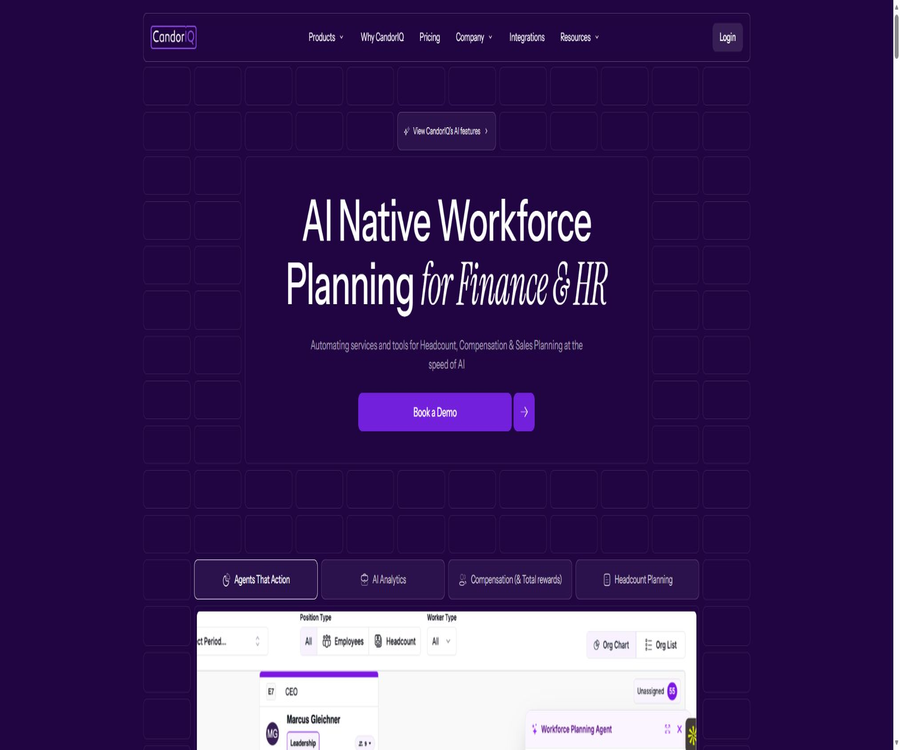
CandorIQ is a platform for human resource planning, compensation management, and total rewards that connects HR and finance functions; it is operated by CandorIQ, Inc. This platform integrates employees, staffing structures, job roles, salary ranges, budgets, recruitment plans, and market benchmark data into a single workflow.
The platform is aimed at growing and medium-sized enterprises that find it difficult to manage labor costs using spreadsheets. It is not a standard HR system for handling scheduling or attendance; rather, it covers the decision-making processes related to planning, approval, setting salaries, adjusting salaries, as well as communication and analysis.
A one-sentence summary
CandorIQ, through AI agents, scenario modeling, and automated approval processes, enables HR professionals, finance staff, recruitment specialists, and business leaders to make decisions related to staffing and compensation based on the same set of human resources and payroll data.
Four types of AI agents
| AI agent | Main responsibilities | Typical tasks |
|---|---|---|
| Finance Agent | Budgeting, planning, and labor costs | Scenarios are generated based on revenue or cost targets, and the inputs required for various regions and positions are calculated. |
| Compensation Agent | Salary strategy and salary adjustment cycle | Match jobs, identify salary gaps, recommend salary ranges and decide on payment cycles |
| Recruiting Agent | Offers and recruitment workflow | Offers are generated and compared based on internal fairness, market data, and historical results. |
| HR Agent | Human insight and analysis | Query employee, mobility, position, and organizational data to identify anomalies. |
AI agents are used to assist in establishing structures, generating scenarios, and identifying issues; they should not be regarded as the ultimate entities that make decisions regarding compensation or employment. Decisions related to individual treatment, promotions, layoffs, or risks of discrimination must be reviewed by authorized personnel.
Main functions
1. Headcount Scenario Planning
Scenario modeling tools allow for comparing the impact of different departments, regions, positions, and recruitment timelines on wages, benefits, equity, and cash expenditures. Finance Agent can also generate candidate plans based on income targets or cost structures.
2. Headcount Requests and Approval
Managers can submit requests for new positions, replacements, or organizational changes, along with information on salary ranges and budget impacts. The system allows for multiple levels of approval based on department, amount, or type of position, and it keeps the decisions and audit records within the same process.
3. Workforce Management
The platform connects to HRIS, Payroll, and ATS, allowing for a unified view of current employees, available positions, hiring and terminations, promotions, as well as planned roles. It serves as a planning layer on top of existing systems, rather than replacing the enterprise’s master data systems.
4. Compensation Builder
The Salary Builder is used to design job families, career levels, job titles, salary ranges, and regional strategies, as well as to manage salary ranges on a bulk basis. AI can match jobs with employees based on job descriptions, but the organization still needs to confirm the responsibilities, levels, and any exceptions.
5. Market salary benchmarks
CandorIQ can make use of market data provided by partners, data from customer surveys, or a combination of both, and it enables comparisons based on job role, level, region, and industry. The official website states that the partnership-related data includes over 10 million records spanning more than 12 industries.
Market data does not represent a single truth; factors such as the time period of the sample, company size, job matching, and regional differences can all affect the results. Companies should keep track of the sources of the data, their validity period, and the reliability of the matching process.
6. Merit Cycle Management
The salary adjustment cycle allows for the setting of budgets, performance criteria, manager recommendations, approval processes, and timelines; it also enables real-time tracking of expenditures related to salary adjustments, bonuses, and equity awards. The system reduces conflicts between different table versions as well as unauthorized access by using permissions and safeguards.
7. Pay Equity Analysis
The platform can identify differences in internal salaries based on position, rank, region, gender, race, and department, and it incorporates fairness checks into the approval process. Analyzing these differences is merely a starting point for investigations; the analysis of sensitive attributes should be designed jointly by legal experts, HR professionals, and data governance specialists.
8. Candidate Offers
The Recruiting Agent generates or adjusts offers by taking into account internal salary structures, data on the success rate of various offers, candidate feedback, and market benchmarks. The candidate profile page displays information on cash compensation, equity options, benefits, brand opportunities, and career development paths, and it is connected to ATS systems and equity platforms.
9. Employee Total Rewards
The employee portal displays the total value of basic salary, bonuses, equity, and benefits, and it allows access to information regarding salary ranges, historical data, and career paths, in line with the company’s policies. Employees can also conduct scenario analyses regarding equity or variable compensation.
10. Human resource analysis and reporting
The system links data on headcount, actual numbers, recruitment, salaries, and budgets together, enabling the identification of plan discrepancies, cash expenditures, employee turnover, and overall organizational health. Management can obtain reports to support decision-making, while finance departments can export settlement and budget-related documents.
11. Global team support
CandorIQ supports multiple countries, various currencies, regional salary adjustments as well as regional approval rules; exchange rates can be updated automatically. Some pages on its official website state that the total return and benchmark metrics cover more than 100 countries.
The workflow from system connection to decision-making
- Identify the responsible persons for master data in HRIS, Payroll, ATS, equity records, and financial systems.
- Connect to or import data on employees, positions, salaries, performance, recruitment, and budgets.
- Unify fields such as employee ID, position, department, region, currency, and salary components.
- Establish a job structure, grade levels, and salary ranges, while also documenting the sources of market data and the rules for making matches.
- Set up staffing and salary adjustment requests, approval workflows, budget limits, and exception permissions.
- Use sandbox scenarios to test the impact of hiring, promotions, salary adjustments, departures, and currency fluctuations.
- The formal process is initiated after being reviewed jointly by HR, finance, legal affairs, and business leaders.
- After the cycle is completed, the audit records are exported, the main system is updated, and the results are communicated to the employees.
Create planning tutorials
- Import current employees, vacancies, approved positions, salary ranges, and department budgets.
- Establish a baseline scenario and verify the number of employees, salaries, benefits, equity, and expected start dates.
- Copy the scenario and test separately the options of growth, freezing, delaying recruitment, or making regional adjustments.
- Compare quarterly and annual costs, cash consumption, target headcounts, and gaps in key positions.
- Convert the selected plan into a job request, and automatically send it for approval based on the amount and department.
- After approval, it is synchronized to ATS or the recruitment process, allowing for continuous comparison between the planned and actual hiring timeline.
- Each time a change is made, record the reason for it, the person who approved it, and the financial impact, in order to avoid making changes to the plan verbally.
Tutorial on salary adjustment cycles
- Determine the participating employees, the benchmark date, performance data, bonuses, equity, and total budget.
- Check whether the position, level, currency, manager relationship, and salary range are accurate.
- The configuration manager can view the fields, recommended ranges, strict limitations, and approvers for exceptions.
- First, use the testing period to verify edge cases related to salary adjustments, promotions, bonuses, and departures.
- After the startup phase begins, real-time monitoring is carried out for budget, completion level, fairness, and suggestions regarding any abnormalities.
- Approval is granted at each level, with HR and the finance department carrying out the final reconciliation; AI suggestions are not accepted directly.
- After locking in the results, synchronize Payroll or HRIS and generate personalized communications for employees.
Which users are it suitable for
- Personnel and Total Rewards Manager: Responsible for defining job roles, salary ranges, salary review cycles, and communicating with employees.
- Finance and FP&A team: Forecasting costs, cash expenditures, and various recruitment scenarios.
- HR Operations and HRBP: Managing requests, approvals, master data, and periodic executions.
- Recruitment team: Develop offers based on market conditions and internal fairness, while reducing the time required for inter-departmental approval.
- Business Manager: Submit proposals for position and employee adjustments within the budgetary and salary limits.
- Executive Team: Compare organizational growth options and examine planned versus actual labor costs.
- Global distributed enterprises: Manage salaries and total compensation in accordance with currency, regional, and national regulations.
- Growing businesses with around 100 to 1,000 employees: Use structured systems instead of complex tables.
Typical use cases
- Annual or semi-annual salary adjustments: unified budgeting, manager recommendations, fair evaluation, and approval process.
- Rapid growth planning: Compare the costs associated with different numbers of hires, locations, and start dates.
- Job structure development: Establishing job families, grade levels, and salary ranges based on job descriptions.
- Offer approval: Incorporate market benchmarks, internal fairness, and budget considerations into the candidate evaluation process.
- Transparent compensation: Show employees the total compensation, salary ranges, and career progression paths.
- Mergers and acquisitions or global expansion: aligning multiple countries, currencies, and existing compensation structures.
- Pay Equity check: Identifies abnormal differences for similar roles or positions and monitors corrective actions.
- Review of the human resources budget: Compare the approved staffing level, the actual number of employees, the recruitment progress, and the financial impact.
Product advantages
- Integrate staffing, salaries, offers, and total compensation within the same labor cost model.
- HR and finance work together using the same data and approval workflows, thereby reducing conflicts between different versions of tables.
- The four types of AI agents are designed with specific functions in mind, and they go beyond merely providing a generic chat interface.
- Benchmark comparisons can be conducted using platform market data, proprietary data, or a combination of multiple sources.
- It supports multiple countries, various currencies, and region-specific payroll rules, making it suitable for distributed teams.
- The integrated directory covers HRIS, Payroll, ATS, PEO, equity tables, and FP&A.
- The employee and candidate portals can explain cash, equity, benefits, and future value.
- SOC 2 Type II, role-based permissions, SSO, and audit logs are suitable for sensitive payroll processes.
Usage restrictions and precautions
- The platform does not have fixed standard prices; quotes are provided based on sales demonstrations as well as the size of the company and the specific modules required.
- The quality of implementation depends on the consistency and timeliness of HRIS, Payroll, ATS, and financial data.
- AI-driven job matching, salary recommendations, and fairness suggestions may be influenced by training data and historical biases within an organization.
- For market benchmarks, it is necessary to verify the sample date, job matching, industry, size, region, and currency.
- Salaries and sensitive attributes are considered high-risk personal data; permissions, exports, and logging must be kept to a minimum.
- AI cannot replace the responsibility of human resources, finance, legal departments, and management for salary and employment decisions.
- Automatic exchange rate fluctuations can affect budgeting and communication with employees; it is therefore necessary to fix the exchange rate date for a specific period.
- Different pages on the official website use two different figures for the number of integrations: over 100 and over 150.
- The Privacy and Terms of Service were primarily updated in 2023; businesses should request the current DPA and security documents when making purchases.
- The official website is primarily in English; there is no confirmation of a complete Simplified Chinese interface or of salary data specific to China.
Price and procurement methods
As of August 21, 2026, CandorIQ does not specify a fixed price in US dollars nor a pricing structure based on the number of employees. The website states that the pricing will be determined flexibly depending on the company’s size and the tools required, with purchases typically being made through scheduled demonstrations, needs assessments, and customized quotes.
| Purchasing items | Public price | Factors affecting the quote | It is recommended to confirm. |
|---|---|---|---|
| Headcount Planning | Contact sales | Number of employees, planned users, scenarios, and system connections | Development and scope of the financial module |
| Compensation Management | Contact sales | Number of employees, time period, salary ranges, market data, and global regions | Number of cycles and permissions for baseline data |
| Employee Total Rewards | Contact sales | Display of the number of users in the employee portal, as well as information on equity and benefits. | Employee access and brand customization |
| Candidate Offers | Contact sales | Recruitment volume, ATS, offer templates, and candidate portal | Number of offers and integration methods |
| AI Agents and Analytics | Contact sales | Scope of representation, volume of data, and users for analysis | AI usage, permissions, and manual review |
| Implementation and integration | Customization | Data cleaning, migration, interfaces, and global complexity | Scope of availability, export support, and exit options |
Some service pages on the official website mention the availability of a free trial, but no specific details are provided regarding the duration of this trial, the functions it includes, or whether payment is required. Before making a formal purchase, it is necessary to obtain a written quote that specifies the subscription period, implementation costs, data source licensing fees, integration requirements, support services, any increases in pricing upon renewal, and the procedures for terminating the service.
Subscription, trial, and refund policies
The terms of service state that subscriptions are typically billed on an annual basis with automatic renewal, and renewal can be canceled through the account or customer support. A free trial can be offered at CandorIQ’s discretion; if payment information is required for the trial, charging may occur automatically if it is not canceled upon expiration.
Unless required by law, the subscription fees that have been paid are non-refundable. As the public terms are outdated, corporate contracts may stipulate different payment, renewal, service level, and termination conditions; the terms outlined in the signed order shall prevail.
Integration capability
According to CandorIQ’s integration catalog, it supports more than 100 HRIS, HCM, payroll, ATS, PEO, Cap Table, and FP&A systems; some pages detailing the new services mention a figure of over 150 systems. This number may vary depending on the network of partners and the scope of the statistics, so it is necessary to verify the actual level of compatibility with the target systems at the time of purchase.
| System category | Publicly available representative products | Common synchronized content |
|---|---|---|
| HRIS and HCM | Workday, BambooHR, Rippling, Bob, Deel, Personio, UKG | Employees, organizations, positions, salaries, and status |
| Payroll | ADP, Gusto, Paychex, QuickBooks Payroll, and various regional service providers | Salaries, actual expenses, and results of changes |
| ATS | Greenhouse, Lever, Ashby | Positions, candidates, offers, and recruitment status |
| Cap Table | Carta, Pulley, Shareworks | Equity grant, value, and candidate presentation |
| Collaboration and Office Work | Slack, Microsoft Teams, Google Workspace | Notifications, approvals, and communication |
| FP&A | Financial planning platform in the integrated directory | Comparison of budgets, forecasts, and plans |
The so-called integration can be achieved through native bidirectional synchronization, collaborative aggregation interfaces, files, or custom connections. It is necessary to define the fields, the direction of synchronization, the frequency of updates, alerts in case of failures, the mechanism for handling deletions, and data ownership.
APIs, SDKs, and GitHub
As of the time of verification, no CandorIQ API references, developer consoles, Webhook documentation, or official SDKs available to ordinary developers were found. Companies may be able to access the service through private integrations or partner connectors, but this does not indicate the existence of public APIs that can be used freely.
No official GitHub repository or open-source license that corresponds specifically to the CandorIQ product was found; therefore, this platform should be considered a closed-source enterprise SaaS solution. The presence of over 100 integrations does not mean that the source code for its core product or connectors is available publicly.
Supported platforms and languages
| Platform or capability | Support status | Explanation |
|---|---|---|
| Web page version | Support | The main entry points for HR, finance, managers, employees, and candidates |
| Employee Portal | Support | View personalized total returns and salary information that can be made public |
| Candidate Offer Page | Support | Display cash, equity, benefits, and company information |
| Standalone Windows or macOS application | No findings were detected. | It is primarily used through a browser. |
| iOS or Android app | Not confirmed | The privacy policy retains the text from the mobile app template, but no such text was found on the official store page. |
| Primary interface language | English | The localization of the complete Simplified Chinese text has not been confirmed. |
| Global Currencies and Regions | Support | It allows for the configuration of multiple currencies, regional rules, and global teams. |
Data security and privacy
In 2024, CandorIQ announced that it had passed the SOC 2 Type II audit; its official website also indicates compliance with GDPR and CCPA regulations. The security details cover AWS, Supabase, SSO, enterprise-level permissions, as well as data access controlled based on role, level, and department.
Salary data includes wages, bonuses, equity, performance-related compensation, information on gender and date of birth, as well as details about the organization; the leakage or unauthorized access to such data can cause harm to employees. Companies should request current SOC 2 reports, DPA agreements, information on sub-processors, details regarding data storage, backup procedures, deletion processes, and rules for event notification.
Baseline data processing
Officials state that the benchmark products do not use any information that can identify individuals; instead, aggregated and anonymized data is employed. Customers still need to examine the methods of anonymization, the threshold for minimum group sizes, rules regarding the reuse of data, and the provisions related to data contribution outlined in the contracts.
Permission design
- HR administrators only access the employee and salary fields required for the management process.
- Managers can only view employees who are under their direct authority or within their authorized scope, and comparisons with peers are restricted.
- Finance allows for the viewing of budgets and aggregated data, while individual details are accessible only with separate authorization based on roles.
- The employee portal displays only the personal and salary range information that has been explicitly approved by the company.
- Integrated accounts utilize the minimum required permissions and are rotated regularly; credentials of former employees are not used.
- Sensitive exports, permission changes, and final approvals should be recorded in the audit log and reviewed regularly.
Basic information
| Project | Information |
|---|---|
| Tool name | CandorIQ |
| Operating company | CandorIQ, Inc. |
| Tool type | AI-based workforce planning, salary management, and total reward platform |
| Core module | Compilation, salary bands, salary review cycles, benchmarks, offers, total compensation, and analysis |
| AI agent | Finance, Compensation, Recruiting, and HR Agent |
| Target scale | For growing and medium-sized enterprises, it is recommended that around 100 to 1,000 people per page. |
| Price pattern | Quotations are customized based on the company’s size and the modules required; typically, it is an annual subscription. |
| Free trial | It may be available, but the conditions have not been made publicly known. |
| Main platforms | Web |
| Public API | No findings were detected. |
| Official SDK | No findings were detected. |
| Official GitHub | No findings were detected. |
| Is it open source? | No |
| Safety | Statements related to SOC 2 Type II, GDPR, and CCPA |
Recommendation score
The recommendation score is 4.5 out of 5. CandorIQ integrates planning, salary structures, salary adjustments, job offers, and overall compensation within a single budgeting model, allowing HR and finance teams to work together in making decisions; it is suitable for growing companies that have outgrown the capabilities of standard spreadsheets.
The main shortcomings are the lack of transparency regarding prices and the limited capabilities of developers; the implementation process relies heavily on the quality of the master data, and the AI recommendations involve high-risk decisions related to employment. It is recommended to verify job suitability, budgets, permissions, integration aspects, and fairness using real data samples before finalizing the terms of the contract.
Frequently Asked Questions
Is CandorIQ free?
It is not a publicly available, permanently free tool. Some pages on the official website state that a free trial is available, but the main way to obtain it is by scheduling a demonstration, with prices determined based on the size of the company and the modules required.
How much is CandorIQ?
The official website does not disclose a fixed amount or a price per employee. The number of employees, the modules used, market data, integration requirements, geographic location, and implementation services all influence the quote.
Will it replace HRIS?
Usually not. CandorIQ is designed to function at the planning and decision-making level, above existing HRIS, payroll, ATS, equity management systems, and financial systems.
Does it support global teams?
It supports multiple countries, various currencies, regional salary strategies, and regional approval processes. Companies still need to verify the applicable standards in the target countries, as well as the labor laws and requirements regarding data transfer across borders.
Can I use my own salary survey data?
Yes. Companies can use the platform’s collaborative data, their own channels, or a combination of both, but it is necessary to ensure that the channels, versions, licenses, and roles used are traceable.
Will AI automatically decide on salary increases for employees?
It shouldn’t be like that. AI can suggest ranges, identify anomalies, and simulate budgets; the final decision, however, must be reviewed by an authorized manager, HR personnel, finance staff, and any necessary legal experts.
Can employees see their colleagues’ salaries?
The platform allows transparency to be controlled in accordance with the company’s policies; the employee portal should display only the information related to approved individuals, salary ranges, and career paths. The specific scope of what is displayed is determined by the permission settings.
How many integrations are there?
The official integration catalog lists over 100 types, while some service pages indicate more than 150 types. When making a purchase, it is necessary to verify whether the target product offers native two-way synchronization, rather than focusing only on the total number of types.
Is an API provided?
No API or SDK documentation available for general developers. Companies that need customized data connections should confirm this during the sales and security assessment phases.
Is CandorIQ open source?
No. No official open-source product repository or license was found; it should be considered a closed-source enterprise service.
Is the data secure?
The authorities have announced SOC 2 Type II compliance and offered SSO, role-based permissions, and auditing capabilities; however, companies still need to examine the current reports, DPA agreements, sub-processors, data storage locations, and their own configuration settings.
What needs to be prepared before implementation?
It is necessary to clarify the master data system, employee and position IDs, organizational structure, components of compensation, currency types, market channels, approval rules, and permission matrices. Cleaning up the data in advance can significantly reduce risks in subsequent phases.
Summary
CandorIQ is suitable for growing companies that wish to move their human resources planning, compensation decisions, and financial budgeting from scattered spreadsheets to a unified system. Its value lies in the ability to manage roles, salaries, offers, and overall compensation all within the same data model, while also facilitating approval processes and communication.
Companies should use AI agents as tools to assist with analysis and execution, rather than to automate hiring decisions. Before making a choice, it is necessary to verify through real data the integration, permissions, suitability of the roles involved, and budget implications; moreover, contracts should clarify the pricing, market data, service levels, and arrangements for data withdrawal.
Tools similar to CandorIQ



 Guigong Network Security Registration No. 45132202000164