






buzzabout
Buzzabout: an intelligent tool focused on improving AI efficiency.
Tags:AI improves efficiencyA one-sentence summary
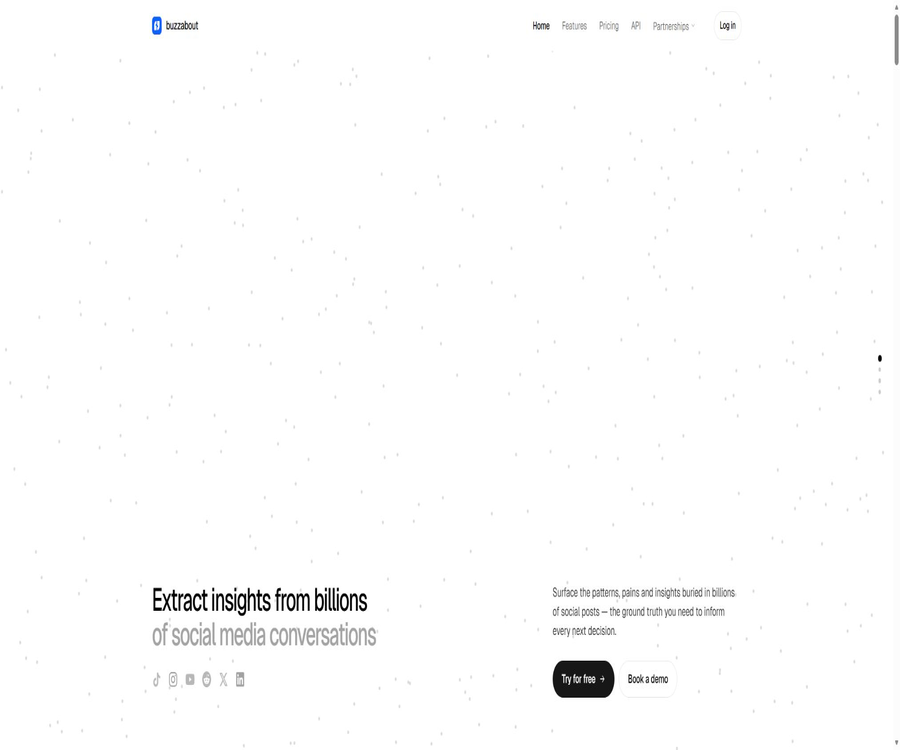
Buzzabout is an AI-driven platform for social media research and monitoring; it can extract trends, pain points, narratives, audience insights, and information about competitors from posts, comments, audio, and video content on six major social media platforms, and it connects the resulting findings to reports, APIs, and AI agent workflows.
What is a buzzabout?
Buzzabout is intended for marketers, brand teams, agencies, product researchers, and content creators. Once users enter a brand, competitors, product category, theme, or specific social media page, the system gathers publicly available discussions and performs a structured analysis of that content.
It is not merely a sentiment analysis tool; rather, it integrates data collection, pattern recognition, AI-driven question answering, audience analysis, continuous monitoring, and report generation within a single analytical framework. Each significant conclusion can be verified against the actual text in question, which helps to distinguish between factual data and AI-generated interpretations.
Supported data channels
| Data source | Topics for research | Typical uses |
|---|---|---|
| Posts, comments, communities, and specified links | Pain points, in-depth discussions, product issues, and category terminology | |
| TikTok | Videos, text, images, and interactive content | Trends, creator content, visual style, and promotional hooks |
| YouTube | Videos, transcript texts, images, and comments | Analysis of long-video themes, audience feedback, and competing products’ content |
| Posts, visual content, comments, and specified accounts | Brand visual identity, content style, and research on creators and interaction | |
| X | Public posts, discussions, and account content | Real-time storytelling, event changes, and brand mentions |
| Posts, comments, and designated homepages | B2B topics, professional audience, industry perspectives, and content strategy |
All paid plans include these six types of public data sources; corporate plans also allow for the integration of custom channels such as review websites, forums, Discord, and customer call records, upon agreement. The data that is visible on different platforms is still subject to login requirements, privacy policies, geographical factors, and the rules set by each platform’s interface.
Core functions
- Cross-platform research: Search multiple social platforms simultaneously around a specific topic, thereby reducing the time required to manually gather posts and comments.
- Pattern recognition: Dynamically identifying pain points, objections, functional requirements, narratives, emotions, tone, hooks, and calls to action.
- Multimodal understanding: Transcription and recognition of video audio, visuals, subtitles, objects, signs, and on-screen text.
- AI Research Assistant: Asks follow-up questions in natural language using the collected data, and provides answers backed by concrete references.
- Audience research: Analyzes signals such as the geographical location, occupation, interests, values, and personality of interactors to draw conclusions.
- Channel-level analysis: Paste the creator’s homepage, channel, account, or community to study and continuously monitor the specified channel.
- Monitoring agent: Periodically detects new mentions, peaks in discussion volume, changes in sentiment, and emerging pain points.
- Project and context: Save insights, references, audience questions, and analysis frameworks for subsequent use by the team and AI.
- Collections and collaboration: Organize posts, quotes, and patterns into collections, with support for tags, comments, and team sharing.
- Reporting and Exporting: Generate shareable charts and reports; users at paid tiers can export in CSV and image formats.
- For developers: Business and Enterprise versions offer REST APIs, while Pro and higher versions provide MCP connectors.
Multimodal and pattern analysis
How is the content processed once it enters the system?
When posts are added to the dataset, they are assigned structured dimensions such as theme, emotion, hook, narrative, tone, intention, call to action, sentiment, entities, and language. Researchers can then describe the patterns they are looking for, without having to rely solely on pre-defined tags.
Video, audio, and image analysis
The system can transcribe video audio and identify objects, signs, and text on the screen. As a result, verbal complaints, packaging details, brand logos, and visual styles can all serve as signals for analysis.
How to understand accuracy?
Officials state that the accuracy of pattern matching varies between 86% and 95% depending on the type of pattern and the size of the sample; specific issues or explicit mentions in a text are generally easier to identify than emotions or narrative structures. This metric does not guarantee that every conclusion drawn is correct – it is still necessary to examine the sample and the original text.
AI research assistant
Users can directly ask about the main criticisms of a particular brand, recent changes in its narrative, the motivations that drive consumers to make purchases, or the elements that contribute to its successful performance. The assistant utilizes data processing tools, clustering techniques, sampling methods, and charting functions to generate responses based on the information collected.
- The basis for the answers is auditable: the conclusions are linked to the specific references provided, which facilitates the team’s review of the samples.
- Further inquiries are supported: it is possible to narrow down the scope by platform, time, location, target audience, or competing brands.
- Charts can be shared: The research charts generated can be downloaded, embedded in documents, or shared via links.
- Project context can be reused: the saved pain points, quotes, and frameworks are incorporated into subsequent research contexts.
Monitoring agents and reminders
The monitoring agent is used to continuously retrieve data from the target channels or topics in order to identify new mentions and changes. It can track the volume of discussions, emotional trends, emerging issues, and patterns, and send alerts and summaries via Slack, email, or Webhooks.
The Starter version includes 1 monitoring agent, the Pro version includes 3, while there is no limit on the number of monitoring agents in the Business and Enterprise versions. When the balance runs low, the existing monitoring panels can remain in use, but new research tasks will be suspended; specific actions related to continuous data collection and alerts need to be verified within the account.
Complete research workflow
- First, clarify the research decisions, such as identifying the issues with new products, comparing the approaches of competitors, or determining the theme for the next round of content.
- Create a project and enter the brand, competitors, product category, keywords, natural language questions, or specific social media channels.
- Select one or more of the platforms: Reddit, TikTok, YouTube, Instagram, X, and LinkedIn.
- Set the language, country, date, number of samples, number of comments, and whether to enable visual recognition or transcription.
- First, use the preview to estimate the data that can be retrieved and the associated costs, before proceeding with the actual data collection task.
- Wait for the asynchronous collection, enrichment, and analysis to complete, and check the channels that failed as well as the actual number of items returned.
- Have the AI assistant extract patterns, pain points, quotes, and charts, then open the samples to examine the evidence.
- Save the validated insights in a project or collection, and turn them into content, activities, products, or research decisions.
- When continuous monitoring is required, create a monitoring agent and configure the notification channels, thresholds, and persons responsible for review.
Introduction tutorial for the web version
- Register for a Buzzabout account and access the new workspace; use the free trial balance to carry out a small-scale study first.
- Enter a specific question; avoid using overly general industry terms, and instead specify the target audience, location, and time period.
- Select the target social platform and the amount of data, preview the results, and check whether it covers the desired types of discussions.
- Run the study and wait for data processing to be completed; do not draw conclusions while the task is still in progress.
- Use the AI assistant to ask about pain points, objections, content hooks, and platform differences, and review each cited example one by one.
- Save reliable insights to the project, and export charts, reports, or data for further analysis by the team.
Which users are it suitable for
- Brand strategy team: Understanding category storytelling, audience language, brand visibility, and competitive positioning.
- Content marketers: Extract themes, hooks, questions, and expressions from truly high-performing content.
- Social media management: Monitoring discussion volume, emotional trends, emerging topics, and brand mentions.
- Market researchers: Transform large-scale public discussions into auditable qualitative and quantitative signals.
- Product team: Identifies functional requirements, usage obstacles, gaps compared to competitors, and unmet needs.
- Advertising and agency services: creating projects for clients, monitoring intelligent agents, and sharing reports.
- Developers and AI teams: Integrate social insights into existing processes via REST APIs, Webhooks, or MCP.
- Educational and non-profit organizations: They can apply for government discount programs intended for academic and non-profit institutions.
Typical use cases
- Competitor analysis: Compare the volume of discussions, public sentiment, content hooks, audience pain points, and untapped opportunities across different brands.
- Content selection: Develop plans for short videos, articles, or social media posts based on popular topics and highly engaging narratives.
- New product research: Collects user complaints, functional requirements, and barriers to purchase in order to provide evidence for the product roadmap.
- Brand health monitoring: Continuous tracking of market share, organic mentions, emotional shifts, and spikes in unusual discussions.
- Audience profile: Analyze the interests, values, occupations, and geographical characteristics of actual interactors, rather than relying solely on internal assumptions.
- Activity review: Analyze changes in narratives, topics, and audience feedback before and after an advertising or marketing campaign.
- Creator research: Tracking specific accounts, channels, or communities to understand the format of the content and the audience involved in interactions.
- AI context provision: The validated market insights are delivered via MCP to chat assistants or coding agents for use.
Product advantages
- It covers six major social platforms at the same time, making it suitable for comparing the discussion structures and audience differences among these platforms.
- It supports text, audio, video, and visual signals, offering a richer range of capabilities than tools that focus only on analyzing text and emotions.
- Pattern extraction can be adjusted dynamically according to the research questions, and is not limited to fixed labels or predefined dictionaries.
- AI responses are linked to actual mentions, allowing for the tracing of evidence and the detection of misinterpretations before the report is delivered.
- It offers listening agents, Slack, email, and Webhooks, supporting both one-time investigations and continuous monitoring.
- The project, collection, and context layers enable teams to build up reusable knowledge about audiences and markets.
- REST APIs, OpenAPI specifications, and MCP cover three types of use cases: manual research, batch automation, and agents.
- The settlement is based on the actual results obtained; any amount that remains unused after reservation will be refunded once the task is completed or fails.
Usage restrictions and precautions
- Data from social media platforms does not represent the entire population; active users, recommendation algorithms, and the level of visibility can all introduce biases.
- The official accuracy rate is an interval-based indicator for pattern recognition; it does not mean that individual brands, languages, or studies with small sample sizes will necessarily achieve the same level.
- The demographic and psychological characteristics generated by AI are based on inference; they cannot be used for high-risk decisions nor as substitutes for the users’ own statements.
- Platform interfaces, login restrictions, and content deletion can affect the integrity of historical data; it is not possible to guarantee that all public discussions will be captured.
- Starter can handle up to 250 mentions per study, while Pro and Business can handle 1,000 mentions; more samples may be required for complex judgments.
- The monthly balance is not carried over; once it is exhausted, new research activities are suspended. The team should estimate the costs associated with monitoring and batch tasks.
- Different functions are billed based on mentions, audience profiles, post processing, or preview channels; it is not possible to estimate the cost solely based on the number of queries.
- The new endpoints of the API may still change; production integrations should lock down fields, handle asynchronous statuses, and pay attention to version upgrades.
- Public social content may still contain personal information; exporting, sharing, profiling, and long-term storage must comply with the platform’s rules and applicable laws.
Prices and packages
As of August 20, 2026, buzzabout operates on a subscription model based on seats along with a dollar-based research balance. Each paid plan replenishes this balance on a monthly basis; actual charges for research are deducted based on the mentions received and other actions taken, and the prices are indicated on the account settlement page.
| Package | Monthly price | Annual payment conversion | Monthly balance and the mentioned unit price | Projects and Listening | Key capabilities |
|---|---|---|---|---|---|
| Starter | $ | $ | $ | 1 project; 1 monitoring agent | Six types of public materials, Webhooks; up to 250 entries per study |
| Pro | $ | $ | A balance of $150; $0.015 per mention | 3 projects; 3 monitoring agents | MCP, custom dates, multiple channels, CSV, audience research; up to 1000 entries per time |
| Business | $ | $ | Balance of $350; $0.007 per mention | There is no limit on the number of projects and monitoring agents. | Includes Pro capabilities and offers REST APIs; up to 1,000 items per request |
| Enterprise | Contact sales | Customization | Custom balance and action rates | There is no limit on the number of projects and monitoring agents. | Custom channels and agents, over 10,000 entries, SSO, DPA, and dedicated support |
Free trial and balance rules
- The free trial offers access to approximately 500 of the mentioned balances for research, with a valid period of one day.
- When the trial period does not convert to a paid subscription, the workspace becomes read-only; however, the existing dashboards do not disappear immediately.
- The subscription balance is reset at the start of each billing cycle, and any unused monthly balance is not carried over.
- If the balance is insufficient, top-ups can be made starting from as little as $5, and the amount topped up will be charged at the current rate applicable to that plan.
- The upgrade takes effect immediately with the difference charged for the remaining period, while the downgrade starts in the next billing cycle.
- Monthly payments can be canceled on the billing page; access rights remain valid until the end of the current cycle.
Charging by action
| Action category | Billing unit | relative unit | Explanation |
|---|---|---|---|
| Mention collection | Each mention that is actually returned | 1 | Both the execution of datasets and the re-fetching by monitoring agents are billed in this manner. |
| Audience profile | Each actual audience profile that is returned | 3 | The price of a single file is three times the price specified for each item in the current package. |
| Post-processing of posts | Each post that is processed | 0.5 | Custom parameters or pattern detection are billed in half of the basic unit. |
| Research Preview | Each preview channel | 1 | Link channels without data will have the corresponding reserved amount refunded. |
| Ask the assistant questions | Each ask call | Free | Asking questions is free of charge, but the collection and processing resulting from research may still consume your balance. |
For all charging operations, a balance is reserved based on the maximum number of results that could be generated; the actual amount returned determines the final charge, with any excess amount being refunded. If a task fails before producing any results, the entire reserved balance should be refunded. When using such systems programmatically, it is necessary to use the real-time prices for the account rather than fixed example rates.
Suggestions for package selection
| Demand | Recommended package | Reason |
|---|---|---|
| Single-person or small-scale single-topic research | Starter | 1 project and 250 in-depth methods suitable for verification, but no MCP, CSV, or audience research. |
| Parallel research by brands or agencies | Pro | 3 projects, 1,000 in-depth analyses, MCP, cross-channel and audience research – more comprehensive |
| An API or continuous monitoring on a large scale is required. | Business | Open REST API available; no limit on the number of projects or monitoring agents, with a minimum fee per mention. |
| Private data sources, SSO, or compliance contracts are required. | Enterprise | Supports custom channels, enterprise security, DPA, and dedicated delivery. |
| The data coverage and methods have not yet been confirmed. | Use the trial version first. | Use 500 mentions within a single day to refer to the quality of the testing channels, the language used, and the research issues. |
Supported platforms and outputs
| Category | Support status | Explanation |
|---|---|---|
| Web page version | Support | Create projects, studies, AI chats, collections, charts, and monitoring tasks |
| Desktop client | No findings were detected. | It is primarily used through modern browsers. |
| iOS and Android apps | No findings were detected. | No official independent mobile apps were found. |
| Slack | Support | Receive listening alerts and team notifications |
| Support | Receive reminders and daily or weekly summaries | |
| Webhook | All paid plans are supported. | Send events and reminders to the custom-built system. |
| MCP | Pro and above | Connect to compatible clients such as Claude, ChatGPT, Codex, and Cursor. |
| REST API | Business and Enterprise | Used for bulk collection, querying, analysis, and account management |
| Output format | Charts, share links, PDF, PNG, SVG, and CSV | Some export capabilities are restricted by the package. |
REST API capabilities
Buzzabout offers versioned REST APIs as well as machine-readable OpenAPI specifications; authentication is carried out using API keys generated by accounts. The APIs cover collections or datasets, asynchronous operations, mentions, audience profiles, listening agents, pattern detection, custom parameters, AI-based Q&A, chat functions, as well as account and pricing information.
The dataset, mentions, audience dataset, and audience profile interfaces have been officially marked as stable; however, newer endpoints such as listening agents, pattern detection, custom parameters, Q&A functions, and account-related features may still undergo changes. Each resource is isolated by account, while chat records are tied to the account in which they were created.
API integration steps
- Purchase a Business or Enterprise plan and create an API Key in the settings; the key is stored securely only at the time of creation.
- First, read the account and price interface to verify the balance, the current transaction fees, and the permissions for making calls.
- Create a collection or dataset, and specify the channel, query, language, country, date, and number of results.
- Start asynchronous execution and poll the task status until collection, enrichment, and analysis are completed or fail.
- Read the results related to mentions, audience, or patterns, and save the resource identifiers for subsequent tracking.
- Provides retry and alerting for throttling, insufficient balance, lack of permissions, missing resources, and temporary failures.
- In the production environment, keys are rotated regularly, and the actual costs as well as any refunds are recorded in the cost monitoring system.
MCP connection capability
The official MCP server is designed for AI clients that support the model context protocol, and it offers 15 tools. The interaction process can be initiated by an assistant to carry out research, poll long-running tasks and render results; it also allows for read-only queries of existing datasets, as well as the use of agents for execution, referencing, targeting, and monitoring.
Standard chat clients can connect via OAuth, while encoded proxies and custom clients use API keys. MCP is suitable for facilitating assistant-driven interactive research, whereas batch processing, scheduled synchronization, and precise resource management are better suited for REST APIs.
SDK, GitHub, and open-source status
As of the time of verification, the official documentation provides examples of multi-language requests, OpenAPI specifications, and instructions for MCP integration; however, no independent Python, JavaScript, or other official SDKs maintained by buzzabout were found. Developers can use OpenAPI to create clients, but the code generated in this way does not constitute an official SDK.
No official open-source GitHub repository related to this product, nor any license for its source code, was found; therefore, buzzabout should be considered a closed-source commercial service. Other repositories with similar names such as Buzz, Buzz AI, or other MCP repositories are not the same as this product.
Privacy, Security, and Compliance
The company states that customer projects, lists, and custom agents are not used to train its models, nor are they shared across different workspaces. The pricing page also mentions that SOC 2 Type II compliance and adherence to GDPR are available, with the option to choose between data centers in the EU or the United States.
Enterprise provides capabilities such as DPA, a list of sub-processors, security review materials, and SSO. Even when analyzing public social data, teams should restrict the creation of sensitive profiles, establish access controls, and define policies for exporting, sharing, deleting, and long-term storage of such data.
Basic information
| Project | Information |
|---|---|
| Tool name | buzzabout |
| Tool type | AI-driven social media intelligence, market research, and social listening |
| Core channels | Reddit, TikTok, YouTube, Instagram, X, and LinkedIn |
| Data type | Posts, comments, accounts, audio, video, and images |
| Primary users | Marketers, brands, agencies, research, and product teams |
| Price pattern | Free trial, subscription by seat, and billing based on the dollar balance per result |
| Starting price | $ |
| Multilingual | Officials state that it supports more than 30 languages and allows filtering by country. |
| Public API | Yes, available for Business and Enterprise. |
| MCP | Yes, available for Pro and higher versions. |
| Official SDK | No independent official SDK has been identified. |
| Official GitHub | No findings were detected. |
| Is it open source? | No |
| Main platforms | Web, Slack, email, Webhook, MCP, and REST API |
Recommendation score
The recommendation score is 4.5 out of 5. Buzzabout’s advantages include support for six different platforms, multi-modal functionality, traceable AI-generated responses, continuous monitoring, as well as a complete set of APIs and MCP tools; it is suitable for converting social discussions into actionable research.
The main barriers are the charging based on the number of seats used, the fact that no monthly balance is carried over, and the fact that APIs are available only with higher-tier plans. Data representativeness, platform coverage, and audience estimation still require verification by researchers; automated charts cannot be considered as a complete representation of the market situation.
Frequently Asked Questions
Is Buzzabout free?
There is no permanent free editing plan, but new users can receive a trial balance that allows them to examine around 500 mentions per day. Without a subscription, the workspace becomes read-only; actual analysis requires a subscription or sufficient balance.
Which social media platforms are supported?
All paid plans support Reddit, TikTok, YouTube, Instagram, X, and LinkedIn. Corporate clients can negotiate the addition of custom channels such as forums, comment sites, private communities, or customer calls.
Is the monthly balance carried over?
No. The balance included in the package is reset at the end of each billing cycle; any unused amount is not carried over. Additional top-ups are charged according to the rules displayed on the account.
How much does it cost to make a mention?
The current charges for Starter, Pro, and Business plans are 0.02, 0.015, and 0.007 dollars per mention, respectively. Audience profiling is billed in units of three, while post-processing is charged at half a unit; corporate prices are customized.
Are the results of AI analysis reliable?
The platform links the conclusions to the specific mentions made, which facilitates verification; however, sample bias, data gaps on the platform, and model errors still exist. Important conclusions should be reviewed through sampling and verified by cross-checking with sales figures, surveys, or customer interviews.
Is support for Chinese research available?
Officials state that it is possible to search in over 30 languages and to filter by country; in theory, it can cover content in Chinese as well. The performance may vary depending on the platform, region, and dialect used, so it is recommended to first test it using sample data.
Is a REST API available?
It is available, but currently only included in the Business and Enterprise packages. The API covers resources such as research data, mentions, audience information, monitoring data, patterns, Q&A functions, and account pricing.
Is MCP provided?
Available in Pro, Business, and Enterprise versions. It enables AI-compatible clients to conduct research, view results, and utilize existing project contexts.
Is there an official SDK?
The official sources provide OpenAPI specifications and examples in multiple languages, but there is no officially maintained SDK available. Developers can create their own clients and are responsible for handling versioning, errors, and authentication.
Is Buzzabout open source?
The product is not an open-source project, and no official source code repository has been found. The public APIs, MCP, and OpenAPI specifications merely represent the interfaces for interacting with the commercial platform; they do not indicate that the backend code or models are available publicly.
Will my project be used to train models?
According to the official statements, projects, lists, and custom agents are not used for training models, nor are they shared across different workspaces. When dealing with sensitive or private data, it is still necessary to review the contracts, DPA agreements, as well as the relevant regional and sub-processors.
What happens once the balance is exhausted?
New research tasks will be suspended; users can top up their accounts or wait until the next cycle for everything to reset. The existing monitoring tools and dashboards will not be deleted immediately, but data collection will be subject to the real-time status of the account.
Summary
Buzzabout integrates social data collection, multi-modal pattern recognition, AI research, audience profiling, continuous monitoring, and team context to create a social intelligence platform. It is suitable for teams that need to develop strategies for their brand, content, competitors, and products based on actual discussions.
When making a choice, it is necessary to take into account the seat fee, the rate per mention, the depth of each individual analysis, the number of projects, and the permissions granted to the developer. The best approach is to first verify coverage and accuracy using a small sample size, then increase the amount of data used, while always retaining the possibility of manual review of the original mentions.
Tools similar to Buzzabout



 Guigong Network Security Registration No. 45132202000164