






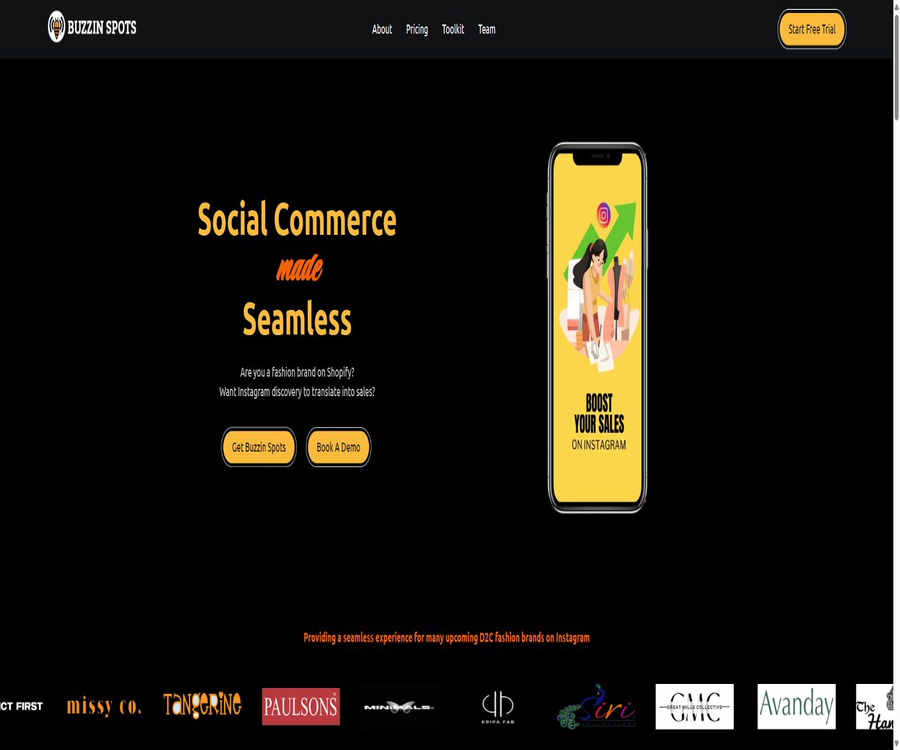
Buzzin Spots
Buzzin Spots – an intelligent tool focused on improving AI efficiency.
Tags:AI improves efficiencyA one-sentence summary
Buzzin Spots is a set of AI-powered social e-commerce tools designed for Shopify fashion brands; it enables the integration of Instagram content, private message inquiries, product discovery, Meta audience data, and WhatsApp management into a single sales process.
What is Buzzin Spots?
Buzzin Spots is designed for D2C fashion brands that use Instagram as a channel for attracting customers and making sales. It synchronizes products via Shopify apps, and then uses visual AI, chat assistants, and chat data analysis to shorten the process from discovering a product on social media to completing the purchase.
The focus of this product is not on general social media scheduling, but rather on creating workflows related to clothing products, image search, private message inquiries, audience segmentation, and conversion rates. Merchants need to have a Shopify store, a professional Instagram account, and a WhatsApp account available.
Four core modules
| module | Main function | Input or data | Typical output |
|---|---|---|---|
| Automagic | Visual product catalog and automatic labeling | Shopify products, Instagram images, or customer screenshots | Related products, similar products, product links, and searchable catalog |
| Buzz | Instagram private message AI shopping assistant | Customer inquiries, images, social updates, past activities, and size information | Immediate responses, product recommendations, size suggestions, and checkout guidance |
| Chatalog | Chat CRM, sales funnel, and Meta audiences | Instagram chat records and natural language filtering criteria | User tags, funnel insights, audience recommendations, and custom audiences |
| Dresscode | Content creation for fashion products | Product images, styles, and trend criteria | Visual product copywriting, trend identification, and styling content |
Automagic Visual Product Catalog
Automagic identifies visual cues in images of clothing, which are used for image search, product discovery, and automatic tagging. When customers send screenshots or reference images via private messages, the system can find matching products; if no exact match is found, it shows similar products instead.
Buzz AI shopping assistant
Buzz is used in the context of shopping via private messages on Instagram; it can take into account images, social content, and past activities to understand the background of a customer’s inquiry. Businesses can also upload size charts, allowing the assistant to recommend suitable sizes based on the measurement data provided by the customers.
Chatalog chat data analysis
Chatalog transforms unstructured conversations into analyzable customer data, enabling the identification of consultation intentions, the tagging of users, and the visualization of the sales funnel. Operators can describe the target audience in natural language, after which they can create Meta custom audiences or similar audience groups.
Dresscode – a tool for fashion-related content
Dresscode generates visual product descriptions based on product catalogs, and it offers functions for identifying trends and suggesting styling options. It is suitable for transforming store products into content that is better suited for sharing on Instagram, but the final descriptions and materials still need to be reviewed by the brand.
Main functions
- Automatic product tagging: It reduces the need to manually add tags to Shopify products or Instagram posts.
- Search for products by image: Identify visual features in customer screenshots, inspiration images, or content photos to find the desired items.
- Smart recommendations: Provides product suggestions based on images, customers’ past activities, and the context of inquiries.
- Private message support: Answering common questions through Instagram DMs and guiding the conversation toward product discovery and checkout.
- Size guidance: Provides size recommendations by combining the size chart uploaded by the seller with the customer’s measurement data.
- Chat funnel: Organizes customer conversations to identify different stages of inquiries and potential conversion opportunities.
- Natural language clustering: Filtering customers based on textual criteria to create Meta Ads audiences.
- Sales Insights: Generate audience recommendations and conversation-based sales analysis from chat records.
- Creation of fashion content: Developing copy for visual products, trend-related content, and themed styling materials.
Complete workflow
- Prepare the Shopify store that sells clothing items, and ensure that the product titles, images, sizes, and inventory details are complete.
- Connect to Instagram business accounts, WhatsApp accounts, and any Meta business assets that need to be used.
- Install the Buzzin Spots app from the Shopify dashboard, and follow the instructions to set up your account and permissions.
- Wait for the product catalog to be read and organized, then check whether image recognition, product matching, and links are accurate.
- Upload the size chart, and set the activation status of the AI assistant, as well as the common issues and situations that require manual intervention.
- Import or preload customer chats that can be analyzed, and use Chatalog to examine the sales funnel and get audience recommendations.
- Use natural language to define the target audience, and before launching the campaign, verify the filtering logic, privacy permissions, and Meta’s rules.
- Use Dresscode to create a draft of the content; manually review the products, the tone of the brand, copyright issues, and marketing wording before publishing it.
Installation and Getting Started Guide
Install the Shopify app
- Log in to the Shopify store dashboard, locate Buzzin Spots in the app marketplace, and check the store compatibility.
- Select a trial plan or a plan that suits the current volume of products and inquiries, and determine the range of data the application needs to access.
- After authorizing the app to connect to the store, follow the instructions to verify the Instagram professional account and WhatsApp number.
- Complete the synchronization of products, and use a small number of actual product images to test image recognition, replies via private messages, and recommendation links.
- Confirm that human customer service can take over abnormal conversations, and then gradually extend this to more products and customers.
Create Meta ad audiences
- First, load the authorized customer conversations into Chatalog and check the chat categories generated by the system.
- Review the sales funnel, common inquiry topics, and AI-generated audience suggestions to identify actionable segmentation criteria.
- Describe the target customers in natural language, for example, those who have recently inquired about a particular style but have not yet made a purchase.
- Preview the target audience and the criteria for filtering, avoiding the use of sensitive attributes or conditions that violate advertising policies.
- Synchronize the verified group to Meta, then use a small budget to test the effectiveness of the ads and make ongoing adjustments.
Which users are it suitable for
- Shopify fashion brands: They already have a product catalog and want to turn the traffic they get from Instagram into orders on their website.
- D2C clothing sellers: need to use images to understand the styles that customers are looking for, in order to reduce the need for manual product matching.
- Social e-commerce operators: They are responsible for handling content, customer messages, as well as audience and advertising-related inquiries in a unified manner.
- Small customer service team: It is intended for AI to handle repetitive questions first, while keeping a manual intervention option available.
- Meta advertising specialists: They aim to create more detailed, customized target audiences based on the actual intentions behind conversations.
- Fashion marketing agencies: The higher tier of the Ultra package is more suitable for managing businesses with a large volume of products or many inquiries.
Typical use cases
- Find the same product via screenshot: Customers send pictures via private message on Instagram, and the assistant searches for matching or similar products and provides a link to purchase them.
- Size consultation: By combining the brand’s size chart with the customer’s measurement details, it helps to answer questions regarding appropriate sizing.
- Creation of new product content: Visual product descriptions are generated from the product images, and these descriptions are then refined by the marketing staff before being published.
- Private message to the sales advisor: It handles automatically questions related to products, styles, and purchases, and transfers them to a human customer service representative when necessary.
- High-intent retargeting: Identifies, from conversations, those who have inquired about specific products but did not complete a purchase, for use in subsequent advertising tests.
- Conversation funnel analysis: Identify the bottlenecks in the customer’s journey from asking questions, making comparisons to making a purchase, and adjust product and customer service strategies accordingly.
Product advantages
- Designed for fashion e-commerce, image recognition, size charts, and styling suggestions are more relevant to clothing sales than those of general chatbots.
- Connect Shopify products, Instagram messages, WhatsApp, and Meta audiences to the same set of business processes.
- It not only answers questions but also organizes conversation data into sales funnels, user tags, and advertising audiences.
- There is no need for manual labeling of each product and piece of content, which reduces the workload associated with maintaining the catalog.
- The three-tier package can be expanded based on the quantity of products, the number of users who receive individual consultations, and the size of the target audience, allowing for upgrades as business volume increases.
- The trial period includes all functions, allowing merchants to test the suitability of the solution using actual products and the consultation process.
Usage restrictions and precautions
- The product has a limited range of applications; it can fully realize its potential only with a Shopify clothing store, a professional Instagram account, and a WhatsApp account.
- The app store currently displays content only in English; the official website and key configuration materials are also primarily in English, which may require additional adjustments on the part of the Chinese-speaking team.
- Visual recognition may lead to mistakes in identifying items with similar styles, colors, or cuts; therefore, product recommendations should allow customers to filter the options again.
- Size recommendations are provided as supplementary information; differences in body shape, cut, and fabric can lead to variations, so absolute fit cannot be guaranteed.
- Chat records contain customer intentions and potential personal information; appropriate authorization must be obtained before importing, analyzing them, or using them for advertising and retargeting.
- Content generated by AI may contain inaccurate product descriptions, deviations in the brand’s tone, or copyright issues; it must be manually reviewed before being published.
- Businesses cannot treat natural language audience criteria as a sufficient basis for compliance; they must still adhere to Meta’s advertising policies and the laws of their respective jurisdictions.
- The official website does not provide any commitments regarding service availability, details on the models used, or accuracy metrics; for critical operations, it is necessary to have backup procedures using manual methods and traditional platforms.
Prices and packages
As of August 20, 2026, both the official website and the Shopify app page offer three monthly subscription plans: Basic, Pro, and Ultra, along with a 30-day free trial. The fees are charged in dollars on a 30-day basis; official subscriptions are managed through Shopify’s billing system, and the final price is indicated on the payment page at the time of installation.
| Package | Price and cycle | Product and assistant quotas | Chatalog quota | Dresscode quota | Suitable for users |
|---|---|---|---|---|---|
| Basic | 35 dollars per month | Up to 1,000 items; up to 300 individual users | Up to 2,000 chat messages can be preloaded; AI-driven sales insights on a weekly basis; up to 10 Meta audiences | Up to 50 products can be identified for trends; there is no limit on the visual copy. | Small brands with infrequent product updates and low levels of customer inquiries |
| Pro | $ | Up to 3,000 products; up to 1,000 individual users | Up to 5,000 chat messages can be preloaded; AI-driven sales insights on a weekly basis; up to 25 Meta audiences | Up to 200 products can be identified for trends; there is no limit on the visual copy. | Growing brands with a high volume of inquiries and ongoing Meta ad spending |
| Ultra | $ | There is no limit on the quantity of products; there is also no limit for unique users. | Up to 10,000 chats can be preloaded; daily AI-driven sales insights; unlimited Meta audience | Up to 500 products can be identified for trends; there is no limit on the visual copy. | Brands with a high volume of products, dedicated social media teams, and marketing agencies |
Trial, commission, and cancellation
- The free trial period lasts 30 days, and according to the official FAQ, all functions are accessible during this trial period.
- Buzzin Spots does not charge a commission on the sales volume of merchants’ products; instead, payment is made through a monthly subscription.
- The subscription fee is included in Shopify’s monthly bill; to cancel or change the plan, it is necessary to do so through Shopify’s admin panel.
- The official website states that the monthly payment option does not involve any long-term commitment, but the timing of cancellation and the rules for switching from a trial version to a paid one need to be confirmed again on the installation page.
How to choose among the different package options
| Selection criteria | Suggested solution | Basis for judgment |
|---|---|---|
| The number of independent consulting users shall not exceed 300, and the number of products shall not exceed 1,000. | Basic | A basic product catalog, low levels of inquiries, and a small number of Meta audience members are sufficient. |
| There are nearly 1,000 independent consulting users, with no more than 3,000 products. | Pro | A larger amount of chat data for preprocessing, as well as more access to audiences and tools for trend monitoring, are required. |
| The number of products or unique users consistently exceeds the Pro limit. | Ultra | Unlimited configurations are available for products, assistant users, and Meta audiences. |
| The effectiveness of visual matching and private message conversions has not yet been confirmed. | Try it out first. | Use a 30-day trial to conduct limited testing of the actual products, support services, and team processes. |
Platform support and integration
| Platform or service | Support status | Primary uses |
|---|---|---|
| Shopify | Supported; the main installation entry point. | Synchronize product catalogs, manage applications, and handle subscription bills |
| Professional Instagram account | Supported; necessary business entry points. | Content discovery, private messaging for guidance, and product interaction |
| Support | Account management, supplementary interaction, and communication with merchants | |
| Meta Audiences | Support | Create custom advertising audiences based on chat data |
| Meta Commerce Manager | Support | For use in conjunction with Meta’s products and commercial assets |
| Web browser | Supports management pages | Configure and view features from the Shopify backend |
| Standalone iOS or Android app | No findings were detected. | Currently, it is mainly used through Shopify and social media platforms. |
| Windows, macOS, or Linux client | No findings were detected. | There is no public, independent desktop client available. |
APIs, SDKs, and open-source status
As of the time of verification, Buzzin Spots does not provide any API documentation, authentication methods, Webhook guidelines, or official SDKs for use by third-party developers. The existing connections between Shopify apps and the Meta ecosystem are part of the built-in integrations of the product, and they do not represent public APIs that users can call directly.
No official GitHub repository or open-source license associated with this product was found; therefore, the platform should be regarded as a closed-source commercial service. Even if the website contains readable front-end resources, this does not mean that the product’s code, AI models, or data processing systems are open source.
Privacy and data security
The privacy policy states that the website collects information on devices, browsing activity, logs, orders, and contact details, and it uses analytical tools to understand how the site is being used. Order information is retained until the user requests its deletion; necessary data may also be disclosed in accordance with legal requirements or to protect rights.
The current policies do not specify the retention period for chat contents, product images, AI input and output data, the purposes of model training, nor the location where processing takes place or which specific service providers are involved. Before importing customer chats and activating advertising targets, businesses should confirm these details with the service provider and provide their own privacy notices.
Pre-deployment checklist
- Confirm that the Shopify store specializes in fashion clothing, and ensure that the product images, sizes, inventory levels, and purchase links are accurate.
- Verify the ownership and administrative rights for Instagram business accounts, WhatsApp, and Meta business assets.
- First, use a test account to verify image matching, recommendations, manual intervention, checkout, and return/refund-related queries.
- Identify which conversations can be imported for analysis, and provide customers with the necessary information, consent mechanisms, and options to withdraw.
- The accuracy of AI recommendations, the rate of manual intervention, response time, and actual conversion rates are used as evaluation metrics during the trial period.
- Before the trial period ends, check the arrangements for subscription, renewal, cancellation, as well as data export or deletion.
Basic information
| Project | Information |
|---|---|
| Tool name | Buzzin Spots |
| Tool type | AI-based social e-commerce, visual product search, shopping assistants, and chat-based CRM |
| Key industries | D2C fashion and apparel e-commerce |
| Core carrier | Shopify apps |
| Primary ecology | Instagram, WhatsApp, Meta Audiences, and Meta Commerce Manager |
| Price pattern | 30-day free trial plus monthly subscription |
| Starting price | 35 dollars per month |
| Sales commission | Officials state that no fees are charged. |
| Interface language | English |
| Registration and prerequisites | A Shopify store and corresponding social media accounts are required. |
| Public API | None |
| Official SDK | None |
| Official GitHub | No findings were detected. |
| Is it open source? | No |
Recommendation score
Its rating is 4.0 out of 5 points. It is well-suited for Shopify fashion brands that use Instagram as their main channel for attracting customers; it offers capabilities such as visual product identification, personalized shopping assistance via private messages, and analysis of chat audience data, thus covering the entire process of social selling.
It is not suitable for businesses in industries other than fashion, or for those that do not have access to the Shopify and Meta ecosystems; there is also little available information regarding their technical capabilities and data management practices. It is recommended to first try it out for 30 days to assess the accuracy of matching, the quality of customer service, and the characteristics of the advertising audience, before deciding on a subscription plan.
Frequently Asked Questions
Is Buzzin Spots free?
It does not offer a permanently free plan, but it provides a 30-day free trial. After the trial period ends, the monthly fees for the Basic, Pro, and Ultra plans are 35, 65, and 99 dollars respectively.
What needs to be prepared before use?
A Shopify store for selling fashion clothing, a professional Instagram account, and a WhatsApp account are required. When it comes to advertising to target specific audiences, it is also necessary to properly set up Meta’s business assets and permissions.
Can it find products based on customer screenshots?
Yes. Automagic and Buzz can identify the visual elements in screenshots or reference images in order to find matching products or recommend similar ones, but sellers should test the accuracy of these tools across different image qualities.
Can it automatically respond to private messages on Instagram?
Buzz is used to handle inquiries related to product discovery, recommendations, and checkout in Instagram private messages. Sellers can enable or disable this assistant from the Shopify dashboard, and they should also arrange for a human to take over in case of any issues.
Can Meta ad audiences be created?
Chatalog can create Meta custom audiences or similar audiences based on the chat context and natural language criteria. It is necessary to check the filtering conditions, customer permissions, and advertising platform policies before creating such audiences.
Does Buzzin Spots charge a sales commission?
The official FAQ states that no sales commission is charged, only a monthly subscription fee is required. Other fees associated with Shopify, payment services, or advertising platforms are not part of the Buzzin Spots subscription.
Is Chinese supported?
The languages listed in the Shopify App Store at present are English; the company does not offer a Chinese interface or Chinese-speaking customer support. The quality of recognition and response to conversations in Chinese should be tested by users during the trial period.
Is there a public API?
No public API documentation or third-party developer console was found. The built-in integrations with Shopify and Meta cannot be used as public APIs.
Is Buzzin Spots open source?
No official code repository or open-source license was found; therefore, it should be considered a closed-source commercial product. The use of AI capabilities by this platform does not imply that the model or the application code are available publicly.
Are customer chats used to train AI?
The public privacy policy does not clearly state whether chat content is used for model training, nor does it specify the duration for which such data is retained. It is necessary to obtain written confirmation from the service provider before going live, and sensitive conversations should not be imported without proper authorization.
How to cancel subscription?
Subscriptions are billed by Shopify, and merchants can manage their subscription plans and cancel them through the Shopify dashboard. The date when a trial period turns into a paid subscription, as well as the date on which cancellation takes effect, are determined according to the instructions displayed in the account.
Summary
Buzzin Spots combines visual search for fashion products, an Instagram messaging shopping assistant, chat-based CRM tools, as well as Meta audience and content generation features, to create a social e-commerce solution for Shopify. It is particularly suitable for clothing brands that are already using Instagram for product discovery and customer service.
The differences among the three monthly payment plans lie mainly in the number of products available, the number of unique users, the capabilities related to chat preprocessing, as well as the limits regarding audience analysis and trend identification. Before adopting one of these plans officially, it is necessary to test them to verify visual consistency and conversion efficiency, and to also confirm the details related to chat data, model training, retention periods, and deletion procedures.
Tools similar to Buzzin Spots



 Guigong Network Security Registration No. 45132202000164