






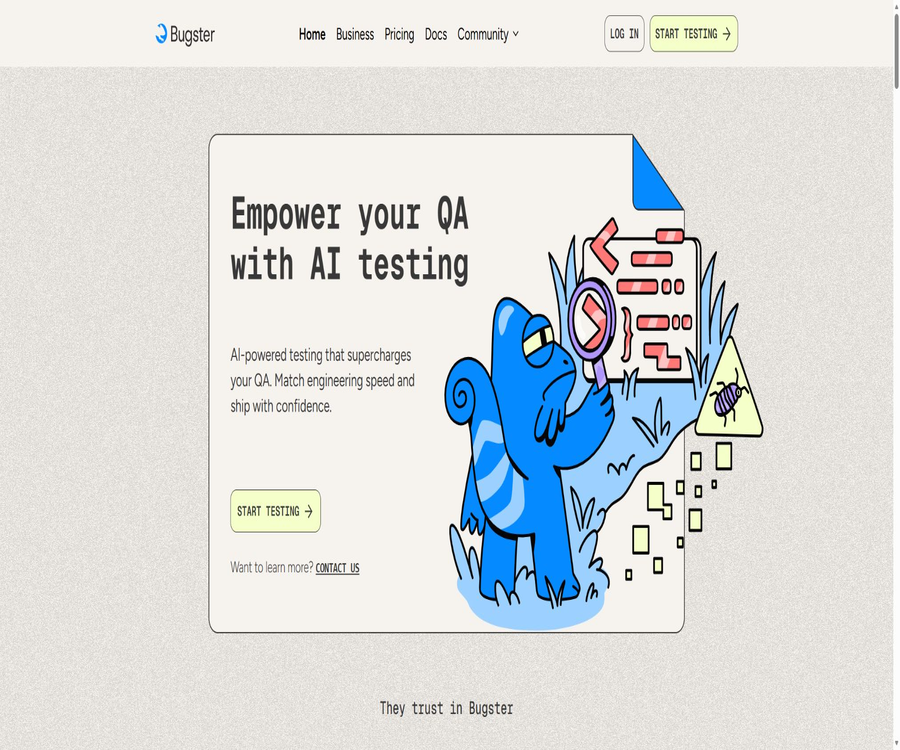
Bugster
Bugster, an intelligent tool focused on improving AI efficiency.
Tags:AI improves efficiencyA one-sentence summary
Bugster is an AI-based end-to-end testing platform for web applications; users can describe the testing procedures in natural language or using structured test specifications, after which agents carry out the operations in the browser, determine the results, and generate evidence.
It offers a web-based workspace, command-line tools, a GitHub App, as well as continuous integration capabilities, making it suitable for integrating product validation, regression testing, and automated testing after deployment.
What is Bugster?
Provided by Bugster Inc., Bugster is designed to serve as an autonomous QA agent for engineering teams, rather than a general-purpose code generator. Its services are based on cloud-based SaaS models, and the testing can be carried out in local development environments, preview environments, testing environments, or accessible production environments.
Developers can manage YAML tests in the code repository, while QA and product teams can describe user workflows using plain language via the web interface. Both approaches share projects, test suites, and execution results, facilitating collaboration among different teams around the same quality standards.
Main functions
Natural language-based test creation
The web interface allows users to describe directly processes such as registration, logging in, purchasing, or submitting forms; the agent then converts these descriptions into executable end-to-end tests. Users can also specify the steps to be taken and the expected results, which helps to avoid misunderstandings that may arise from open-ended exploration.
Execution in a real browser
By running the command, the testing specifications of the project can be viewed; a browser instance is launched and the AI agent is used to carry out the necessary actions on the page step by step. The browser engines listed in the current command-line documentation are Chromium, Firefox, and WebKit, with Chromium being used by default.
Evidence and reports of failures
Upon completion of the test, a pass or fail status, step-by-step logs, screenshots, and result details are provided; in the case of a failed test, a video is also recorded automatically. The results can be transmitted in real time to the web dashboard, or saved in JSON format for further processing by continuous integration systems or other tools.
Testing synchronization and collaboration
Developers can export web-based tests in readable YAML format, modify them in tools such as Cursor, Claude Code, or ordinary editors, and then push them back to the platform. Tests can also be organized into suites based on functionality, and synchronized across branches, environments, and team members.
Affected tests and automatic updates
Bugster allows for the execution of only those tests that are related to code changes, and it also provides a workflow for updating test specifications. This feature helps to reduce the time required to run the entire set of tests with each submission; however, it is still necessary to include fixed regression tests in the critical processes, in order to avoid missing any errors due to changes.
Destructive Agent exploration test
Destructive Agent is used to explore boundary conditions and destructive operations that are often overlooked by conventional approaches to achieving success; it is particularly useful for identifying unexpected behaviors after functional changes. It serves a different purpose from end-to-end testing of known key processes, and its current usage quota is determined based on the team’s subscription plan.
- Describe user workflows, steps, and expected outcomes in natural language or YAML.
- Perform clicking, typing, navigation, logging in, and page validation in the browser.
- Generate videos, screenshots, detailed logs, and steps to reproduce for failed tests.
- Run all tests from the command line, or test a specific directory, a single file, or use temporary prompts.
- It supports parallel execution, headless operation, stream-based result transmission, and JSON output.
- Automatically run tests on pull requests and preview deployments through the GitHub App.
- It supports scheduled execution, testing in multiple environments, and management of team test suites.
- Integrate other deployment platforms into the test initiation process by using custom Webhooks.
Testing specifications and configuration methods
YAML test content
Test files can record the name, target page, page path, tasks, steps, and expected results; in login scenarios, pre-configured credential identifiers can also be used. The structured format facilitates code review, version management, and modification with the help of coding tools.
Project-level configuration
Project configuration allows for the definition of options such as the base address, credentials, number of parallel tasks, output location, headless mode, and the option to run only the affected tests. Command-line parameters override the corresponding settings in the configuration file, which enables continuous integration environments to maintain their own independent execution strategies.
Sensitive credentials
The usernames, passwords, and tokens for different roles should be provided through environment variables or platform keys, with the test files then using these credentials to identify them. Never include actual keys directly in YAML files or submit them to code repositories.
| Configuration details | Uses | Precautions |
|---|---|---|
| Base address | Specify local, preview, testing, or production environment | It is necessary to ensure that the target environment is accessible before running. |
| Testing steps | Describe the page actions that the agent needs to perform. | The clearer the steps, the easier it is to review the results. |
| Expected result | Define the criteria for determining whether a test is successful or failed. | Observable page states should be used. |
| Credential identifier | Select login credentials for different roles | The secret value should be placed in an environment variable or a key management system. |
| Number of parallel tasks | Control the number of tests running simultaneously | Excessive parallelism may overwhelm shared services. |
| Result output | Save the JSON and transmit it to the web dashboard. | It is necessary to take into account the logging and video retention policies. |
Complete workflow
- Create Bugster organizations and projects, and identify the Web applications that need to be tested as well as the target environments.
- Connect to a GitHub repository or install the CLI locally, then complete account authentication and project initialization.
- Generate tests in natural language, or specify the steps and expected results in a web page or a YAML file.
- Configure environment variables for login roles to prevent account passwords from being stored in the repository.
- First, run a small number of key processes locally to check the proxy operations, assertions, screenshots, and recordings of failures.
- Synchronize the validated tests to the platform and integrate them into suites for logging in, settlement, backend management, etc.
- Integrate the tests into pull requests, preview deployments, or scheduled tasks, and adjust the parallelism and triggering rules based on the results.
- Regularly review false positives, false negatives, and outdated specifications to ensure that manual inspections and AI-based testing complement each other.
Introduction to the command line
- Ensure that the device is running a supported Windows, macOS, or Linux operating system, and have Node.js version 18 or higher available.
- Install the official CLI and run the authentication command to obtain your personal API key from the dashboard.
- Initialize in the project directory, allowing the tool to create the project configuration and test directories.
- Execute the generation command to create the initial set of test specifications, and then manually examine the tasks, steps, and expected results.
- Run all tests or a specific file; it is recommended to use a low level of parallelism and to display detailed logs on the first use.
- When continuous integration is required, enable headless mode, JSON output, and streaming transmission of results.
The official CLI repository provides Windows installation packages as well as instructions for cross-platform installation. The Windows executable files may trigger alerts from security software due to the lack of a digital signature from a well-known publisher; therefore, the team should first verify the official version and the source of the files, and then decide whether to approve their use in accordance with the internal security procedures.
Quick Testing and Debugging Tutorial
- First, start the local application or prepare an accessible test address.
- Use the temporary prompt parameter to write a specific test task that is no longer than 1000 characters.
- Monitor whether the agent accesses the correct page, uses the right account, and performs the intended actions.
- In the event of failure, check the step-by-step logs, screenshots, and videos to determine whether it is due to a product defect, an environmental issue, or ambiguous test instructions.
- Organize the stable, repetitive temporary tests into YAML format and then include them in the official test suite.
The maximum concurrency for quick feedback tests is 1, making them suitable for exploration and short-term validation. For formal regression testing, version-controlled test files should be used, with human-readable expected results provided for key assertions.
Integration with GitHub and CI/CD
Bugster’s GitHub App can be connected to organizations and specific repositories; it triggers tests once the preview deployment associated with a pull request is ready. Test results, details of any failures, and video evidence can be incorporated back into the development workflow, helping the team to identify regressions before merging code.
- Install the Bugster GitHub App in the organization settings, and grant permissions only to the repositories that need to be tested.
- Connect the target repository to the Bugster project and verify that the scope of permissions for the repository matches that of the application.
- Configure Vercel, Railway, Netlify, or other deployment platforms to send events once the preview environment is ready.
- Submit the project configuration and test directories in the warehouse, but store the API keys and login credentials in a secret management system.
- Choose to run it on each submission or each pull request, and set the environment to production, preview, or both.
- Create a controlled failure to verify that the feedback from pull requests, as well as video recordings, email notifications, and Slack alerts, are all functional.
The current official website lists GitHub as an available code hosting integration, while GitLab and Bitbucket are still marked as soon to be supported. Any promotions for GitLab appearing on other pages should not be considered to indicate that it is already available; the actual options available in the dashboard should be taken as the reference.
Custom Webhook API
The official documentation provides a Webhook interface for deploying integrations; third-party pipelines can submit the project, organization, and environment details along with relevant submission information after a successful deployment, thereby triggering Bugster tests. This interface uses API keys for authentication and is suitable for deployment platforms that do not have built-in connectors.
This is an API designed to be triggered by deployment events; it is not equivalent to a general public SDK that covers project, testing, result, and account management. As of now, no complete multi-language client SDK released officially exists, and the scope of integration should be determined in accordance with the public interface documentation.
| Access method | Current status | Primary uses |
|---|---|---|
| GitHub App | Officially available | Warehouse connection, pull requests, and deployment testing |
| GitHub Actions | Provide official guidelines | Trigger tests in the automated pipeline |
| Vercel | Officially available | Test the protected preview deployment |
| Railway | Officially available | Run tests based on warehouse and preview deployment. |
| Netlify | Officially available | Trigger tests by deploying notifications |
| GCP Cloud Build | Provide official guidelines | Call the tests after the cloud-based construction is completed. |
| Custom Webhook | Public documents | Allow other deployment platforms to submit success events. |
| GitLab and Bitbucket | The official website indicates that support is upcoming. | It should not be described as a formal built-in integration. |
Framework, browser, and platform support
The official website lists front-end frameworks such as Next.js, React, Svelte, Angular, and Vue; however, the level of automatic generation varies to some extent among these frameworks. The official documentation considers Next.js to offer enhanced support, while the other frameworks are better suited for generation with the help of editor rules and coding proxies. Testing can still be carried out on accessible web applications.
- Command-line systems: Windows, macOS, and Linux.
- System requirements: Node.js 18 or a later version, along with the browser required by Playwright.
- Browser engines: Chromium, Firefox, and WebKit; the actual availability depends on the operating environment.
- Front-end frameworks: The official website lists Next.js, React, Vue, Angular, and Svelte.
- Deployment platforms: Vercel, Railway, Netlify, GCP, and custom deployment processes.
- Code collaboration: GitHub is currently the official integration tool, while GitLab and Bitbucket are still part of the roadmap.
- Development interfaces: web dashboard, CLI, GitHub App, and deployment Webhook.
The marketing page mentions support for major browsers and devices, but the CLI documentation specifies three browser engines. If the project requires real smartphones, specific system versions, or a laboratory with physical devices, it is necessary to confirm this with the team before making a purchase; WebKit simulations should not be considered equivalent to actual Safari devices.
Which users are it suitable for
- QA Engineer: Convert key user workflows into test cases that can be executed repeatedly, and use recordings and logs to analyze failures.
- Front-end developer: Runs regression tests on local environments, branches, and preview deployments to minimize unexpected issues resulting from changes to the interface.
- Product manager: Define the acceptance process in plain language, and then work with QA to add precise steps and expected outcomes.
- Project manager: Pull requests for access control testing are used to monitor the execution status, reasons for failures, and testing costs in a centralized manner.
- Small startup teams: In the absence of a large team dedicated to automated testing, it is necessary to cover registration, login, payment, and the key conversion processes first.
- Platform engineering team: Uses Webhooks and continuous integration to integrate testing into the existing deployment pipeline.
Typical use cases
- Login regression: Verify the behavior of logging in using different roles, as well as the permission menu and unauthorized pages.
- E-commerce process: Check whether the search, product details, shopping cart, discount, and checkout pages are coherent.
- Form validation: Testing required fields, incorrect inputs, successful submissions, and error messages.
- Pull request validation: Once the preview environment is deployed, the relevant tests are automatically executed and evidence is sent back.
- Nightly regression: Run the stability suite on a scheduled basis to detect changes in dependencies, the environment, or long-term processes in advance.
- Exploratory testing: Have the Destructive Agent attempt boundary operations, after which QA will identify the associated risks and the ways in which they can be reproduced.
- Multi-environment verification: Use the same standards to examine the key processes in the development, testing, preview, and production environments.
Product advantages
- The test description is designed to serve both non-technical users on the web interface and developers in code repositories.
- The YAML specification is readable, reviewable, and version-manageable, which reduces the situation where testing logic exists only within black-box platforms.
- The agent is responsible for handling browser interactions and generating screenshots, logs, and videos of failures, which facilitates troubleshooting rather than just providing a red indicator.
- GitHub Apps, deployment platforms, and Webhooks integrate test triggers into existing delivery processes.
- The free version provides a defined monthly usage limit, making it suitable for testing key use cases and identifying the level of false positives.
- The official CLI offers its source code under the MIT license, allowing teams to review the implementation and release of the command-line components.
Usage restrictions and precautions
- AI agents may misinterpret vague goals or consider page delays as failures; key tests require clear procedures, stable data, and human review.
- The testing target must be accessible from the runtime environment; local services, protected previews, and corporate networks may require additional configuration.
- For Starter, each pull request can execute up to 5 end-to-end tests, with a maximum of 3 tests running in parallel; complex test suites require an assessment of the required billing capacity.
- The quick prompt allows a maximum of 1000 characters and supports only one concurrent operation; it is not suitable as the sole method for storing large sets of regression tests.
- Excessive parallelism may put strain on test accounts, shared databases, rate-limited interfaces, or third-party services.
- Destructive processes such as actual payments, message deletion, and message sending should make use of isolated environments, test accounts, and recoverable data.
- The update frequencies for the official website, documentation, and GitHub README files vary; the framework support and maximum number of commands should be determined in accordance with the current product documentation and console.
- Automated results cannot replace a comprehensive quality process that includes accessibility, performance, security, business rules, and manual exploration.
Prices and packages
As of August 20, 2026, the main pricing section on the official website offers the free Starter version and the Team version. Another official page states that the basic price for the Team version is $99 per team per month; it also mentions that additional capacity and features can be customized, so the final cost should be determined by contacting sales or checking the billing page.
| Package | Reference price | Billing cycle | Core benefits or quota | Suitable for users |
|---|---|---|---|---|
| Starter | $ | Refresh monthly | 70 E2E executions per month, up to 5 items per PR, up to 3 executions in parallel, GitHub App and CLI | For individual developers and small projects for testing purposes |
| Team | The basic price is $99 per team. | Starting from a monthly payment; the details are confirmed in the contract. | Custom E2E and Destructive Agent quotas, higher parallelism, scheduled execution, priority support, and SLA | Teams that require large-scale testing |
| Capacity and additional items | Custom quote | In accordance with the contract | Usage capacity, additional features, and integration support | Organizations with high testing requirements or compliance needs |
Starter can be started for free, and the official website states that no credit card is required; however, the fact that it’s free does not mean that all functions can be used indefinitely. For Team, the price is indicated on the main pricing page as “Contact sales”, with $99 being the basic rate listed on the official website. It is necessary to verify the actual cost, any additional fees, and the SLA before making a purchase.
Data privacy and security
The safety guidelines state that Bugster relies on AWS for its core computing and storage functions, while GCP is used for auxiliary services; OpenAI and Anthropic are utilized for inference purposes. Transmission is carried out via TLS 1.2 or 1.3, and customer code as well as test outputs are not used for training or fine-tuning models.
The homepage of the official website states that the testing is carried out on deployed environments without access to the source code, while the security page explains that the GitHub source code can be obtained temporarily during execution and then discarded. These two descriptions refer to different scopes; before connecting to a private repository, it is necessary to verify the authorization permissions, the temporary handling procedures, and the contractual obligations based on the actual functionality.
- The source code is not stored permanently in the Bugster database; the security page states that it is discarded after access during execution.
- Logs, screenshots, and videos are stored in object storage by default for 30 days, and can be deleted as needed.
- The deletion request will remove the item from the active system within 24 hours and from the backups within 30 days.
- Model prompts and responses are confined to the scope of the session, and observation logs are anonymized for debugging and reliability monitoring.
- Official statements say that customer codes and test outputs will not be used for model training or fine-tuning.
- Bugster itself has not yet obtained SOC 2 certification; the certification of a cloud provider cannot be considered equivalent to product certification.
- The security page listed BYOK as a planned feature; it is necessary to check with the official sources to determine whether it is now available in reality.
Tests often involve accounts, customer data, and business operations; therefore, organizations must implement principles of minimum permissions, regular rotation of credentials, isolation of test data, and controls on access to recordings. When dealing with medical, financial, or other regulated data, it is necessary to review the data processing agreements, jurisdictional aspects, subcontractors, and procedures for deleting evidence prior to entering into any contracts.
API, CLI, and open-source status
Bugster offers a CLI that requires an account API key, as well as deployment Webhooks; these Webhooks enable custom pipelines to submit events indicating successful deployment and to trigger tests. The public documentation does not provide a universal REST API that covers all platform resources, nor a formal multi-language SDK, so it cannot be classified as a fully comprehensive open API platform.
The Bugster commercial web platform, AI agents, and cloud execution services are not open-source products. The official bugster-cli repository does provide the source code under the MIT license; this merely means that the CLI component can be used in accordance with that license, but the cloud backend, model orchestration, and paid services are not made available.
| Components | Open state | Explanation |
|---|---|---|
| Bugster Cloud Platform | Closed-source commercial services | Use through an account, free quota, or team package |
| AI testing agent | It was not released as a complete open-source project. | Execution and result management rely on a managed platform. |
| Official CLI | Open source | The official repository uses the MIT license. |
| Deploy Webhook API | Public access documentation | Used to submit deployment events and trigger tests. |
| Complete platform SDK | No findings yet. | Do not describe the CLI or Webhook as a generic SDK. |
| GitHub App | Integration of business platforms | During installation, check the warehouse authorization scope. |
Key points of the terms of service
The current terms of service come into effect on January 5, 2025; users must be at least 18 years old and capable of entering into agreements. Users are responsible for protecting their login credentials and for any activities carried out on their accounts, and any use that is illegal or harmful to others is prohibited.
The terms provide the service as it is, and reserve the right to suspend or terminate accounts in case of rule violations; the applicable law is the law of Delaware, United States. The provisions regarding intellectual property and liability limitations are rather brief, and corporate purchases should be reviewed further in conjunction with the order, data processing agreements, and SLAs.
Basic information
| Project | Content |
|---|---|
| Tool name | Bugster |
| Development entity | Bugster Inc. |
| Tool type | AI end-to-end testing, QA automation, and browser proxies |
| Primary target | Web applications and accessible deployment environments |
| Use the entrance | Web dashboard, CLI, GitHub App, and Webhook |
| Price pattern | Free quota, team monthly subscription base price, and custom capacity |
| Free version | 70 E2E test executions per month |
| Is registration required? | It is necessary. |
| Chinese support | Natural language can be used for input, and the interface as well as the documents are primarily in English. |
| API | It provides webhook deployment, but it is not a complete, universal platform API. |
| SDK | No official multilingual platform SDK has been found yet. |
| Open-source status | The platform is closed-source, while its official CLI is licensed under the MIT license. |
| Operating system | Windows, macOS, and Linux |
| Built-in code hosting | For GitHub and other platforms, the status needs to be verified again. |
Recommendation score
The recommendation score is 4.3 out of 5. Bugster provides a comprehensive set of features including natural language testing, readable YAML format, browser proxies, recordings of failures, and feedback on pull requests; developers, QA specialists, and product managers can work together within the same workflow.
The deductions are mainly due to the need to obtain quotes for the final amount associated with team packages, to minor discrepancies in the information provided on different official pages, and to the possibility of false positives in AI browser tests. Teams that have clear requirements for testing GitHub workflows and web applications would benefit from using the free quota to verify key processes first.
Frequently Asked Questions
Is Bugster free?
A free Starter version is available; it includes 70 end-to-end tests per month, up to 5 tests per pull request, and a maximum of 3 tests running in parallel. The official website states that it is possible to start using this service without a credit card.
How much is the Team package?
The official website states that the basic price is $99 per team per month, but the main pricing display on the homepage suggests contacting sales for details. Since factors such as usage volume, Destructive Agent, parallel processing, additional features, and SLAs can be customized, the final price shall be based on the quote or billing page.
Can it be used without knowing how to code?
On the web interface, it is possible to describe the testing process in plain language, or to list the steps and expected results explicitly. For complex assertions, test data, environment isolation, and continuous integration settings, it is still recommended that QA professionals or developers be involved.
Which browsers are supported?
The CLI documentation lists the three browser engines: Chromium, Firefox, and WebKit. If a specific version of a browser, real mobile devices, or physical device laboratories are required, it is necessary to consult the official sources separately.
Can it be run locally?
CLI allows tests to be run locally on accessible development addresses, but AI processing, authentication, and the streaming of results still require a connection to the Bugster service; it is not a completely offline local testing framework.
Is CI/CD supported?
GitHub Apps, GitHub Actions, Vercel, Railway, Netlify, GCP Cloud Build, and custom Webhooks are supported. Teams should store API keys in a secret management system for continuous integration.
Are APIs provided?
A Webhook API is provided for customizing deployment integration, allowing tests to be triggered upon successful deployment. The available information at present is not sufficient to describe it as a universal API that covers all project and test management functions.
Is Bugster open source?
Commercial cloud platforms are not open source; their official CLI repositories are licensed under the MIT license. To use the open-source CLI, it is still necessary to have a Bugster account as well as access to hosting services.
Will the source code be saved?
The security page states that the source code will not be stored permanently in the database; the code obtained from GitHub at runtime is discarded after processing. The home page says that a testing environment has been set up and that the code is not accessible, and users of private repositories should check their actual permissions based on the features enabled.
Will the test data be used to train the model?
According to the official safety guidelines, customer codes and test outputs are not used for training or fine-tuning models. Testing still involves the use of external models and monitoring services; sensitive projects require further verification of contracts, subcontractors, and data pathways.
Has Bugster passed SOC 2?
No. The security page clearly states that Bugster itself has not yet obtained SOC 2 certification; the certifications mentioned on that page pertain to providers such as AWS and GCP, and cannot be considered as certifications for Bugster’s products.
Can it completely replace human QA?
No. It is suitable for expanding the coverage of end-to-end regression and deployment tests, but business decisions, exploratory testing, security considerations, performance issues, accessibility aspects, and high-risk releases still require the involvement of professionals.
Tools similar to Bugster


 Guigong Network Security Registration No. 45132202000164