






Briefly
In short, intelligent tools focused on improving AI efficiency.
Tags:AI improves efficiencyA one-sentence summary
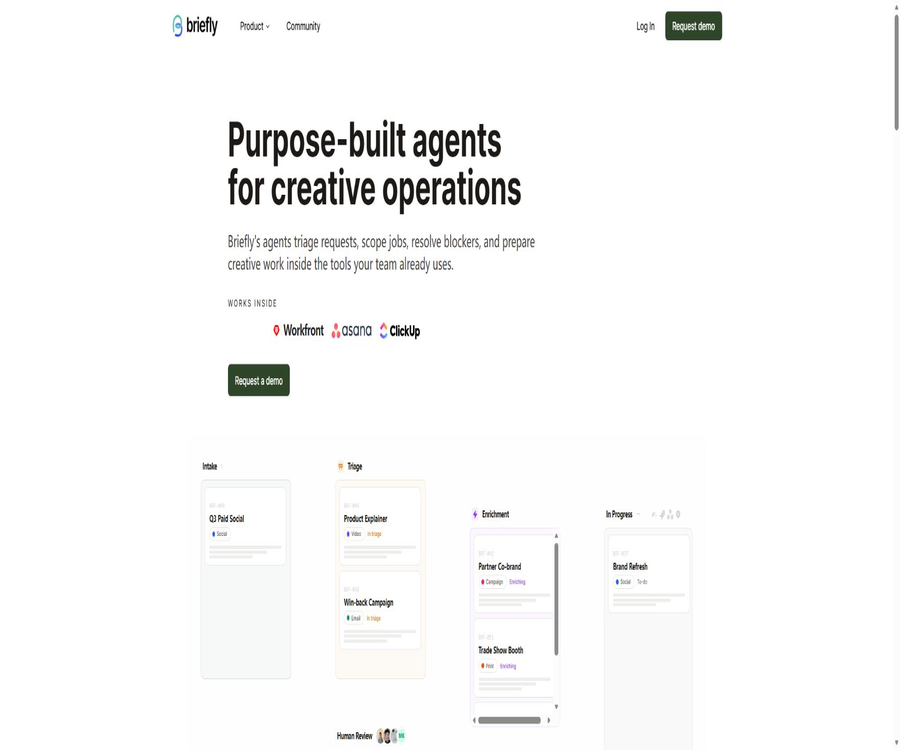
Briefly is an AI agent platform designed specifically for creative operations; it is used to receive marketing requests, assess the quality of briefs, provide additional context, identify obstacles, and send the completed work into existing project management processes.
Tool Introduction
Briefly is operated by Briefly Ltd, based in London, UK, and its target users are internal creative studios, marketing teams, and agencies. It focuses on completing the clarification of requirements and the necessary preparations before work begins, rather than serving as a substitute for design, copywriting, or project management software.
In its early stages, the product focused on using AI to assist in drafting marketing and creative briefs; currently, the official website presents it as a \"creative operations agency\". The old self-service packages, feature screenshots, and past updates can still illustrate the evolution of the product, but they cannot reflect the current prices or scope of services offered.
Current product positioning
| Stage | Briefly, the tasks assigned to this role | Tasks reserved for existing systems or personnel |
|---|---|---|
| Receiving requests | Capture requests from Slack, team communications, emails, or existing forms | The applicant is required to provide the business objectives and relevant background information. |
| Automatic triage | Read content, check rules, identify missing items, assess complexity and risks | Creative operations staff handle exceptions that require judgment. |
| Context completion | Look for relevant information in brand materials, past projects, and the knowledge base. | The data owner maintains accurate and up-to-date source files. |
| Route delivery | Determine the queue, responsible person, reviewers, and upgrade path in accordance with team rules. | Project management tools continue to track the progress of execution. |
| Continuous improvement | Analyze recurring bottlenecks and suggest process optimizations | The person in charge approves rules and organizational changes. |
Main functions
Receiving requests from multiple entries
Users can submit creative requests through the communication or work tools they are already using. Briefly is responsible for organizing unstructured information into structured briefs. The official website lists options such as Slack, Teams, email, and custom templates; however, the availability of some of these options on different pages isn’t always consistent.
AI-based automatic triage
The triage agent reads the content upon receipt of a request, and checks its completeness, scope, timing, dependencies, and risks in accordance with the team’s standards. Requests that are simple and meet the established rules can be processed automatically, while those that require professional judgment are sent for manual review.
- Check whether the objectives, target audience, deliverables, channels, timeline, budget, key messages, and approvers are clear.
- Priority, complexity, dependencies, and feasibility are determined in accordance with the rules of the creative studio.
- Ask the requester for the missing information, thereby reducing the need for creative staff to provide repeated clarifications via email or meetings.
- Route tasks to the appropriate queue based on project type, team capabilities, region, or risk.
Review Intelligence
Review Intelligence is used to transform a team’s briefing criteria into actionable checking logic, and it allows for the establishment of detailed feedback rules specific to different types of requests. It functions more like a quality control tool for operations, rather than just a writing assistant that focuses on grammar corrections.
Handling of blocking issues
The agent can identify requests that lack necessary materials, brand guidelines, product information, a budget, or a decision-maker, and take action to fill in those gaps. Complex or conflicting requests are escalated to the appropriate personnel, so as to prevent the AI from making decisions on its own in uncertain situations.
AI data completion
Briefly allows one to find brand guides, historical events, audience research data, and project information from sources such as Google Drive, and then include those details in the request. The quality of the results depends on the access rights, the quality of the available data, and the settings of the enterprise.
Workflows and automation
Teams can combine receiving, reviewing, completing, routing, upgrading, and delivering into a workflow, adjusting it to fit their own operational methods. The official solution emphasizes that Briefly assists with the design, implementation, and maintenance of proxies, so customers do not need to build a generic proxy system from scratch.
Briefly Insights and Dashboards
Insights and dashboards are used to monitor request quality, common bottlenecks, queue pressure, and process patterns, thereby assisting those in charge with identifying recurring operational issues. Specific metrics, data export options, and retention periods need to be confirmed during a demonstration or in the order details.
Infinity Briefs and custom templates
The current customized options include unlimited briefs, custom templates, and workflows; they are no longer categorized based on the number of briefs as in the earlier self-service versions. Unlimited usage is still subject to constraints related to reasonable use, storage, model costs, and the terms of the contract, and these aspects must be confirmed in writing at the time of purchase.
How do AI agents work?
- Creative requests are submitted to Briefly via communication tools, emails, forms, or marketing workflow management systems.
- The agent reads the request and applies the Brief standards, feedback rules, and escalation criteria defined by the team.
- The system asks the requester for the missing information and retrieves brand assets and historical background from connected knowledge sources.
- The agent evaluates complexity, dependencies, and risks, sends standard requests to the target queue, and hands over edge cases for human review.
- The prepared Brief is synchronized to the existing project management system, after which Briefly identifies recurring bottlenecks and opportunities for improvement from the results.
Implementation and launch process
The official website follows an implementation timeline of around 30 days, rather than allowing companies to figure things out on their own after making the purchase. The actual time required is influenced by the number of integrations, data permissions, the complexity of the processes, and security audits.
| Phase | The key points of the official description | The customer needs to get ready. |
|---|---|---|
| Day 1 | Streamline the process, identify the first high-value bottleneck, connect the tools, and establish the first automation. | Process owner, sample requests, permissions, and success metrics |
| Day 5 | Test and iterate on the first proxy, then select the next set of blocking issues. | Real test data, misclassification feedback, and edge cases |
| Day 30 | Expand automation to enable more requests to be routed, completed, and processed. | Governance system, responsible persons, monitoring, and continuous improvement plans |
Usage tutorial
Select the first automated scenario.
- The statistical creativity team examined the questions that were asked repeatedly, selecting those that are asked often, have clear rules, and whose outcomes can be measured.
- Organize the qualified and unqualified Brief samples, identifying the required fields, common gaps, permitted exceptions, and conditions for upgrading.
- Define success metrics, such as the rate of complete submissions on the first attempt, the number of clarifications required, the time taken for triage, or the percentage of tasks started on time.
- First, define a team, a type of request, and a limited number of connections, in order to avoid altering the entire creative process at once.
- Hand over the scope and sample to the Briefly implementation team to carry out a trial run using a real request.
Configure the triage agent
- Create or import a request template, specifying the objectives, target audience, deliverables, channels, deadline, budget, and approvers.
- Formulate the studio’s priorities, quality criteria, rejection conditions, and upgrade rules as verifiable requirements.
- It connects to approved brand assets and project systems, granting only the minimum permissions required to complete tasks.
- Setting up a proxy allows for the automatic execution of actions, as well as the definition of boundaries for actions that require manual approval or cannot be executed at all.
- Use historical brief replays for testing, and then check whether further questions are necessary, whether the routing is correct, and whether the additional information provided is relevant.
Operation methods after going live
- On a daily basis, random checks are conducted on the requests that were approved automatically and those that were upgraded, with records kept of any requests that were missed, misjudged, or required further invalid inquiries.
- Check weekly for repeated blockages, reasons for rejections, and changes in request types, and update the templates and feedback rules accordingly.
- Update the knowledge source in parallel when there are changes to brands, products, or compliance policies, to prevent agents from referencing outdated materials.
- Manual approval should be retained for high-risk and high-cost projects, and the responsible persons should not be removed as a result of increased automation.
- Compare the metrics before and after implementation on a monthly basis; expand the scope only if time is saved without a decline in the quality of the briefs.
Integration capability
The value of Briefly lies in its ability to work in conjunction with existing tools, rather than forcing teams to migrate all tasks to a new system. The current public integration catalog should distinguish between three statuses: available, demonstrated on the official website, and coming soon.
| Category | It has been clearly provided. | Preview may require confirmation |
|---|---|---|
| Core entrance | Slack, Google Drive, monday.com | Microsoft Teams appears on the pricing page, but the category is still listed as Coming Soon. |
| Work management | Jira, Linear, Notion, monday.com | Asana, Wrike, Smartsheet, and ClickUp are marked as “Coming Soon”; Workfront requires confirmation from the sales team. |
| Knowledge and documents | Google Drive | OneDrive and various DAM connections are marked as Coming Soon or require customization. |
| Creative production | The official website does not list the standard official connection. | Figma, Adobe Creative Cloud, and Canva are marked as Coming Soon. |
| Approval and analysis | Advanced integration is customizable. | Frame.io, HubSpot, and Salesforce Marketing Cloud are marked as Coming Soon. |
There may be differences in the timing of updates across various official pages, especially for tools such as Teams, Workfront, and ClickUp. Purchasers should request demonstrations of actual connections, the direction of data synchronization, the conditions that trigger certain actions, error recovery mechanisms, and the scope of permissions.
Which users are it suitable for
- In-house creative studio: It receives a large number of requests related to marketing, design, video production, copywriting, and retail materials on a daily basis.
- Head of Creative Operations: It is necessary to standardize the briefs, reduce the number of clarification meetings, and identify any bottlenecks in the process.
- Brand and marketing team: Requests should be submitted via Slack or existing forms, with the brand background information being added automatically.
- Advertising and creative agencies: They need to guide clients to submit more complete briefs and keep different clients’ information separate from one another.
- Teams using Monday.com, Jira, Linear, or Notion: retain their existing workflow systems and focus solely on strengthening the preparatory steps.
- Large organizations or those subject to regulatory constraints: SAML, SSO, BYOK, a customer success manager, and customized security assessments are required.
Typical use cases
- Request for event creativity: Check whether the channels, material specifications, target audience, budget, timeline, and approval responsibilities are all specified.
- Retail product production: Automatically asks for information such as store location, retailer, size, version, language, and delivery date.
- Video project triage: Identifying the dependencies among scripts, filming, copyright, budget, and multi-format delivery.
- Multi-marketing: Assign requests to the appropriate studios and reviewers based on region, language, and brand guidelines.
- Complete brand information: Extract guidelines, product facts, and historical data from the authorized knowledge base and attach them to the brief.
- Agent client portal: Use adaptive questions to guide clients in providing actionable information, thereby reducing the number of back-and-forth emails.
Product advantages
- It focuses on the preliminary tasks related to creative operations, placing greater emphasis than generic chatbots on quality controls, routing, dependencies, and upgrades.
- It can be integrated with existing communication and project management tools, thereby reducing the training and change costs associated with a full migration.
- The agent can proactively ask questions, obtain information, and prepare tasks, rather than merely having a text brief generated automatically.
- It involves the manufacturer and the customer working together to define the processes and set up the first agent, and it is suitable for organizations that lack an in-house AI engineering team.
- It supports enterprise features such as custom templates, rules, workflows, SAML, SSO, and BYOK.
- Complex requests are upgraded based on manual judgment of boundaries, adhering to the actual process that requires assigning responsibility to a specific person in order to meet the needs of creative operations.
Usage restrictions and precautions
- The official website does not specify a fixed amount; the costs related to implementation, integration, support, and modeling need to be determined through a customized quote.
- The product is not responsible for creating the final ads, designs, or videos, nor can it replace a project management system for tracking progress.
- Agents may misclassify vague requests; complex creative decisions, conflicts regarding available resources, and political risks still require human judgment.
- The integrated directory contains many projects that are still in the “Coming Soon” phase; therefore, not all of the listed names can be considered as currently available connections.
- Knowledge completion can only utilize authorized and retrievable materials; outdated, conflicting, or missing content reduces the reliability of the results.
- The legal links on the official website could not be accessed properly during this verification; the aspects related to data training, retention periods, sub-processors, and deletion procedures should be specified in the contract.
- BYOK means that customer-managed model keys can be used, but it does not automatically indicate that all data is processed only within the customer’s environment.
Prices and plans
As of August 20, 2026, the Briefly website offers only one corporate plan that is customized on a monthly basis by creative studios; no figures in dollars or pounds are provided, nor are there any options for a free version, a trial period, or pricing based on the number of users.
| Plan | Price | Included content | Suitable for users |
|---|---|---|---|
| Briefly for your team | Custom quote per month based on the studio | Reception, triage, completion, unlimited briefs, workflows, advanced integration, SAML and SSO, BYOK, advanced security, and customer success manager | Enterprise teams that need customized creative operations agencies |
| Historical self-help solutions | Not as current price | Old updates showed several self-service package options, but the current price page no longer offers them. | It is intended solely for understanding the evolution of the product; purchasing based on it is not recommended. |
The price typically depends on factors such as the number of studios, the volume of requests, the complexity of integration, the scope of implementation, security requirements, the choice of models, and the level of support; however, the official website does not provide a formula for calculating these costs. Upon request, the initial implementation fee, monthly fees, rules regarding excess usage, renewal conditions, and data export procedures in case of withdrawal should be specified.
Plan evaluation prior to procurement
| Evaluation items | Issues recommended for confirmation | Acceptance evidence |
|---|---|---|
| Triage quality | Which Briefs can be approved automatically, and which ones require an upgrade? | Calculate the rates of missed detections, false positives, and manual reversals using historical data. |
| Integration | What are the currently available connections and synchronization directions? | Demonstrate creation, updating, failure, and retry in the testing environment. |
| Data governance | To which models and sub-processors is the content sent, and for how long is it stored? | DPA, list of sub-processors, deletion and audit provisions |
| Cost | Implementation, studios, request volume, models – and how billing for support works | Complete order, overage price, and renewal price |
| Operation | Who maintains the rules, knowledge sources, and edge cases | Responsibility matrix, review schedule, and SLA upgrades |
Supported platforms
| Platform or method | Status | Explanation |
|---|---|---|
| Web platform | Support | Configure workspace, Brief, agent, workflow, insights, and management features |
| Slack proxy | Support | Briefs can be created by mentioning an agent, projects can be searched for, and requests can be initiated. |
| Emails and forms | Displayed on the official website | Used to receive unstructured requests; the actual configuration is determined by the scope of implementation. |
| Microsoft Teams | Status needs to be confirmed. | The price page includes a link to the agent portal, while the integrated catalog is still marked as Coming Soon. |
| Desktop and mobile native applications | The official information has not been made public. | No standalone clients for Windows, macOS, iOS, or Android were found. |
| Browser extensions | The official information has not been made public. | No Chrome or other browser extensions were found. |
APIs, SDKs, and open-source status
As of the date of verification, the authorities have not made available any public API documentation, a page for applying for developer keys, or an official SDK; nor has any official GitHub open-source organization been identified. The advanced integration and BYOK features mentioned on the official website are part of the enterprise-level services offered, and they cannot be considered equivalent to an open development platform.
| Project | Conclusion | Explanation |
|---|---|---|
| Public API | No findings were detected. | If you wish to establish your own connection, you should consult the sales team regarding the interfaces, authentication methods, traffic throttling rules, and associated costs. |
| Official SDK | No findings were detected. | There are no public client libraries for Python, JavaScript, etc. |
| Official GitHub | No findings were detected. | Third-party warehouses with the same name cannot be considered official code. |
| Open-source product | No | Briefly is a business hosting platform along with customized implementation services. |
| BYOK | Support | Customers are allowed to use their own model keys; however, the data pathways and responsibilities still require confirmation through a contract. |
| Advanced Integration | Provide | It is determined by the plan and scope of implementation; it does not mean that all customers have access to a universal API. |
Data privacy and security
The current pricing page lists SAML, SSO, BYOK, advanced security features, and customer success managers, indicating that the product is intended for teams that require enterprise-level access control and procurement oversight. The website’s FAQ addresses questions regarding data usage and training, but the available page does not show complete answers to these questions.
- Do not rely on the titles of FAQs to determine the training policies; clear written commitments should be obtained from the order or data processing agreement.
- Verify whether the entered Brief, brand information, past projects, and model outputs are fed into third-party models, and whether they are used for training or to improve services.
- Confirm the data storage location, encryption methods, retention period, deletion deadline, backup deletion procedures, and notification requirements for any changes in subcontractors.
- When using BYOK, it is necessary to determine who is responsible for key management, invocation costs, logging, rate limits, and the terms set by the model provider.
- Connect to Google Drive and the project system using the minimum level of permissions required, and restrict sensitive customer data or unpublished campaign materials to only those who need access to them.
Basic information
| field | Content |
|---|---|
| Tool name | Briefly |
| Operating company | Briefly Ltd |
| Location of the company | London, UK |
| Current location | A dedicated AI agent platform for creative operations |
| Tool type | Creative briefs, request triage, data completion, and automation of marketing workflows |
| Price pattern | Monthly customized quote based on the creative studio |
| Is a demonstration needed? | Yes |
| Free version | The current official website does not disclose it. |
| Chinese support | The official website does not specify this; it should be tested during the demonstration. |
| Public API | No findings were detected. |
| Official SDK | No findings were detected. |
| Is it open source? | No |
| Primary mode of use | Web platforms, Slack, and enterprise integration |
Recommendation score
The recommendation score is 4.3 out of 5. Briefly handles tasks such as clarification before handling numerous creative requests, quality checking, data completion, and identifying issues related to task allocation in an accurate manner, while also preventing the team from having to abandon their existing work management system.
The deductions are due to the need for fully customized pricing, a lack of transparency regarding product documentation and data policies, as well as an inconsistent mix of official and preview statuses in the integration catalog. This solution is most suitable for teams with a steady volume of requests, a clear point of responsibility for operations, and the capability to carry out corporate purchases.
Frequently Asked Questions
What is Briefly?
It is an AI agent platform designed for creative operations teams, responsible for receiving, reviewing, completing, and routing requests before the start of creative projects.
Is it still an AI tool for writing briefs?
While AI-assisted brief drafting remains the core capability, its role has now expanded to that of a creative operations agency. It handles tasks such as receiving requests, asking follow-up questions, completing necessary information, sorting tasks, and delivering results, rather than just generating documents.
Is Briefly free?
The current official website does not disclose any free version or self-purchase prices; it only offers customized monthly quotes based on the studio’s services. The self-service packages available in earlier versions should not be considered as an option for the current situation.
What is the price?
The official website does not specify a fixed amount; the price is determined through sales quotes. Companies should also inquire about implementation fees, monthly fees, charges for additional requests or models, as well as costs related to integration and support.
Will it replace Monday.com or Jira?
No. Briefly is positioned as an intelligent preparation and triage layer that operates on top of the existing systems, while the project management tools remain responsible for task tracking and delivery.
What official integrations are supported?
The public catalog lists Slack, Google Drive, monday.com, Jira, Linear, and Notion. Many other connections are still marked as Coming Soon or require sales confirmation.
Is Microsoft Teams available yet?
The pricing page includes Teams Agents among the available options, but the integration catalog still shows “Coming Soon” – there is a discrepancy between the status on these two pages. Before making a purchase, it is necessary to ask the vendor to demonstrate the functionality in the target tenant environment.
Can it automatically ask the requester further questions?
Yes. The agent will check for missing information and work to fill it in, then escalate any edge cases that require human judgment to the creative operations staff.
Can advertising materials be created directly?
The focus at present is not on creating the final ads, images, or videos, but rather on turning creative ideas into actionable tasks. The various tools used for production are still mostly in the preview or customization stage.
Is enterprise SSO supported?
The current proposal lists SAML and SSO, as well as BYOK and advanced security features. Specific identity providers, automatic configuration options, and auditing capabilities need to be confirmed in the quote.
Will Briefly use customer data to train models?
The FAQ on the official website addresses this issue, but no complete and public answer was obtained during this verification. Do not assume anything; the company should specify the rules regarding training, retention, deletion, and sub-processing by means of the DPA and the order details.
Are APIs or SDKs available?
No public APIs or official SDKs have been found. Advanced integration is part of the capabilities offered for enterprise solutions; if custom development is required, it is necessary to determine in advance what interfaces and levels of support are available.
Is it briefly open source?
It is not an open-source product, and no official code repository has been found. The use of BYOK or connection to third-party tools does not mean that the platform’s source code is available publicly.
Is it suitable for small teams?
If the volume of requests is low and the process is simple, templates or standard forms may be more cost-effective. Briefly is better suited for teams that have a constant need for creativity, involve multiple stakeholders, and face measurable operational bottlenecks.
Tools similar to Briefly



 Guigong Network Security Registration No. 45132202000164