






BrandBastion
BrandBastion: an intelligent tool focused on improving AI efficiency.
Tags:AI improves efficiencyA one-sentence summary
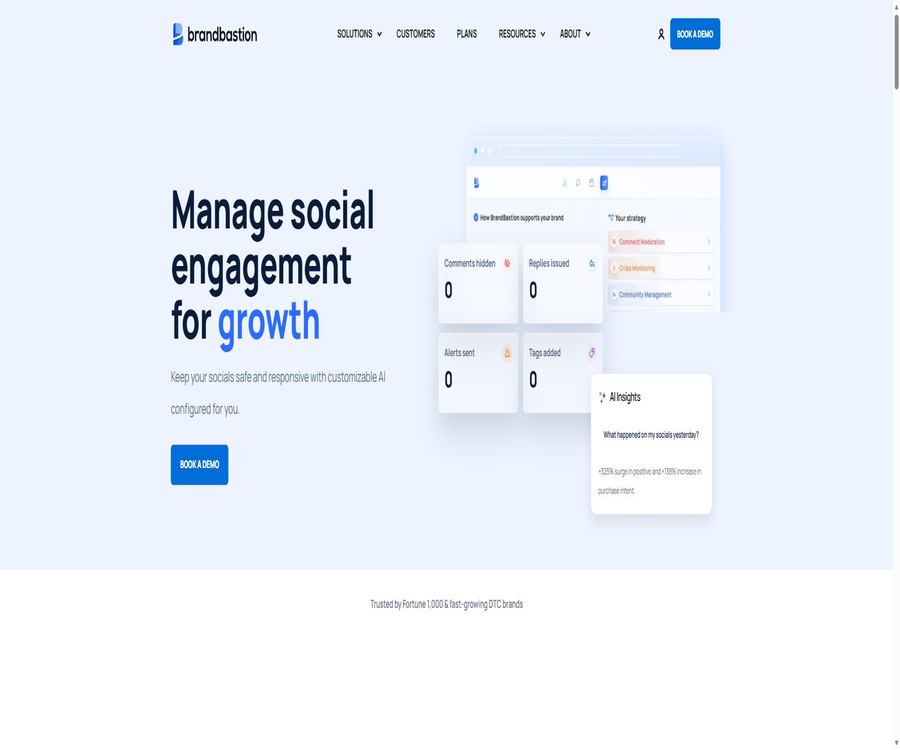
BrandBastion is an AI-powered social media management platform designed for brands, advertisers, and agencies; it brings together functions such as comment moderation, risk detection, unified responses, social listening, content publishing, and evaluation management in one single workspace.
Tool Introduction
BrandBastion is operated by a remote team with offices in the United States and Finland; its purpose is to assist organizations in managing public social conversations while safeguarding both the brand and the community. It is not a general-purpose chatbot, nor is it a simple scheduling tool designed for individual creators.
The platform continuously collects comments, private messages, mentions, reviews, and post data from social accounts owned by or authorized for use by brands, via various network interfaces. AI is responsible for categorizing this data, assessing its emotional tone, identifying potential risks, and drafting responses; sensitive tasks can also be handed over to human reviewers or dedicated teams for handling.
Current product positioning
| Direction | Key capabilities | Typical person in charge |
|---|---|---|
| Brand safety | 24/7 comment moderation, crisis monitoring, anomaly detection, and risk classification | Branding, Public Relations and Compliance Teams |
| Community interaction | Unified inbox, AI-generated reply drafts, batch approval, routing, and manual handling | Community Management and Customer Service Team |
| Social insights | Emotion analysis, topic tagging, trend analysis, and performance analysis of events | Market and Consumer Insights Team |
| Content operation | Multi-platform publishing, calendar, drafts, approval, and retry on failure | Content and Social Media Team |
| Evaluation Management | Centralize the processing of reviews from stores and local businesses, and identify key themes in the feedback. | Product and Customer Experience Team |
Main functions
AI review moderation and brand safety
BrandBastion analyzes reviews based on the context rather than just individual keywords, and it categorizes the content into categories such as discrimination, violence, extreme or mild profanity, personal information, spam, impersonation, bullying, and brand attacks. Teams can set rules for hiding, upgrading, or keeping certain content specific to different brands.
- It includes natural content, promotional content, and various dynamic advertising comments; the specific scope depends on the social networking interface.
- Real-time alerts can be set for crises, negative emotions, or abnormal numbers of messages, thereby reducing the need for manual inspections.
- The transparency panel retains the audit actions, allowing the team to examine the results generated by AI and those produced manually.
- Advanced solutions combine proprietary models, third-party tools, along with ongoing supervision by language experts and operational staff.
Unified social inbox
The platform aggregates the comments, mentions, and private messages from multiple accounts into a single inbox, and offers features for filtering, searching, tagging, setting priorities, assigning responsible persons, and adding internal notes. Teams can automatically assign conversations to the appropriate members based on language, time, event, intent, or risk category.
Context-aware AI responses
Agent+ can generate draft responses that match the brand’s tone by utilizing the original post, website content, or information from the help center; these drafts are then placed in a queue for batch approval. Engage+ goes a step further by offering round-the-clock managed responses and upgrades provided by the BrandBastion team.
Emotion analysis and social listening
The platform can track the volume of conversations, emotional shifts, keywords, topic tags, mentions, and performance metrics, in order to identify potential risks or content opportunities. The official help page lists entries in 194 languages, some of which are available on a experimental basis; the website provides limited formal coverage regarding the core AI capabilities.
Automated workflows
Workflows can be used to perform tasks such as assignment, tagging, reminders, or creation of external tickets, based on criteria like tags, sentiment, language, post type, activities, and time. Automatic assignment relies on a clear tagging system; when rules overlap, it is necessary to define exclusion conditions.
Content calendar and cross-platform publishing
The publishing module allows for posting across different platforms, adjusting the text and media based on the network conditions, previewing content, publishing it immediately or at a set time, saving drafts, receiving alerts in case of failures, and attempting to publish again. Teams can also make use of role-based permissions, internal notes, event tags, as well as AI-generated suggestions for text.
Evaluation Management
BrandBastion allows for centralized viewing and responding to reviews on Trustpilot, Google Business Profile, Apple App Store, and Google Play. The scope of reviews that can be viewed, the ability to input historical data, and the options for responding to reviews are still determined by the account settings and interface rules of each respective platform.
Analysis and Transparency Report
The dashboard allows users to view reviews, responses, sentiment, tags, activities, and the performance of agents; it can also generate regular reports. These reports are useful for assessing response efficiency and the structure of public opinion, but they cannot be used to determine a causal relationship between platform activity and advertising conversions.
Supported channels
| Channels | Mainly covers | It is necessary to pay attention. |
|---|---|---|
| Pages, natural and advertising reviews, mentions, ratings, and replies to stories | Private message replies are subject to the 24-hour and 7-day rules; group management is not supported. | |
| Nature and advertising reviews, Reels, private messages, stories, mentions, topics, and media tags | Some story elements, comments and likes, as well as the monitoring of common keywords, are subject to restrictions imposed by the interface. | |
| TikTok | Nature, advertising, and reviews, mentions, topics, and private messages related to Spark Ads | Smart ad reviews may not be available through the API at the moment. |
| YouTube | Shorts, video comments and promotional video reviews, as well as keyword monitoring | Historical data is usually limited to the past 30 days; some analyses and automated responses are subject to restrictions. |
| X | Replies, mentions, citations, promoted comments, private messages, and keywords | Only conversations in which the account has participated or been mentioned can typically be responded to via the interface. |
| Reviews, mentions, and opinionated shares about nature and advertising | Comments can only be deleted; they cannot be hidden. There are limitations on ad metadata. | |
| Threads | Natural reviews and keyword monitoring | Responses and certain actions are restricted, and there is a shared quota for keyword searches. |
| Evaluation channels | Trustpilot, Google Business, Apple App Store and Google Play | Appropriate permissions are required; the historical range is determined by the channel rules. |
Working principle
- The administrator creates a workspace and connects social media pages, advertising assets, or review platforms using an account with sufficient permissions.
- The platform captures real-time conversations starting from the point of connection, and fills in some historical data whenever the network permits it.
- AI classifies content based on language, emotion, theme, risk, and response requirements, and then applies labeling, hiding, reminders, or assignment in accordance with brand rules.
- Operators review the results in the unified inbox, approve AI responses, escalate sensitive incidents, or instruct the hosting team to handle them according to pre-approved procedures.
- The team reviews mistakes, response times, risk trends, and feedback from activities through reports, and continuously adjusts the rules and explanatory statements.
Getting started guide
Connect to the brand account
- Apply for a demonstration or trial, create a company workspace, and define roles such as administrator, operator, and read-only user.
- In the asset settings, select the social media channels and use the page administrator or advertising account permissions to complete the authorization process.
- Verify the actual coverage status of organic content, ads, private messages, mentions, reviews, and historical data.
- Create asset groups to manage different countries, brands, customers, or projects separately.
- Use test comments to check the collection, hiding, reminder, and response actions, before gradually enabling full automation.
Establish review rules
- First, organize the brand community guidelines to determine what content must be hidden, what should only be marked, what requires manual approval, and what needs to be upgraded.
- View the available approval categories for the plan, and add brand-specific terms, as well as exceptions and high-risk scenarios, based on the market and language.
- Combine tags with actions such as hiding, reminding, assigning a responsible person, or creating customer service tickets to form workflows.
- Use historical samples and manually labeled data to test for false positives and missed detections; do not apply the strictest rules to all accounts at once.
- After going live, the transparency panel is checked randomly, and it is calibrated regularly based on new products, events, and internet slang.
Configure the AI response process
- Import or specify the help center materials to be used as a reference for responses, and outline the brand’s tone, prohibited terms, and criteria for upgrading.
- Approved responses are prepared for common inquiries, and it is determined which categories can generate drafts and which ones require manual handling.
- Start by using a draft-and-approval approach, and check the responses for accuracy, tone, and consistency with policies.
- Use filters to review low-risk responses in batches, and forward those related to refunds, legal matters, health issues, or crises to specialists.
- Continuously monitor response times, reasons for rejection, and users’ subsequent feedback, then update the knowledge content and tone rules.
Team collaboration and integration
BrandBastion offers support for team members, role permissions, asset groups, workspaces, internal notes, and two-factor authentication. Companies can also purchase an SSO add-on; the configuration is carried out by the vendor’s team, after which login is managed through an enterprise identity provider.
- Slack and Microsoft Teams can receive alerts or regular reports.
- Zendesk can create tickets automatically or manually based on specific criteria, and send replies, whether public or private, back to the original social media channel.
- Salesforce enables the creation of standard cases, synchronization of status and priorities, and allows agents to respond to social conversations from within those cases.
- Different integration features may require a Customer Success Manager to enable them, administrative privileges for external systems, or an appropriate subscription plan.
Which users are it suitable for
- Large-scale brand social media teams: handle the management of multiple markets, profiles, advertising accounts, and campaigns with a high volume of messages.
- Brand safety and PR team: Monitors for signs of discrimination, fraud, impersonation, attacks, and crises, and establishes mechanisms for responding to such situations.
- Customer Service Team: Routes comments and private messages that need to be dealt with to internal staff, Zendesk, or Salesforce.
- Social media agencies: Utilize multiple workspaces and asset groups to serve different clients, while providing unified oversight, interaction, and reporting.
- Applications and local business operators: Centralized analysis and response to reviews on app stores, Trustpilot, and Google Business.
- Global organizations: they require multilingual categorization, translation support, regional teams, as well as round-the-clock community management.
Typical use cases
- Advertising review protection: Identifies spam, fraud, malicious attacks, and personal information during periods of high ad deployment, thereby reducing the duration that harmful content remains online.
- New product or crisis monitoring: Detect sudden increases in negative emotions and the number of comments, and promptly inform PR and compliance staff about sensitive conversations.
- Cross-timezone customer service: Automatically identifies complaints, delivery issues, refunds, and pre-sales questions, then assigns them based on language, shift, or severity.
- Content management: Schedule posts across multiple channels on the same calendar day, and have local teams review the copy and materials for their respective markets.
- User feedback research: Comments and store reviews are aggregated by theme to identify recurring issues, functional requirements, and content preferences.
- Delivered by agencies: Independent work areas are created for multiple clients, and reports on reviews, responses, sentiment, and activities are generated.
Product advantages
- Put paid ad comments, organic interactions, private messages, listening, publishing, and evaluation management in the same platform.
- AI classification, combined with brand rules and human oversight, is suitable for teams that require thorough review rather than simple keyword blocking.
- Reputation+, Agent+ and Engage+ form a clear hierarchy that ranges from brand protection to internal AI responses and all the way to fully managed services.
- The integration of a unified inbox, workflows, internal notes, and external tickets facilitates collaboration among operations, customer service, and public relations teams.
- It covers a variety of social networks and review platforms, and provides clear information on the historical data associated with each platform as well as its interface limitations.
- The privacy policy clearly states that the data collected is not used to train AI models.
Usage restrictions and precautions
- No fixed prices are available for any of the packages; the budget and benefits must be confirmed during the demonstration, quotation, and order process.
- AI may misinterpret sarcasm, dialects, the context of images, or internal brand jokes; random checks and manual intervention should be used for hidden and high-risk responses.
- The social network interface determines the visible data, the time range of historical records, the format of posts, and the time window for responding; the platform cannot bypass these rules.
- Insufficient permissions for the authorized account, an invalid token, or changes in the identity used for publishing ads can result in comments not being captured, failing to be hidden, or failing to receive replies.
- Before submitting public comments, private messages, and user profiles to third-party processors, it is necessary to conduct assessments regarding privacy, region, retention period, and access rights.
- The help center has marked some custom AI classifiers as “Coming Soon”; they cannot be considered available for all accounts until the contract is finalized.
- Managed interactions require clear response guidelines and defined boundaries for upgrades; refunds, legal matters, medical issues, security concerns, and crisis situations should not be handled entirely automatically.
Prices and packages
As of August 20, 2026, the official website lists three official corporate solutions, but it does not disclose the prices, pricing units, or minimum contract duration; to obtain information, it is necessary to schedule a demonstration and contact sales for a quote. The agency’s page offers a trial version that does not require a bank card, though it is not specified whether this trial applies to all solutions.
| Plan | Public price | Core rights and interests | Suitable for users |
|---|---|---|---|
| Reputation+ | Custom quote | 24/7 auditing, crisis alerts, emotional support and active listening, custom rules, a unified inbox, and unlimited users and assets | Teams that need brand protection and insights |
| Agent+ | Custom quote | Includes Reputation+, offering AI draft responses based on help materials and post context, batch approval, and brand tone guidelines. | Brands that hope to receive prompt responses from their in-house teams |
| Engage+ | Custom quote | Includes Agent+, offering 24/7 managed responses, customized interaction guides, manual quality checking, upgrades, and transparent reports. | Companies that need to outsource community interaction |
| Agency trial period | The official website does not disclose the subsequent prices. | The page states that the setup takes about 2 minutes and no bank card is required; the specific features, duration, and payment conditions need to be confirmed after registration. | Organizations that wish to first test multi-client workflows |
The name of the plan and the associated benefits may vary depending on the contract terms, region, amount of assets, volume of interactions, scope of services, and any additional integrations. When placing an order, it is necessary to request that the quote specify the number of accounts covered, the amount of data, the languages supported, historical data restoration options, human support services, SSO functionality, response times, and any charges for excess usage.
How to choose a package
| Demand | Suggested solution | Reason for selection |
|---|---|---|
| It primarily helps to control harmful comments and reputation risks. | Reputation+ | Includes review, crisis warning, listening, and basic operation work areas. |
| There is already an internal community or customer service team. | Agent+ | AI prepares the responses first, followed by batch review by human staff, with control over the final sending. |
| Nighttime, weekend, or multilingual fully managed service required | Engage+ | The manufacturer’s team carries out responses, upgrades, and manual quality checks in accordance with the manual. |
| Agency firms manage multiple clients. | Apply for a trial period with an agent first, then negotiate the terms. | First, verify whether the workspace isolation, approval processes, reporting mechanisms, and customer permissions are appropriate. |
Supported platforms and usage environments
| Type | Support status | Explanation |
|---|---|---|
| Web version | Support | The main entry point for use; officially supported on the current version and the first three previous versions of Chrome, Edge, and Firefox. |
| Mobile browser | Partial support | The publishing feature indicates that it is suitable for mobile devices, but complex management tasks are better handled using a desktop browser. |
| Native desktop applications | The official information has not been made public. | No instructions for standalone clients for Windows, macOS, or Linux were found. |
| Native mobile apps | The official information has not been made public. | No separate instructions for iOS or Android apps intended for operational staff were found. |
| Enterprise SSO | Optional additional items | It needs to be configured by the manufacturer’s development team; it can connect to common identity providers. |
| Customer service and collaboration integration | Support | This includes Slack, Microsoft Teams, Zendesk, and Salesforce; the actual scope of availability needs to be confirmed. |
APIs, SDKs, and open-source status
As of the date of verification, the authorities have not made available to customer developers any official documentation for BrandBastion’s general API, a page for applying for API keys, or an official SDK. The API restrictions mentioned in the help center refer mainly to the interfaces of social networks such as Meta, TikTok, YouTube, and X; this does not mean that customers can use BrandBastion’s API.
| Project | Conclusion | Explanation |
|---|---|---|
| Public customer API | No findings were detected. | If the purchaser needs data export or system-level integration, they should confirm this with the sales team prior to signing the contract. |
| Official SDK | No findings were detected. | There are no public SDKs for Python, JavaScript, or other languages. |
| Official GitHub | No public product organizations were found. | One cannot determine the official open-source status based on warehouses with the same name owned by third parties. |
| Product source code | Not open source | Platforms and proprietary AI fall under commercial services. |
| Social media platform interface | Use | Used to connect to external accounts; its functionality is subject to various network policies and quotas. |
| Ready-made integration | Provide | It can be connected to collaboration and customer service systems, but this does not mean that universal development interfaces are available. |
Data privacy and security
The official privacy policy, prepared jointly by BrandBastion Oy and BrandBastion Inc, outlines the activities related to data processing; the services mentioned include BrandBastion Platform and BrandBastion Lite. The policy states that customer personal data will not be sold, nor will it be used for targeted advertising, data brokerage, or training AI models.
- The platform handles account information, data generated by connection services, as well as any information necessary to provide, improve, and protect the services.
- The data may be processed by storage service providers such as AWS and business service providers like HubSpot; when using it across borders, it is necessary to verify the contracts and the mechanisms for data transfer.
- The retention period for personal data is determined based on the type of data, its purpose, relevant regulations, and internal policies; not all data has a fixed, publicly specified retention period.
- Companies should use the minimum level of permissions necessary to access assets, enable two-factor authentication, and regularly remove former employees from the system as well as revoke any permissions that are no longer needed.
- The privacy policy does not guarantee absolute security in data transmission or storage; sensitive industries still need to conduct their own assessments of risks and compliance requirements.
Basic information
| field | Content |
|---|---|
| Tool name | BrandBastion |
| Development and operation entities | BrandBastion Inc and BrandBastion Oy |
| Date of establishment | 2013 |
| Tool type | AI for social media management, comment moderation, brand security, and community interaction |
| Price pattern | Custom quotes for businesses; the agency’s website offers a trial version. |
| Main plan | Reputation+, Agent+, Engage+ |
| Is registration required? | It is necessary, and authorization for the relevant social or review assets is required. |
| Chinese support | Supports classification in simplified and traditional Chinese; testing is required in actual brand contexts. |
| Public API | No findings were detected. |
| Official SDK | No findings were detected. |
| Is it open source? | No |
| Main platforms | Integration with web interfaces as well as various social, review, and customer service systems |
Recommendation score
The recommendation score is 4.4 out of 5. BrandBastion is suitable for medium to large teams that have high demands regarding ad reviews, brand risks, cross-channel responses, and 24/7 operation; the three different service packages clearly distinguish between in-house handling and fully managed services.
The deductions are mainly due to the lack of transparency regarding prices, the heavy reliance on external social networking interfaces for functionality, as well as insufficient information available regarding the public development interfaces and the native client applications. Small teams should first conduct trials using real accounts, ad formats, and language samples, before assessing the costs associated with signing a contract.
Frequently Asked Questions
What is BrandBastion?
It is an AI-driven platform for social media management and brand security, used for reviewing comments, monitoring public opinion, responding to users, publishing content, and managing reviews.
Is BrandBastion free?
For the three official plans, there is no permanent free version or fixed price available; in all cases it is necessary to contact sales. The agent’s website offers a trial option that does not require a bank card; the specific duration, benefits, and conditions for switching to a paid version are specified on the registration page.
What are the differences between the three packages?
Reputation+ focuses on review and insights; Agent+ adds AI draft responses approved by internal staff; Engage+ provides 24/7 managed responses and upgrades by the vendor’s team.
Can harmful comments be hidden automatically?
Review actions can be carried out based on categories and brand rules, but different platforms may only allow hiding, deleting, or refusing to perform such actions. Before full activation, it is necessary to test for errors and to retain manual review.
Are ad comments supported?
Support is provided for various types of ad comments on Facebook, Instagram, TikTok, YouTube, X, and LinkedIn. Dynamic identities, smart ads, and certain ad metadata may still be subject to restrictions imposed by the platform’s interfaces.
Can I manage private messages?
Some channels allow for the receipt and response to private messages, but platforms such as Meta have set times limits for automated as well as manual responses; after those time limits are reached, the user must initiate another interaction in order to get a response.
Is Chinese supported?
It supports classification in simplified and traditional Chinese, and the list of official languages includes many other languages as well. Chinese slang, industry-specific terminology, and brand-specific expressions still require calibration using actual examples.
Are AI responses available?
Agent+ offers AI-generated draft responses based on posts, support materials, and the brand’s tone, which are then approved and sent in bulk by the team; Engage+ can be handled end-to-end by the hosting team.
Is content publishing supported?
It supports cross-platform drafting, previewing, scheduled publishing, and calendar management; the available formats vary across different platforms. Story stickers, music, alternative text, and certain tagging features may not be able to be published through the API.
Can it be integrated with Zendesk or Salesforce?
It is possible to create and synchronize Zendesk tickets or Salesforce Cases, as well as to send agent responses back to social media channels. To enable this feature, corresponding system permissions and a BrandBastion subscription are required.
Are open APIs provided?
The authorities have not made the general customer API documentation or the page for requesting keys available to the public. If a company wants to create its own data pipelines, it must specify the endpoints, permissions, rate limits, support options, and costs in the purchase agreement.
Is BrandBastion open source?
It is not an open-source product, and no official SDK has been made available. Third-party platform interfaces and external integrations do not change BrandBastion’s inherent proprietary nature.
Will customer data be used to train AI?
The official privacy policy states clearly that the data collected is not used for training AI models. Companies should still verify the service contracts, sub-processors, cross-border data transfers, retention periods, and deletion procedures.
Can it completely replace human-led community management?
It is not recommended to use it in this way. AI is suitable for sorting, categorizing, drafting, and handling repetitive tasks; however, crises, legal matters, refunds, security issues, and complex emotional conversations still require human intervention.
Tools similar to BrandBastion



 Guigong Network Security Registration No. 45132202000164