






Boo AI
Boo AI: an intelligent tool focused on improving the efficiency of AI.
Tags:AI improves efficiencyCurrent status of Boo AI
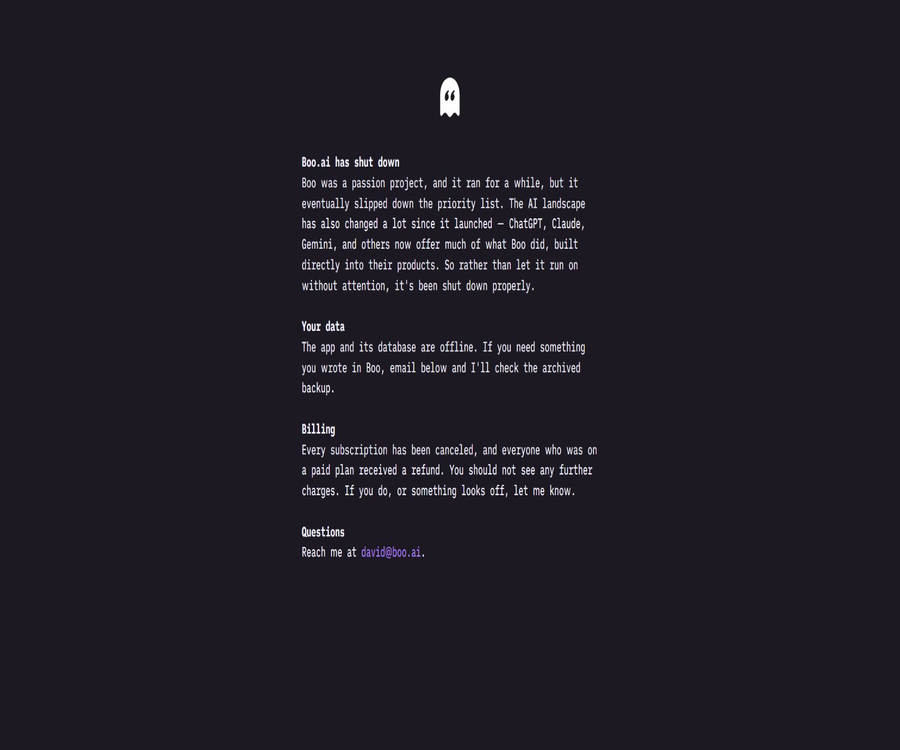
Boo AI has ceased operations; its official website now only contains a shutdown announcement, and it no longer offers functions for registration, logging in, editing, or AI-generated content creation. Both the application and the online database have been taken down, so it should no longer be considered a functional AI writing tool.
The operator states that all subscriptions have been canceled, and the original paying users have received their refunds; no further charges will be made. Those who need to retrieve past documents can request access to the archived copies by contacting the email address provided in the announcement, though it cannot be guaranteed that the documents will be restored in their entirety.
A one-sentence summary
Boo AI was once a minimalist AI text editor that assisted users in writing articles, emails, notes, and marketing texts through intelligent text completion, writing templates, custom prompts, and editing feedback. It is now officially shut down and can only be considered as a product that is no longer in use, along with historical documentation.
Product historical positioning
Boo.ai combines AI-generated content with a regular text editor, allowing users to receive suggestions for their writing while they continue to type, without having to copy content back and forth between chat tools and documents. The older version of its website described it as a simpler personal writing assistant compared to large marketing content platforms.
Early public statements indicated that GPT-3 was used for content generation; subsequent updates added examples of cross-document writing as well as personalized suggestions. Since the product has been discontinued, these models and functions can only be understood in terms of their past capabilities, and they cannot be considered available services today.
What can be done after it stops operating?
| Matters | Current status | Actions that users can take | Precautions |
|---|---|---|---|
| Visit the app | Unavailable | There is no need to continue trying to register or log in. | The current page only displays the announcement to close it. |
| Online database | Offline | It is not possible to view the document directly from the original editor. | Old links and browser cache do not indicate that the service is still running. |
| Historical documents | There may be archived backups available. | Contact the operators via the email address provided on the website’s shutdown page. | Existence, integrity, and response time are not guaranteed. |
| Paid subscription | All have been canceled. | Check the bank card and payment statements. | If deductions continue, keep records and contact the service provider or payment processor. |
| Refund | The official website states that refunds have been issued to the original paid users. | Verify the records of the original payment method. | The time it takes for the funds to arrive and the exchange rate differences depend on the payment method used. |
| New users pay a fee | Unavailable | Do not pay to unofficial pages that claim to be Boo AI. | Be careful of products with the same name and counterfeit websites. |
| Technical support | Only keep the contact email address. | Only send the necessary account identification information. | Do not send passwords or complete sensitive documents directly. |
Main functions of history
Intelligent automatic continuation
Boo AI used to predict the subsequent content based on the current document and context, helping users to continue writing from a single sentence, note, or paragraph. Automatic continuation of text can alter the original meaning or generate incorrect facts; therefore, the older versions of this product also required manual review.
Custom prompt
Users can ask the AI to expand, rewrite, summarize content, or adopt a specific tone by providing custom prompts. The more precise the prompt, the more likely the output will be aligned with the task requirements; however, this does not guarantee accuracy, originality, or compliance with professional standards.
Writing template
The public update records listed templates for creative brainstorming, generating outlines from notes, leave requests, payment reminders, rejection of candidates, and interview invitations. These templates are intended to help create a structure quickly, but the final content still needs to be adjusted according to the actual recipients and the specific business context.
Personalized writing suggestions
Historical versions take into account the user’s writing samples from different documents, gradually providing suggestions that better reflect the individual’s style of expression. This design implies that the written content may be processed by the platform; the scope of archiving and the deletion status after the platform stops operating need to be confirmed with the administrators.
Editorial feedback
The tool not only checks spelling and grammar but also offers suggestions regarding style, tone, structure, and professional feedback. Such advice is of a supplementary nature and cannot replace the final judgment of editors, teachers, legal experts, or industry specialists.
Markdown format
The Boo AI History Editor uses Markdown for handling plain-text elements such as headings, lists, and highlights. Markdown facilitates export and migration, but the older version of this application is no longer available; it cannot be opened or exported through the online interface any longer.
Historical use cases
- Blogs and articles: Generate drafts and subsequent ideas from topics, notes, or introductory paragraphs.
- Email: Prepare requests, follow-ups, payment reminders, and routine business emails.
- Marketing copy: Drafting property descriptions, product introductions, and short promotional texts.
- Work documents: Creating drafts of business plans, outlines, summaries, and internal notes.
- Job hunting and recruitment: Prepare messages to communicate with candidates, as well as emails for inviting them for interviews or declining their applications.
- Learning to write: conducting brainstorming, restructuring, and adjusting the tone.
- Personal notes: Record ideas in a simple editor and use AI to help expand them.
History writing workflow
- Create a new document in the editor and write down the topic, target audience, and main arguments.
- Select a template or enter a custom prompt to ask the AI to generate an outline or short paragraphs.
- Use intelligent continuation to expand the content, but ensure that each part remains focused on the original goal.
- Use the feedback function to check for issues with tone, structure, and expression.
- Verify each fact, figure, name, date, citation, and copyright detail.
- Use Markdown to format headings, lists, and key points, followed by final manual editing.
- Export it or copy it to your own storage location, to avoid keeping it only in the online tool.
Apply to retrieve historical documents
- Confirm the email address used to log in to Boo AI and the approximate period of use.
- Check the browser’s download folder, local backups, emails, and any content that has been copied to other documents.
- Send a brief request to restore service via the email address listed in the current official website shutdown announcement.
- Only provide the email address, document name, and approximate date required to identify the account; do not send the password.
- Inquire about whether archiving is available, what formats are offered, the methods of transmission, and the procedures for deletion.
- Once the file is received, save it immediately in a controlled location and check whether the characters, Markdown format, and attachments are complete.
- After the recovery is complete, you can request confirmation regarding the archived copy and the way in which the data in your personal account will be handled going forward.
Check refunds and deductions
- View the credit card, payment service, and email billing used for the original subscription.
- Find the last transaction related to a deduction by Boo AI, any cancellation records, and possible refund transactions.
- Check that the refund amount, currency, fees, and date of arrival match those of the original payment.
- If further deductions occur, save the transaction number, date, amount, and a screenshot of the bill.
- First, contact the operator via the email address provided in the announcement to explain the issue.
- If the issue cannot be resolved, then a formal dispute should be submitted following the procedures of the bank card or payment service provider.
- Do not provide verification codes, the full card number, or remote control access to third-party so-called refund agents.
Steps to migrate to other writing tools
- List the documents, templates, personal notes, and common writing processes that need to be retrieved.
- Give priority to tools that support importing and exporting in standard text, Markdown, or common document formats.
- Check the model, pricing, quotas, privacy policies, training procedures, and data deletion rules of the new platform.
- Only a small number of non-sensitive documents are imported to verify the format, Chinese content, length, and editing experience.
- Create a local or cloud-based primary copy, so that the only copy of the document is no longer stored solely on the AI platform.
- Set up automatic backups, version history, and regular exports for important documents.
- Once the migration is complete, delete the browser sessions and authorizations left by the old service.
Criteria for selecting alternative tools
| Select dimension | Issues that need verification | Why is it important? |
|---|---|---|
| Editing method | Is it continuation within a document, generation via chat, or a template form? | Determine whether it conforms to the original Boo AI’s writing style. |
| Import Export | Does it support plain text, Markdown, DOCX, and batch export? | Reduce the risk of data migration in the event of another shutdown. |
| Model transparency | Which models to use, and whether it is possible to select or provide one’s own keys | Affects quality, cost, and supplier dependency |
| Context and personalization | Which documents and writing samples will be read? | It relates to effectiveness and privacy boundaries. |
| Data training | Enter whether it is used for training, and whether it can be turned off or deleted. | Protecting customers and personal data |
| Price | Free quota, monthly fee, overage charges, and cancellation methods | Avoid comparing only the starting prices. |
| Team capabilities | Are permissions, versions, comments, approvals, and auditing functions all available? | Personal tools are not necessarily suitable for businesses. |
| Going concern | Are the update logs, support channels, export procedures, and shutdown policies clearly defined? | Reduce the impact of sudden service shutdowns |
Historical prices and packages
The following are the historical prices listed in Boo AI’s update log for January 2023; they are provided solely to help understand the product options available before the service was discontinued. The service is no longer active, so it is no longer possible to purchase these packages.
| Historic packages | Historical prices | Word count included | premium price | Current status |
|---|---|---|---|---|
| Free | $ | 2,000 AI-generated words per month | The old records do not provide any information. | Service has been discontinued. |
| Starter | $ | 10,000 AI-generated words per month | $ | Subscription canceled. |
| Pro | 36 dollars per month | 50,000 AI-generated words per month | $ | Subscription canceled. |
| 3-day trial | No credit card required | Historically, it was tried out as part of a pilot program. | If no subscription is purchased after the trial period ends, it will revert to Free. | No longer available |
The announcement on the official website states that all subscriptions have been canceled, and the original paying users have received their refunds; no further charges will be made. If the bill differs from what is stated in the announcement, one should use the saved payment evidence to contact the service provider or the payment institution.
Historical platforms and feature support
| Platform or capability | Historical support status | Current situation |
|---|---|---|
| Web editor | Support | Taken offline |
| Intelligent automatic continuation | Support | Unavailable |
| Custom prompts | Support | Unavailable |
| Writing template | Support | Unavailable |
| Personalized AI | Paid plans were once available. | Unavailable |
| Markdown | Support | Old documents may still contain Markdown text. |
| Windows and macOS desktop applications | No official independent client was found. | No available clients. |
| iOS and Android apps | No official store version was found. | No available apps. |
| Browser extensions | No findings were detected. | None |
| API | Not disclosed | No available APIs. |
Advantages of historical products
- Place the AI continuation function directly in a simple text editor to reduce the need to switch between different tools.
- Custom prompts and templates satisfy both open writing and fixed tasks.
- It supports Markdown, making it suitable for users who prefer a plain-text workflow.
- The free version and the lower entry price used to be suitable for individual writers who wrote infrequently.
- Examples of cross-document writing were used to provide more personalized suggestions.
- The feedback function takes into account tone, style, and structure, not just spelling.
- Trials once did not require a credit card, which reduced the barriers to trying something out in the past.
Current restrictions and risks
- The product has been discontinued; all old features, prices, and trials are no longer available.
- The online database is now offline, and users cannot log in on their own to export historical documents.
- There are no guarantees regarding whether archived backups include specific documents, the format in which they can be restored, or the retention period.
- The current official website does not provide a complete privacy policy, terms of service, or schedule for data deletion.
- The older version used GPT-3, and its generation quality and security capabilities cannot be compared directly with those of the current model.
- The historical personalization feature takes writing samples into account; the original user should inquire about the status of archiving and deletion.
- Search engines may still display summaries of older marketing pages, and this cannot be used as an indication that the service is still operational.
- The prices and features listed in third-party catalogs may be outdated, and other products with the same name might be included among them.
- The so-called new Boo AI subscriptions, download packages, or refund agents may not be the genuine products; be cautious of counterfeits.
Data and Privacy Processing
The current shutdown announcement states clearly that the applications and databases are now offline, and historical documents may be stored in archived backups for manual retrieval. The announcement does not provide information regarding the encryption of these archives, their location, the retention period, who has access to them, or when they will be deleted.
If the original user has handled confidential or personal data, they can contact the operator to inquire whether such data is still present in the backups, and request access to it or its deletion where applicable. When submitting a recovery request, the principle of minimizing data should be followed; account passwords or complete versions of sensitive documents must not be included.
- First, verify your identity using the email address associated with your account, thereby avoiding the need to provide unnecessary identification documents or payment card details.
- It is required to use secure methods for file transfer; sensitive documents should not be included in the body of regular emails.
- After receiving the archived files, check their integrity and store them in an encrypted location under one’s own control.
- If the document is no longer needed, you can ask when the archived copy and account records will be deleted.
- Check whether third-party authorizations are still in place for Google or other accounts that were used for logging in.
- Clear the passwords, Cookies, and old bookmarks stored in the browser to avoid visiting fake websites.
API, GitHub, and open-source status
The former official website of Boo AI did not make API, SDK, Webhook, or developer documentation available, and the current page also offers no programmed services. It should be labeled as lacking an API, rather than having the incorrect statement that it provides OpenAI interfaces when in fact it used GPT-3 under the hood.
A search on GitHub did not yield any source code for products certified by the Boo.ai website, nor any official SDK repositories. Boo AI is a commercial web application with closed-source code and it is no longer in use; it has no direct connection to any open-source projects, dating applications, or other AI products that share a similar name.
Basic information
| field | Content |
|---|---|
| Tool name | Boo AI |
| Common notation | Boo.ai |
| Tool type | Historical AI writing assistants and text editors |
| Current status | Operations have been discontinued. |
| Applications and databases | Taken offline |
| Core historical functions | Smart continuation, custom prompts, templates, feedback, and Markdown |
| Historical models | The old version of the official website indicated GPT-3. |
| Historical price patterns | Free version, Starter, and Pro available on a monthly subscription basis |
| Current fee | No fees anymore; the subscription has been canceled. |
| Refund status | The official website states that refunds have been issued to the original paid users. |
| Historical platforms | Web |
| API | None |
| Official SDK | None |
| Official GitHub | No findings were detected. |
| Is it open source? | Not open source |
Recommendation score
The current recommendation score is 1.0 out of 5. This low score does not reflect a negative experience with previous edits; it is due to the fact that the product is no longer available, and it is impossible to register for it, use it, renew its subscription, or access the online documents.
Existing users should prioritize document restoration, refund verification, and the removal of third-party authorizations, while new users should opt for alternative tools that are still under maintenance and support export in standard formats. No directory page should anymore use prompts such as “Try now” or “Free trial”.
Frequently Asked Questions
Can Boo AI still be used?
No. The official website clearly states that the product has been discontinued, with both the application and the database no longer in use.
Why do the search results still show old features?
Search engines may retain cached versions of the old homepage and update logs. The current status should be determined based on the announcement displayed when accessing the official website directly.
Is it still possible to register a free account?
No. The historical Free plan as well as the 3-day trial have been discontinued; there is currently no way to register or log in.
How much did Boo AI cost before?
Historically, Free included 2,000 words per month, Starter cost $8 per month, and Pro cost $36 per month. These were the old prices from 2023; they are no longer available for purchase.
Will charges continue to be deducted for the subscription?
The official website states that all subscriptions have been canceled, so no further charges will be incurred. Users should still check their payment statements and address any unusual transactions promptly.
Have the original paid users received their refunds?
The announcement states that all paid users have received their refunds. The specific time of receipt, the currency used, and the amount refunded will depend on the records of the original payment method.
How to retrieve documents from Boo AI?
Contact the administrators via the email address listed in the current shutdown announcement, provide the email address of the original account as well as relevant documents, and request that the archived backups be checked. There is no guarantee regarding whether the data can be recovered or in what format it will be available.
Have the historical documents been deleted?
It cannot be confirmed. The database is offline, but it is stated that archived backups exist; therefore, the original user can inquire about the scope of retention, the duration, and the arrangements for deletion.
Does Boo AI provide APIs?
No historical or current public APIs and SDKs were found; moreover, no services that can be called are available after the service was discontinued.
Is Boo AI open source?
It is not open source; no repository containing the product’s source code, as verified by the official website, was found.
Is it possible to download and install an older version?
No official desktop or mobile client has been found, and the backend is closed. Do not download so-called offline or cracked versions from unofficial sources.
What alternative tool should be chosen now?
Give priority to AI editors that are still under maintenance, support Markdown or the export of common document formats, have clear data handling rules, and offer local backup. Test them first with non-sensitive samples before moving over actual data.
Tools similar to Boo AI



 Guigong Network Security Registration No. 45132202000164