






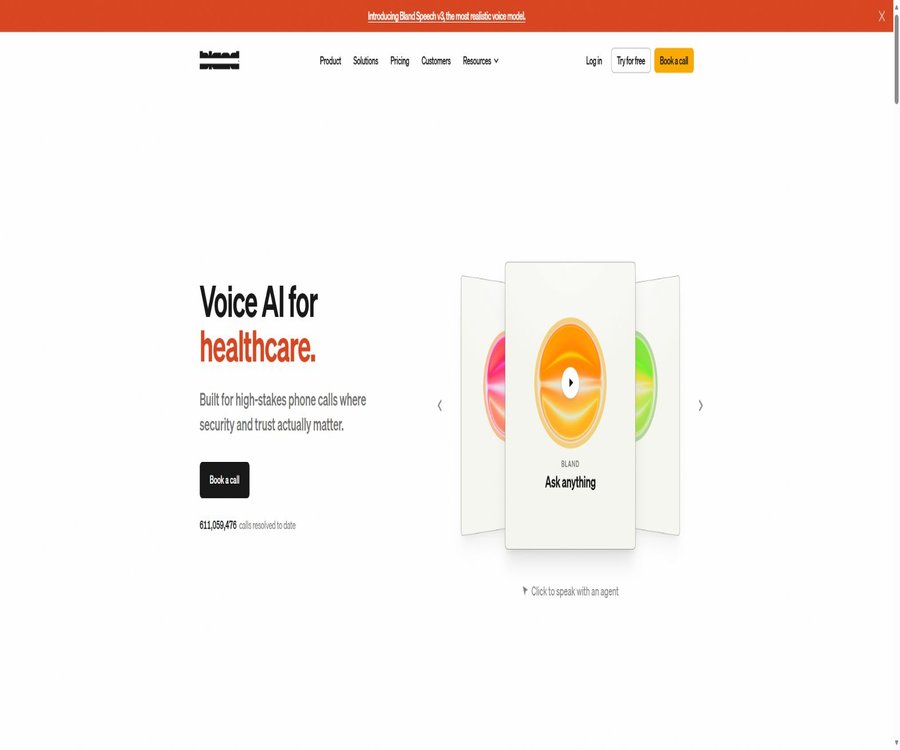
Bland
Bland: an intelligent tool focused on improving AI efficiency.
Tags:AI improves efficiencyWhat is Bland AI?
Bland AI is a platform designed for building, deploying, and managing AI voice agents; it can handle incoming calls, outgoing calls, voice interactions over web pages, as well as certain enterprise messaging tasks. It integrates speech recognition, dialogue reasoning, speech synthesis, phone connectivity, workflow management, and analysis tools into a single product.
The product is offered by Intelliga Corporation under the Bland AI brand, and it is designed to serve teams that need to handle customer service, scheduling, sales screening, dispatching, and other tasks that involve large-scale telephone communications. Ordinary developers can start with the Start plan, which does not incur any platform fees, while regulated organizations can opt for enterprise contracts, dedicated infrastructure, or a private environment.
Product composition
| Product or module | Key capabilities | Typical input | Main output | Suitable for users |
|---|---|---|---|---|
| Bland Voice | Incoming calls, outgoing calls, and phone agents | Phone number, task, or Pathway | Real-time calls, forwarding, recording, and results | Operations, customer service, and development teams |
| Conversational Pathways | Visual dialogue orchestration | Nodes, conditions, variables, and tools | Testable multi-round business processes | Teams that need to maintain stable control over conversations |
| Norm | Create and debug Agents using natural language | Description of business objectives and processes | Editable Agents and Pathways | Users who wish to create prototypes quickly |
| Web Agent SDK | Embed voice or chat agents in web pages | Agent configuration and short-term session tokens | Real-time sessions on the web page | Web developers and enterprise clients |
| Bland Speech | Text-to-speech and voice cloning | Text, audio, and performance tags | Streamed or file-based audio | Voice application developers |
| REST API and CLI | Programmatic management of calls and resources | Keys, parameters, and commands | Calls, logs, Pathway, and test results | Engineering and Automation Team |
Main functions
Incoming and outgoing AI calls
Users can assign agents to incoming numbers, and they can also initiate outbound calls through the console, batch files, or APIs. Call tasks can use simple targets or be linked to tested Pathways.
Conversational Pathways
Pathways utilizes nodes and paths to manage multiple rounds of dialogue, and it can handle tasks such as asking questions, handling conditional branches, performing knowledge searches, using external tools, waiting, ending the dialogue, and making transfers. Flex Mode allows the Agent to choose the next step based on the dialogue, within a defined set of nodes, which is suitable for scenarios that are not entirely linear.
Knowledge base and document retrieval
A knowledge base can be constructed from files, text, or web pages, and it provides agents with information on products, policies, and processes during calls. Different self-service packages impose limits on the number of entries in the knowledge base, and the quality of that information directly affects the reliability of the responses provided.
Tools, Integration, and Real-time Requests
The tool’s functions enable the Agent to query or update external systems during calls, such as checking calendars, creating appointments, reading customer status, or sending notifications. Integrations with services like Cal.com, Salesforce, and Slack are provided by the vendor, and it is also possible to connect to custom business interfaces.
Switch to manual handling and upgrade processing
When the agent is unable to complete a task, it is possible to end the call, leave a message, schedule a callback, or transfer the call to a human operator. Advanced routing options, real-time transfer, and department-based routing are designed for enterprise solutions; the specific permissions depend on the package chosen.
Call logs, results, and evaluations
After a call ends, it is possible to view the transcription, summary, metadata, costs, recording, and reason for termination; these details can also be synchronized to a CRM or ticketing system via callbacks. Scenarios, Standards, and Evals are used to turn actual calls into reproducible test cases, thereby reducing the risk of regressions that occur after changing the prompts.
Voice, language, and expression control
The platform offers preset and custom sound options, and supports multiple languages as well as experimental cross-lingual capabilities. Pronunciation dictionaries, pause response parameters, and sound settings can be used to improve the delivery of names, terms, as well as interruptions and responses.
Web Agent and messaging channels
The official documentation provides a Web Agent SDK and web widgets; the enterprise messaging capabilities also include channels such as SMS, RCS, and iMessage. The available plans specify that enterprise-level permissions are required for web chatting and messaging functions, and end-users should not assume that they can use all these channels right after registration.
Comparison of dialogue models and patterns
| Pattern | Main features | Suitable for tasks | Important restrictions |
|---|---|---|---|
| Base | Stable execution in accordance with scripts and processes; supports comprehensive tools and advanced actions. | Customer service processes, booking, eligibility screening, and complex transactions | Response speed and actual performance need to be tested through real calls. |
| Turbo | Greater emphasis is placed on low latency and natural, continuous expression. | Telephones with a simple structure and an emphasis on quick response. | The official documentation indicates that certain features related to routing, navigation, and custom tools have limited capabilities. |
| Pathway | Restrict the dialogue path through nodes, conditions, and variables. | Businesses with compliance requirements, regulatory oversight, and a large number of branches | The design and maintenance costs are higher than those for simple task prompts. |
| Flex Mode | Allow the Agent to independently choose the next step within the controlled node group. | Sessions in which the user’s order of expression is not fixed | Clear boundaries and tests are needed to prevent incorrect transitions. |
Complete workflow
- Determine the call target, the contact channel, the data that can be used, and the situations in which it is necessary to switch to a human operator.
- Select Simple Task, Pathway, or Persona, and configure the voice, language, opening statement, and content to be disclosed.
- Connect to knowledge bases, calendars, CRM systems, or custom tools, and define variables, conditions, and failure handling.
- Cover normal paths, rejections, interruptions, silences, and abnormal inputs in text, web speech, and test calls.
- Set the number, concurrency level, time window, block list, recording duration, and cost alerts.
- First, run it on a small scale within the organization or with pre-approved test subjects, and then check the transcription, results, latency, and routing.
- Adjust the suggestions, node permissions, and tool permissions; after conducting regression tests, gradually increase the volume of actual traffic.
- Continuously monitor failures, complaints, exit requests, abnormal charges, and high-risk responses, while maintaining a manual handling process.
A beginner creates their first phone agent.
- Register an organizational account and access the console; use the free credit provided to get familiar with call and number settings.
- Use Norm to describe the Agent’s identity, business objectives, the scope of responses it is allowed to provide, and the information that needs to be collected.
- Check the automatically generated suggestions or Pathways, remove the unverifiable commitments, and add manual escalation rules.
- Select voice and language to simulate various accent, interruption, follow-up question, and rejection scenarios on the testing interface.
- Initiate calls using authorized test numbers to check the initial disclosure, audio notification, and exit procedures.
- Review the call logs and the transcript of each conversation to ensure that every variable, tool, and branch is functioning as expected.
Use Pathway to build business processes
- Break down the process into stages such as greeting, identity verification, requirement identification, execution, confirmation, and completion.
- For each node, specify the goal, the content that can be spoken, the variables to be extracted, and the tools that can be used.
- Normal, rejected, missing information, tool failure, and manual intervention paths are connected through conditional edges.
- Controlled node groups are established for the parts whose order is not fixed, and it is determined whether Flex Mode is required.
- Language and business logic are verified using single-node testing, scenario testing, and actual phone calls.
- Lock the verified version before release, log each modification, and retain a production version from which a rollback can be made.
Initiate outbound calls through API
- Store the API keys on the server side; do not save long-term keys in the browser or in public code.
- Prepare a number in international format, and verify the contact’s authorization, available calling times, and cancellation status.
- Call the interface for creating a call, and submit the number along with the task text or Pathway identifier.
- Parameters such as sound, language, variables, tools, callbacks, and compliance safeguards can be added as needed.
- Save the returned call identifier, which is used to query the status, transcription, costs, and final results.
- Handle failures, busy lines, voicemails, and rate limits separately to avoid unnecessary repeated calls.
Configure knowledge base and tools
- Organize the approved product descriptions, procedures, prices, and policies, and remove any outdated or conflicting information.
- Create a knowledge base, import files, texts, or data that can be scraped, and then use test questions to check the recall rate.
- Only add the tools necessary for the Agent to complete tasks, and store the credentials of external systems using Secrets.
- Restrictions are placed on the writable fields, amounts, customer ranges, and number of operations; manual confirmation is required for high-risk actions.
- Simulate situations such as knowledge gaps, interface timeouts, lack of permissions, and abnormal responses, and configure secure fallback messages and redirection mechanisms.
Which users are it suitable for
- Customer Service Team: Handles common calls, identity verification, status inquiries, messages, and transfers to a human agent.
- Reservation and on-site service team: Handles requests, matches available time slots, creates reservations, and arranges schedules.
- Sales Operations Team: Conducts qualification screening, follows up on qualified leads, and schedules demonstrations.
- Healthcare, insurance, and financial institutions: Establish controlled telephone procedures after the contracts, BAA agreements, and compliance reviews are approved.
- Logistics and travel team: Handles arrival confirmation, notification of any abnormalities, collection of identity information, and upgrade procedures.
- Developers and system integrators: Connect to existing systems via APIs, CLI, SDKs, callbacks, and SIP connections.
- Large-scale call centers: Utilize dedicated orchestration, version control, monitoring, and private deployment in enterprise solutions.
Typical use cases
- Calls are answered around the clock; after identifying the intent, the system answers questions, processes requests, or routes them to the appropriate department.
- Carry out reminders, confirmations, satisfaction surveys, or sales follow-ups based on the list of those who have been granted permission.
- Check the calendar and make reservations, change dates, cancel appointments, and receive follow-up notifications.
- Collect information according to a fixed process in claims processing, registration, or service requests, and synchronize it with the business system.
- It replaces the complex key-based navigation system, allowing users to express their requests in natural language.
- Provide spoken agents on the web to escalate complex issues to online human agents.
- Batch evaluation of actual calls revealed deviations from the script, omissions in disclosures, and errors in tool usage.
Product advantages
- Calls, voice models, workflow orchestration, tool invocation, and analysis are all integrated within the same platform.
- Pathways balances strict processes with limited autonomy, making it suitable for complex, multi-stage transactions.
- The per-minute price includes large models, speech recognition, and speech synthesis; no additional fees for model tokens are charged.
- It supports integration with proprietary Twilio, SIP, and call center solutions, allowing enterprises to retain their existing phone infrastructure.
- It provides testing, evaluation, safeguards, alerts, and versioning mechanisms to facilitate continuous optimization in the production environment.
- The enterprise solutions offer BAA, SSO, data residency, dedicated facilities, and private deployment options.
- API, CLI, Web Agent SDK, and MCP services support a variety of engineering workflows.
Usage restrictions and precautions
- Start is a plan that eliminates platform fees, but it does not mean that calls are completely free on a long-term basis; once the free minutes have been used, charges will still be applied based on the number of minutes and the telephone network used.
- In addition to the charges based on call usage, Build and Scale also impose monthly platform fees.
- Using Bland numbers to connect to a human agent incurs additional call-transfer fees; with Twilio, there are no platform-related transfer fees, but the operator’s charges still apply.
- There is a minimum fee for attempts to make calls using the Bland phone network, and this fee can also apply in case the call fails.
- AI may misinterpret accents, background noise, negative expressions, or complex business rules; therefore, important actions must be confirmed and backed up by additional measures.
- Warm switching, real-time routing, message channels, monitoring, and certain compliance features are primarily part of the enterprise solutions.
- A knowledge base cannot replace fact-checking; outdated policies, conflicting information, and incorrect data collected can directly affect the accuracy of the responses.
- Recordings, transcriptions, numbers, customer information, and tool outputs are considered sensitive data, and a minimum retention period necessary for their storage should be established.
- The fact that the platform provides compliance tools does not mean that each deployment will be compliant automatically; the customer remains responsible for authorizing contacts, setting call rules, and ensuring proper disclosure.
Prices and packages
The following are the official standard prices as of August 20, 2026; the currency used is the US dollar. Taxes, telephone service provider fees, number fees, as well as any costs related to corporate contracts and the actual settlement amounts may vary.
| Package | Platform fee | AI call charges | Labor cost for transfer | Limits and capabilities | Suitable for users |
|---|---|---|---|---|---|
| Start | $ | $ | $ | 10 concurrent connections, 100 messages per day, 100 messages per hour, 1 voice, 10 knowledge bases | Developers and small-scale testing |
| Build | $ | $ | $ | 50 concurrent connections, 2,000 messages per day, 1,000 messages per hour, 5 voices, 50 knowledge bases | A team that operates stably |
| Scale | $ | $ | $ | 100 concurrent connections, 5,000 messages per day, 1,000 messages per hour, 15 voices, 100 knowledge bases | Operations with high call volume |
| Enterprise | Custom quote | Contract price | Contract price | Customized concurrency, unlimited daily limits, dedicated facilities, BAA, SSO, and data residency | Regulation and large organizations |
Cost composition
| Cost items | Billing rules | It is necessary to pay attention. |
|---|---|---|
| Connection call duration | Based on the package’s rate per minute, accurate to the second | The total duration of calls in which AI is actually involved. |
| Large models, speech recognition, and speech synthesis | Already included in the AI minute fee | Advanced audio is also included, but the phone network is charged separately. |
| Transfer to a human agent via Bland number | A separate charge is applied based on the unit price per minute for calls routed through packages. | Additional charge for minutes spent connected to AI |
| Switch to human agent via Twilio | The platform transfer fee is $0. | The customer is responsible for the costs associated with the telephone service provider directly. |
| Bland telephone network outbound attempts | A minimum of $0.015 per time | Failed calls can also result in the lowest cost. |
| Voice mail | Charged based on standard call duration | It is necessary to configure messages, exit options, or subsequent actions. |
| Number and carrier | Charged separately or at actual cost | Region, number type, and provider affect the total cost. |
Suggestions for package selection
| Demand | Suggested solution | Basis for judgment |
|---|---|---|
| Verify a phone process | Start | There are no platform fees; use the free credits and low-concurrency testing for now. |
| Hundreds to thousands of messages are processed steadily on a daily basis. | Build | Increased concurrency and daily limits, with lower per-minute fees |
| Thousands of messages per day, with cost sensitivity | Scale | Lower per-minute charge and support for 100 concurrent connections, but the break-even point for platform fees must be taken into account. |
| Message channels, complex routing, or strict monitoring | Enterprise | The public package list lists various advanced features as enterprise permissions. |
| Regulated data or private environments | Enterprise | A BAA can be signed, and arrangements can be made regarding data residency, exclusivity, VPC deployment, or on-premises installation. |
| There are already telephone service providers. | Built-in phone network | It allows the number and SIP process to be retained, while avoiding Bland transfer fees. |
Bland Speech speech synthesis
Bland Speech is an independent text-to-speech product; it uses the Bland Speech v3 model to generate audio in Studio or via API. It supports streaming output, performance tags, real-time voice cloning, as well as proven professional voice cloning.
| Project | Public price or quota | Explanation |
|---|---|---|
| Character-based billing | $ | Studio and API follow the same pay-as-you-go pricing. |
| Free gift for new accounts | 133,000 characters | Official estimates suggest that more than two hours of audio can be generated. |
| Top up to unlock | Top up $5 at a time | Unlock professional voice cloning and 5x concurrent processing |
| Instant voice cloning | Approximately 10-second audio sample | The user must confirm that they have the rights to use that sound. |
| Professional voice cloning | Approximately 30 minutes of tested audio. | Permission and voice verification need to be completed. |
| Credit balance | It will not expire. | In the end, the account billing rules shall prevail. |
Platform and integration support
| Platform or integration | Support status | Explanation |
|---|---|---|
| Web console | Support | Create Agents, Pathways, numbers, knowledge bases, logs, and bills |
| Telephone network | Support | You can use the connections provided by Bland, or your own Twilio or SIP services. |
| Web Agent | Support | Usage examples for JavaScript and React are provided; the actual permissions for the package need to be confirmed. |
| Native mobile applications | No officially released applications were found. | The web version can be used, but it should not be stated that iOS or Android apps are available. |
| Cal.com, Salesforce, Slack | Official integration | Used for tasks such as reservations, business data, and notifications. |
| Five9 and NICE CXone | Enterprise connection | Used to integrate with existing contact center systems |
| REST API and callbacks | Support | Covers calls, numbers, Pathway, logs, knowledge, and automation |
| CLI and MCP | Support | Manage accounts, conduct testing, forward local callbacks, and connect to encoding agents. |
APIs, SDKs, and developer tools
Bland makes its REST API available publicly; it allows for the creation and retrieval of phone numbers, control over active calls, access to recordings and transcripts, as well as management of numbers, knowledge bases, and Pathways. Callback signatures, Secrets, and short-lived server-side tokens can be used to reduce the risk of key exposure and fraudulent requests.
The official documentation provides the Bland CLI, Web Agent SDK, Bland TTS toolkit, and MCP service. The Web Agent SDK supports Node.js, native JavaScript, and React; browser clients should receive only one-time session tokens, while long-term API keys must remain on the server.
GitHub and the open-source status
The Bland AI platform is proprietary commercial software; it is not an open-source phone agent platform that can be deployed freely. The enterprise version offers VPC, local, or isolated environments as part of its commercial delivery model, and this does not mean that the source code of the platform is available publicly.
According to the official npm documentation, the Bland CLI, Web Agent SDK, and Bland TTS toolkits are licensed under the MIT license. The organization also makes available repositories containing the JavaScript SDK, TypeScript SDK, example recipes, various skills, and n8n nodes. Some of these repositories do not indicate their licensing terms in the GitHub metadata; therefore, it is necessary to check the license files within each repository before using them.
Data privacy and security
The privacy policy states that the platform collects account details, billing information, call recordings and transcripts, messages, usage metadata, device information, and Cookie data. This information is used to provide and improve services, conduct analyses and research, ensure security, comply with legal requirements, and facilitate communication.
The data may be shared with service providers, related parties, and business partners, or it may be disclosed as required by transactions or legal obligations. The policy does not specify a uniform and fixed retention period; it only states that the data is retained for as long as is necessary to provide the services, fulfill the intended purposes, meet legal obligations, and resolve disputes or enforce agreements.
- Organizations can set the number of days for which recordings are retained at the account level; the official interface allows a retention period of 1 to 1825 days, or it is possible to disable retention altogether.
- The privacy policy allows users to request access to, correction of, or deletion of their personal information, but the actual outcome is subject to legal and contractual obligations.
- Data may be processed outside the user’s country, including in the United States; cross-border teams must conduct a transfer impact assessment.
- Enterprise DPA is applicable to business contract scenarios in which personal data of customers is processed as a processor; it should not be assumed that all self-service accounts are automatically signed.
- The official requirements include SOC 2 Type II, HIPAA compliance, GDPR, and PCI DSS; however, for HIPAA compliance, it is necessary to sign a BAA.
- Security reports, penetration test summaries, and certain compliance certificates are typically provided through the enterprise trust portal or secure procedures.
Legal and compliance considerations
Voice Agents are involved in telemarketing, automated dialing, artificial intelligence-based identity verification, recording, and the processing of personal information. The platform provides mechanisms for disclosure and opt-out, but customers still need to establish legitimate procedures in line with the location of the contacts, the type of numbers used, their purpose, and industry regulations.
- Save valid consent, business relationships, or other legitimate grounds for contact prior to dismissal, and verify the lists of individuals who should have their calls rejected or whose contact is prohibited.
- In appropriate situations, indicate who is calling, the AI’s identity, and the fact that recording is taking place; do not rely on the other party to guess these details.
- It is executed immediately upon receiving a request to stop contact or to withdraw, and is synchronized across all lists, CRM systems, and automated processes.
- Voice cloning can only be done using one’s own voice or a voice for which explicit permission has been obtained; it is not allowed to impersonate real persons.
- In medical, insurance, financial, and legal processes, Agent permissions should be restricted, with human review reserved for diagnosis, underwriting, transactions, or legal decisions.
- Guardrails should not be regarded as an absolute guarantee; instead, scenario testing, real-time monitoring, complaint handling, and regular legal reviews should be employed.
Basic information
| field | Content |
|---|---|
| Tool name | Bland AI |
| Operating entity | Intelliga Corporation |
| Tool type | AI voice agents, smart phones, dialogue workflows, and voice APIs |
| Main morphology | Web console, telephone service, API, CLI, SDK, and MCP |
| Price pattern | Start without any platform fees, monthly packages, pricing based on the number of connection minutes, and corporate contracts available |
| Is registration required? | Yes |
| Chinese support | Multi-language support is available, but the interface’s performance in Chinese requires actual testing. |
| Inhale and exhale | All are supported. |
| Proprietary phone network | Supports Twilio, SIP, and other methods. |
| Public API | Yes |
| Official SDK and CLI | Yes |
| Official GitHub | There are public SDKs, examples, and integration repositories. |
| Is it open source? | The platform is not open-source; some development tools and software packages are available. |
| Mobile apps | No official native applications were found. |
Recommendation score
The comprehensive recommendation score is 4.5 out of 5 points. Bland AI is suitable for teams that need to consolidate complex phone processes, knowledge bases, tool integrations, testing, and operational analysis within a single platform; its public APIs and self-service setup options also facilitate verification by developers.
The total cost is not determined solely by the price per minute; enterprise features, telephone networks, numbers, call routing, and implementation all affect the budget. When dealing with regulated data or large-scale outbound calls, it is necessary to finalize contracts, address compliance issues, arrange for data retention, and conduct tests of actual calls before making any purchases.
Frequently Asked Questions
Is Bland AI free?
The Start package is free of platform fees; it includes two initial credit amounts as well as a calling number worth approximately 15 dollars per month. Once the allocated credits are used up, charges will still apply for calls, the number itself, and the telephone network, so it cannot be considered completely free.
How does Bland AI calculate call costs?
The self-service packages are charged based on the time of AI connection, with precision to the second; the current price is between 0.11 and 0.14 dollars per minute. Using a Bland number to connect to a human operator incurs an additional transfer fee, and the costs associated with the phone service provider and the number itself must be calculated separately.
Can it handle incoming and outgoing calls?
Yes. Users can set the incoming numbers, and they can also make outgoing calls through the console, batch tasks, or APIs.
What are Conversational Pathways?
It is a node-based dialogue orchestration tool that uses conditions, variables, knowledge bases, tools, and transition actions to control multi-round telephone interactions.
Is it possible to switch to a human agent?
It is supported, but the permissions for basic forwarding, advanced seamless forwarding, and real-time forwarding vary. Using a platform number may also incur additional fees per minute for forwarding.
Is Chinese supported?
The platform offers multilingual support as well as experimental cross-lingual capabilities, and it is possible to configure calls in Chinese. For accents, technical terms, numbers, and interruption effects, it is still necessary to use real phone numbers for testing.
Is an API provided?
Available. The public API covers call creation, status management, activity control, recording, transcription, numbering, Pathway, knowledge bases, and other platform resources.
What are the official development tools?
Currently, it includes CLI, Web Agent SDK, Bland TTS toolkit, MCP services, as well as public examples and integration repositories.
Is Bland AI open source?
The platform itself is not open source. Some SDKs, CLIs, toolkits, and integration packages do have open licenses, which simply means that those development tools can be used in accordance with the terms of those licenses.
How are Bland Speech and phone agents charged?
The phone agent charges based on the number of connection minutes and the plan selected, while Bland Speech charges based on the number of characters entered. These are different billing units; the character quota for Speech cannot be considered as free call minutes.
How long are call recordings kept?
The privacy policy does not specify a uniform deadline for all accounts; the organization’s interface allows for a setting of 1 to 1825 days, or it is possible to disable audio recording. The actual available settings and contractual requirements should be confirmed within the account itself.
Will the data be used for training?
Public privacy policies permit the processing of user data for analysis, research, and service improvement, but they do not provide a simple, uniform mechanism for opting out of training processes that applies to all accounts. For sensitive operations, the purposes of data usage, model training, as well as the rules regarding data retention and deletion must be specified in contracts and DPA agreements.
Does Bland AI automatically comply with telephone marketing regulations?
No. Disclosure, opt-out options, and recording safeguards can help ensure that the rules are followed, but it remains the customer’s responsibility to obtain consent, maintain a list of people to whom calls should not be made, control the timing of calls, and comply with local laws.
Is it suitable for medical or financial institutions?
Enterprise solutions offer the necessary security and compliance capabilities; they can be used in HIPAA scenarios after a BAA is signed. The organization still needs to carry out supplier evaluations, design appropriate access controls, implement manual reviews, and fulfill its own industry-specific obligations.
Tools similar to Bland’s



 Guigong Network Security Registration No. 45132202000164